Romania · The Entente
Marie, Queen of Romania
Queen of Romania (1914–1927), Red Cross activist
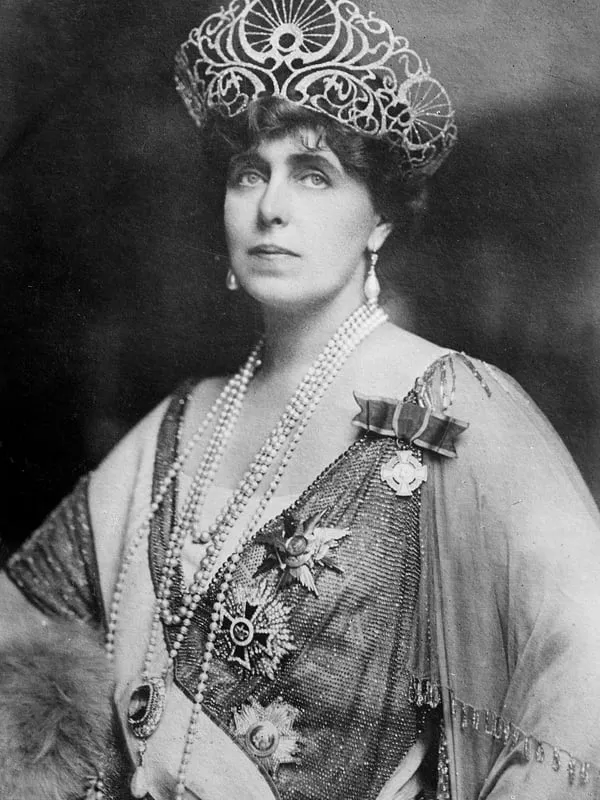
- Born:
- 29 October 1875, Eastwell Park, Kent (England)
- Died:
- 18 July 1938, Sinaia
- Author:
- Łukasz Skowroń
- Photo:
- autor nieznany, domena publiczna, Wikimedia Commons

Marie, wife of King Ferdinand I, was the best-known woman on a throne during the Great War and one of the few who had real influence on politics. A British princess, granddaughter of Queen Victoria and of the Russian Tsar Alexander II, she supported Romania’s entry into the war on the side of the Entente from the start and used her kinship with the courts in London and Petrograd to that end. When the 1916 campaign ended in disaster, she worked in the hospitals of Jassy, crowded with refugees and wounded, and became a symbol of resistance for the Romanians. In 1918 she was one of the few in the king’s entourage who opposed a separate peace with the Central Powers to the end. The Romanians called her “the mother of the wounded”, and after the war she became the face of Greater Romania at the peace conference in Paris.
Before the war
She was born on 29 October 1875 at Eastwell Park in Kent, the daughter of Prince Alfred, the second son of Queen Victoria, a naval officer and later Duke of Saxe-Coburg and Gotha, and of Grand Duchess Maria Alexandrovna, daughter of Tsar Alexander II. In the family she was called Missy. She spent her childhood in England, in Malta, where her father commanded the Mediterranean Fleet, and in Coburg. Her cousins included the future King of Great Britain George V, who reportedly wanted to marry her, the future Tsar Nicholas II and the Kaiser Wilhelm II.
On 10 January 1893, aged seventeen, she married the heir to the Romanian throne, Ferdinand of Hohenzollern, at Sigmaringen. The first years in Bucharest were hard: the old King Carol I kept the crown prince and his wife under strict discipline and took their two eldest children away to be brought up by him. They had six children, among them the future King Carol II. The marriage of convenience grew over time into a partnership, but not into love. The crown princess’s love affairs were gossiped about all over Europe, and her closest friend and adviser became Prince Barbu Știrbey, brother-in-law of the Liberal prime minister Ion I. C. Brătianu. Marie quickly learned Romanian, wore folk costume and won a popularity her shy husband never had. In the summer of 1913, during the Second Balkan War, when cholera was spreading through the Romanian army, she worked in field hospitals. She regarded this experience as a turning point in her life.
Neutrality (1914–1916)
On 3 August 1914 the crown council at Sinaia rejected the wish of King Carol I, who wanted to enter the war on Germany’s side, and came out in favour of neutrality. On 10 October 1914 Carol I died, and Marie became queen. She made no secret of her sympathy for the Entente, which led people at home and abroad to see her as a counterweight to her husband’s German origins. The French minister in Bucharest, Count de Saint-Aulaire, wrote that the queen was an ally of France twice over: by birth and by heart.
Neutrality weighed on her because, as she recalled, it forced her to weigh every word. At the request of the king and of Prime Minister Brătianu she wrote unofficial letters to her cousins, George V and Nicholas II, in which she set out Romanian aspirations to unite with their compatriots in Transylvania and Bukovina. In her memoirs she admitted that she was better informed about affairs of state than queens usually are. Some contemporaries, and after them some biographers, believed that it was she who persuaded Ferdinand to go to war on the side of the Entente. Romanian historians are more cautious: the decision was prepared and carried through by Brătianu, and the queen strengthened the king in a choice that was in any case increasingly settled. She herself wrote of her husband that he was not a man of action but had a strangely strong obstinacy in him, and that she was beside him “like a good watchdog”.
War and Jassy
On 27 August 1916 Romania declared war on Austria-Hungary. Saint-Aulaire wrote that the queen embraced the war as others embrace a religion. In those days she began keeping a diary, which she wrote almost every day throughout the war. She took charge of the Romanian Red Cross, visited hospitals daily and settled disputes between the medical missions from France, Britain and Russia. She wrote in English the book “My Country”, published in London in 1916, the proceeds of which went to the Romanian Red Cross and which was meant to win Romania the sympathy of the Allies abroad.
The war quickly turned into a catastrophe. On 2 November 1916 her youngest son, the three-year-old Prince Mircea, died of typhoid fever at Buftea. A few weeks later the court and the government moved to Jassy, and on 6 December Bucharest fell. In the winter of 1916/1917 overcrowded Jassy was decimated by typhus, and food, fuel and medicines were scarce. The queen, in a nurse’s uniform, went daily to the railway station to meet the wounded, visited hospitals and sick bays, including those for infectious diseases, and went to the front. Saint-Aulaire wrote that it was hard to speak of her courage, because courage presupposes fear, which she seemed not to know. In the summer of 1917, after the Battle of Mărășești, she decorated soldiers together with the king. It was then that her nickname “the mother of the wounded” (Mama Răniților) was born.
Against the peace
The October Revolution in Russia cut Romania off from its allies. On 9 December 1917 the Armistice of Focșani was signed. Marie received it with bitterness. She believed that Romania was putting its hand into a machine from which it would not escape, whereas Brătianu and Știrbey saw the armistice as a way of gaining time. In February 1918, after Mackensen’s ultimatum, the government of General Alexandru Averescu opened negotiations. In those weeks the Canadian businessman and adventurer Joseph Boyle appeared in Jassy. He became her close confidant and, together with Știrbey, was one of the few in the court circle who believed in an Entente victory.
The queen opposed the peace more vehemently than anyone else around the king. In her diary she described a stormy scene in which she accused her husband of selling his own honour, that of his family and that of his country, and accused his advisers of having made him their tool. When Știrbey explained that the king could not resist alone, without responsible politicians, she replied that there were no men in this country. At the crown council in Jassy on 2–4 March 1918 the crown prince Carol spoke on her behalf, calling for resistance to the end. Averescu complained that two policies were being pursued at court, the king’s and that of the queen and her son. The generals and the supply figures, however, left no illusions. On 5 March the government signed the preliminary peace of Buftea, and on 7 May the government of Alexandru Marghiloman concluded the Treaty of Bucharest. The king did not sign it.
Marie never accepted the treaty. In August 1918 she visited villages that were to go to Austria-Hungary and told the weeping peasants that this was not farewell, because the last word would be spoken by the guns of the Allies. Marghiloman went to the king to protest against this demonstration, but the queen declared that she did not care about his diplomatic scruples. That summer a family blow also fell on her: the crown prince Carol left his garrison without permission and secretly married Zizi Lambrino in Odessa. According to her biographers, on Boyle’s advice his parents punished him with confinement in a monastery.
Victory
In the autumn of 1918 the Central Powers collapsed. On 10 November Romania re-entered the war, and on 1 December Marie and Ferdinand rode into Bucharest on horseback, with General Henri Berthelot at their side, greeted by crowds. On the same day the assembly at Alba Iulia proclaimed the union of Transylvania with Romania. Earlier, Bessarabia and Bukovina had decided on union with Romania. The queen wrote in her diary that the dream of Greater Romania was becoming a reality so incredible that she hardly dared to believe in it. A few days later she fell ill with Spanish flu.
In March 1919, when Brătianu had quarrelled with the great powers at the peace conference, she went to Paris and London at the government’s request. Parisians received her enthusiastically, and Prime Minister Georges Clemenceau, who is said to have told her on greeting her that he did not like her prime minister, reportedly softened his position on Romania afterwards. She met Raymond Poincaré, George V, David Lloyd George and Winston Churchill. President Woodrow Wilson refused to be charmed. Historians differ on how great her influence on the conference’s decisions was. Ion G. Duca, a Liberal politician, considered the visit useless, while Brătianu is said to have remarked later that the queen had achieved more in a few days than he had in a few months.
After the war
On 15 October 1922 Marie and Ferdinand were crowned at Alba Iulia as sovereigns of Greater Romania. In 1926 she made a much-publicised tour of the United States. After her husband’s death in 1927 her influence waned, and when her son, Carol II, returned to the throne in 1930, he excluded her from all affairs. She spent her time at Bran Castle in Transylvania and at her residence at Balchik on the Black Sea. In 1934–1935 she published in English her three-volume memoirs, “The Story of My Life”. She died on 18 July 1938 at the Pelișor palace in Sinaia. She was buried at Curtea de Argeș, and her heart, in accordance with her wishes, was placed in a chapel at Balchik. Under communism her memory was vilified, and after 1989 she became one of the most admired figures of national history in Romania.
Assessment
Contemporaries were sharply divided over Marie. For the Romanians and the Allies she was a heroine: a brave, beautiful and unbending queen who, as one French general put it, was “the real man” of the Romanian royal family. The propaganda of the Central Powers portrayed her as an ambitious schemer who for personal motives had dragged her country into a disastrous war, and rumours of her love affairs were used against her during and after the war.
Historians today generally rate her highly, though more cautiously than her admirers. They stress that her influence on the 1916 decision is often overstated, and that her opposition to the peace in 1918, though courageous, was not based on a realistic assessment of the balance of forces. They agree, however, that in the worst months of the war she was a symbol for soldiers and civilians that her husband was unable to create, and that her connections and popularity abroad were a valuable asset for Romania. In her person, as the American writer Robert D. Kaplan put it, a British princess was transformed into a Romanian who understood her country better than many of its native-born leaders.
Sources
Spotted a mistake?Report an error
Often appears with
People who appear in the same events.