Romania · The Entente
Alexandru Averescu
Commander of the Romanian 2nd and 3rd Armies (1916–1918), Prime Minister of Romania (1918)
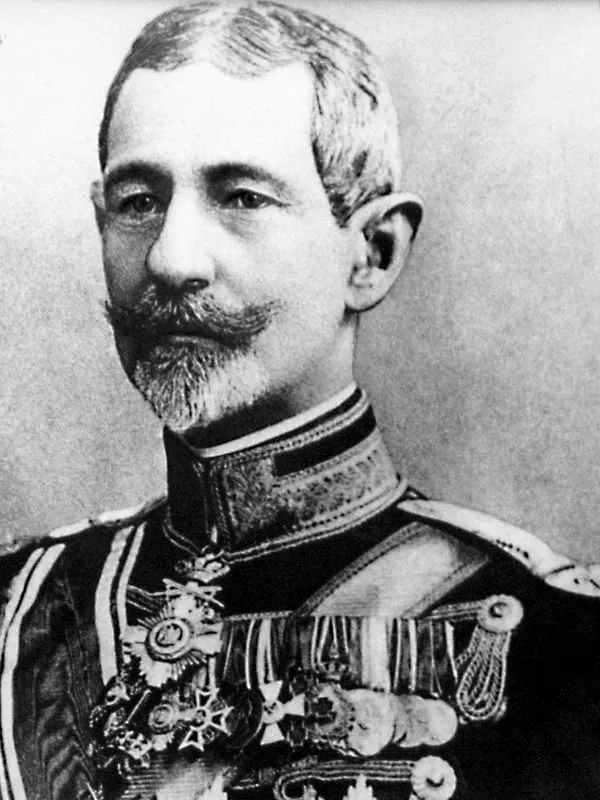
- Born:
- 9 March 1859, Babele near Izmail (today Ukraine)
- Died:
- 2 October 1938, Bucharest
- Author:
- Łukasz Skowroń
- Photo:
- autor nieznany, domena publiczna, Wikimedia Commons

Alexandru Averescu was the most popular Romanian general of the First World War. He commanded the 2nd Army, which in the summer of 1917 at Mărăști won the first clear victory of the rebuilt Romanian Army. Soldiers and peasants saw in him a commander who knew how to win and did not belong to the discredited political elite. His rivals considered him a conceited and quarrelsome intriguer. At the darkest moment of the war, in February 1918, the king entrusted him with the government and with negotiations with the Central Powers, which weighed on his reputation. After the war he founded his own party and was prime minister three times.
Before the war
He was born in March 1859 in the village of Babele near Izmail, in southern Bessarabia, which then belonged to Moldavia (sources give different days of birth, most often 9 March). He graduated from the theological seminary in Izmail. In the War of Independence of 1877–1878 he fought as a cavalry non-commissioned officer and was decorated. He then completed officer school in Romania and the military academy in Turin, where he married the opera singer Clotilde Caligaris. He was commandant of the War School in Bucharest and military attaché in Berlin.
In March 1907, during the great peasant revolt, he became Minister of War in the Liberal government and directed its suppression. The army used artillery against villages, and the number of peasants killed, according to various estimates, ranged from several hundred to several thousand. This affair was to weigh on him for the rest of his life. He remained minister until 1909 and parted with the Liberals in a conflict that turned into lasting enmity between him and Ion I. C. Brătianu. In 1911–1913 he was Chief of the General Staff and prepared the campaign against Bulgaria in the Second Balkan War. When Brătianu took office in 1914, Averescu was sidelined. He had hoped to become chief of staff, but the post was formally kept by the ailing General Vasile Zottu, while the staff was in practice run by the prime minister’s protégé, the secretary-general of the War Ministry, Dumitru Iliescu, whom Averescu despised.
The 1916 campaign
On 27 August 1916 Romania declared war on Austria-Hungary, and Averescu’s 2nd Army crossed the Carpathian passes and took Brașov. After the defeat at Turtucaia in early September the general took command of the 3rd Army, and then of an army group in the south. At the council of war on 15 September he clashed sharply with the commander of the Army of the North, General Constantin Prezan: Averescu wanted to halt the offensive in Transylvania and strike across the Danube at Bulgaria, while Prezan defended the Transylvanian plan. King Ferdinand I, on the advice of Alekseyev and Joffre, sided with Averescu.
On 1 October Averescu’s troops crossed the Danube at Flămânda, taking the Bulgarians and Mackensen completely by surprise. According to Glenn Torrey, the bridgehead was quickly extended to several kilometres. But on the same day German aircraft were already bombing the pontoon bridge, during the night a storm broke it in three places, and on 2 October Austro-Hungarian monitors appeared. Averescu halted the crossing, and on 3 October headquarters, alarmed by the situation in Transylvania, ordered the troops withdrawn and two divisions handed over to the north. Losses were small, but the operation, for which forces had been taken from Transylvania, weakened the front there at the moment of Falkenhayn’s attack. The dispute over who was to blame, Averescu or headquarters, went on in Romania for decades.
After the loss of Brașov Averescu again took over the 2nd Army. He ordered his troops to defend themselves not at the mouths of the passes, where German heavy artillery would destroy them, but deep in the mountain valleys, and for several weeks his divisions held the Germans in the Carpathians. In December, after the defeat on the Argeș, whose plan he had considered wrong from the start, he withdrew the army to Moldavia. When Iliescu was dismissed after the fall of Bucharest, he was the most obvious candidate for chief of staff. According to Torrey, however, the king, Brătianu and the head of the French military mission, Henri Berthelot, did not want him in the post and chose Prezan. Averescu took this as a personal affront.
Mărăști (1917)
In the winter and spring of 1917 the 2nd Army, re-equipped and retrained with French help, recovered its strength. Averescu was demanding and ruthless. The correspondent of The Times wrote in February 1917 that in his army there was no forgiveness for cowards, but the brave knew they would find in him a friend and protector. The general made sure that his army would not be given merely a supporting role in the summer offensive.
On 22 July 1917 the artillery of the 2nd Army opened fire on the German positions in the Vrancea region, and on 24 July the infantry broke through the front at Mărăști. “At last we have a fine day, a day such as our army has never had before,” Averescu wrote in his diary. The next day, in view of the Russian defeat in Galicia, came the order to halt the offensive. Averescu protested that stopping the troops right after a victory would break their spirit and that the line they held was poor for defence, and he won permission to advance to a better position. The fighting ended on 1 August. In August his army was on the defensive in the Third Battle of Oituz, and when the Germans threatened its rear at Mărășești, it had to give up the Soveja basin taken in July. Even so, in the eyes of the public Averescu remained the victor of 1917.
Prime minister (1918)
In February 1918 Mackensen issued Romania an ultimatum, and Brătianu, unwilling to conduct the negotiations, resigned and suggested the popular general to the king. On 9 February Ferdinand asked Averescu to form a government. The general was to play for time in the hope of better terms. He went to Buftea to talk with Mackensen, and on 24 February he met the ministers Kühlmann and Czernin there and refused to give up Dobruja. The Central Powers would not yield. After the crown council in Jassy, at which Averescu argued that further fighting would be possible but short and would end in the destruction of the army, his minister Constantin Argetoianu signed the preliminary Peace of Buftea on 5 March. On 9 March Averescu also signed with representatives of the Soviet authorities in Odessa a protocol in which Romania promised to withdraw from Bessarabia, which it never did.
The government had lost its reason for existing. On 12 March the king admitted in a conversation with the prime minister that he no longer had confidence in him, and Averescu resigned. The government was taken over by the pro-German Conservative Alexandru Marghiloman. For years his opponents reproached the general for having been the one who began talks with the enemy, although the terms were dictated by a situation over which he had no control.
After the war
In the spring of 1918 Averescu left the army and founded the People’s League, later transformed into the People’s Party. In 1919 his popularity was immense. Argetoianu wrote that peasants dreamed of him and told how they had seen him come down to them from an aeroplane. He was prime minister in 1920–1921, when Romania signed the Treaty of Trianon and carried out land reform, and in 1926–1927, each time by the grace of Brătianu, who later pushed him aside. In 1923 he became an honorary member of the Romanian Academy, together with Prezan, and in 1930, again together with him, a Marshal of Romania. He supported Carol II’s return to the throne but soon fell out with him. He died on 2 October 1938 in Bucharest. His war diaries are one of the most important sources for the history of the Romanian campaign.
Assessment
In Romanian memory Averescu remained the hero of Mărăști and one of the two great commanders of the war, alongside Prezan, with whom he competed throughout the campaign. Many contemporaries saw him as the opposite of the corrupt and incompetent politicians and generals of 1916. Historians are more cautious. Glenn Torrey, while acknowledging his abilities, calls him conceited, quarrelsome and ambitious and believes that Prezan was the better choice for chief of staff. Western authors judge the Romanian command of 1916, Averescu included, very harshly, and the Flămânda affair remains controversial: some see it as a bold idea spoiled by the weather and by headquarters, others as an operation that dispersed forces at the worst possible moment. As a politician Averescu did not fulfil the hopes placed in him. His popularity became a tool in Brătianu’s hands, and the movement that was to renew Romanian public life fell apart in the 1930s.
Sources
Spotted a mistake?Report an error
Commanded in battles
(02)Mentioned in battles
(03)Often appears with
People who appear in the same events.