1917: The Romanian front
Battle of Mărăști
- Dates:
- 22 July – 1 August 1917
- Front:
- Balkan Front
- Location:
- The hills above the Limpejoara stream near the villages of Mărăști and Răcoasa, the Soveja basin and the Putna valley in the Vrancea region, on the border of Moldavia and Transylvania (Romania)On the battle map →
- Sides:
- Romania and RussiaAlexandru Averescu, Artur Văitoianu, Alexandru Mărgineanu, Aleksandr RagozaGermany and Austria-HungaryArchduke Joseph August of Austria, Franz Rohr von Denta, Friedrich von Gerok
- Result:
- Romanian and Russian victory. The front moved some 15–20 kilometres and the 2nd Army regained almost all of Vrancea, but the offensive was halted after the Russian defeat in Galicia.
- Author:
- Łukasz Skowroń
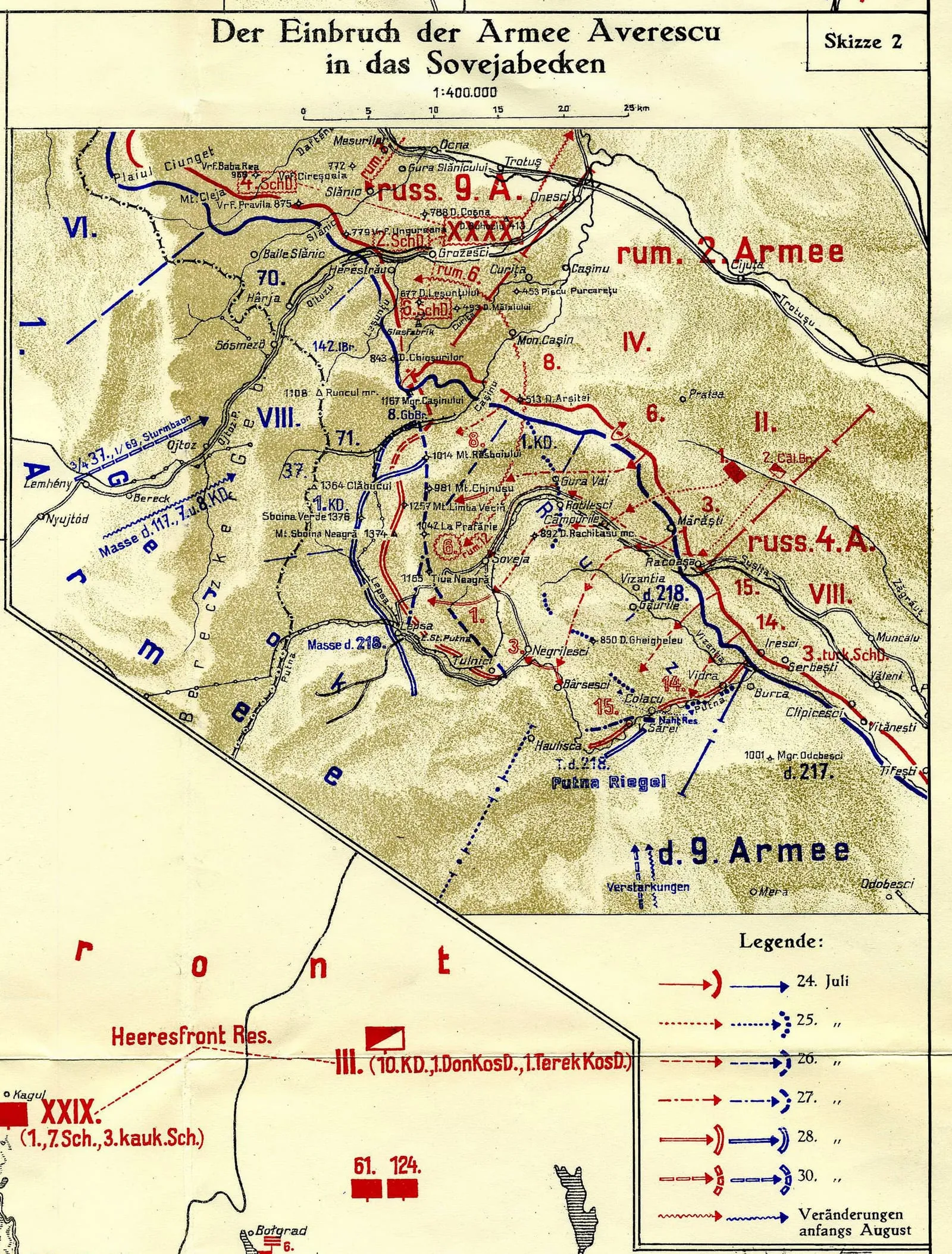
The Battle of Mărăști was the first great victory of the Romanian army rebuilt after the defeat of 1916. On 22 July 1917 the 2nd Army of General Alexandru Averescu, supported by the Russian VIII Corps, began shelling the positions of the German 218th Infantry Division in the hills of the Vrancea region, in a mountainous corner of Moldavia (PL) by the border with Transylvania. At dawn on 24 July the Romanian infantry broke the front near the village of Mărăști within a few hours, and over the following days drove the Germans and Austro-Hungarians out of the Soveja basin as far as the Putna river. The offensive, which was meant to be part of a great attack by the whole Russian-Romanian front, had to be halted, however, because in Galicia the Russian army was just then falling apart. The fighting for the last peaks went on until 1 August.
Name and dates
The battle took its name from the village of Mărăști (today in the commune of Răcoasa in Vrancea County), fortified by the Germans in the middle of the sector of attack. We take the dates 22 July – 1 August 1917 from the Romanian historian Constantin Kirițescu. On 22 July the artillery preparation began, on 24 July the infantry moved off, and on the evening of 1 August, after a failed assault on Măgura Cașinului, the fighting ceased along the whole front of the 2nd Army. The Austrian official history (“Österreich-Ungarns letzter Krieg”) describes the “irruption of Averescu’s army into the Soveja basin” on 22–29 July. Romania then reckoned time by the Julian calendar, so in Romanian documents the battle lasted from 9 to 19 July, and the day of the assault was 11 July.
A British chronology of the war gives under 22 July the beginning of the “battle of Mărășești”, and under 1 August the end of its “first phase”. This confuses two different battles. Mărăști lies in the mountains, about 30 kilometres north-west of the small town of Mărășești in the valley of the Siret. There the battle began only on 6 August, when the German 9th Army went over to the counter-offensive. The mistake does have some justification, though: the Romanian general and historian Gheorghe Dabija held after the war that the two battles formed a single whole in time and space, and proposed calling that summer’s fighting together the “battle of Oituz–Mărăști–Mărășești” or the “battle for Moldavia”.
Background
After the campaign of 1916 and the fall of Bucharest, Romania was left with only Moldavia, with its government in Iași. In January 1917 the front came to a halt beyond Focșani, on the Putna and Siret rivers and in the hills of Vrancea. Over the winter and spring the Romanian army was rebuilt with the help of the French military mission of General Henri Berthelot. France supplied most of the weapons, and the soldiers were trained in Western Front tactics. According to the Austrian official history, by the summer 10 of the 15 infantry divisions were fully fit for combat, and the Romanian soldier, unlike his Russian neighbour, had not been touched by disintegration.
The plan for the summer offensive was approved by King Ferdinand I, the nominal commander of the Romanian front. In practice the front was directed by his Russian deputy, General Dmitry Shcherbachev, and the Romanian side by the chief of staff, General Constantin Prezan. The offensive was the last link in the Russian summer attack of 1917, which had begun in Galicia on 1 July (the Kerensky offensive). The main blow was to be struck by the Romanian 1st Army of General Constantin Cristescu at Nămoloasa (PL), on the lower Siret, towards Râmnicu Sărat. The Russian 4th Army of General Aleksandr Ragoza was to take the Măgura Odobești massif and threaten Focșani from the north. Averescu’s 2nd Army was to break the front at Mărăști and reach the Putna valley. Since the spring Averescu had pressed for his army not to be given a merely auxiliary role. The start of the offensive was postponed twice and finally set for 22 July.
On the other side, the sector between the Cașin and Șușița valleys belonged to the group of the German General of Infantry Friedrich von Gerok, the right wing of the Austro-Hungarian 1st Army of General Franz Rohr, part of the front of Archduke Joseph August. South of the Șușița began the German 9th Army of Field Marshal August von Mackensen’s army group. The hills above Mărăști were defended by General Nostitz’s German 218th Infantry Division, and north of it by the Austro-Hungarian 1st Cavalry Division, fighting on foot. Both were under Lieutenant Field Marshal Ruiz de Roxas. According to Kirițescu the whole sector attacked was held by 21 infantry battalions, six regiments of dismounted cavalry and 30 batteries. The line consisted of heavily fortified strongpoints on the ridges, but had no depth. The 218th Division had not built a second position, and reserves were very scanty. The German and Austro-Hungarian commands expected the main blow on the lower Siret. Mackensen himself was preparing an offensive there, and in Baden it was doubted that the “not very combat-worthy” Romanian divisions were capable of a major attack.
Course
Artillery preparation (22–23 July). According to the Austrian official history the 2nd Army had 56 battalions and 316 guns; according to Kirițescu 228 guns took part in the bombardment. Averescu divided the front into two sectors. On the right wing, General Gheorghe Văleanu’s IV Corps (the 8th Division and part of the 6th) was only to pin the enemy down. On the left, the corps of General Artur Văitoianu (the 3rd Division and a brigade of the 6th Division, with the 1st Division in reserve) was to break through the positions between Încărcătoarea hill and the village of Mărăști on a 13-kilometre sector. The assault was directed by the commander of the 3rd Division, General Alexandru Mărgineanu. The bombardment began on 22 July. The Austrian official history says the batteries opened fire just after midnight; Kirițescu and Averescu’s diary say that rain and clouds interrupted the firing until the afternoon. On 23 July the Romanian artillery was already firing for destruction. Patrols counted several gaps in the wire in front of the 3rd Division, and the village of Mărăști went up in flames. Feint attacks forced the Germans to reveal their machine-gun nests.
The assault (24 July). At three in the morning the artillery once again pounded the German trenches, according to the Austrian official history also with gas shells. At four the infantry, which had crossed the Limpejoara stream during the night and crawled up under the slopes, went into the attack. In the centre the 2nd Rifle Regiment (vânători) and the 4th Infantry Regiment of the 3rd Division burst through the gaps in the wire onto the Mărăști ridge, and the 18th and 17th Regiments took the neighbouring redoubts. At 6.30 a.m. the Romanian 22nd Regiment took the village of Mărăști, attacking it from the flank and rear. In the afternoon, after fighting from several sides, the heavily fortified Mănăstioara hill also fell. In the south the Russian 15th Division of VIII Corps took Momiia hill before noon. According to Kirițescu the Russians took more than 400 prisoners and 35 guns there. The Austrian official history admits that the batteries of the 218th Division stayed in their positions too long and most of them fell into enemy hands. On the right wing of the attack, the 6th Division’s assaults on the Încărcătoarea redoubt broke down with heavy losses. By the evening, however, the front had been broken over a width of about 10 kilometres, and the Romanians stood on the Șușița. “At last we have a fine day, a day such as our army has never had before,” Averescu wrote in his diary. Gerok concluded that the 218th Division would not withstand another blow, and during the night withdrew the whole of Ruiz’s group to the west.
The order to halt (25 July). In the morning the Germans abandoned Încărcătoarea. The Romanians advanced cautiously and in places lost contact with the enemy. In the afternoon Averescu received an entirely unexpected order to halt the offensive. That day the Provisional Government, shaken by the defeat in Galicia, ordered the Russian armies on the Romanian front to stop their attack. The attack at Nămoloasa, prepared by a three-day bombardment from some 600 guns, never started at all. Averescu protested: troops halted straight after a bloody victory would lose heart, and the line on which they stood was poor for defence, because the enemy would keep the ridge dominating the Soveja basin. Headquarters allowed him to go on as far as a suitable line of defence.
The pursuit (26–29 July). At dawn on 26 July the Romanians pushed the 218th Division off the ridge between the Gheighelău and Răchitașu hills. Gerok had to pull the whole sector back to the eastern ridge of the mountains on the Transylvanian border. The Romanians entered the Soveja basin, and in Soveja, Rucăreni and Dragosloveni, according to Kirițescu, the people greeted the soldiers with flowers. On 27 July General Dumitru Stratilescu’s 1st Division pushed the 218th Division back as far as the fork of the Lepșa and Putna valleys, and the 3rd Division, after fierce fighting for the Cerdac and Bătăragă hills, took Bârsești on the Putna. In this fighting Captain Coravu, who had led the assault on the village of Mărăști on 24 July, was killed. On the evening of 27 July the Romanian high command, considering its objectives achieved, ordered the offensive to be finally ended. On 28 July the 30th Infantry Regiment beat off several counter-attacks on Pleașa hill, and on 29 July the Romanians took Valea Sării and dug in on the left bank of the Putna.
Fighting in the mountains (28 July – 1 August). Averescu’s right wing was still held back, because his Russian neighbour gave almost no help. On 28 July the 8th Division attacked the Măgura Cașinului massif. A Russian “battalion of death” was to strike from the north, but according to Kirițescu comrades from other units turned it back by force. A Romanian regiment went several times, singing and to the beat of drums, against the positions of the Austro-Hungarian 82nd Infantry Regiment, made up of Székelys, who were defending their native soil. In the south the 6th Division pushed the Austro-Hungarian cavalry off the Zboina Neagră ridge. On 30 and 31 July Colonel Liciu’s group took the Seciu and Războiului mountains. On 1 August the last assault on Măgura Cașinului, defended by concrete positions and positions cut into the rock, failed, and Averescu gave up further attacks. From then on the 2nd Army’s front ran in an arc from Măgura Cașinului through Zboina Neagră and Tulnici to Bârsești and Valea Sării.
Losses
According to Kirițescu the Romanians lost nearly 4,900 men killed, wounded and missing in the battle, including about 1,400–1,500 killed. The heaviest losses, about 1,800, were suffered by the 3rd Division. German and Austro-Hungarian losses are not known exactly. The 2nd Army took 23 officers and 2,746 men prisoner, and the Russians several hundred more. The Romanians captured 40 guns, 30 trench mortars and huge quantities of equipment. The Austrian official history writes that the 218th Division had “melted away badly” and three of its regiments had to be withdrawn from the fighting.
Significance
The Romanians broke the front over a width of about 30 kilometres and pushed the enemy back to a depth of up to 20 kilometres. They regained about 30 villages and almost the whole of the Vrancea region, and the junction between the forces of Archduke Joseph and Mackensen was threatened. The Central Powers had to bring reinforcements to this sector from Transylvania, Bukovina and the 9th Army, and Mackensen postponed his planned offensive at Nămoloasa. For the first time since 1916 the Romanian army had beaten the Germans in open battle. For the Romanians, Mărăști became proof that the army, shattered a few months earlier, had been reborn.
Strategically, the victory could not be exploited. The offensive along the whole Russian-Romanian front was halted before it had developed, and as the Romanians were entering Soveja, the Germans and Austrians in Galicia were taking Tarnopol and approaching the border of Moldavia from the north. The German Supreme Army Command, with General Erich Ludendorff, decided to exploit the disintegration of the Russian army and drive Romania out of the war. On 6 August the 9th Army struck at Mărășești, and on 8 August Gerok’s troops attacked in the Oituz valley. In both battles the Romanians, this time on the defensive, held the front. Mărăști, Mărășești and Oituz went down in Romanian memory as a single series of victories in the summer of 1917, often called the “heroic triangle”. In 1928 construction of a mausoleum to the fallen began at Mărăști.
Spotted a mistake?Report an error