Romania · The Entente
Constantin Prezan
Commander of the Northern Army (1916), Chief of the General Staff of the Romanian Army (1916–1918, 1918–1920), Marshal of Romania
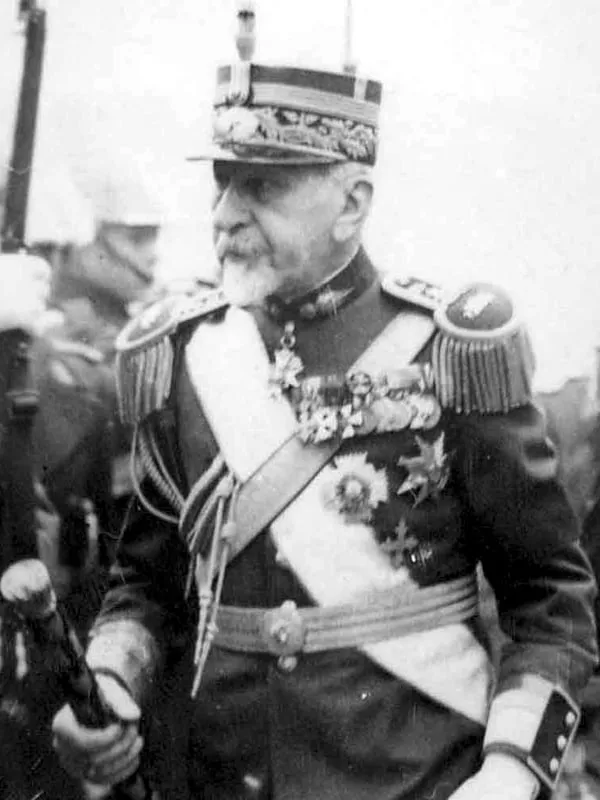
- Born:
- 27 January 1861, Sterianul de Mijloc, Butimanu commune (Romania)
- Died:
- 27 August 1943, Bucharest
- Author:
- Natalia
- Photo:
- autor nieznany, domena publiczna, Wikimedia Commons

Constantin Prezan was the most important commander of the Romanian army in the First World War, although he never won the popularity of his rival, General Alexandru Averescu. In 1916 he led the Northern Army in Transylvania and then directed the unsuccessful counter-offensive before Bucharest. From December 1916, as chief of staff of general headquarters, he rebuilt the shattered army, and in the summer of 1917 he co-ordinated the battles in which the Romanians held Moldavia. A calm, taciturn military engineer, close to the King and to Prime Minister Brătianu, he was made Marshal of Romania in 1930.
Before the war
He was born on 27 January 1861 in the village of Sterianul de Mijloc in the commune of Butimanu, north of Bucharest. According to Romanian biographers the family had French roots, and the name was also spelt Presan. He studied at the school for soldiers’ sons in Iași and at the officers’ school in Bucharest, which he left in 1880 as a second lieutenant. He chose the engineers. He completed the artillery and engineering school in Bucharest and then furthered his education in France. In Paris he met Ion I. C. Brătianu, then studying engineering, which mattered for his later career. He taught fortification, supervised in Germany the manufacture of equipment for the Focșani–Nămoloasa–Galați line of fortifications, and commanded a battalion of sappers.
From 1896 to 1901 he was aide-de-camp to the heir to the throne, Prince Ferdinand, the future king. He then commanded a regiment in Vaslui and a brigade in Bârlad, and in 1907, after the suppression of the peasant revolt, he became a general. By an irony of fate the decree was countersigned by the then minister of war, General Averescu, who reminded Prezan of this ten years later, when Prezan was already his superior. In 1913 he commanded the 7th Division in the Bulgarian campaign, and his troops stood out for their discipline and low losses during the cholera epidemic. In 1914 he was given command of IV Corps in Iași.
The Northern Army (1916)
Under the war plan, IV Corps became the Northern (4th) Army on mobilisation. Prezan was the only army commander who went to war in August 1916 with troops and a staff he had known for years. During the night of 27–28 August his roughly 108,000 soldiers crossed the passes of the Eastern Carpathians and entered the Székely Land. The army advanced slowly but in good order, and was the only one to reach roughly the line set in the plan, from Vatra Dornei to the area of Odorheiu Secuiesc.
After the defeat at Tutrakan, Prezan, at the council of war on 15 September, sharply opposed shifting the main effort to the Danube, as Averescu demanded. He lost, and his fears were soon confirmed. When Falkenhayn defeated the 1st and 2nd Armies at Hermannstadt and Kronstadt, the Northern Army withdrew towards the frontier within a few days. Critics, Romanian authors among them, reproached it for not even trying to relieve its neighbours. At the frontier, however, its resistance stiffened, and counter-attacks in the passes stopped the Austro-Hungarians. On 11 October King Ferdinand I held it up in an order of the day as a model for the other armies, and Prezan received the Order of Michael the Brave.
The battle for Bucharest
In November, when Falkenhayn’s troops came down from the Carpathians and Mackensen crossed the Danube, Prezan took command of the army group defending Bucharest. He took with him his closest associate from the staff, Captain Ion Antonescu, later dictator of Romania. Together with the head of the French military mission, General Henri Berthelot, he prepared a bold plan: to strike the exposed flank of Mackensen’s Danube Army before it could join Falkenhayn’s Ninth Army, and to defeat the enemies one at a time.
On 1 December his strike group fell on the German 217th Division and for two days came close to success. The plan, however, had serious weaknesses: divisions cobbled together from the remnants of shattered units, a lack of communications and reconnaissance, and Russian help limited to two divisions that would not move without orders. Romanian orders carried by stray officers fell into German hands by chance, and Falkenhayn directed his divisions into the gap in the Romanian rear. On 3 December the strike group was routed and the Battle of the Argeș was lost. On 6 December the Germans entered Bucharest. Averescu, who had not been consulted, regarded the operation as lost from the start. Ferdinand and Brătianu, however, appreciated the scope and resolve of the plan, as Romanian historiography writes.
Chief of staff (1916–1918)
In mid-December 1916 the King dismissed General Dumitru Iliescu and appointed Prezan chief of staff of general headquarters. According to Glenn Torrey this might have seemed surprising after a lost battle, but Prezan had the confidence of the King and Brătianu and the support of Queen Marie and of Berthelot, who called him the only truly capable soldier in Romania, while Averescu, the most obvious candidate, was unacceptable to them. Averescu took the appointment as an insult and said that Prezan was a deserving sapper who had never served a day on the staff.
General headquarters moved to Moldavia. In the winter of 1916–1917 Prezan, together with the French mission, reorganised the bled-out divisions, armed them and trained them. His operations staff was headed by Antonescu. Prezan also had to work with the Russians, who held most of the front. He was skilful at this: the minister Ion G. Duca wrote that through his gentleness, conciliatory manner and loyalty Prezan won the respect of the Russian command, and with General Dmitry Shcherbachev, from April 1917 the de facto commander of the front, he was on positively friendly terms. The plan for the summer campaign, worked out in long disputes with the Russians, provided for attacks at Nămoloasa and Mărăști.
At Mărăști Averescu’s army broke through the front in July, but the offensive had to be halted. In August Mackensen attacked at Mărășești. At the critical moment Prezan and Shcherbachev backed General Eremia Grigorescu, who had refused to carry out a Russian order to retreat, and gave him command of the whole sector. The Romanians stopped the Germans. Back in July Prezan had received the Order of Michael the Brave, second class, for preparing the summer operations. When the Russian front collapsed after the Bolshevik revolution, the King on 4 December 1917 handed him command of the Romanian army, so as not to be personally responsible for a possible capitulation. Under his orders the army entered the Armistice of Focșani. After the Peace of Buftea, which required demobilisation, Prezan retired in the spring of 1918.
Unification (1918–1920)
On 10 November 1918, when Romania re-entered the war, Prezan again became chief of staff. He directed the occupation of Bukovina and Transylvania, the defence of Bessarabia and the war with the Hungarian Soviet Republic, in which the Romanian army entered Budapest in August 1919. In February 1920 he received the Order of Michael the Brave, first class. When Averescu became prime minister in March 1920, Prezan left the army. Antonescu wrote bitterly that his resignation was accepted with the haste with which one dismisses a bad farmhand.
After the war
Prezan avoided politics. He was a senator by right, in 1923 he became, together with Averescu, an honorary member of the Romanian Academy, and in June 1930, again together with him, Marshal of Romania. In 1929 he was proposed as a member of the regency council, and in June 1930 King Carol II entrusted him with forming a government of national unity, a task he abandoned after a few days, unable to reconcile the parties. In 1932 he travelled to Nice for Shcherbachev’s funeral. In 1940 he turned down Antonescu, by then leader of the state, when Antonescu offered him the post of prime minister. He died on 27 August 1943 and was buried on his estate of Schinetea in Vaslui County. King Michael I and Marshal Antonescu attended the funeral.
Assessment
Romanian military historiography rates Prezan very highly. It stresses that under his direction the army shattered in 1916 was turned into a force that stopped Mackensen in the summer of 1917, and that he was able to work with both the Russians and the French. Glenn Torrey considers that he had the character and personality needed to rebuild the army and was a better choice than the “conceited, quarrelsome and ambitious” Averescu.
There are also critical voices. The Battle of the Argeș, bold in conception, ended in defeat, and its plan exceeded the capabilities of exhausted troops. The Northern Army was accused of passivity in the critical days of October 1916. His opponents, led by Averescu, called him a “drawing-room officer” who owed his career to the court and his friendship with Brătianu. The quarrel between the two marshals, fanned by politicians, weighed on Romanian memory of the war. Today they are usually seen as complementary figures: Averescu was the commander who inspired his soldiers, and Prezan the organiser who knew how to hold the army together.
Sources
Spotted a mistake?Report an error
Commanded in battles
(02)Mentioned in battles
(02)Often appears with
People who appear in the same events.