1916: The Romanian campaign
Battle of the Argeș
- Dates:
- 1–5 December 1916
- Front:
- Balkan Front
- Location:
- The Wallachian Plain west and south-west of Bucharest, between the Glavacioc, Neajlov and Argeș rivers, from around Pitești and Titu to the Danube (Romania)On the battle map →
- Sides:
- Romania and RussiaConstantin Prezan, Constantin IancovescuGermany, Bulgaria, the Ottoman Empire and Austria-HungaryAugust von Mackensen, Erich von Falkenhayn, Robert Kosch, Viktor Kühne
- Result:
- Central Powers victory. The Romanian strike group was destroyed, the 1st Army was thrown back eastwards, and on 6 December the Central Powers entered Bucharest and Ploiești unopposed.
- Author:
- Łukasz Skowroń
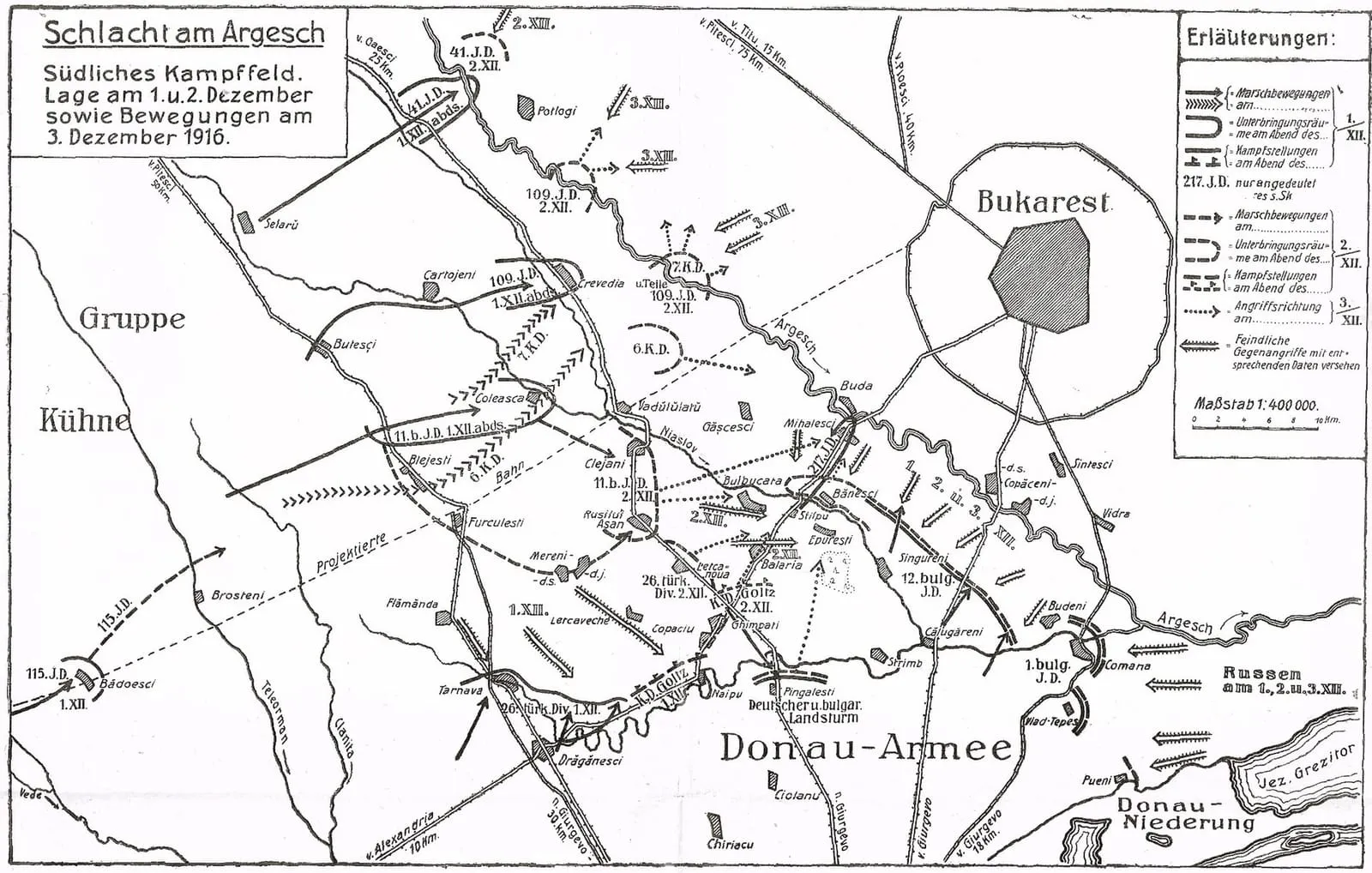
The Battle of the Argeș was the last great battle of the Romanian campaign of 1916 and the last attempt to defend Bucharest. At the end of November two armies of the Central Powers were closing in on the Romanian capital like pincers: the German 9th Army of General Erich von Falkenhayn, coming down from the Carpathians and out of Oltenia, and General Robert Kosch’s Danube Army from Field Marshal August von Mackensen’s army group, which had crossed the Danube at Zimnicea. General Constantin Prezan decided to drive in between them and destroy the forward Danube Army first. On 1 December his strike group fell on the flank of the German 217th Infantry Division and for two days came close to success. By chance, however, the Romanian operational plan fell into German hands, and Falkenhayn sent his divisions into the gap the Romanians had left behind them. On 3 December the Romanian strike group was routed, over the following days the whole army fell back eastwards, and on 5 December the Romanian command decided to give up the capital without a fight.
Name and dates
In Romania this fighting is called the Battle of the Neajlov and Argeș or the Battle of Bucharest. German and Austrian accounts call it the Battle of the Argeș (Schlacht am Argesch). Sources set its limits differently. The Austrian official history (“Österreich-Ungarns letzter Krieg”) states that the Romanian attack on the Danube Army began as early as 30 November, while the American historian Glenn Torrey writes that Prezan postponed it twice and the strike group hit the German flank only on 1 December, towards evening. The Romanian historian Constantin Kirițescu regards 29 November to 3 December as the decisive days. The outcome of the battle was settled on 3 December, but fighting continued on 4 and 5 December as the Romanians fell back behind the Argeș and towards Bucharest. We use the dates from the British chronology of the war: 1 to 5 December 1916. The first date is the day of the strike group’s actual attack, the second the day on which the Romanian command ordered a general retreat and resolved not to defend the capital. Romania still reckoned time by the Julian calendar, so in Romanian documents the battle lasted from 18 to 22 November.
Background
After the breakthrough on the Jiu and the capture of Craiova the 9th Army crossed Oltenia and reached the Olt, and on 23 November Mackensen crossed the Danube at Svishtov. Romanian plans for a counter-stroke on the Olt lost their point. The head of the French military mission, General Henri Berthelot, noted at the time that all the plans for a manoeuvre on the Olt had fallen apart and that the capital would have to be defended by gathering every available force on the Argeș, west of the city. The Russian General Belyaev advised the Romanians to retreat, but their command, as the Austrian official history puts it, was determined to fight a battle for the capital, the centre of government, of administration and of the country’s entire railway network.
Command of the 1st Army, the Danube Defence Group and the reserves of the high command was taken over, as army group commander, by General Prezan, previously commander of the Northern Army in Moldavia. On 27 November he returned from the front near Pitești to headquarters with a ready plan, together with his closest associate on the staff, Captain Ion Antonescu, later the dictator of Romania. The Romanians saw that the Danube Army, advancing along the road from Alexandria to Bucharest, had got ahead of Falkenhayn’s troops and had an exposed left flank. Between it and the 9th Army lay a wide gap which, it was believed, was held only by General Eberhard von Schmettow’s cavalry. Prezan wanted to “fall with all his strength on Mackensen’s flank”, push his army into the Danube and then turn north-west against Falkenhayn. It was a classic manoeuvre on interior lines. Torrey notes that it resembled the manoeuvre with which the Germans had crushed the Russians in East Prussia in 1914. Berthelot backed the plan, but with the proviso that it had to be carried out quickly and vigorously. General Alexandru Averescu, whose opinion was not sought, considered it a battle lost from the start.
The plan had serious weaknesses. The strike group consisted of three infantry divisions and one cavalry division: the 2nd/5th and 9th/19th, hastily cobbled together from the remnants of divisions shattered in the Dobruja, the 21st, only just rebuilt after its losses in the Prahova valley, and the 2nd Cavalry Division. According to Torrey a single company sometimes held soldiers from five or more regiments, and replacements often had no training at all. The divisions were 40 to 78 kilometres apart and had to march several dozen kilometres to their attack positions. Prezan’s staff lacked teleprinters and telephone cable, the civilian lines were being cut by German cavalry, and there was no air reconnaissance. Romanian intelligence misjudged the enemy’s strength and only on 2 December established that the Danube Army had five divisions. General Stratilescu’s 1st Army, which was to cover the whole undertaking from the west, was exhausted by three months of fighting. Prezan was also counting on Russian help, but after long pleading the Stavka promised only two divisions of the Russian IV Corps.
The Central Powers, for their part, lacked a unified command. Falkenhayn and Mackensen were rivals, and the Danube Army had pushed far ahead of the 9th Army. Only on 29 November did the German and Austro-Hungarian high commands agree that from the evening of 30 November the 9th Army would come under Mackensen’s orders.
Forces
According to the Austrian official history, at the start of the battle 8½ infantry divisions and 2 cavalry divisions were fighting on the Romanian side, but as it went on almost the whole Romanian army was drawn in. In the end 15½ infantry divisions and 3 cavalry divisions fought, most of them badly depleted. The Central Powers had 14 infantry divisions and 3 cavalry divisions in Wallachia. Kirițescu counts 16½ enemy divisions against 13½ Romanian ones, joined at the end by two Russian divisions. In his account the battle front was about 120 kilometres long, from around Pitești almost to the Danube. The figures often found in the literature, 150,000 Romanians and Russians and 250,000 Central Powers troops, have no reliable source.
The Danube Army consisted of the German 217th Infantry Division, the Bulgarian 1st and 12th Divisions, the Ottoman 26th Division and General von der Goltz’s improvised cavalry division. From the 9th Army, General Viktor Kühne’s LIV Corps (the Bavarian 11th and the 41st, 109th and 301st Infantry Divisions) and Schmettow’s cavalry were coming up from the west, and from the north-west General Krafft von Dellmensingen’s group with the Alpine Corps and the Austro-Hungarian 73rd Division.
Course
The approach (28–30 November). The attack, set for 29 November, was delayed because the divisions had not reached their positions in time. The 21st Division, which had taken up positions on the Alexandria road, took the blow of the Danube Army on its own and was pushed back behind the Neajlov and then behind the Argeș. General Alexandru Socec’s 2nd/5th Division marched from the east bank of the Olt for a full day and night from the evening of 28 November, harassed by Schmettow’s cavalry. The soldiers, as Torrey writes, in torn uniforms and carrying their wounded, were no longer fit to attack. Russian help came slowly: part of the IV Corps detrained far from the battlefield and continued on foot. Meanwhile Stratilescu’s 1st Army was falling back before Krafft’s group, and on 29 November the Germans took Pitești and Câmpulung. The 1st Army’s retreat widened the gap between it and the strike group to about 60 kilometres, and it was into this gap, almost unopposed, that Kühne and Schmettow were marching.
The blow against the Danube Army (1–2 December). On 1 December the German 217th Division threw the Romanian 21st Division back behind the Argeș at Mihăilești. At that moment the 9th/19th and 2nd/5th Divisions fell on its left flank and rear. According to Kirițescu, units of the 9th/19th took the village of Bulbucata with the bayonet at dawn, and at 10 p.m. the Romanian 40th “Călugăreni” Infantry Regiment burst into the village of Bălăria, where the headquarters of the 217th Division stood, taking more than 200 prisoners and three heavy guns. The divisional commander, General von Gallwitz, escaped with his staff. The Germans fell back from the Argeș to the Neajlov and formed a horseshoe, facing three ways. In the south, on the lower Neajlov, fighting with the Bulgarians swung back and forth. In the evening the first brigade of the Russian 40th Division arrived.
On 2 December the Romanians took Iepurești and the bridge over the Neajlov at Stâlpu, and the 21st Division crossed back over the Argeș and split the 217th Division from the Bulgarian 12th Division. According to Kirițescu, in two days the 217th Division lost 1,500 prisoners, 20 guns and 30 machine guns. Torrey gives 2,000 prisoners and writes that its regiments had shrunk to 800, 500 and 300 men. The Austrian official history describes it “in hedgehog formation”, surrounded on three sides and defending itself “with the courage of despair”. Mackensen twice asked Falkenhayn for urgent help. Prezan, convinced that victory was close, ordered, in an order dropped from an aircraft, that the attack be continued on 3 December “without a pause” and the battle decided that day. He also asked the Russians to strike the Bulgarians’ right flank, but, as Kirițescu writes, the commander of the Russian 40th Division refused, pleading the lack of orders from General Vladimir Sakharov and the fact that he did not yet have his whole division. When a Romanian officer asked him whether he wished to play the part of Grouchy at Waterloo, the Russian is said to have replied that he had not come to listen to a history lecture.
The captured order. As early as the afternoon of 1 December a car carrying two staff officers of the Romanian 8th Division lost its way on the upper Argeș and drove in among marching German troops. The officers were carrying operational orders from higher commands which revealed Prezan’s entire plan. The documents reached Falkenhayn. The Austrian official history writes that “at a single stroke the darkness lifted” over the Romanians’ intentions. Falkenhayn at once sent the Bavarian 11th Division on a forced march south-east into the rear of the Romanian strike group, the 41st Division north-east into the rear of the 1st Army, and the 109th Division and Schmettow’s cavalry east towards the Argeș and Bucharest. On the evening of 2 December the Bavarians reached Rușii lui Asan and made contact with the Turks.
The decision (3 December). On the morning of Sunday 3 December the 217th Division, with the last of its strength, beat off further Romanian attacks. Before noon the 2nd/5th Division was struck from three sides by the Bavarians, the Turks, Goltz’s cavalry and the regrouped 217th Division. According to Torrey the Romanians held on until about 1 p.m. and then, exhausted by a week of marching and fighting, began to give way. According to Torrey, General Socec suffered a nervous breakdown and lost control of his division. He was later court-martialled for it. The 9th/19th had to fall back behind the 2nd/5th, and both divisions fled in disorder across the Neajlov and the Argeș as far as Bragadiru, a dozen or so kilometres from Bucharest. The bridge on the road was choked with wagons and the bodies of men and horses, so many soldiers tried to ford the icy river and drowned. A feeble Russian attack on the Bulgarian 1st Division changed nothing. The same day the 41st Division broke through to Titu and forced the 1st Army to retreat behind the Dâmbovița, and General Morgen’s corps took Târgoviște. In the evening Prezan ordered the remnants of the strike group to withdraw towards Bucharest, which merely confirmed the retreat.
The retreat (4–5 December). On 4 December the Romanian high command, which had moved to Buzău, took over the direction of operations. Berthelot judged that the Romanian troops were incapable of another effort and proposed a general retreat of about 100 kilometres eastwards, to the Râmnicu Sărat–Viziru line, where Russian troops were assembling. On 5 December King Ferdinand I accepted this plan. The Danube Army meanwhile crossed the Argeș and approached the Romanian positions on the Sabar, just outside Bucharest. On the morning of 5 December Mackensen sent an envoy under a flag of truce with a summons to surrender the fortress. Bucharest could not defend itself, because the fort guns had been removed before the war to serve as heavy artillery for the field army. The envoy returned with the answer that it was an open city. The same day, as the Romanian 16th Division passed through Câmpina on its retreat from the Prahova valley, the derricks of the oilfields there were set on fire, according to the Austrian official history with the participation of two senior British officers.
Casualties
Full figures are lacking. The Austrian official history, summing up the battle and the occupation of Bucharest and Ploiești, states that Falkenhayn’s army took 60,000 prisoners, 85 guns and 115 machine guns, and the Danube Army, on 3 and 4 December alone, 5,000 prisoners and 39 guns. It gives no figures for killed and wounded on either side. According to Torrey the 2nd/5th Division, which had begun its march south with about 10,000 men, numbered 2,500 after the battle, and the 9th/19th about 5,000. Both lost almost all their artillery. The losses of the German 217th Division were heavy, but the total losses of the Central Powers have not been published.
Significance
The Battle of the Argeș decided the fate of Bucharest. On 6 December the Central Powers entered the capital and Ploiești unopposed, and the Romanian army, much of it in disarray, fell back eastwards into Moldavia (PL). The Austrian official history credits the Romanian plan with a “bold conception”, but judges that assembling the manoeuvre group took too long and that its troops lacked the strength to destroy the Danube Army in a short time. The Romanian attack was possible at all only because the Danube Army had raced ahead of the 9th Army. Victory, on the other hand, came from Falkenhayn’s lightning grasp of the situation on 1 December and his decisive action. Torrey adds that the Romanian command based its decision to counter-attack from a very unfavourable position on a mistaken assessment of the enemy’s strength, of its own army’s capabilities and of Russian help. The Romanians blamed the defeat above all on their Russian ally, who had failed to come to their aid at the decisive moment.
It was also the largest battle on the Romanian front in 1916. Kirițescu compared it with the Battle of the Marne: the front line was a river valley, both sides threw almost all their forces into the fight, and the fate of the capital depended on the outcome. The Romanians fought bravely in it. For two days the 9th/19th and 21st Divisions almost encircled the German 217th Division, and the Danube Army went through, as Torrey writes on the basis of Austro-Hungarian documents, the peak of its crisis. The defeat on the Argeș, however, broke the strength of the Romanian army and, as the Austrian official history puts it, the soldiers’ confidence in their commanders. Its remnants were withdrawn to Moldavia to be rebuilt, and the defence of the front was largely taken over by the Russians.
Spotted a mistake?Report an error