Romania · The Entente
Ferdinand I of Romania
King of Romania (1914–1927), formal commander-in-chief of the Romanian Army
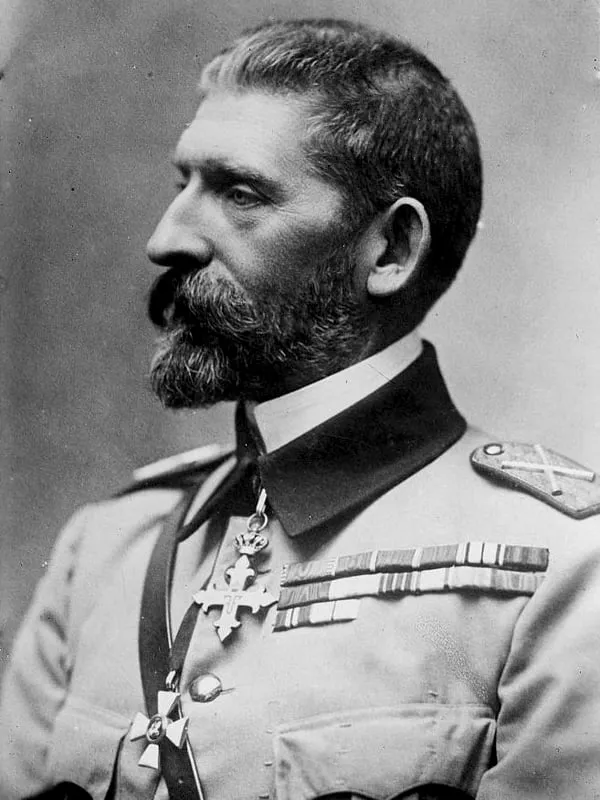
- Born:
- 24 August 1865, Sigmaringen (Germany)
- Died:
- 20 July 1927, Sinaia
- Author:
- Łukasz Skowroń
- Photo:
- Bain News Service, domena publiczna, Wikimedia Commons

Ferdinand I was the second King of Romania and one of the most remarkable monarchs of the Great War. A German prince of the Catholic line of the Hohenzollerns, brought up in Swabia, in 1916 he signed the declaration of war on Austria-Hungary knowing that it meant war with Germany, his family’s homeland. The 1916 campaign ended in disaster: Romania lost its capital and two-thirds of its territory, and the king and the government took refuge in Jassy. Yet Ferdinand survived defeat, occupation, the collapse of his Russian ally and a humiliating peace that he never ratified. When the war ended, he ruled a state twice the size it had been in 1914. The Romanians called him “the Loyal”, because he kept the oath he had sworn to his new homeland, and “the Unifier” (Întregitorul).
Before the war
He was born on 24 August 1865 in Sigmaringen, the second son of Prince Leopold of Hohenzollern-Sigmaringen, the same man whose candidacy for the Spanish throne served in 1870 as the pretext for the Franco-Prussian War, and of the Portuguese infanta Antónia. Ferdinand’s uncle, Carol I, had reigned in Romania since 1866 but had no surviving children. Ferdinand’s father renounced his rights to the Romanian throne in 1880, and his elder brother Wilhelm in 1886. Thus the younger son, who reportedly did not want it at all, became heir to the throne of a foreign, Orthodox country. He studied in Tübingen and Leipzig, and in 1889 he settled permanently in Romania. He kept his Catholic faith, but his children had to be brought up Orthodox.
The first years were not easy. In 1891 he fell in love with one of the queen’s ladies-in-waiting, the poet Elena Văcărescu, and King Carol, regarding marriage to a subject as impossible, ended the romance and sent his nephew on a tour of Europe in search of a suitable wife. On 10 January 1893 Ferdinand married Marie of Edinburgh at Sigmaringen, a granddaughter of Britain’s Queen Victoria and of Tsar Alexander II. They had six children, among them the future King Carol II. The marriage of convenience was not a happy one, and the beautiful, energetic and ambitious Marie, linked by a close friendship to Prince Barbu Știrbey, soon overshadowed her husband. In 1897 Ferdinand nearly died of typhoid fever.
The heir to the throne aroused little enthusiasm. He was educated, well read, knew several languages and was passionate about botany, but in public he was awkward, spoke clumsily and found it hard to make decisions. Behind his back he was called “poor Fritz”. Carol I kept him away from politics. Ferdinand made a career in the army, and in the summer of 1913, during the Second Balkan War, he was in formal command of the Romanian troops that advanced deep into Bulgaria almost without a fight.
Neutrality (1914–1916)
When the war broke out, King Carol wanted to remain faithful to the secret alliance of 1883 with Germany and Austria-Hungary, but on 3 August 1914 the crown council at Sinaia came out in favour of neutrality. On 10 October 1914 Carol I died and Ferdinand became king. Taking the oath before parliament the next day, he declared that he would reign as a good Romanian. The change on the throne removed the most important obstacle to rapprochement with the Entente: the new king did not feel bound by his uncle’s commitments, and Queen Marie openly sympathised with Britain and Russia.
Foreign policy, however, was directed by the prime minister, Ion I. C. Brătianu, leader of the Liberals, with whom Ferdinand worked from then on until his death. It was Brătianu who conducted secret negotiations with both sides, concluded an agreement with Russia in the autumn of 1914 and refused to help Serbia in 1915, waiting for the most favourable moment. The king remained in the background, but his role was not passive. He stood by the government and resisted pressure both from his German relatives and from domestic advocates of immediate war. Queen Marie wrote of him that he might not be energetic, but he had a strangely strong stubbornness in him: the more he was pushed and frightened, the less he could be moved. Ferdinand and Brătianu also used her connections with the courts in London and Petrograd to present Romania’s claims to Transylvania there unofficially.
The decision of 1916
In the summer of 1916, after the successes of the Brusilov offensive, Brătianu decided that the moment had come. On 17 August he signed a treaty with the Entente, and on 27 August Ferdinand convened a crown council at the Cotroceni Palace. The decision had already been taken, and the king needed only the backing of the political leaders. The American historian Glenn Torrey writes that the monarch spoke then with a self-assurance never seen in him before: he set out the conflict between his German origins and his duty as King of the Romanians and asked those present to support a war for the unification of the nation. When the Germanophile Petre P. Carp reminded him that no Hohenzollern had ever yet been defeated, Ferdinand is said to have replied that he had already defeated one – himself. That evening Romania declared war on Austria-Hungary, and the next day the king issued a proclamation calling for the completion of the work of Michael the Brave and the union of all Romanians.
In Germany this was regarded as treachery. Wilhelm II was shaken and, according to widespread accounts, ordered Ferdinand’s name struck from the register of the House of Hohenzollern. The family at Sigmaringen broke off contact with him.
Defeat in 1916
Ferdinand was formally commander-in-chief, but operations were directed by general headquarters, where the decisive voice belonged to the deputy chief of staff, General Dumitru Iliescu, a protégé of Brătianu. The offensive in Transylvania soon stalled, and on 6 September the Bulgarians and Germans took Turtucaia. The king, overwhelmed by conflicting advice, called a conference of army commanders on 15 September, which turned into a bitter quarrel between Generals Alexandru Averescu and Constantin Prezan. On the advice of Alekseyev and Joffre, Ferdinand agreed to shift the main effort to the south, which ended in Averescu’s failed crossing of the Danube at Flămânda. Meanwhile Falkenhayn drove the Romanians out of Transylvania. On 11 October the king issued an order forbidding all talk of retreat, threatening the severest penalties for falling back without enemy pressure and holding up Prezan’s Army of the North as a model.
The autumn brought further defeats, and the king was also struck by personal tragedy: on 2 November his youngest son, the three-year-old Prince Mircea, died of typhoid fever. Soon the armies of Falkenhayn and Mackensen converged on Bucharest. After the defeat on the Argeș, on 5 December Ferdinand accepted a plan for a general retreat put forward by the head of the French military mission, General Henri Berthelot. The next day the Germans entered the capital. In mid-December the king removed Iliescu, citing, as Torrey reports, general discontent, and appointed Prezan chief of staff. According to Torrey, the choice was made by Ferdinand, Brătianu and Berthelot, who did not want the popular but quarrelsome Averescu in the post.
Jassy (1917)
The court, the government and parliament moved to Jassy, the old capital of Moldavia. In the winter of 1916/1917 the overcrowded city was ravaged by typhus, food and fuel were scarce, and the front was held mainly by Russian troops. Formally Ferdinand commanded the whole Romanian Front, but from April 1917 it was in practice directed by his Russian deputy, General Dmitry Shcherbachev. Meanwhile Berthelot’s French mission was rebuilding the Romanian Army.
The greatest threat now was the February Revolution in Russia. Russian soldiers in Moldavia were forming soviets and fraternising with the enemy, and revolutionary slogans could easily spread to an army made up overwhelmingly of landless peasants. Ferdinand then made the most important political gesture of his reign. On 5 April 1917 (23 March by the Julian calendar, then in force in Romania), at Răcăciuni, he addressed the soldiers of the 2nd Army and promised that after the war they would receive the land they were fighting for, as well as a broad share in the affairs of the state. In the summer the parliament in Jassy amended the constitution, introducing the principle of expropriating large landed estates and universal suffrage. Historians agree that the promise helped maintain discipline in the army while the Russian forces were disintegrating.
In the summer the rebuilt Romanian Army won the Battle of Mărăști, and at Mărășești and Oituz it halted Mackensen’s offensive. The king and queen often visited the front and the hospitals. In these months Marie became a symbol of resistance, which overshadowed her husband even more.
A separate peace
After the October Revolution Shcherbachev lost control of his troops. On 4 December 1917 a council chaired by the king agreed to talks on a purely military armistice, and Ferdinand entrusted command of the Romanian Army to Prezan so as not to put his own name to a possible capitulation. On 9 December the Armistice of Focșani was signed. In January 1918 the Bolsheviks broke off relations with Romania and seized its gold in Moscow, and in February Mackensen issued an ultimatum. Brătianu resigned, and Ferdinand entrusted the government to Averescu.
In Berlin some commanders and politicians demanded that the “traitor” be deprived of his throne. The Austro-Hungarian foreign minister, Ottokar Czernin, believed, however, that a lasting peace could be concluded only with the legitimate king. On 27 February he met Ferdinand in a saloon car at Răcăciuni station. According to Romanian historians, he spoke arrogantly, gave the king 48 hours to reply and made it clear that if he refused, the dynasty would lose the throne. The Conservative leader Alexandru Marghiloman noted that the king wept. At the crown council in Jassy on 2–4 March the queen and Crown Prince Carol called for resistance to the end, but the generals and the supply figures left no illusions. On 5 March the Averescu government signed the preliminary Peace of Buftea.
Ferdinand had to swallow further humiliations. In March he dismissed Averescu and appointed a Marghiloman government, led by a politician the Germans trusted. Bessarabia was the compensation: after the vote of the Sfatul Țării in Kishinev, the king approved the union by decree of 22 April. On 7 May the Marghiloman government signed the Treaty of Bucharest, which took Dobruja and the Carpathian passes from Romania and placed its oil and grain under German control. The parliament elected under Marghiloman approved the treaty, but the king never signed or promulgated it. This refusal, whether deliberate or a result of Ferdinand’s characteristic procrastination, proved invaluable after the war. In the summer of 1918 a family scandal also befell him: Crown Prince Carol left his garrison without permission and secretly married Zizi Lambrino in Odessa, for which his father punished him with arrest.
Victory
In the autumn of 1918 the Central Powers were collapsing. On 6 November, at the demand of the Entente’s representatives, Ferdinand dismissed Marghiloman and appointed an interim government under General Constantin Coandă. On 10 November, the day before the Armistice of Compiègne, Romania re-entered the war, and in a proclamation the king called on the nation to stand alongside the Allies against the enemy that had been plundering the country for two years. Prezan once again became chief of staff.
On 1 December 1918 Ferdinand and Marie rode into Bucharest on horseback, greeted by crowds, with General Berthelot at their side. On the same day the assembly at Alba Iulia proclaimed the union of Transylvania with Romania. Earlier, on 28 November, the Congress of Bukovina had voted for union, and on 10 December the Sfatul Țării of Bessarabia proclaimed unconditional union. At the end of December the king signed the decrees approving the unions of Transylvania and Bukovina. Full recognition of the new borders came with the peace treaties of 1919–1920, for which Brătianu fought at the Paris conference.
After the war
In 1919, in the war with the Hungarian Soviet Republic, the Romanian Army reached Budapest. The promises of Răcăciuni were kept: the first elections by universal suffrage were held in November 1919, and in 1918–1921 a land reform was carried out, one of the most radical in Europe at the time. On 15 October 1922 Ferdinand and Marie were solemnly crowned rulers of Greater Romania in the newly built cathedral at Alba Iulia. A new constitution was adopted in 1923.
The last years of the reign were dominated by Brătianu and his Liberals, and by a dynastic crisis. In December 1925 Carol, involved with Elena Lupescu, again renounced his rights to the throne, and the king recognised his four-year-old son Michael as heir. Ferdinand died of bowel cancer on 20 July 1927 at Sinaia. He was buried at Curtea de Argeș, beside his uncle. The throne passed to his grandson Michael I under a regency council, and four months later Brătianu also died.
Assessment
In his lifetime Ferdinand was a figure held in low regard. He was seen as a weak monarch, steered by his wife, Brătianu and Știrbey, and the Romanian journalist Sterie Diamandi wrote in 1934 that two versions of him circulated in society: the official one, from textbooks and occasional speeches, and another, of a man without personality and of mediocre intelligence, which was more readily believed. Critics point out that as commander-in-chief he bore formal responsibility for the disaster of 1916, for the disastrous choice of chief of staff and for the vacillation that threw the army back and forth between Transylvania and the Danube.
Modern historians judge him far more leniently. They stress that at key moments he took decisions that required courage: in 1916 he turned against his own family and the country of his birth, in 1917 he promised the peasants land, and in 1918 he did not sign the Treaty of Bucharest, which allowed Romania to return to the camp of the victors. The German historian Gerhard Grimm saw him as a ruler who strictly observed the constitution and put the duty of a king above his personal feelings. Most scholars agree that his greatest strength was stubbornness rather than initiative: he did not direct events, but he would not be broken. Romania owes him in large part the fact that it emerged from a war in which it suffered some of the heaviest losses of any participant as Greater Romania.
Sources
Spotted a mistake?Report an error
Mentioned in battles
(02)Often appears with
People who appear in the same events.