1916: The Romanian campaign
Battle of Transylvania
- Dates:
- 27 August – 14 October 1916
- Front:
- Balkan Front
- Location:
- Transylvania (Austria-Hungary, now Romania), from the passes of the Eastern Carpathians (Tölgyes, Gyimes, Ojtoz) through the Székely Land, the Burzenland with Brașov and the Olt valley near Făgăraș and Sibiu to the Petroșani basin and Orșova on the DanubeOn the battle map →
- Sides:
- RomaniaIoan Culcer, Alexandru Averescu, Grigore Crăiniceanu, Constantin PrezanAustria-Hungary and German EmpireArthur Arz von Straußenburg, Erich von Falkenhayn
- Result:
- Central Powers victory. By mid-October the Romanians had been driven out of almost all of Transylvania, but their armies withdrew behind the Carpathians and held the passes.
- Author:
- Łukasz Skowroń
The Battle of Transylvania was the first great operation of the Romanian army in the First World War and at the same time its first defeat. On the evening of 27 August 1916, at the hour of the declaration of war on Austria-Hungary, three armies of Romania set off through the Carpathian passes into Transylvania, a land inhabited mostly by Romanians, whose conquest was the aim of the whole war. The weak Austro-Hungarian units fell back before them, and on 29 August the Romanians took Brașov. The offensive soon lost momentum, however, and after the defeat in Dobruja the Romanian command halted it. The Central Powers gained time to bring up reinforcements. From the end of September the German Ninth Army of General Erich von Falkenhayn and the Austro-Hungarian First Army of General Arthur Arz von Straußenburg routed the Romanians at Sibiu and Brașov and by 14 October had driven them back across the mountains.
Name and dates
English-language literature speaks of the Battle of Transylvania, the Austrian official history of the campaign in Transylvania (Feldzug in Siebenbürgen). Romanian historiography divides the same events into two operations: the offensive in Transylvania and the defence of the Carpathian passes. On this page we describe the whole campaign, from the Romanian invasion to their expulsion across the border.
We adopt the dates 27 August – 14 October 1916. The first marks the evening on which the Romanian advance guards crossed the border. The second comes from the Austrian official history, according to which by 14 October the German Ninth Army and the Austro-Hungarian First Army had driven the Romanians out of the whole of Hungary and Transylvania, except for narrow strips near Orșova and at two passes of the Eastern Carpathians. The English Wikipedia ends the battle on 16 October. The later fighting for the passes and the November breakthrough in the Jiu valley belong to the campaign in Wallachia.
Romania then used the Julian calendar, 13 days behind. In Romanian documents and some Romanian studies the war therefore began on 14 August, and the Romanians entered Brașov on 16 August. On this page all dates are given according to the Gregorian calendar.
Background
From the start of the war Romania had been bargaining with both sides over the price of its participation. As early as autumn 1914 Russia recognised its right to Transylvania, but the Prime Minister, Ion I. C. Brătianu, waited for the moment when entering the war would be as safe as possible. It was given to him by the success of the Brusilov Offensive, which in the summer of 1916 shattered the Austro-Hungarian armies in Volhynia and Bukovina, and by the simultaneous battles of Verdun and the Somme, which tied down Germany’s forces. On 17 August 1916 Brătianu signed a treaty with the Entente and a military convention in Bucharest. Romania undertook to declare war on Austria-Hungary by 28 August at the latest, in return for the promise of Transylvania, the Banat and part of Bukovina. Russia was meanwhile to attack along the whole front and send to Dobruja a corps of two infantry divisions and a cavalry division, and the Entente army at Salonika was to open an offensive against the Bulgarians.
Austria-Hungary had long reckoned with Romania’s entry into the war, but after the blows of the Brusilov Offensive it had no troops to cover some 700 kilometres of border in the Carpathians. In the summer of 1916 Transylvania was guarded only by border gendarmerie and depot units. In July and August the Austro-Hungarian command moved troops there battalion by battalion and formed new divisions from this assortment. On 14 August command of the new First Army was taken over by General Arthur Arz von Straußenburg, a native of Sibiu. He was to delay the Romanian crossing of the mountains and fall back gradually to the line of the rivers Mureș and Küküllő (Târnava). The Germans, although German headquarters doubted the threat from Romania, promised reinforcements and agreed that Field Marshal August von Mackensen should prepare in northern Bulgaria a strike against Romania from the south.
Forces and plans
According to the Austrian official history, the Romanian army at the moment of entering the war numbered about 564,000 men in the field, in 20 infantry divisions (in September three more were created by division) and two cavalry divisions. It had about 1,300 guns, of which only about 760 were modern. It lacked heavy artillery, machine guns, ammunition and experience. It had last fought in the short and almost bloodless campaign against Bulgaria in the Second Balkan War in 1913.
The war plan, known in the literature as “Hypothesis Z” and drawn up under the direction of the Chief of the General Staff, General Vasile Zottu, sent three quarters of the army into Transylvania. The Northern (Fourth) Army of General Constantin Prezan was to cross the passes of the Eastern Carpathians into the basins of the Székely Land, the Second Army of General Alexandru Averescu was to take Brașov and the valley of the Olt near Făgăraș, and the First Army of General Ioan Culcer was to cross the Southern Carpathians near Sibiu, in the Jiu valley and on the Danube near Orșova. The three armies were then to make a great wheel to the west, seize the line of the Mureș and, after about six weeks, stand before Cluj and at the gates of the Great Hungarian Plain. The Third Army was meanwhile to defend the Danube and Dobruja against the Bulgarians. The Austrian official history notes that the plan took no account at all of the participation of German troops.
According to Austrian calculations the three attacking armies numbered about 369,000 men. In the first days Arz had about 34,000 rifles and 76 guns, more than ten times fewer.
Course: the Romanian invasion (27 August – mid-September)
The Romanian advance guards crossed the border at about 9 p.m. on 27 August, at the moment when the Romanian minister in Vienna was handing over the declaration of war. Along almost the entire length of the border they struck at weak outposts and Landsturm battalions, which fell back, destroying bridges and tracks. In the Eastern Carpathians the divisions of the Northern Army seized the Tölgyes, Békás and Ojtoz passes on 28 August and on 2 September took Miercurea-Ciuc. Units of the Second Army crossed the passes above the Burzenland. At Bran (PL) the Székely 82nd Infantry Regiment inflicted heavy losses on the attackers, but on 29 August the Romanian 4th Division entered Brașov, and in the following days the Romanians occupied the whole plain around the city.
In the south the First Army occupied the Petroșani basin with its important coal mines. Near Sibiu one of its columns took the Red Tower Pass (Turnu Roșu) and destroyed an Austro-Hungarian armoured train, but a second column, fired on in a gorge, panicked and fell back several kilometres. By the beginning of September the Romanians had occupied in a semicircle the hills around the exit from the pass, a few kilometres from the city. On 1 September two burghers came to the Romanian commander and, without any authority, offered the surrender of the almost defenceless city. The Romanian general asked his command for permission and, as the Austrian official history puts it, through a “grotesque chain of mistakes, misunderstandings and indecision” Sibiu was never taken. On 1 September the Romanians also broke through the defences near Orșova.
The Hungarian and Saxon population of the border belt fled in panic. The Hungarian government, not wishing to alarm the population, had delayed preparing an evacuation and issued the order to leave the border communes only on 29 August. According to some estimates about 200,000 civilians in all left their homes.
After the first bound the Romanian armies halted to complete their concentration. They advanced slowly: according to the Austrian official history, the division that went furthest needed 23 days of marching to cover 130 kilometres from the Uz valley to beyond Odorheiu Secuiesc, not counting 16 days of halts ordered by the command. In mid-September the Romanians stood near Făgăraș, on the eastern approaches to Sighișoara and in the upper Mureș valley. South of the Danube, meanwhile, the situation had turned against them. On 1 September Bulgaria declared war on Romania, and on 6 September Mackensen’s army took the fortress of Turtucaia (now Tutrakan), capturing, according to various sources, between 22,000 and 28,000 prisoners. The Romanian command threw into Dobruja the reserve intended for Transylvania and three divisions from the armies in Transylvania, Averescu moved to command the Third Army, and the Second Army was taken over by General Grigore Crăiniceanu. On 9 September the First and Second Armies received orders to halt the advance. On 15 September a council of war in Bucharest decided to shift the main effort to the south and cross the Danube at Flămânda, which finally put an end to the offensive in Transylvania.
Course: the Central Powers’ counter-offensive (mid-September – 14 October)
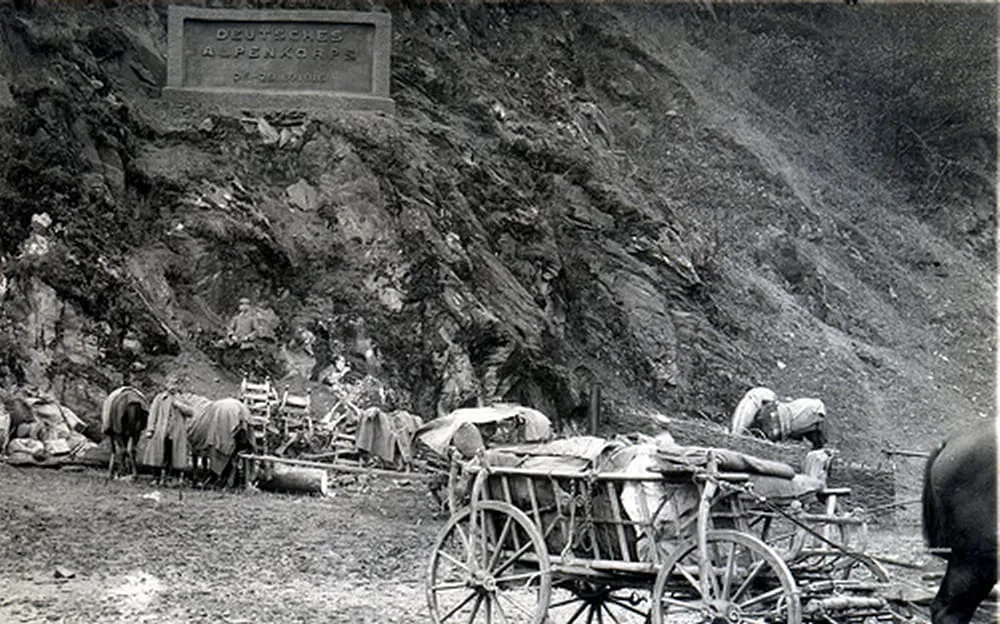
Romania’s defeat in Dobruja and the halt of its armies in Transylvania gave the Central Powers time. German and Austro-Hungarian divisions, among them the mountain Alpenkorps, were moved to Transylvania from the Western, Eastern and Italian fronts. Falkenhayn, dismissed as Chief of the General Staff on 29 August, took command on 19 September of the new German Ninth Army, formed from the troops in southern Transylvania. Arz with the First Army defended the northern sector. As early as 14–19 September the group of General Hermann von Staabs retook the Petroșani basin. The Romanians returned there at the end of the month, and the fighting for the mines went on into October.
Sibiu, 26–29 September. Falkenhayn decided first to destroy the Romanian I Corps of General Popovici, which had been standing idle south of Sibiu for weeks. The Alpenkorps of General Konrad Krafft von Dellmensingen crossed the ridges of the Cibin Mountains into the Romanians’ rear and on 26 September came out on the road in the Red Tower Pass, while three German and Austro-Hungarian divisions attacked from the north. The Romanians counter-attacked desperately to open a line of retreat, and the Second Army moved to their relief but arrived too late. On the morning of 29 September the Germans no longer found an enemy in front of them: the remnants of I Corps had fled across the mountains and through the partly open pass. According to the Austrian official history the Romanians left 3,000 prisoners and 13 guns on the battlefield.
The Geisterwald forest and Brașov, 5–9 October. After the victory the Ninth Army turned east along the Făgăraș Mountains and advanced on Brașov. The Romanian Second Army, weakened by giving up divisions, fell back. On 5 October Staabs’s corps broke through its positions in the Geisterwald forest on the western slopes of the Perșani Mountains. The battle for Brașov lasted from 7 to 9 October. The German 187th Division and the Hungarian 51st Honvéd Division forced their way into the city, and Romanian counter-attacks from the north-east were repulsed. On the night of 8–9 October the Romanians withdrew towards the passes. The victors captured 25 guns and about 200 wagons of supplies, but took few prisoners.
Retreat across the border. At the same time Prezan’s Northern Army, which had not even tried to relieve the neighbouring army, withdrew under pressure from Arz’s troops, covering in a few days a distance that in August and September had taken it weeks. By 14 October the Romanians had left almost the whole of Transylvania. On the border, however, in the fortified passes, their resistance stiffened. Falkenhayn had hoped to cross the mountains on the heels of the retreating enemy, but his attempts to break through the defences in the passes south of Brașov failed.
Losses
There are no complete figures for the losses in this campaign. The Austrian official history gives numbers only for individual battles: at Sibiu the Romanians lost 3,000 prisoners and 13 guns, and at Brașov 25 guns. The English Wikipedia states that at Brașov the Romanians left behind 1,175 prisoners. The heaviest losses were suffered by the Romanian I Corps at Sibiu and by the Second Army in the fighting in the Geisterwald forest and at Brașov. Many Romanian divisions were decimated after the retreat, and the army lost a large part of its already modest artillery.
Significance
Romania’s entry into the war caused a shock in the Central Powers. It contributed directly to Falkenhayn’s dismissal and the handing of the German command to Hindenburg and Ludendorff. Romania, however, had the best opportunity in its history and failed to use it. The Austrian official history reproaches the Romanian command for the lack of a clear main thrust, the slowness of the advance and, above all, the shifting of divisions back and forth between Transylvania and the Danube: almost a third of the army spent a month wandering between the fronts without deciding the outcome anywhere.
The Central Powers, despite their great successes, failed to encircle and destroy any of the three Romanian armies. These manned the passes and throughout October repulsed the attacks of the Ninth Army at Predeal, Bran and in the Olt valley, and at the end of October also in the Jiu valley. Only in mid-November did Falkenhayn break through the front in the Jiu valley; on 17 November he defeated the Romanians at Târgu Jiu and came out onto the plain of Wallachia. On 23 November Mackensen’s army crossed the Danube at Svishtov, and on 6 December the Central Powers took Bucharest. Transylvania became part of Romania only after the collapse of Austria-Hungary in 1918.
Spotted a mistake?Report an error
Battles and phases
(02)- 26–29 September 1916Battle of HermannstadtOn 26–29 September 1916 Falkenhayn's German 9th Army tried to encircle Romanian I Corps at Hermannstadt. It fled over the mountains, but Transylvania was lost.
- 7–9 October 1916Battle of BrașovOn 7–9 October 1916 Falkenhayn's German 9th Army drove the Romanian 2nd Army out of Brașov and the Burzenland. The Romanians fell back to the Carpathian passes.