Romania · The Entente
Ion I. C. Brătianu
Prime Minister of Romania (1914–1918 and 1918–1919), leader of the National Liberal Party
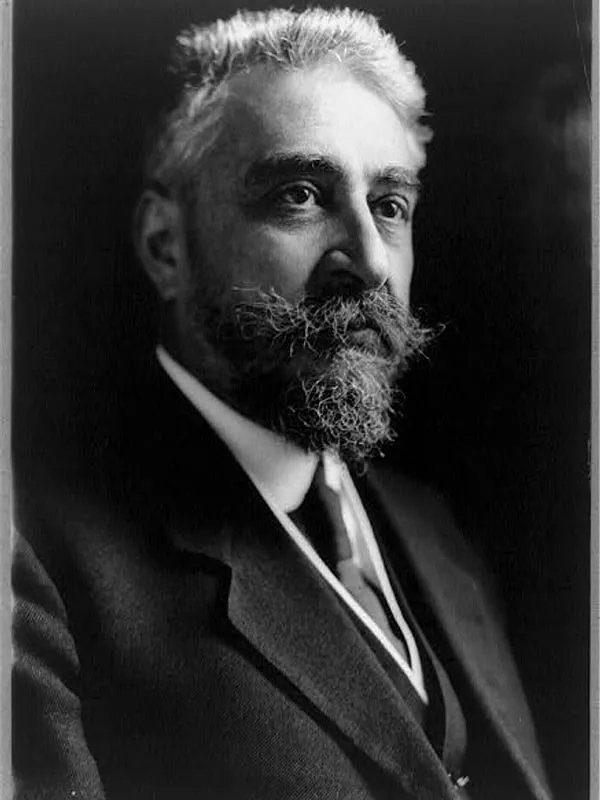
- Born:
- 1 September 1864, Ștefănești (Romania)
- Died:
- 24 November 1927, Bucharest
- Author:
- Natalia
- Photo:
- Harris & Ewing, domena publiczna, Wikimedia Commons

Ion I. C. Brătianu, called Ionel by Romanians to distinguish him from his famous father, was the most powerful Romanian politician of the first quarter of the 20th century. As prime minister in 1914–1918 he kept the country neutral for two years, negotiating simultaneously with the Entente and with the Central Powers, until in August 1916 he decided that the moment had come to reach for Transylvania. The war brought Romania first defeat and occupation, and only afterwards the union that Brătianu defended at the peace conference in Paris. To some he was the architect of Greater Romania, to others a cold gambler who took an unprepared army into the war and delayed too long. The press called him “the sphinx”, because until the last moment nobody knew what he intended.
Before the war
He was born on 1 September 1864 (20 August in the Julian calendar) on the family estate of Florica at Ștefănești, in Argeș County. He was the eldest son of Ion Brătianu, one of the founders of modern Romania, prime minister for many years and leader of the National Liberal Party. In the 1880s he studied engineering in Paris and, after returning, worked on railway construction under the famous bridge builder Anghel Saligny. In 1895 he entered parliament, later becoming minister of public works and, in 1907, after the bloodily suppressed peasant revolt, minister of the interior. In 1909 he became leader of the Liberal Party, which he led until his death, and took office as prime minister for the first time.
Brătianu understood that Romania, a country of great latifundia and poor peasants, needed reform. In 1913 he won the Liberals over to a programme of partial expropriation of the great landed estates and extension of the franchise. In January 1914 he again became prime minister. In June he received Tsar Nicholas II and the foreign minister Sergey Sazonov at Constanța. When the Russian asked what Romania would do in the event of a war between Russia and Austria-Hungary, Brătianu replied that everything depended on the circumstances. Sazonov later wrote to the Tsar that Romania would join the stronger side, the one that promised her the most.
Neutrality and bargaining (1914–1916)
On 3 August 1914, at the crown council in Sinaia, King Carol I wanted to come out on the side of Germany and Austria-Hungary. Brătianu argued that the alliance of 1883 was defensive in character and that Vienna had not warned Bucharest of the ultimatum to Serbia. The war, he said, would be long, so it was necessary to wait. The council resolved on neutrality, which the prime minister called “armed expectation”. Two months later Carol I died, and the new king, Ferdinand I, left foreign policy to the prime minister. In December 1914 all the parties agreed not to debate it in parliament, which gave Brătianu an almost free hand.
The prime minister played on two pianos. In the autumn of 1914 he concluded a secret agreement with Russia, in which Petrograd recognised Romania’s right to Transylvania in return for benevolent neutrality, and he signed two agreements with Italy on joint action, made public in January 1915. In January 1915 he obtained a loan in London. At the same time he assured Vienna and Berlin that he personally favoured the Central Powers and was held back only by public opinion, and he asked the Austro-Hungarian minister, Count Ottokar Czernin, what the price for neutrality would be. Czernin believed that Brătianu wanted “to snatch Transylvania without risk” and that concessions given for nothing made no sense. Hungary would in any case not have agreed to give up a single scrap of Transylvania.
The year 1915 was for Brătianu a time of the hardest choices. When Italy entered the war in May, Romania did not follow. Russia was retreating from Galicia and Poland, and in the autumn Bulgaria took Germany’s side. When the Entente asked for help to save Serbia, Brătianu demanded that 400,000 Allied soldiers first arrive at Salonika, and refused to help. He also held up in Romania transports of ammunition for Turkey, but once Serbia had fallen he allowed huge quantities of grain to be sold to Germany and Austria-Hungary. At rallies in Bucharest the supporters of war, the Conservative Nicolae Filipescu and Take Ionescu, accused him of inaction, while the Germanophiles accused him of breaking faith with the allies.
War (1916)
In the summer of 1916 the Brusilov offensive shattered the Austro-Hungarian armies in Volhynia and Bukovina. The Russian chief of staff, Mikhail Alekseyev, gave Brătianu to understand that this was the last opportunity, and the French threatened to withdraw their promises. The prime minister went on bargaining for another six weeks, demanding guarantees that the Allies would not make peace without satisfying Romania’s claims and refusing to declare war on Bulgaria. On 17 August, in the house of his brother Vintilă, he signed the treaty with the Entente, which promised Romania Transylvania, the Banat as far as the Tisza and most of Bukovina. On 27 August, at the crown council, he admitted that he was not sure of victory, but said that inaction would be a moral desertion that would weigh on the nation’s fate for centuries. That evening Romania declared war on Austria-Hungary.
Brătianu was also minister of war, and it was he who placed his protégé, General Dumitru Iliescu, at headquarters as deputy chief of staff and de facto commander-in-chief, passing over the popular General Alexandru Averescu, who was at odds with the Liberals. The campaign went disastrously. The fall of Turtucaia, that is Tutrakan, on 6 September caused panic in Bucharest; the army was shifted back and forth between Transylvania and the Danube; and in the autumn the troops of Falkenhayn and Mackensen occupied Wallachia. The prime minister sent ever more desperate appeals for help to Russian headquarters. On 3 December, after the defeat on the Argeș, his government left Bucharest. Czernin later heard that the fall of the capital had “completely broken” Brătianu. In mid-December the prime minister had to agree to Iliescu’s recall, and the post of chief of staff went to General Constantin Prezan, an old acquaintance from his student days in Paris.
Iași (1917)
In Iași Brătianu rebuilt his authority. In December 1916 he formed a coalition government that included Take Ionescu, and he sent the National Bank’s gold for safekeeping to Moscow, which proved one of the costliest decisions of the war. Several times he travelled to Petrograd to agree a joint offensive with the Provisional Government after the February Revolution. Most important, however, was that he carried out the 1913 programme in wartime. Following the promise of land that the King made to the soldiers in April 1917, the parliament in Iași wrote the principle of expropriating the great estates and universal suffrage into the constitution that summer. The Romanian historian Constantin Kirițescu stressed that these reforms were not a result of the Russian revolution, because the Liberals had announced them as early as 1913. Other scholars believe that without the Russian example they would not have been carried out so quickly.
The victories at Mărăști and Mărășești in the summer of 1917 raised the government’s prestige, but the October Revolution wrecked all its plans. The Russian armies in Moldavia were disintegrating and Romania was being left alone. Brătianu agreed to the armistice of Focșani, treating it as a manoeuvre to gain time. The opposition held him responsible for the defeat, and according to some accounts, when the King opened the session of parliament in December, some deputies demanded the prime minister’s resignation.
Resignation and return (1918)
In February 1918 Mackensen gave Romania four days to open negotiations. Brătianu believed that the country had to hold out until the Allied victory, but he did not want to put his own name to a peace that would undo his policy. On 8 February his cabinet resigned, and the prime minister suggested General Averescu to the King. At the crown council at the beginning of March he spoke in favour of resuming resistance, but did not want to take responsibility for it himself. The preliminary peace of Buftea was signed by the Averescu government, and the Treaty of Bucharest by the cabinet of the Germanophile Alexandru Marghiloman. The Liberals went into opposition, which saved their reputation. The government majority in the new parliament even talked of putting Brătianu’s ministers on trial for dragging the country into the war.
Germany’s defeat reversed the situation. In November Romania re-entered the war, and on 12 December 1918, after the interim government of General Coandă, Brătianu became prime minister for the fifth time. The government carried out the integration of Transylvania, Bukovina and Bessarabia, which in 1918 had proclaimed their union with Romania.
The peace conference
In January 1919 Brătianu headed the Romanian delegation in Paris. He demanded that the 1916 treaty be carried out to the letter, with the whole of the Banat and a border on the Tisza, as well as recognition of the union with Bessarabia. The great powers, with the exception of Italy, considered, however, that by making a separate peace Romania had herself broken the 1916 agreement. The Banat was divided between Romania and the Kingdom of Serbs, Croats and Slovenes, and Brătianu, a politician used to dominating in his own country, took badly to Romania being treated as a second-class state. He objected above all to the minorities protection treaty, which he regarded as interference in internal affairs. In April 1919, after the Hungarian Soviet Republic had been proclaimed, the Romanian army advanced into Hungary and in August entered Budapest, against the wishes of the great powers. Sharp notes from the Supreme Council rained down on Romania, and in September 1919 Brătianu resigned, unwilling to sign the treaties on the terms imposed. In the end the peace treaties with Austria, Bulgaria and Hungary were signed by subsequent governments.
After the war
Brătianu remained the most important politician in the country. Twice he helped General Averescu to power, only to push him aside afterwards. In 1922–1926 he governed again, passing the constitution of 1923, which settled the political system of Greater Romania for decades. During the dynastic crisis he was the chief advocate of excluding Prince Carol from the succession to the throne. In June 1927 he took office as prime minister for the last time. A month later King Ferdinand died, and on 24 November 1927 Brătianu himself died in Bucharest of an infection that had developed from an acute throat inflammation. He was buried at the family estate of Florica.
Assessment
Romanian historiography sees Brătianu above all as the creator of Greater Romania. His supporters stress that neutrality made it possible to build up the army and that hard bargaining produced a treaty Romania could invoke in Paris. Without the decision of August 1916, they say, there would have been no Alba Iulia.
Critics, among them many Western historians, point to the costs. Romania entered the war with a poorly equipped army, with a plan based on Russian help and on an offensive from Salonika that never came, and at a moment when the Brusilov offensive was already dying down. The British official historian Cyril Falls wrote that Romania rightly judged the moment to be exceptional, but delayed too long. The prime minister was also accused of filling the command with trusted men, and the Liberals of corruption and oligarchic rule. He was also an open opponent of equal rights for Jews. Historians agree on one thing: for ten years it was he, not the King, who decided the direction of Romanian policy, and the successes and failures of that period are largely to his account.
Sources
Spotted a mistake?Report an error
Mentioned in battles
(01)Often appears with
People who appear in the same events.
On the timeline
(27)1914
1915
1916
January
August
- 30
- Key eventTurkey declares war on RomaniaOn 30 August 1916 Turkey announced that, together with Germany and Bulgaria, it was declaring war on Romania. Enver Pasha was readying a corps for Dobruja.
- Romania breaks off relations with BulgariaOn the evening of 30 August 1916 the Romanian minister in Sofia asked for his passports and broke off ties. Two days later Bulgaria declared war on Romania.