Key event
February Revolution
- Category:
- Politics
- Date:
- 12 March 1917
- Author:
- Łukasz Skowroń
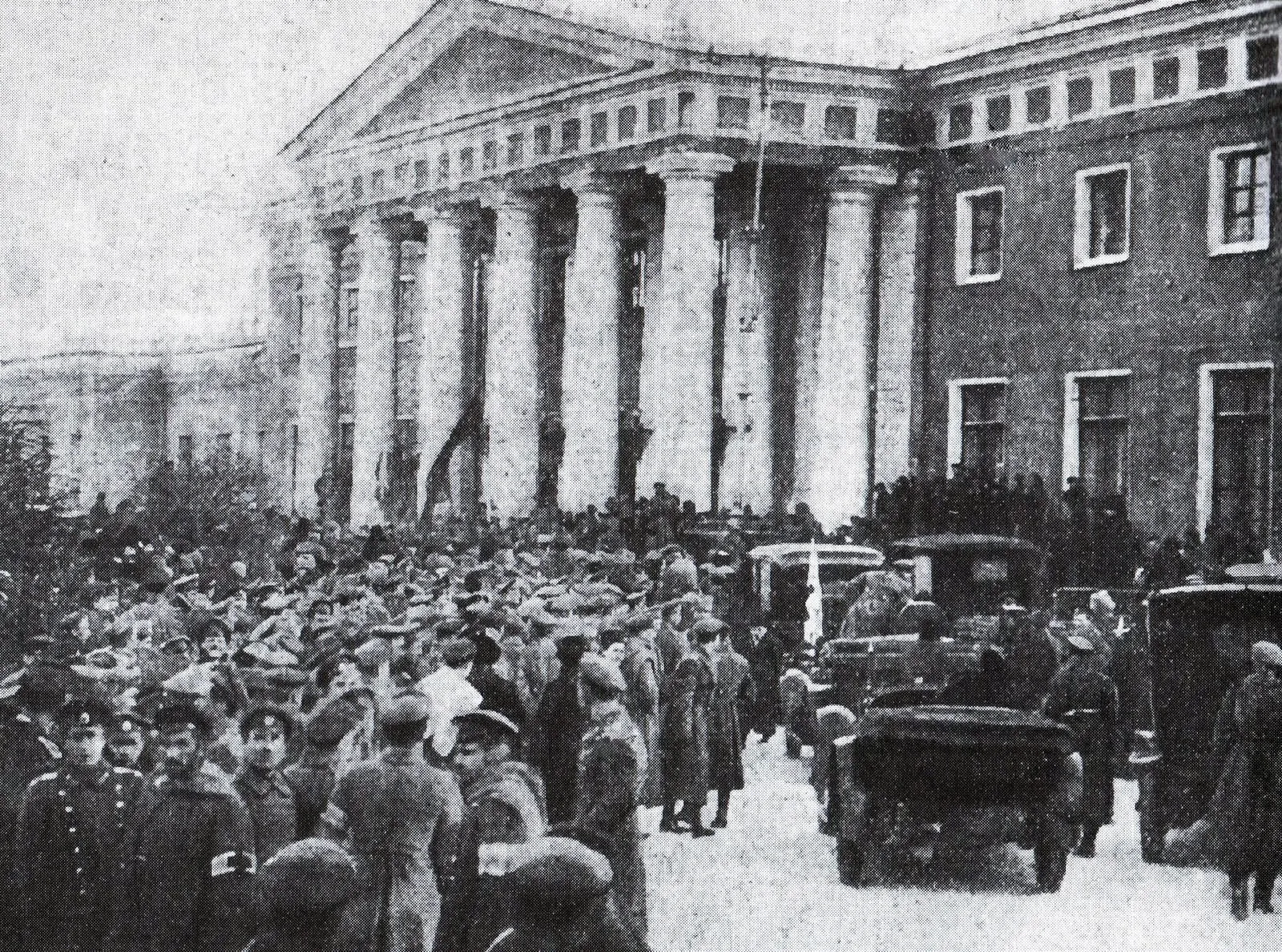
On Monday 12 March 1917 the garrison troops in Petrograd mutinied. For four days the city had been gripped by strikes and demonstrations, and the day before soldiers had fired on the crowd. Now regiment after regiment joined the workers. By evening the insurgents controlled most of the capital, had taken the arsenal, opened the prisons and set police buildings on fire. The government ceased to function, and in the Tauride Palace, the seat of the State Duma, two new centres of power arose that same day: the Provisional Committee of the Duma and the Soviet of Workers’ Deputies. This day is regarded as the decisive moment of the February Revolution.
Why “February”
Russia then used the Julian calendar, which in the 20th century lagged 13 days behind the Gregorian calendar used in almost all of Europe. By the Russian calendar the disturbances began on 23 February and the garrison mutinied on 27 February. That is why the revolution, which by our calendar broke out in March, is called the February Revolution. For the same reason the Bolshevik coup of 7 November 1917 went down in history as the October Revolution. Russia switched to the Gregorian calendar only in February 1918.
Why in 1917
After two and a half years of war Russia had lost millions of killed, wounded and prisoners, as well as Poland, Lithuania and part of Latvia. Inflation ate up wages, and failing transport meant that the cities lacked bread and fuel, although there was no shortage of grain in the country. The authority of the monarchy was undermined by constant changes of ministers and rumours about the influence of Grigori Rasputin and the “German” Empress Alexandra Feodorovna. The murder of Rasputin at the end of 1916 changed nothing. The Tsar handed the government to Nikolai Golitsyn, who did not want the office himself, and kept the interior minister Alexander Protopopov, hated by the Duma. The Allies, who in February had met at the Petrograd conference, left uneasy, but without the conviction that revolution was close.
The army decided the outcome. The Petrograd garrison numbered about 160,000 soldiers, but these were not the pre-war guardsmen, most of whom had fallen at the front. The reserve battalions of the Guards regiments consisted of recruits and convalescents who were to go to the front after a few weeks of training. They were crammed into overcrowded barracks, and there were few officers, often men who had ended up there by chance. The police numbered only about 3,500 men. The plan for the defence of the capital assumed that order would be kept by selected training detachments of the garrison. No one foresaw that they would be the first to mutiny.
The mutiny of the Volhynian Regiment
On the morning of 12 March the training detachment of the reserve battalion of the Volhynian Guards Regiment, about 600 men, refused to go out onto the streets. The day before it had been this detachment that fired on the crowd in Znamenskaya Square. The soldiers, led by Senior NCO Timofei Kirpichnikov, killed the detachment’s commander, Staff Captain Ivan Lashkevich, and left the barracks with weapons in hand. They drew in the neighbouring battalions of the Preobrazhensky and Lithuanian regiments, and soon the sappers as well. The British military attaché, General Alfred Knox, watched from a window of the Main Artillery Directorate on Liteyny Prospekt as a “great disorderly mass of soldiers” approached without officers, with red flags on their bayonets, led by a diminutive student. He was struck by the “uncanny silence” of the scene. The French ambassador Maurice Paléologue saw from his window how on the Liteyny Bridge a crowd with red banners met an approaching regiment. He expected a clash, but the two groups merged.
On Liteyny the soldiers joined the striking workers. The crowd took the Arsenal and handed out rifles, set fire to the District Court building and moved on to the Vyborg Side, to the capital’s largest prison, Kresty. All the prisoners were released, including members of the workers’ group of the Central War Industries Committee, arrested in January. During the day police stations, the building of the Okhrana, gendarmerie headquarters and the office of the military governor were also burning. Policemen who resisted, and often also those who surrendered, were killed on the spot. According to Russian calculations about 25,000 soldiers had joined the uprising in the morning, and by evening already about 67,000.
Last attempts at resistance
General Sergey Khabalov, commander of the Petrograd Military District, assembled a detachment of companies that were still loyal and placed it under Colonel Alexander Kutepov, an officer of the Preobrazhensky Regiment who was in the capital on leave. Kutepov fought the insurgents for several hours around Liteyny, but his soldiers melted away into the crowd and by evening the detachment had ceased to exist. Khabalov shut himself up with the remnants of his troops in the Admiralty building. After midnight he telegraphed General Headquarters that he had been unable to carry out the order to restore order, because most units had defected “one after another”. The war minister, General Mikhail Belyaev, declared a state of siege in the city, but there was no longer anyone to enforce it.
The government met in the evening in the Mariinsky Palace. The ministers persuaded Protopopov to declare himself ill and leave, and asked the Tsar to dismiss the whole cabinet. Paléologue, who together with the British ambassador George Buchanan visited the foreign minister Nikolai Pokrovsky that day, heard from him: “The Emperor is blind!”. In the evening, as the two ambassadors were returning home, a crowd of agitated soldiers surrounded their car outside the barracks of the Pavlovsky Regiment. They were rescued by a mounted NCO who recognised the ambassadors and raised a cheer for France and England.
Two centres of power
In the morning the Duma deputies learned that the Tsar had suspended its sittings until April. At about two in the afternoon thousands of soldiers and workers appeared outside the Tauride Palace, led by activists freed from Kresty. The deputies did not want to defy the decree openly, so they met in a “private conference”. At it they set up the Provisional Committee of Members of the State Duma “for the restoration of order in the capital and for contacts with persons and institutions”. Mikhail Rodzianko became chairman of the Provisional Committee of the Duma, and its members were mainly leaders of the liberal Progressive Bloc, among them the Kadet leader Pavel Milyukov, and from the left the Menshevik Nikolay Chkheidze and the Trudovik Alexander Kerensky. Milyukov later wrote that the Duma’s participation gave the street and military movement “a centre, a banner and a slogan” and thus turned a mutiny into a revolution.
In another wing of the same palace socialist activists, mainly Mensheviks, set up the Provisional Executive Committee of the Soviet of Workers’ Deputies and called on the factories and regiments to elect their representatives. In the evening, at about nine, the first session of the Petrograd Soviet of Workers’ and Soldiers’ Deputies met, with soldiers sitting in it from the very first moment. Chkheidze became chairman, and one of the deputy chairmen was Kerensky, the only man who belonged to both bodies. Thus was born the “dual power” that was to shape Russia’s fate over the following months.
Late in the evening Rodzianko persuaded the Tsar’s brother, Grand Duke Michael Alexandrovich, to ask the Emperor by telegraph to appoint at once a new government headed by Prince Georgy Lvov. Nicholas II replied through General Mikhail Alekseyev that he would settle the question of the government after his return to Tsarskoye Selo. He decided to send a punitive expedition from the front against the capital under General Nikolai Ivanov and to return to Tsarskoye Selo himself. His train left Mogilev in the early hours of 13 March. That day the insurgents arrested the first dignitary of the old regime, the chairman of the State Council, Ivan Shcheglovitov. During the night the Provisional Committee of the Duma announced that, as the government had stepped down, it was taking power.
Casualties
The revolution was later called “bloodless”, but it was not. According to figures compiled by Zemgor, the organisation of the zemstvos and towns, about 1,440 people were killed or wounded on the streets of Petrograd in the days of the upheaval, including more than 850 soldiers. Some authors give this number as the number killed. Russian historians estimate that about 300 people died. Most of the casualties fell on 11 and 12 March.
What next
On the evening of 12 March nothing was yet decided. The Tsar had an army of many millions behind him, and no one knew how it would receive the news from the capital. The next day, however, the last points of resistance fell, the Peter and Paul Fortress and the Admiralty, and the mutiny spread to Moscow and the fleet’s bases. The generals at the front, instead of suppressing the revolution, advised the Tsar to abdicate. Three days later Nicholas II renounced the throne and power passed to the Provisional Government.
Remember the articles you have read? Only in this browser; nothing is sent anywhere.How it works
Read ·
A voice from the front
“Half past one. Armed workers, soldiers, people are marching along the Sergievskaya past our windows. […] A strange crowd goes past the windows: soldiers without rifles, workers with sabres, youths and even children of seven or eight, with bayonets, with dirks. […] Not a single horse in the streets; only roaring motor cars, like porcupines: bristling all round with the shining needles of bayonets.”
Translated · Original (ru)
1½ ч. дня. Идут по Сергиевской мимо наших окон вооруженные рабочие, солдаты, народ. […] Мимо окон идет странная толпа: солдаты без винтовок, рабочие с шашками, подростки и даже дети от 7-8 лет, со штыками, с кортиками. […] На улицах ни одной лошади, ни в каком виде; только гудящие автомобили, похожие на дикобразов: торчат кругом щетиной блестящие иглы штыков.
Spotted a mistake?Report an error
Meanwhile
(04)Elsewhere in the same days.
- 12 March 1917 · Western FrontLondon conference on the commandOn 12–13 March 1917 in London the British and French clarified the Calais agreement. Haig was to keep Nivelle informed but did not hand over his armies.
- 11 March 1917 · Middle EastBritish take BaghdadOn 11 March 1917 Maude's troops entered Baghdad unopposed, the Turks having left it overnight. It was Britain's greatest success in the Middle East so far.
- 11 March 1917 · Balkan FrontStart of the March offensive in MacedoniaOn 11 March 1917 the French 76th Division attacked between Lakes Ohrid and Prespa to outflank the enemy at Bitola. The attack at once bogged down in snow.
- 14 March 1917 · Western FrontMain German retreat to the Hindenburg Line beginsOn 14 March 1917 the British noticed the Germans leaving their trenches in St Pierre Vaast Wood. The main retreat to the Hindenburg Line was beginning.
Related events
(04)The same battle, people or subject.
- 15 March 1917 · PoliticsFormation of the Provisional GovernmentOn 15 March 1917 Milyukov announced the Provisional Government, led by Prince Lvov. It arose from an agreement of the Duma Committee and the Petrograd Soviet.
- 15 March 1917 · PoliticsAbdication of Nicholas IILate on 15 March 1917 at Pskov Nicholas II gave up the throne for himself and his son in favour of his brother Michael. The next day Michael declined the crown.
- 9 April 1917 · PoliticsProvisional Government on war aimsOn 9 April 1917 the Provisional Government declared that free Russia's aim was not conquest but a lasting peace. It was a compromise with the Petrograd Soviet.
- 3 May 1917 · PoliticsApril CrisisOn 3 May 1917 the papers published Milyukov's note on war to victory. Soldiers marched on the seat of government and Petrograd saw two days of demonstrations.