Russia · The Entente
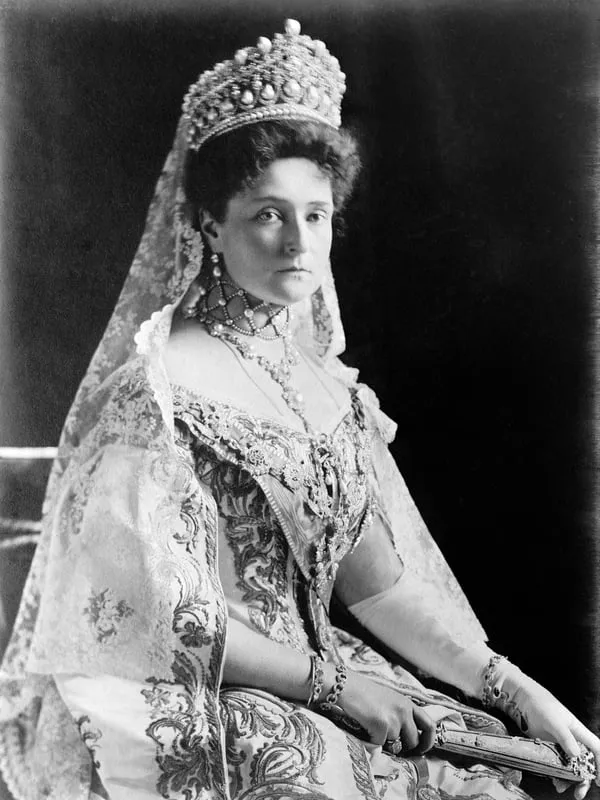
Alexandra Feodorovna
Empress of Russia (1894–1917), wife and adviser of Nicholas II, in 1915–1916 in effect overseeing appointments to office in the capital
- Born:
- 6 June 1872, Darmstadt (Grand Duchy of Hesse)
- Died:
- 17 July 1918, Yekaterinburg
- Author:
- Łukasz Skowroń
- Photo:
- Boasson and Eggler, St. Petersburg, domena publiczna, Wikimedia Commons

Alexandra Feodorovna, born Princess Alix of Hesse, was the wife of Emperor Nicholas II and the last Empress of Russia. For twenty years of marriage she lived apart from the court and society, absorbed in her family and her son’s illness. During the war her role suddenly grew. When in September 1915 the Tsar left for General Headquarters, it was she in Petrograd who suggested names of ministers to him and pressed for the removal of people she considered enemies of autocracy and of her “Friend”, Grigori Rasputin. She also worked as a nursing sister in a hospital for the wounded. Born in Germany, in Russia she was regarded as “the German woman” and suspected of treason, although there is no evidence whatever of this. After the revolution she shared her husband’s fate until her death at the hands of the Bolsheviks in Yekaterinburg.
Before the war
She was born on 6 June 1872 in Darmstadt, the sixth child of Grand Duke Louis IV of Hesse and Alice, daughter of Britain’s Queen Victoria. In childhood she lost her mother and a younger sister to diphtheria, and was brought up largely under her grandmother’s eye, in an English and Protestant spirit. Her elder sister Elisabeth married Grand Duke Sergei Alexandrovich, uncle of the future Tsar. Nicholas fell in love with Alix while still heir to the throne, but for a long time she could not bring herself to change her faith. They became engaged in the spring of 1894. After the sudden death of Alexander III in November she converted to Orthodoxy, took the name Alexandra Feodorovna, and on 26 November 1894 married the new emperor. Russians said she had come “behind a coffin”.
She embraced Orthodoxy with the zeal of a convert and an inclination to mysticism. At court she was shy and stiff, she disliked the St Petersburg aristocracy, and it repaid her with dislike. The couple had four daughters, and only in 1904 the longed-for son, Alexei. The boy inherited haemophilia from his mother, a disease that through Queen Victoria’s daughters reached several European courts. The heir’s illness was a state secret, and the Empress, tormented by guilt, shut herself away ever more in Tsarskoye Selo. From 1905 she sought help from the Siberian “elder” Rasputin, and after the crisis at Spała in the autumn of 1912 she came to see him as the only man who could save her son. She regarded all reports of his debauchery as slander and wrote that saints are always calumniated. She was also deeply convinced that the simple people loved the Tsar, and that only the corrupt elites of the capital opposed autocracy.
Nursing sister
She greeted the outbreak of war with despair, but as an ardent Russian patriot. She had long detested her cousin, Emperor Wilhelm II. From the first weeks she devoted herself to charitable work: in Petrograd workshops and depots under her patronage sewed linen and prepared dressings for soldiers, and palaces and buildings in Tsarskoye Selo were turned into military hospitals. Together with her two eldest daughters, Olga and Tatiana, she took a nursing course with the surgeon Vera Gedroits and in the autumn of 1914 received a nursing sister’s certificate. She assisted at operations and changed dressings, and in the evenings wrote to her husband about the wounded. She also maintained hospital trains at her own expense. Her work in the hospitals was not appreciated. The aristocracy thought it unworthy of an empress, and the belief spread in society that “the German woman” favoured the enemy. Her brother, Grand Duke Ernest Louis of Hesse, served in the German army, which fed the rumours. In the capital it was even said that she was hiding him in the cellars of the palace.
Power in the capital
When in the summer of 1915 the army was retreating from Poland, Alexandra urged her husband to take command himself. She distrusted the popular Grand Duke Nicholas Nikolaevich, who was an enemy of Rasputin, and suspected him of political ambitions. The Tsar went to Mogilev against the wishes of most of his ministers, and the Empress stayed in Tsarskoye Selo as his eyes and ears. Grand Duke Alexander Mikhailovich later wrote that, since the Emperor had gone off to the war, his wife ruled in his stead.
In almost daily letters to “Nicky”, written in English, she assessed ministers, generals and bishops and proposed successors. Some 1,700 letters and telegrams of the couple survive from this period. She urged her husband to be firm like Peter the Great and Ivan the Terrible, rejected the demands of the Duma and reminded him that he was an autocrat by the will of God. Within some fifteen months Russia had three prime ministers, several ministers of the interior and three ministers of war. People she recommended were appointed to office, such as the prime minister Boris Stürmer, and those she considered enemies left their posts, such as the war minister Alexei Polivanov, who was removed in March 1916, or the foreign minister Sergei Sazonov, dismissed in July. In the autumn of 1916 she defended the interior minister Alexander Protopopov, whom the Tsar already wanted to dismiss. She also passed Rasputin’s opinions on to her husband in military matters. Nicholas II did not always listen to her. In November 1916, despite her opposition, he dismissed Stürmer.
Rumours of a “court party” undermined the authority of the monarchy. When on 14 November 1916 the Kadet leader Pavel Milyukov quoted in the Duma a Viennese newspaper about the “court party grouped around the young Tsarina”, copies of his speech, supplemented with the charge that the Empress was a spy, circulated throughout the country. Warnings came from within the dynasty. Her sister Elisabeth, widow of Grand Duke Sergei, assassinated in 1905, asked her to send Rasputin away and was turned out. The interventions of several grand dukes ended in the same way. Her mother-in-law, the Dowager Empress Maria Feodorovna, with whom Alexandra had never been close, was by then living far from the capital, in Kiev. After Rasputin’s murder during the night of 29–30 December 1916 Alexandra demanded the punishment of the perpetrators and shut herself and her husband away in an even narrower circle.
Revolution and death
When revolution broke out in March 1917, the Tsar was in Mogilev and the Empress in Tsarskoye Selo with her children ill with measles. She learnt of her husband’s abdication from Grand Duke Paul. On 21 March General Lavr Kornilov informed her on behalf of the Provisional Government that she was under arrest, and the next day the former Tsar was brought under guard to the Alexander Palace. Alexander Kerensky, who as minister of justice questioned her about her influence on government, reportedly concluded that she was telling the truth when she said that as a wife she had simply advised her husband. Contrary to suspicions, no evidence of her contacts with the Germans was found either.
In August 1917 the family was taken to Tobolsk. After the Bolshevik coup the conditions of captivity worsened, and in the spring of 1918 she was moved together with her husband and her daughter Maria to Yekaterinburg, where on 30 April they were placed in the Ipatiev House. During the night of 16–17 July 1918 the Bolsheviks murdered the whole family together with four companions. Alexandra was 46. Her remains were identified in the 1990s, among other things by comparing DNA with Prince Philip, her sister’s grandson, and in 1998 they were buried in the Peter and Paul Cathedral in St Petersburg. The Russian Orthodox Church recognised her as a saint in 2000.
Assessment
Most historians judge the Empress’s wartime role severely. She is accused of strengthening her husband’s aversion to any concessions, of making appointments to the most important offices depend on loyalty to herself and Rasputin, and of compromising the dynasty by her presence close to power. The British historian Bernard Pares, one of the first to make use of her letters, considered her the main author of the monarchy’s fall. Others, such as Dominic Lieven, point out that the final decisions were made by the Tsar, and that the fall was decided above all by the war and the supply crisis. They also stress that the accusations of treason were completely unfounded and that Alexandra was a sincere Russian patriot. Biographers draw attention to her isolation, her illness and her fear for her son, which help to explain her dependence on Rasputin. For the Orthodox Church she is a martyr; for many historians, an example of how attachment to autocracy and a family tragedy combined to bring down a three-hundred-year-old dynasty.
Sources
Spotted a mistake?Report an error
Often appears with
People who appear in the same events.