Key event
Abdication of Nicholas II
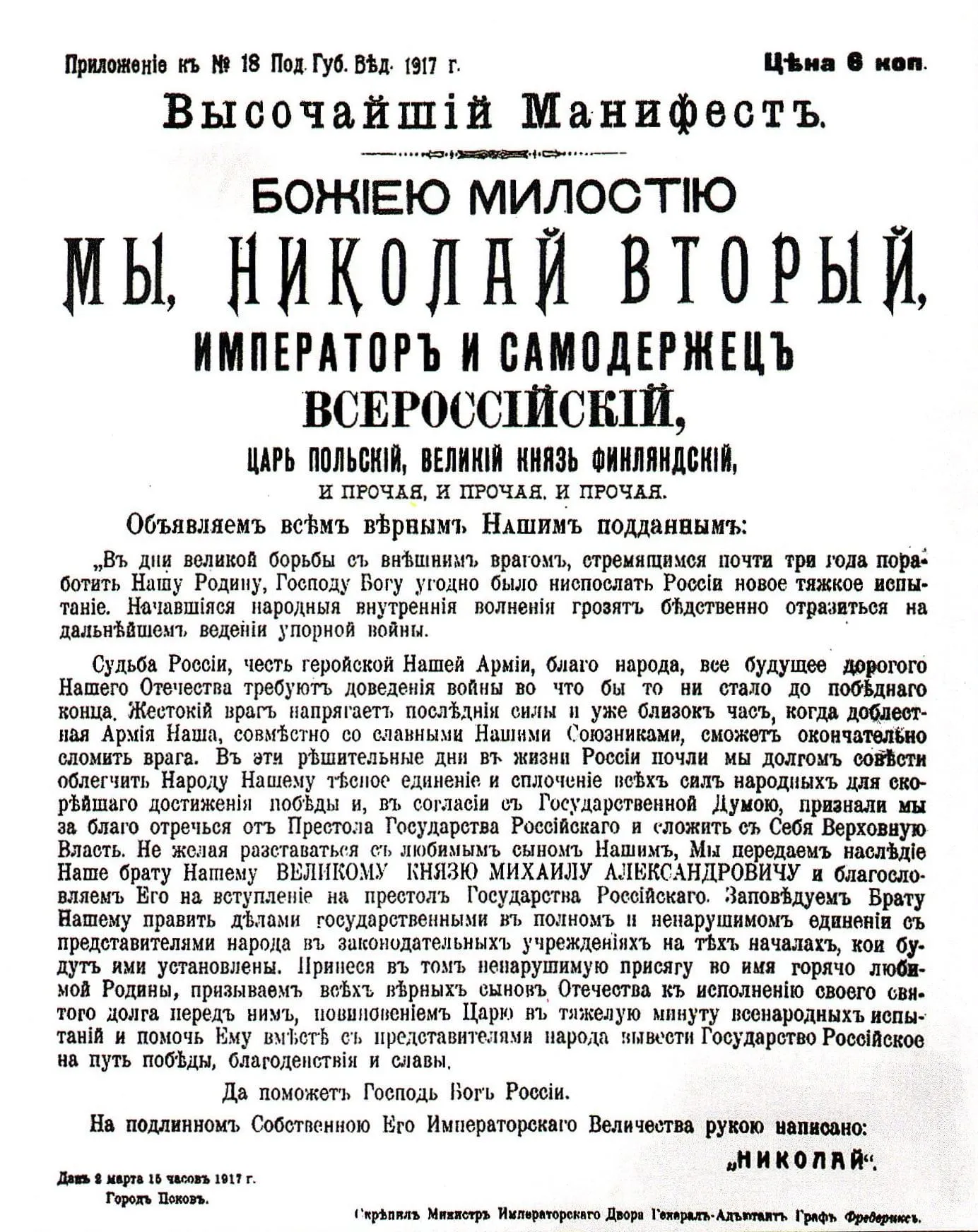
On 15 March 1917 (2 March in the Julian calendar), in the saloon car of the imperial train standing at the station in Pskov, Tsar Nicholas II signed an act renouncing the throne. He abdicated for himself and for his twelve-year-old son, the heir to the throne, Alexei, and handed the crown to his younger brother, Grand Duke Michael Alexandrovich. He was brought to this decision not by revolutionaries but by his own generals, who had concluded that only the Emperor’s departure would make it possible to master the revolution in the capital and go on fighting the war. He handed the act to two envoys of the Duma before midnight. The next day Michael declined the crown, and the more than three-hundred-year rule of the Romanov dynasty came to an end.
The train that never arrived
When the garrison in Petrograd mutinied on 12 March, the Tsar was at General Headquarters in Mogilev. He had been Commander-in-Chief since September 1915 and spent most of his time there. He rejected requests to appoint a government enjoying the confidence of the Duma, sent a detachment under General Nikolai Ivanov against the capital and decided to return to his family at Tsarskoye Selo, where his children were ill with measles. The imperial trains left Mogilev early in the morning of 13 March. That day in Petrograd the Golitsyn government fell, and the deputy Alexander Bublikov, who had taken over the Ministry of Communications on behalf of the Provisional Committee of the Duma, could follow every movement of the Tsar’s train.
During the night of 13–14 March, at the station of Malaya Vishera, about 160 kilometres from the capital, the Tsar was told that the stations further on were in the hands of mutinous soldiers. The train turned back and by a roundabout route, through Dno, headed for Pskov, where the headquarters of the Northern Front was located. It arrived there on 14 March at about seven in the evening. The Tsar noted in his diary that it had not been possible to get through to Tsarskoye Selo, and added: “Shame and disgrace!” Cut off from General Headquarters and from his family, for nearly two days he had only intermittent telegraph communication.
Pskov, the night of 14–15 March
No guard of honour was waiting on the platform. The front commander, General Nikolai Ruzsky, who made no secret of regarding autocracy as an anachronism, arrived only after a few minutes. After supper he spent many hours trying to persuade the Tsar that he must appoint a government responsible to the Duma. Nicholas replied that he did not understand the role of a constitutional monarch who reigns but does not rule. At 10.20 p.m. a draft manifesto on such a government arrived from General Headquarters, prepared by the Chief of Staff to the Commander-in-Chief, General Mikhail Alekseyev. It was clear that Alekseyev fully supported Ruzsky. Late in the night the Tsar gave way: he agreed to a government responsible to the chambers and by telegraph halted Ivanov’s detachment.
It was already too late. At about half past three in the morning Ruzsky spoke by telegraph with the President of the Duma, Mikhail Rodzianko. Under pressure from the Petrograd Soviet and losing control of events, Rodzianko declared that the concession came too late. “Hatred of the dynasty has reached its utmost limits,” he said. In his view the only way out was abdication in favour of the son, with Michael as regent. The record of this conversation reached Mogilev in the morning. On his own initiative Alekseyev circulated it to the front commanders, asking for their urgent opinion, and worded his telegram so that in practice it suggested the answer.
The generals say: abdication
Before eleven in the morning of 15 March Ruzsky laid before the Tsar the record of the conversation with Rodzianko and Alekseyev’s telegram. At about two in the afternoon the replies began to reach General Headquarters. The Tsar’s uncle, Grand Duke Nicholas Nikolaevich, commanding in the Caucasus, begged him “on his knees” to renounce the crown to save Russia and the dynasty. The front commanders came out in favour of abdication: General Alexei Evert of the Western Front, General Aleksei Brusilov of the South-Western Front and General Vladimir Sakharov of the Romanian Front. The last of these called the Duma a “gang of brigands”, but added that “sobbing” he had to accept abdication as the least painful way out. The commander of the Black Sea Fleet, Admiral Alexander Kolchak, did not reply. In the evening the commander of the Baltic Fleet, Admiral Adrian Nepenin, joined the generals.
Between two and three in the afternoon Ruzsky entered the saloon car with the front’s chief of staff, General Yuri Danilov, and General Sergei Savich. The Tsar asked both of them for their frank opinion. Both spoke in favour of abdication. According to Savich’s account, there was silence. Nicholas stood up and said: “I have decided. I renounce the throne.” He crossed himself, and the generals with him. At about three o’clock the Tsar signed two short telegrams, to Rodzianko and to Alekseyev, on his abdication in favour of his son with Michael as regent.
A change of mind
Ruzsky wanted to send the telegrams at once, but the suite, taken aback by the haste, persuaded the Tsar to hold them back until the Duma’s envoys arrived. In the course of the afternoon Nicholas changed his mind. According to accounts from the Tsar’s entourage, he asked his personal physician, Professor Sergei Fyodorov, whether his son, who suffered from haemophilia, could be cured. He was told that “there are no miracles” and that after an abdication the boy would most probably have to live with the regent’s family. The Tsar did not want to be parted from his child. He decided to renounce the throne on his son’s behalf as well, although the law of succession made no provision for abdicating on behalf of someone else.
At 9.45 p.m. the envoys of the Provisional Committee of the Duma arrived in Pskov: the Octobrist leader Alexander Guchkov and the monarchist Vasily Shulgin. Guchkov described the situation in the capital: no one had prepared the movement, it had broken out spontaneously and threatened to spread to the front, and the only salvation could be abdication in favour of the heir. The Tsar replied that he had already made his decision in the afternoon, but now, not wishing to be parted from his son, he was renouncing the throne in favour of his brother. Taken by surprise, the deputies accepted this after a brief consultation. Nicholas did not sign the draft they had brought, but his own text, prepared at General Headquarters, to which a sentence about the new emperor’s oath had been added.
The act of 15 March
At about 11.40 p.m. the Tsar handed Guchkov and Shulgin the act, signed in pencil and countersigned by the Minister of the Court, Count Vladimir Frederiks. The document explained that “internal popular disturbances” threatened to have a disastrous effect on the further conduct of the “stubborn war”, which must end in victory. Therefore, “in agreement with the State Duma”, the Emperor renounced the throne and laid down the supreme power. “Not wishing to be parted from our beloved son”, he passed the inheritance to his brother and charged him to govern “in full and inviolable unity with the representatives of the people” on the principles they would establish. The act closed with the appeal: “May the Lord God help Russia!”
The act was marked with the time 3 p.m., so that it would not appear that the Tsar had renounced the throne under pressure from the deputies. That same evening Nicholas also signed two decrees, dated to an even earlier hour so that they would have the force of acts issued by the lawful monarch: appointing Prince Georgy Lvov Chairman of the Council of Ministers and Grand Duke Nicholas Nikolaevich Commander-in-Chief. On leaving the carriage Guchkov called out to those gathered on the platform: “Russians, bare your heads, cross yourselves, pray to God… Russia is setting out on a new road!” The Tsar wrote in his diary that at one in the morning he left Pskov “with a heavy feeling of what I have lived through”, and summed up: “All around is treason, cowardice and deceit!”
Michael’s refusal
In Petrograd the news that the throne was to go to Michael rather than to the under-age Alexei under a regency caused panic. Workers among whom Guchkov tried, early on 16 March, to raise a cheer for “Emperor Michael” nearly lynched him. The Petrograd Soviet demanded a republic. Rodzianko asked General Headquarters to stop the publication of the manifesto in the army. On the morning of 16 March members of the Duma Committee and of the new government met Michael in his flat on Millionnaya Street. The majority, including Rodzianko and Alexander Kerensky, advised him to refuse. Only Pavel Milyukov and Guchkov argued that without a monarch the government would be a “frail boat” on a stormy sea. When Rodzianko admitted that he could not guarantee the Grand Duke’s safety, Michael signed an act declaring that he would assume power only if that was the will of the people expressed through the Constituent Assembly, and until then he called on citizens to obey the Provisional Government.
On the evening of 16 March Nicholas, by now back in Mogilev, learned of his brother’s decision from Alekseyev. Both acts were published together on 17 March. Russia ceased to be a monarchy, although formally its system of government was yet to be determined by the Constituent Assembly. A few days later the Provisional Government decided to deprive the former Tsar of his liberty and take him to Tsarskoye Selo. Abroad the abdication was received with relief and hope: in London and Paris it was hoped that a free Russia would wage the war more vigorously than a discredited court, and in Berlin and Vienna that the revolution would weaken her army.
Remember the articles you have read? Only in this browser; nothing is sent anywhere.How it works
Read ·
A voice from the front
“So that is settled with Mikhail Alexandrovich. On parting, Kerensky firmly shook the Grand Duke’s hand: “You are a noble man.” […] On the Nevsky they were breaking off the eagles everywhere, very peacefully, the yard-keepers swept up, the boys dragged the wings about, shouting: “Here’s a little wing for dinner.””
Translated · Original (ru)
Итак, с Мих. Алек. выяснено. Керенский на прощанье, крепко пожал вел. князю руку: «вы благородный человек». […] На Невском сламывали отовсюду орлов, очень мирно, дворники подметали, мальчишки крылья таскали, крича: «вот крылышко на обед».
Spotted a mistake?Report an error
Meanwhile
(04)Elsewhere in the same days.
- 14 March 1917 · Middle EastAction at MushahidaOn 14 March 1917 the British 7th Division drove the Turkish rearguard from Mushahida station on the Baghdad–Samarra line. The Black Watch lost 43% of its men.
- 14 March 1917 · Asia and the PacificChina breaks off relations with GermanyOn 14 March 1917 China broke off relations with Germany in protest against submarine warfare. The German minister Paul von Hintze was given his passports.
- 14 March 1917 · Western FrontMain German retreat to the Hindenburg Line beginsOn 14 March 1917 the British noticed the Germans leaving their trenches in St Pierre Vaast Wood. The main retreat to the Hindenburg Line was beginning.
- 16 March 1917 · War at seaSinking of the raider LeopardOn 16 March 1917 north of the Shetlands the cruiser Achilles and the steamer Dundee sank the raider Leopard, formerly Yarrowdale. None of over 300 men survived.
Related events
(04)The same battle, people or subject.
- 12 March 1917 · PoliticsFebruary RevolutionOn 12 March 1917 the Petrograd garrison joined the strikers. Tsarist rule in the capital collapsed; a Duma Committee and a Soviet arose in the Tauride Palace.
- 3 May 1917 · PoliticsApril CrisisOn 3 May 1917 the papers published Milyukov's note on war to victory. Soldiers marched on the seat of government and Petrograd saw two days of demonstrations.
- 18 May 1917 · PoliticsFirst coalition government in RussiaOn 18 May 1917 a coalition government with six socialists was formed in Petrograd. Kerensky took the war ministry and Tereshchenko foreign affairs.
- 22 March 1917 · DiplomacyRecognition of the Provisional GovernmentOn 22 March 1917 the United States became the first to officially recognise Russia's Provisional Government. Britain, France and Italy followed two days later.