Russian Empire · The Entente
Alexei Evert
Commander of the 4th Army (1914–1915), Commander-in-Chief of the armies of the Western Front (1915–1917), General of Infantry
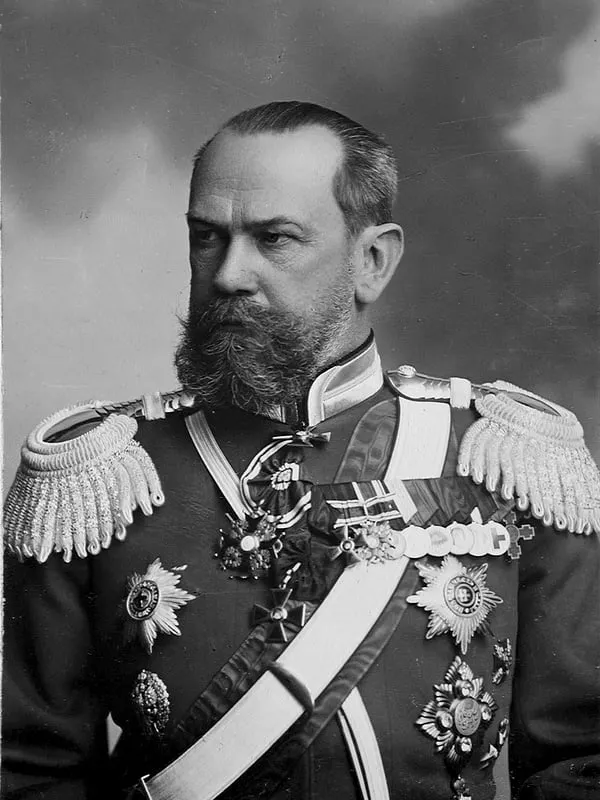
- Born:
- 4 March 1857, Moscow (Russian Empire)
- Died:
- 12 November 1918, Mozhaysk
- Author:
- Natalia
- Photo:
- Фотография ателье Буллы, domena publiczna, Wikimedia Commons

Alexei Yermolayevich Evert was one of the most senior commanders of the Russian army throughout the war. In 1914, after the defeat at Kraśnik, he took over the 4th Army and led it to victories over the Austrians near Lublin and over the Germans on the Vistula. From the autumn of 1915 he commanded the Western Front for a year and a half, the strongest of all the Russian fronts, which guarded the road to Minsk and Moscow. In 1916 his troops were to deliver the main blow of the summer campaign, but Evert, disheartened by the bloody defeat at Lake Naroch, kept putting off the attack, and when he finally struck at Baranovichi he suffered heavy losses for no gain. For many contemporaries he became a symbol of a wasted chance of victory. In March 1917 he came out in favour of the Tsar’s abdication, and soon afterwards he lost his post. He was killed during the Red Terror.
Before the war
He was born on 4 March 1857 (20 February in the Julian calendar) in Moscow, into a noble family of German origin and of the Orthodox faith. He graduated from the Moscow Cadet Corps and the Alexander Military School, served in the Life Guards Volhynia Regiment and as a young officer fought in the war with Turkey of 1877–1878. In 1882 he graduated from the General Staff Academy and for the next twenty years was a staff officer. He spent several years on the staff of the Warsaw Military District and was chief of staff of a division and of successive corps. In the war with Japan he was quartermaster-general of the field staff of the commander-in-chief and then chief of staff of the 1st Manchurian Army. For this he received the Golden Weapon for Bravery.
After the war he briefly headed the Main Staff, from 1908 he commanded the XIII Army Corps, and in 1911 he was promoted to General of Infantry. From 1912 he commanded the Irkutsk Military District and was ataman of the Transbaikal Cossack Host. He was regarded as a conscientious, hard-working and pedantic staff officer, an excellent organiser of the rear. General Vladimir Sokolov, who knew him from the 4th Army, later wrote that as a commander Evert “remained a chief of staff” and did not distinguish himself in any way as a strategist, but was a “modest and noble” man.
1914: the 4th Army
At the beginning of the war Evert was to take over the 10th Army then being formed, but at the end of August, after the lost Battle of Kraśnik, he replaced General Anton Salza at the head of the 4th Army. The army was then falling back towards Lublin before the troops of Viktor Dankl. Evert received fresh corps, including the Guards Corps and the Grenadier Corps, and in September went over to the attack. In the Battle of Tarnawka the Guards regiments broke through the defences of the Austro-Hungarian 1st Army, which contributed to the Austrian defeat in the whole Battle of Galicia.
In the autumn the 4th Army was moved to the middle Vistula. In the Battle of the Vistula River it held bridgeheads at Ivangorod and Kozienice, and in the second half of October crossed the Vistula in greater strength than the Austrians had expected and advanced towards Radom. In November, together with the 9th Army, it attacked towards Silesia and Kraków, but at Kraków the offensive broke down, and in December the front settled on the Nida.
1915: the retreat
In 1915 Evert’s army stood on the left bank of the Vistula, and after the breakthrough at Gorlice it had to retreat together with the rest of the front. In May it fought at Opatów, in June it delivered a successful blow against the flank of the Austro-Hungarian forces on the Tanew, and in July its corps fought in the Lublin region, in the Second Battle of Kraśnik, and at Sienno and Ivangorod. In the summer the 4th Army withdrew across the Kingdom of Poland behind the Bug.
At the end of August the Russian forces in the north were divided into two fronts. When General Mikhail Alekseyev became chief of staff to the Tsar, who had just assumed supreme command, Evert took over the Western Front from him. At the beginning of September he faced his first test: German cavalry broke through a gap north of Vilna and came out in the rear of the Russian armies. In the Battle of Vilna Evert managed to move corps quickly enough to close the breach between Dvinsk and Smorgon, although Vilna itself had to be given up. For this manoeuvre, and for the fighting at Opatów and Lublin, he received the Order of St George, 3rd class, in October, and in December the rank of adjutant general to the Tsar. The front stabilised on the line of Lakes Naroch and Drisvyaty and on through Smorgon.
1916: Naroch and Baranovichi
For the 1916 campaign Evert proposed a powerful thrust by his front towards Vilna, supported by secondary attacks on other sectors. Events in the west changed the plan. When the Germans attacked at Verdun, the French asked the Russians for help, and in March the Western and Northern Fronts attacked at Lake Naroch. The offensive began on the eve of the thaw, was poorly reconnoitred and badly prepared by the artillery, and command of the army was given at the last moment to a general who knew neither the troops nor the terrain. By the end of March the Russians had lost almost 80,000 men and gained scraps of ground. The French Slavist Jules Legras, who studied the documents of the operation, wrote of Evert’s endless orders and counter-orders and his pompous, empty phrases.
At the conference in Mogilev on 14 April 1916 Alekseyev entrusted the Western Front with the main summer blow towards Vilna, with the largest reserves and the heavy artillery. Evert and the commander of the Northern Front, General Alexei Kuropatkin, however, doubted that the German positions could be broken. Only General Aleksei Brusilov insisted that his front could attack. On 4 June it was the Brusilov Offensive that broke the Austro-Hungarian front in Volhynia, while Evert, who was to attack on 10–11 June, postponed the date several times. He persuaded Stavka that it would be better to attack not at Vilna but at Baranovichi, closer to Brusilov, which required several weeks of fresh preparations. Brusilov asked Alekseyev in vain to force him to attack. The Tsar, who trusted Evert, put no pressure on him.
The Battle of Baranovichi began only on 2 July. The new 4th Army, despite a several-fold superiority in infantry, took only parts of the first lines, and after a week of assaults, on 9 July, Evert halted the attack. The Russians lost about 80,000 men. Stavka shifted the main effort to Brusilov’s front, and in August briefly placed under Evert the armies attacking towards Kovel, but there too the breakthrough failed. Brusilov wrote in his memoirs that all Russia was then cursing the names of Evert and Kuropatkin, and of Evert, with his German name, people even said that he was a traitor. The charge of treason was groundless, but the burden of the defeat stayed with him for ever.
1917: abdication and dismissal
In planning the 1917 campaign Evert again proposed a great offensive towards Vilna, but under Stavka’s plan his front was to make only a secondary attack. When the February Revolution broke out in March, Alekseyev asked the front commanders for their views on abdication. Evert, a loyal monarchist, delayed his reply until Generals Nikolai Ruzsky and Brusilov had spoken. Then he telegraphed the Tsar that the army “in its present composition” could not be relied upon to suppress the unrest, and as a “boundlessly devoted” subject implored him to take the decision that alone could end the revolution and save Russia from anarchy. On 15 March 1917 Nicholas II renounced the throne.
The new authorities, however, did not trust the general. An emissary of the War Minister Alexander Guchkov came to the front headquarters in Minsk and persuaded him to leave. On 24 March (11 March in the Julian calendar) Evert was removed from command, and at the beginning of April he was discharged from the army with the right to wear uniform and a pension. According to the recollections of an acquaintance, he later said that he and the other front commanders had “betrayed the Tsar” and that they would all pay for it with their lives.
After the war
He settled in Smolensk, and in February 1918, during the German offensive, moved to Moscow. The Cheka arrested him in mid-February. After his release, which his wife obtained, he went to Vereya near Moscow. After the Red Terror was proclaimed, in September 1918, he was arrested again and held in the prison at Mozhaysk. According to the most widely accepted version, based on his widow’s account, on 12 November 1918 he was shot by his escort on the way from the prison to the station, allegedly while trying to escape. He was buried in Mozhaysk, and the grave has not survived. Some publications give another version, according to which he survived and died peacefully in 1926, but it has no firm basis in the sources.
Assessment
Most historians, Russian and Western alike, judge Evert unequivocally critically. He is portrayed as a good organiser and staff officer who was not equal to commanding a front: he was indecisive, overestimated the strength of the Germans and after the defeat at Lake Naroch lost faith that a breakthrough was possible. His delays in the summer of 1916 are considered one of the main reasons why the only great success of the Russian army, the Brusilov Offensive, failed to bring a decision. Some authors defend him, however, pointing out that Stavka did not organise co-operation between the fronts, that the German defences north of Polesie were much stronger than the Austrian ones in Volhynia, and that heavy responsibility also lies with Alekseyev, who allowed front commanders to change plans. Until 1916, moreover, Evert was regarded as one of the best Russian commanders, and his army played an important part in the victories of the autumn of 1914 and in saving the front at Vilna in 1915.
Sources
Spotted a mistake?Report an error
Commanded in battles
(07)- 23 August – 11 September 1914Battle of GaliciaEastern Front
- 7–9 September 1914Battle of TarnawkaEastern Front
- 15–28 November 1914Battle of KrakówEastern Front
- 1–19 July 1915Second Battle of KraśnikEastern Front
- 9 September – 2 October 1915Battle of VilnaEastern Front
- 18 March – 28 April 1916Lake Naroch offensiveEastern Front
- 2–9 July 1916Battle of BaranovichiEastern Front
Mentioned in battles
(03)Often appears with
People who appear in the same events.