Austria-Hungary · The Central Powers
Viktor Dankl
Commander of the First Army (1914–1915), of the defence of Tyrol (1915–1916) and of the Eleventh Army (1916), colonel general
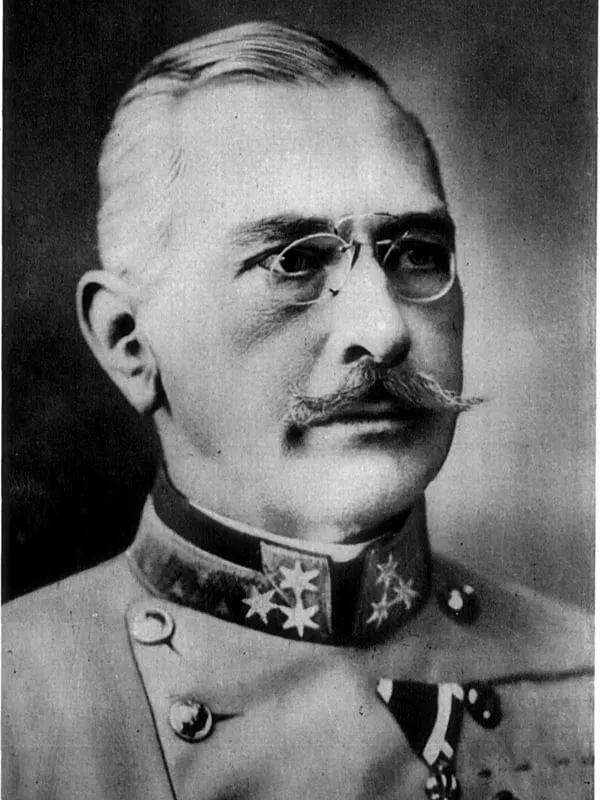
- Born:
- 18 September 1854, Udine (Venetia)
- Died:
- 8 January 1941, Innsbruck
- Author:
- Natalia
- Photo:
- The New York Times Current History (1914), domena publiczna, Wikimedia Commons

Viktor Dankl, from 1918 Count Dankl von Krasnik, was the commander who gave the Austro-Hungarian army its first victory of the First World War. On 23–25 August 1914 his First Army defeated the Russians at Kraśnik in the Lublin region, and the monarchy, just humiliated by defeat in Serbia, hailed him as a hero. The success proved short-lived, for two weeks later Dankl’s army had to fall back from Lublin. In 1915, with very modest forces, he halted the Italians on the Tyrolean border, and in 1916 his Eleventh Army opened the great offensive from Tyrol. After it, amid quarrels with his superiors and because of illness, he left the front and held no further command until the end of the war.
Before the war
He was born on 18 September 1854 in Udine, then still in Austrian Venetia. His father, an army captain from Vienna, settled with his family on retirement in Gorizia and then in Trieste, where Viktor attended German grammar schools. At fourteen he entered the cadet school at St. Pölten, and from 1870 he studied at the Military Academy in Wiener Neustadt. He served in the cavalry, in a dragoon regiment at Enns, and after graduating from the war school in Vienna, from 1880 on the General Staff. In the 1890s he also served in an uhlan regiment stationed in Galicia. In 1899 he became head of the central bureau of the General Staff, in 1903 a major general, and in 1907 commander of the 36th Infantry Division in Zagreb.
In 1912 he took over XIV Corps in Innsbruck, one of the best in the army, made up largely of Tyrolean mountain riflemen. He was also responsible for the defence of Tyrol and Vorarlberg. In October that year he was promoted to general of cavalry. He was regarded as a careful and well-prepared officer, but also a hot-tempered one.
1914: Kraśnik
After mobilisation Dankl was given command of the First Army of three corps, concentrated in the fork of the Vistula and the San. In the plan of the Chief of the General Staff, Franz Conrad von Hötzendorf, his army, together with the Fourth Army under General Moritz von Auffenberg, was to strike north from Galicia, deep into the Kingdom of Poland, and crush the Russians before they had assembled all their forces. On 23 August, in the hills and ravines south of Kraśnik, his troops collided with the Russian Fourth Army under General Anton Salza. The Austro-Hungarians had numerical superiority and from the outset pushed back the enemy’s right wing. On 25 August Dankl concentrated his attack on the left wing, and the Russians, threatened with envelopment, began to withdraw towards Lublin.
According to historians’ estimates, the Battle of Kraśnik cost about 15,000 Austro-Hungarian and about 25,000 Russian soldiers, including 6,000 prisoners. Salza lost his command. Soon afterwards Auffenberg won the Battle of Komarów, and for a moment Vienna believed that the campaign in the east was going according to plan. Dankl became a hero of the press and one of the most popular generals of the monarchy.
He followed the Russians north, and at the turn of August and September his leading units stood on the hills before Lublin. They got no further. The high command was focused on the east, where the Russians were routing the Austro-Hungarian armies near Lviv, and Conrad turned Auffenberg’s army back south. A gap opened between the First and Fourth Armies. From 5 September the reinforced Russian Fourth and Ninth Armies, including the Guards Corps, attacked Dankl’s front. According to Austrian accounts, around 7 September his three corps faced seven Russian ones. His only support was the German Landwehr Corps of General Remus von Woyrsch. In the Battle of Tarnawka the Russians broke through the defence, and on 9 September Dankl began to fall back towards the San. Two days later Conrad ordered the whole front to retreat, and the Battle of Galicia was lost.
The Vistula, the Nida and Kraków
At the turn of September and October the First Army was moved across the Vistula to the Kielce region, to strike at the middle Vistula together with the German Ninth Army. Dankl’s troops reached Sandomierz, and in the Battle of Warsaw and Dęblin they took over from the Germans the sector near the fortress of Ivangorod. His army included the 1st Regiment of the Polish Legions of Józef Piłsudski, which on 22–26 October fought the hard Battle of Laski and Anielin. On 22 October Dankl went over to the attack, but the Russians crossed the Vistula in much greater strength and threatened his flanks. On 27 October the Central Powers broke off the battle, and the First Army fell back towards Kraków.
In November Dankl stood on the defensive on the Kraków-Częstochowa Upland and took part in the Battle of Kraków. Later his army took up positions on the Nida, north-east of Kraków, where the front froze for the winter and spring of 1915. The weight of the fighting then shifted to the Carpathians.
The defence of Tyrol
On 23 May 1915 Italy declared war on Austria-Hungary. Dankl, who knew Tyrol from his time in command of XIV Corps, took charge of the defence of the province, with headquarters in Bolzano. His position was difficult. The Tyrolean regiments were fighting in Galicia, and the border was defended by forts, units of the Landsturm and volunteer rifle companies, often made up of the old and the very young. Even so the Italians, who advanced cautiously, nowhere broke through the defence before reinforcements arrived from other fronts. Dankl held the high-mountain front from the Swiss border to the Dolomites throughout 1915.
1916: the offensive from Tyrol
In March 1916 the command of the defence of Tyrol was turned into the Eleventh Army, and Dankl, promoted to colonel general in May, became its commander. It was to break through the front in the first wave of the offensive planned by Conrad, while the Third Army under General Hermann Kövess was to exploit the breakthrough and descend to the Venetian plain. Deep snow postponed the attack several times, until Dankl finally fixed it for 15 May. After the start of the Trentino offensive his troops took the first Italian lines within a few days, occupied the Vallarsa valley and the Col Santo massif near Pasubio, and at the end of May the troops of the offensive entered Arsiero and Asiago. In the Battle of Asiago, however, the strength ran out for the last ridges before the plain. The Eleventh Army’s attacks on Monte Giove collapsed on 12 and 13 June, and after the start of the Brusilov Offensive divisions had to be given up to the east.
The command of Archduke Eugen’s army group and the high command reproached Dankl for being too slow. Dankl preferred not to attack before bringing up his artillery and, according to some accounts, ignored demands to hurry. At odds with his superiors and ill, in mid-June he asked to be relieved. On 17 June 1916 General Franz Rohr took over command of the Eleventh Army, and the army’s chief of staff was also recalled. The Austrian official history later concluded that the whole attack had been too methodical, but how much of the blame lay with Dankl himself remains a matter of dispute.
The guard and titles
After a serious throat operation Dankl did not return to the front. From January 1917 he was captain of one of the bodyguards at the Viennese court, and in 1918 for a time he commanded all the bodyguards. In July Conrad, recalled from the front, was appointed their honorary colonel. On 17 August 1917 Emperor Charles I awarded him, for Kraśnik, the Commander’s Cross of the Military Order of Maria Theresa, which carried the hereditary title of baron. In 1918, in the last days of the monarchy, Dankl received the title of count and the predicate “von Krasnik”. He was one of the few Austrians born commoners to rise to the rank of count. A few months later the Republic of Austria abolished the nobility.
After the war
From 1 December 1918 he was retired and lived in Innsbruck. He received an honorary doctorate from the university there and was patron of the building of the heroes’ monument in Vienna’s Burgtor. In 1925, after Conrad’s death, he became chancellor of the Military Order of Maria Theresa, and he also chaired the legitimist association Reichsbund der Österreicher, which called for the return of the Habsburgs. To the end of his life he remained an opponent of Nazism and of the Anschluss, the annexation of Austria by Germany in 1938. He died in Innsbruck on 8 January 1941 and was buried in the cemetery by the basilica in Wilten.
Assessment
In the interwar period Dankl was revered in Austria. The 1925 yearbook of the association of former Kaiserjäger called him “a truly Austrian soldierly nature” and a general “always revered by his soldiers”. He himself contributed to an apologetic picture of the imperial army by writing prefaces to memoirs and books about the war. Historians judge him more calmly. Kraśnik was a real, if small, victory, won over a weaker enemy and quickly undone by defeats on other sectors of the front for which Dankl was not responsible. Before Lublin and Ivangorod his army, isolated and too weak, had to give way to Russian superiority.
His defence of Tyrol in 1915 is the most highly regarded, when with improvised units he held off a much larger army. Dankl’s role in the 1916 offensive raises more doubts. Critics see him as an over-cautious commander who wasted the momentum of the first days. His defenders point out that in the mountains fortified ridges could not be taken without artillery, and that the offensive was in any case cut short by the catastrophe on the Eastern Front. Conrad is said to have counted him among the best generals of the Austro-Hungarian army.
Sources
Spotted a mistake?Report an error
Commanded in battles
(07)- 23 August – 11 September 1914Battle of GaliciaEastern Front
- 23–25 August 1914Battle of KraśnikEastern Front
- 7–9 September 1914Battle of TarnawkaEastern Front
- 28 September – 8 November 1914Battle of Warsaw and DęblinEastern Front
- 15–28 November 1914Battle of KrakówEastern Front
- 8 July 1915 – 18 April 1916Fighting on the Col di LanaItalian Front
- 15 May – 25 June 1916Battle of AsiagoItalian Front
Mentioned in battles
(01)Often appears with
People who appear in the same events.