Poland · The Polish cause
Józef Piłsudski
Commander of the First Brigade of the Polish Legions (1914–1916), from 11 November 1918 commander-in-chief of the Polish Army and Provisional Chief of State
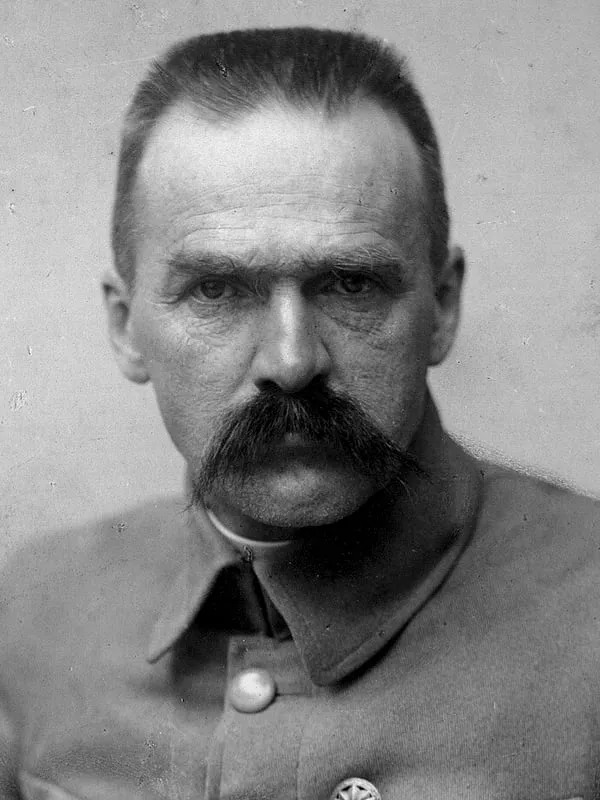
- Born:
- 5 December 1867, Zułów in the Vilna region (Russian Empire)
- Died:
- 12 May 1935, Warsaw
- Author:
- Łukasz Skowroń
- Photo:
- autor nieznany, domena publiczna, Wikimedia Commons

Józef Piłsudski entered the Great War as the leader of a handful of Galician riflemen and emerged from it as the head of the reviving Polish state. For years he had foreseen a conflict between the partitioning powers, and he staked his hopes on Austria-Hungary against Russia, which he regarded as the main enemy. On 6 August 1914 his company marched into the Kingdom of Poland, and for the next two years he commanded the First Brigade of the Polish Legions, fighting alongside the Central Powers. When Russia was falling apart and Germany wanted a Polish army without a Polish government, he broke with the Germans and in July 1917 ended up in a German prison. Freed in the days of the revolution in Germany, he returned to Warsaw on 10 November 1918 and within a few days took control of the army and the state. To some he was the creator of independence; to others, especially the National Democrats, he was a man who had backed the wrong horse and only by good luck managed to change mounts in time. The dispute accompanied him to the end of his life and continues to this day.
Before the war
He was born on 5 December 1867 at Zułów near Vilna, into an impoverished noble family brought up in the cult of the January Uprising. In 1887, as a medical student, he was drawn into a plot against the life of Tsar Alexander III, in which he himself played a marginal role while his brother Bronisław was more deeply involved, and he was exiled to Siberia for five years. After his return he joined the Polish Socialist Party and edited its illegal paper Robotnik; arrested in Łódź in 1900, he escaped a year later from a St Petersburg asylum by feigning mental illness. During the Russo-Japanese War he travelled to Tokyo to seek Japanese help for a Polish uprising, and then created the Combat Organisation of the PPS, which attacked Russian officials and money transports. Its most famous action was the raid on a train at Bezdany in 1908, in which he took part in person.
From then on Piłsudski was less and less a socialist and more and more a soldier. He believed that war between the partitioning powers was inevitable and that the Poles must then have an army of their own. In 1908 the clandestine Union of Active Struggle was founded in Lviv on his initiative, and on its basis the open riflemen’s associations in Galicia, of which he became commander-in-chief. On 1 December 1912 the Temporary Commission of Confederated Independence Parties, which brought together parties from Galicia and the Kingdom, appointed him commander of all Polish military forces. The Austrian authorities tolerated these organisations because they might prove useful against Russia. Research by historians, especially Ryszard Świętek, has shown that from 1906 Piłsudski and his men cooperated with Austrian military intelligence, passing on information about the Russian army in return for freedom of action. According to accounts cited by his biographers, at a lecture in Paris early in 1914 he predicted that Russia would be beaten by the Central Powers, and they in turn would succumb to France and Britain. The authenticity of this prophecy is sometimes questioned, but it captures his later calculation well.
1914: the Cadre Company and the Legions
When war broke out, Piłsudski did not wait for Vienna. On 3 August, on the Błonia meadow in Kraków, the First Cadre Company, 144 men strong, was formed from his riflemen, and on 6 August, the day Austria-Hungary declared war on Russia, the company crossed the border of the Kingdom of Poland near Michałowice. Piłsudski announced that he was acting on the orders of a secret National Government in Warsaw, which in reality did not exist. This fiction was meant to make him independent of the Galician politicians and to sweep the Kingdom into an uprising. The calculation failed. On 12 August the riflemen entered Kielce, but the inhabitants received them coolly, many with hostility. The Poles of the Russian partition did not want to fight on Austria’s side, and soon Grand Duke Nicholas promised them in his proclamation the unification of the Polish lands under the Tsar’s sceptre.
The Austrian command, disappointed, demanded that the rifle units be disbanded or incorporated into the Austro-Hungarian army. Rescue came from the Supreme National Committee, set up in Kraków on 16 August, which took under its patronage the Polish Legions then being formed. Piłsudski gave up the National Government and kept command of his riflemen, who became the 1st Regiment of the Legions. The Legions, however, were headed by generals sent from the Austro-Hungarian army, and the Galician politicians, mostly ill-disposed towards him, prevented him from becoming their commander. At the same time Piłsudski built up his own base. In the autumn of 1914 the Polish Military Organisation began to operate on his initiative, an underground network that in time covered the whole Russian partition, including Warsaw.
In the autumn his regiment fought as part of Viktor Dankl’s army. On 22–26 October the legionaries fought a heavy action at Laski and Anielin in front of Dęblin, one of the episodes of the Battle of Warsaw and Dęblin. As the Austrians fell back, Piłsudski with three battalions marched by night between the withdrawing Austrian troops and the advancing Russians, through Ulina Mała, and reached Kraków around 11 November. A few days later, according to some accounts on 15 November, he was promoted to brigadier. In the Battle of Limanowa his units covered the flank of the Austrian counter-offensive and fought a night action at Marcinkowice, and on 19 December at Nowy Sącz they were reorganised as the First Brigade of the Polish Legions. The brigade fought its hardest battle of 1914, at Łowczówek, without him, because the commander had gone to Vienna for political talks.
1915–1916: the First Brigade
Throughout the winter of 1914–1915 the First Brigade held the line of the Nida. In May, after the breakthrough at Gorlice, it moved north, and in July it arrived near Urzędów, where Piłsudski had his quarters during the Second Battle of Kraśnik. At the turn of July and August, in the battle of Jastków near Lublin, the brigade together with the 4th Infantry Regiment broke through the positions of a Russian Siberian division. The Legions were now moving deep into the Kingdom, but few volunteers came forward. In the second half of August, a dozen or so days after the Germans took Warsaw, Piłsudski came to the city, incorporated a POW battalion into the First Brigade and halted recruitment to the Legions. From then on he pursued a policy his opponents called “bidding”: a Polish soldier in return for a Polish government and a Polish army under Polish command. Yet in a letter of 2 September 1915 to the president of the Supreme National Committee he wrote that for him the political aim of the war was the union of Galicia and the Kingdom within the Habsburg monarchy, because no better terms for Poland could be obtained in this war.
In the autumn of 1915 the Legions were transferred to Volhynia, where they spent the winter and spring on the line of the Styr. On 4–6 July 1916, during the Brusilov offensive, the First and Third Brigades held off the attack of a Russian corps for three days in the Battle of Kostiuchnówka, losing about 2,000 killed and wounded. For Piłsudski this was the moment to force the issue. In July he demanded his release from service in protest against the treatment of the Legions as auxiliary units, and many officers followed him with requests to resign. The Austrians sent him on leave and accepted his resignation only at the end of September, when the Legions were renamed the Polish Auxiliary Corps.
The Council of State and the oath crisis
The conduct of the Legions, and above all the need for Polish recruits, led the Central Powers to issue the Act of 5 November 1916, which announced the creation of a Kingdom of Poland. Piłsudski did not reject it, but as early as 6 November he warned that creating an army without a Polish government made no sense. On 12 December he came to Warsaw, greeted by a crowd at the Vienna Station, and joined the Provisional Council of State, where as military rapporteur he headed the Military Commission. On 16 January 1917 he placed the POW under the Council. He soon began to clash, however, with the Governor-General Hans von Beseler over the shape of the Polish Armed Force, which was to be subordinate to Germany.
The February Revolution and the proclamation of the Russian Provisional Government, which recognised the right of the Poles to an independent state, changed his calculation. According to his biographers he concluded that Tsarist Russia had ceased to be a threat and that Germany was becoming the main obstacle to the Polish cause. On 2 July he left the Council, and on 9 and 11 July, during the oath crisis, the legionaries of the First and Third Brigades at his call refused to swear an oath of “brotherhood in arms” with Germany and Austria-Hungary. Those who refused were interned at Beniaminów and Szczypiorno, and the soldiers from Galicia were drafted into the Austro-Hungarian army. On the night of 21–22 July the Germans arrested Piłsudski and his chief of staff, Kazimierz Sosnkowski. By way of Danzig, Spandau and Wesel he was taken to the fortress of Magdeburg, where he spent more than a year in a wooden cottage in the courtyard of the citadel.
Prison did more for his legend than two years of fighting. Opponents among the National Democrats had until then portrayed him as a tool of the Central Powers; now he became a victim of the Germans and a symbol of the struggle against all three partitioning powers. The Polish Military Organisation, led in his absence by Edward Rydz-Śmigły, went deeper underground and turned against the occupiers. The Polish left demanded his release when in the autumn of 1917 the occupiers set up the Regency Council. The Germans still tried to obtain from the prisoner an undertaking that he would not act against them, but Piłsudski refused.
November 1918
When revolution broke out in Germany, Piłsudski and Sosnkowski were released on 8 November. The matter was handled by the diplomat Count Harry Kessler, and both prisoners were taken from Magdeburg to Berlin and from there by special train to Warsaw. They arrived on the morning of 10 November. Only a dozen or so people greeted them at the station, but that same day Piłsudski spoke with the regents, and that day or the next morning he agreed with representatives of the German soldiers’ council that the garrison would lay down its arms in return for a safe return home. The disarming of the Germans began that evening. On 11 November the Regency Council handed him supreme command of the army, and on 14 November it dissolved itself and handed him full power. Ignacy Daszyński’s Lublin government placed itself at his disposal.
Within a few days Piłsudski had become the arbiter of Polish politics. On 16 November he notified the powers of the creation of an independent Polish state, on 18 November he put Jędrzej Moraczewski at the head of the government, and on 22 November he made himself by decree Provisional Chief of State until a Legislative Sejm was convened. In the east the Poles were already fighting for Lviv, and in the following weeks for other borders too. The Entente powers regarded him with distrust. They recognised Roman Dmowski’s Polish National Committee in Paris and treated the former ally of the Central Powers and his socialist government with reserve. An understanding came only in January 1919, when Ignacy Jan Paderewski became prime minister.
After the war
As Chief of State and Commander-in-Chief Piłsudski led Poland in the wars over its borders, above all in the Polish–Soviet War. In March 1920 he was made a marshal, and in August his counter-stroke from the Wieprz decided the victory in the Battle of Warsaw. In December 1922 he handed power to the first president, and in 1923 he withdrew from public life to Sulejówek. In May 1926 he returned to power through a coup d’état and until his death, as minister of military affairs, inspector general of the armed forces and twice prime minister, was the de facto leader of the state. He died on 12 May 1935 at the Belweder. He was buried in a crypt at Wawel, and his heart in the Rasos cemetery in Vilnius.
Assessment
Piłsudski’s role in 1914–1918 was disputed from the start, because his supporters wrote of it as a carefully considered plan and his opponents as a chain of accidents. Biographers from his camp, such as Wacław Jędrzejewicz, presented the Legions as the nucleus of the Polish army and proof that the Poles had won independence by their own efforts. Critical historians, led by Andrzej Garlicki, pointed out that until 1916 Piłsudski played almost exclusively the Austrian card, that the Legions were a small force of little military significance, and that independence was brought above all by the simultaneous defeat of all three partitioning powers. Much of the image of “the Commandant as prophet” was built by his camp’s propaganda after 1926.
Modern scholars, such as Włodzimierz Suleja and Tomasz Nałęcz, look for a middle way. They concede that Piłsudski did not foresee the course of the war as precisely as the legend claimed, and that for a long time he counted on an Austro-Polish solution. They stress, however, that by his armed action in 1914 he put the Polish question on the international stage, that in 1917 he knew how to break in time with the losing side, and that imprisonment at Magdeburg gave him an authority that no other Polish politician possessed. It was this authority, together with the officers of the Legions and the POW loyal to him, that allowed him in November 1918 to concentrate within a few days a power that no one else in Warsaw was able to hold. The dispute between the Piłsudskiites and the National Democrats over who had served independence better, the legionaries or the diplomats in Paris, lasted throughout the interwar years and revives to this day at each anniversary of 11 November.
Sources
Spotted a mistake?Report an error
Commanded in battles
(03)Mentioned in battles
(09)Often appears with
People who appear in the same events.
On the timeline
(53)The 40 most important of 53 events. All tagged “Józef Piłsudski” (26) →
1908
1910
1912
1914
1915
1916
1917
1918
October
November
- 28
- Polish women get the voteOn 28 November 1918 Piłsudski signed the electoral law for the Legislative Sejm. The vote went to every citizen aged 21 and over "without distinction of sex".
- Voluntary Legion of WomenOn 28 November 1918 the first volunteers in Lviv joined Aleksandra Zagórska's women's militia. In December it became the Voluntary Legion of Women.