1914: The Battle of Galicia
Battle of Kraśnik
- Dates:
- 23–25 August 1914
- Front:
- Eastern Front
- Location:
- Area around Kraśnik, Lublin region, Kingdom of PolandOn the battle map →
- Sides:
- Austria-HungaryViktor DanklRussian EmpireAnton Saltza
- Result:
- Austro-Hungarian victory. The Russian 4th Army withdrew towards Lublin, and its commander was dismissed.
- Author:
- Natalia
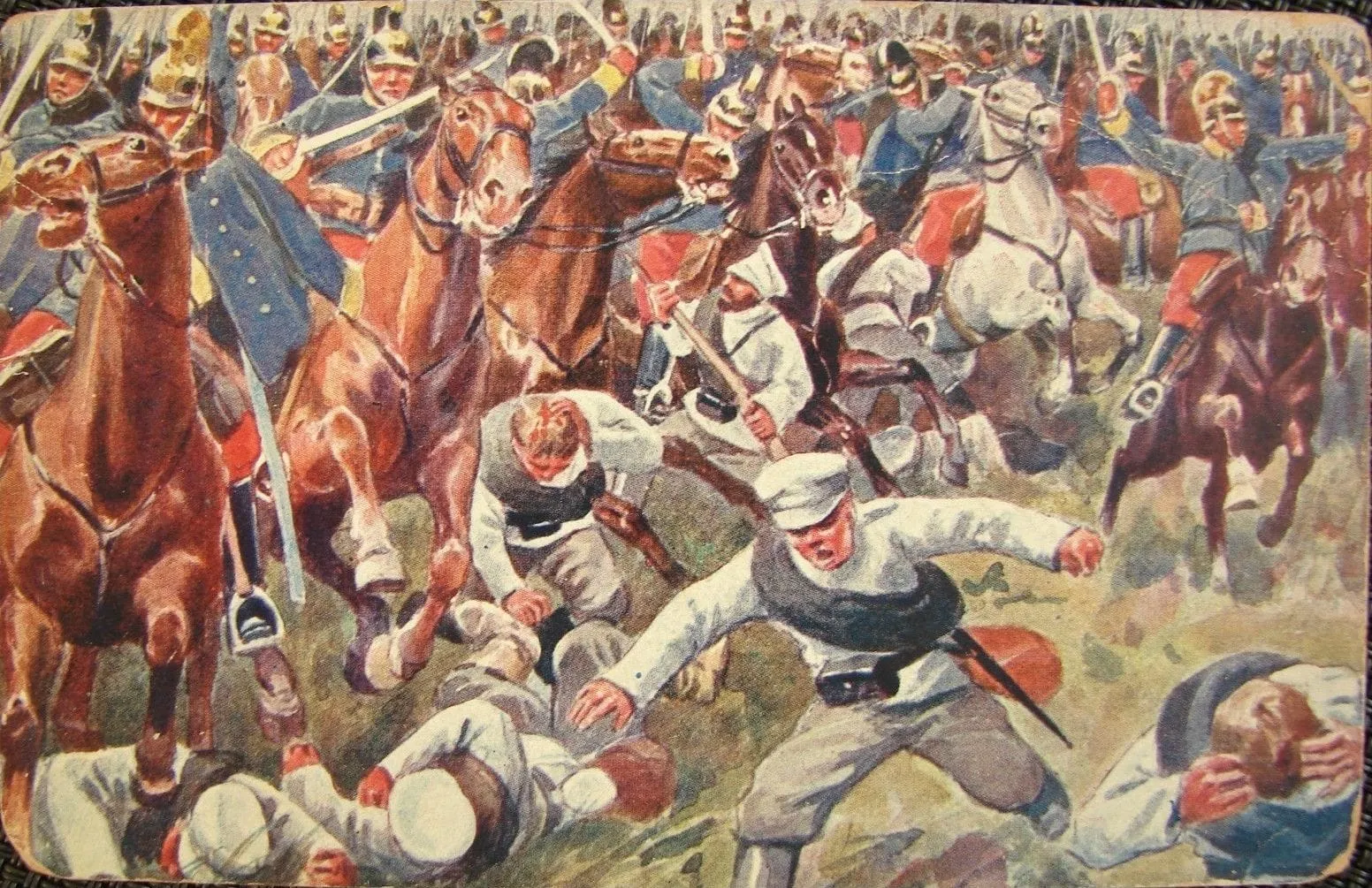
The Battle of Kraśnik was fought on 23–25 August 1914 in the southern Lublin region, on land then belonging to the Kingdom of Poland under Russian rule. The Austro-Hungarian First Army of General Viktor Dankl clashed there with the Russian Fourth Army of General Anton Saltza and after three days of fighting forced it to retreat towards Lublin. It was the first engagement of the great Battle of Galicia and the first victory of the Austro-Hungarian army in the First World War. It was fought on Polish soil, and Poles served in the ranks of both armies.
Name and dates
The name comes from Kraśnik, a small district town in the Lublin governorate, which Dankl’s troops reached on 25 August. The fighting, however, took place on a broad front several dozen kilometres long, from the Vistula near Annopol and Zaklików (PL) to the area of Frampol (PL) and Janów Lubelski (PL). The Austrians called it the Schlacht von Kraśnik, and Dankl later received the title of count with the territorial designation “von Krasnik”. In Russian and Soviet historiography the fighting forms part of the Lublin–Kholm operation, the first stage of the Battle of Galicia. By the Julian calendar then in use in Russia it lasted from 10 to 12 August.
We use the dates 23–25 August, given by most accounts. The Austro-Hungarian troops had set out from the Tanew as early as 21 August, but the first two days were taken up with crossing the wooded and marshy belt along the river. Some authors end the battle on the night of 24–25 August, when Saltza began withdrawing his main forces towards Lublin, others only on the evening of 25 August, after the last Russian counter-attack had been repulsed.
Background
Austria-Hungary declared war on Russia on 6 August. The Chief of the General Staff, Franz Conrad von Hötzendorf, decided not to wait for a Russian offensive but to strike first, northwards from Galicia between the Vistula and the Bug, and to destroy the Russian armies gathering in the Kingdom of Poland before Russia completed its mobilisation. On the left wing of this offensive, along the Vistula, advanced Dankl’s First Army, and to its right the Fourth Army of General Moritz von Auffenberg. Beyond the Vistula the left flank was covered by the small army group of General Heinrich Kummer, which took no part in the fighting at Kraśnik.
Dankl’s army consisted of three corps: I Corps from Kraków, V Corps from Pressburg and X Corps from Przemyśl, deployed in that order from the Vistula eastwards. It numbered ten and a half infantry divisions and two cavalry divisions. The Russian Fourth Army of Baron Saltza, part of the South-Western Front of General Nikolai Ivanov, had three corps, the Grenadier Corps, XIV and XVI, that is six and a half infantry divisions and three and a half cavalry divisions. It had not yet completed its concentration and had no reserves. According to the Austrian official history Dankl had 144 infantry battalions, 71 cavalry squadrons and 354 guns, and Saltza 104 battalions, 100 squadrons and 350 guns.
Both sides misjudged the enemy’s intentions. The Russian plan, co-authored by the front’s chief of staff, General Mikhail Alekseyev, assumed that the main Austrian forces would stand east of the San, near Lviv. The Fourth Army was therefore to march south from the Lublin area, west of Przemyśl, to cut off the Austrians’ line of retreat, and it expected no serious resistance. Conrad, for his part, believed that the Russians were concentrating more slowly and further west. Cavalry reconnaissance on both sides produced no useful information. A week earlier, on 17 August, the Russian cavalry brigade of General Carl Gustaf Mannerheim had fought a successful skirmish with the Austrians near Kraśnik, but it did not change the picture. The Austro-Hungarian air service achieved more: on the eve of the offensive its aircraft reconnoitred Russian rail traffic and field fortifications, and on 22 August one crew flew 350 kilometres in 270 minutes, then a front-line record.
The course of the battle: 23 August
On 22 August the Russian Fourth Army moved south from Lublin, and the Austro-Hungarian armies crossed the Tanew. At about nine in the morning of 23 August the Austro-Hungarian I Corps ran into the Russian 18th Infantry Division of XIV Corps near Zaklików, while further west the Austro-Hungarian 3rd Cavalry Division clashed with the Russian 13th Cavalry Division. At midday V Corps entered the fight, engaged the Russian 45th Infantry Division and secured the village of Polichna (PL). The Austrians had a clear numerical advantage. By evening the Russian XIV Corps had been driven back north in disorder, and the western flank of the whole Russian front had been laid bare.
The course of the battle: 24–25 August
On 24 August the fighting spread along the whole front. The Grenadier Corps and XVI Corps, unaware that Ivanov had ordered the Fourth Army to halt and wait while the Fifth Army struck the Austrian flank, kept marching south and ran into the Austro-Hungarian V and X Corps. The fighting went on for most of the day, on hilly ground cut by ravines, until in the afternoon the Russian XVI Corps fell back towards Kraśnik. On the left wing the Austro-Hungarian I Corps advanced along the Vistula and took Urzędów.
On 25 August Dankl concentrated his attack on his left wing. The Russian right was again forced back, and the left, attacked in the flank, also gave way. A Russian counter-attack on the line Janów Lubelski – Frampol was repulsed. Dankl’s troops entered Kraśnik, and the whole Russian Fourth Army withdrew north towards Lublin. According to some accounts the Russians had fallen back by about 11 kilometres by evening. That night Saltza lost his command, and General Aleksei Evert was appointed in his place.
Poles at Kraśnik
The battle was fought on Polish land, among Polish villages and small towns, and Poles fought in it on both sides. Most of them were in the Austro-Hungarian I Corps from Kraków. Its 12th Infantry Division was called “the Polish division” because its core was formed by regiments from western Galicia: the 56th from Wadowice, the 57th from Tarnów and the 20th from Nowy Sącz, in which Lemkos served alongside Poles. The regiments from the Kraków area were predominantly Polish: in the Kraków 13th Regiment, for example, known as the “Children of Kraków”, Poles made up 82 per cent of the soldiers. The artillery brigade of the 12th Division was commanded by Tadeusz Rozwadowski, in October 1918 the first Chief of the General Staff of the Polish Army, who described the division’s first battles in his memoirs. Some regimental commanders were Poles too, such as Colonel Stanisław Puchalski of the 20th Regiment.
On the other side stood the Tsar’s subjects. Before the war some 200,000 Poles served in the Russian army, more than 150,000 of them from the Kingdom of Poland, and mobilisation called up many more. The Russian authorities deliberately sent conscripts from the Kingdom to units deep inside the empire rather than to the Warsaw and Vilna military districts, so they ended up in regiments from all over Russia. The historian Mieczysław Wrzosek called the presence of Poles on both sides of the front “a peculiar fratricidal war”. A few days before the battle Grand Duke Nicholas called on the Poles to fight at Russia’s side, while on the Austrian side the Legions were being formed. Józef Piłsudski’s units were then operating in the Kielce region, on the other side of the Vistula, away from the battlefield. For the inhabitants of the Kraśnik area the battle meant marching armies, requisitions and fighting in the villages.
Casualties
The exact figures are not known. According to the British historian Prit Buttar, Austria-Hungary lost about 15,000 men killed, wounded and missing, and the Russians about 25,000, including some 6,000 prisoners. Some tallies add the loss of 28 guns on the Russian side.
Significance
Kraśnik gave Austria-Hungary a moment of joy after the defeat in Serbia. The victory removed the threat of envelopment from the Vistula side and covered the left flank of the neighbouring Fourth Army, which on 26 August began the Battle of Komarów. Dankl became a hero, and in 1917 the Emperor awarded him the Commander’s Cross of the Military Order of Maria Theresa for this battle. The Russians still believed they were facing only isolated Austrian detachments and prepared an attack from three sides, which at Komarów nearly ended in disaster for their Fifth Army.
The successes in the north, however, proved short-lived. In the east, near Lviv, the Russians were defeating the weaker Austro-Hungarian armies, and at the beginning of September they took the city. Dankl’s army reached the outskirts of Lublin, but there, faced with growing Russian superiority, it had to halt. After the failed fighting at Rawa Ruska Conrad ordered the whole front to retreat behind the San, and the gains of Kraśnik had to be abandoned. A year later, in the summer of 1915, the second Battle of Kraśnik was fought in the same area.
Sources
Spotted a mistake?Report an error