Austria-Hungary · The Central Powers
Franz Conrad von Hötzendorf
Chief of the General Staff of the Austro-Hungarian Army (1906–1911, 1912–1917), commander of an army group in the Tyrol (1917–1918), field marshal
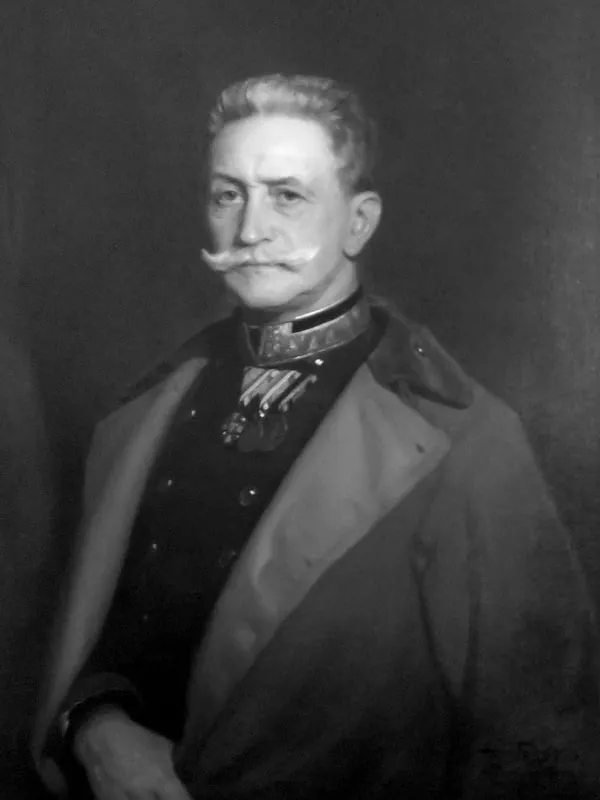
- Born:
- 11 November 1852, Penzing near Vienna (Austria)
- Died:
- 25 August 1925, Bad Mergentheim (Germany)
- Author:
- Łukasz Skowroń
- Photo:
- Hermann Torggler, domena publiczna, Wikimedia Commons

For more than ten years Franz Conrad von Hötzendorf was the most important soldier of the Habsburg Monarchy and one of the men who did most to bring about the war. As Chief of the General Staff from 1906 he demanded again and again a preventive war against Serbia or Italy, and in the summer of 1914 he was among the most ardent supporters of a reckoning with Belgrade. During the war the nominal commander-in-chief was Archduke Friedrich, but it was Conrad who planned and directed the operations of the Austro-Hungarian Army. His bold, sweeping plans usually ended in defeat: in Galicia in 1914, in the Carpathians in the winter of 1915, in the Tyrol in 1916 and on the Piave in 1918. Victories were won mostly with the help of the Germans, on whom the monarchy became ever more dependent. For decades revered in Austria as a strategic genius, he is today judged very critically by most historians.
Before the war
He was born on 11 November 1852 in Penzing, then just outside Vienna, into a family of officers and officials whose ancestor had been ennobled in 1815 with the predicate “von Hötzendorf”. His father, a retired cavalry officer, had fought at the Battle of Leipzig. Contrary to popular belief, “Conrad” was his surname and not his first name, although even his closest friends called him that. He graduated from the Theresian Military Academy in Wiener Neustadt and the War School in Vienna, took part in the occupation of Bosnia in 1878 and in the suppression of the Krivošije uprising in 1882. For several years he was chief of staff of a division in Lviv, and then taught tactics at the War School. Many of his pupils became senior officers during the war, often devoted to him. He wrote tactical manuals that earned him a reputation as a reformer and modern theorist.
He was an adherent of Social Darwinism. He believed that the life of nations and states was a ceaseless struggle for existence in which the stronger would survive, and that the best defence was attack. For the monarchy, torn apart by national quarrels, he sought salvation in expansion in the Balkans. He wanted to incorporate Serbia into the Habsburg state and create, alongside Austria and Hungary, a third, South Slav part of the monarchy. In 1906, at the request of the heir to the throne Franz Ferdinand, Emperor Franz Joseph I appointed him Chief of the General Staff of the entire armed forces of the monarchy. In doing so he passed over the more senior Oskar Potiorek, who from then on was his rival.
As early as 1907 Conrad proposed the first preventive war against Italy, formally an ally of the monarchy, and he returned to the idea regularly thereafter. According to the calculations of the British historian Hew Strachan, he proposed war with Serbia in 1906, in 1908–1909, in 1912–1913, in October 1913 and in May 1914, and in 1913 alone twenty-five times. The Foreign Minister, Alois Aehrenthal, rejected these ideas, and in November 1911 the old emperor admonished Conrad that the policy of the monarchy was made by him alone and that it was a policy of peace. At the turn of November and December Conrad was dismissed. A part was also played by the scandal surrounding his affair with a married woman, Gina von Reininghaus, whom he married in 1915. In December 1912, however, during the Balkan Wars, Franz Ferdinand brought about his return. In the spring of 1913 Conrad tried to hush up the affair of Colonel Alfred Redl, the former deputy head of military intelligence, who for years had been selling the army’s secrets to Russia, including, as some historians suppose, its war plans.
The July Crisis
After the assassination in Sarajevo Conrad demanded from the very first days an immediate mobilisation against Serbia. The Foreign Minister, Leopold Berchtold, later summed up his position in three words: “war, war, war”. After the German blank cheque of 5 July Conrad was, alongside Berchtold, among the supporters of a hard line who over the following days won over the hesitant Hungarian Prime Minister István Tisza. At the same time he declared that the army could not start the war at once, because many soldiers were on harvest leave. In a letter to Gina he wrote that it would be a hopeless struggle, but that it had to be taken up, because so old a monarchy and so old an army could not perish without glory. The Austrian historian Fritz Fellner observed bitterly that the man who for years had preached preventive war was now asking for a postponement, and that no one had ever started a war more amateurishly.
On 25 July the emperor ordered partial mobilisation under the plan for a war against Serbia alone. Conrad counted on Russia staying out, and sent to the Balkans, in addition to the forces earmarked against Serbia, the so-called B-Staffel, the 2nd Army, which in the event of war with Russia was to go to Galicia. When Russia announced mobilisation and on 31 July the monarchy ordered general mobilisation, the transports could not be turned back without chaos on the railways. The 2nd Army went first to the Sava and the Drina, and reached Galicia late, when the battles in the east were already under way. It was missing in both places.
1914: defeat in Galicia
After the declaration of war on Russia on 6 August Conrad turned his main effort eastwards. Fearing a faster Russian mobilisation, he moved the concentration of the army westwards, behind the San and the Dniester, and the soldiers had to march dozens of kilometres on foot to reach the front line. He decided to strike on his own before the Germans defeated France and came to his aid. The plan envisaged an advance northwards, deep into the Kingdom of Poland, between the Vistula and the Bug, with only a weak screen in eastern Galicia. In the north the 1st Army of Viktor Dankl won the Battle of Kraśnik, and the 4th Army of Moritz von Auffenberg the Battle of Komarów. In the east, however, Conrad judged that only weak Russian forces were advancing there, and ordered the 3rd Army to attack. It was routed on the Złota Lipa and the Gniła Lipa, and on 3 September the Russians took Lviv.
Conrad would not accept the loss of the capital of Galicia. He turned Auffenberg’s exhausted army south, towards Rava Ruska, opening a gap between it and Dankl’s army. In the Battle of Gródek and Rava Ruska the attack collapsed and the Russians pushed into the gap. On the evening of 11 September Conrad, fearing he would be cut off from the crossings on the San, ordered the whole front to retreat. One of his four sons, Herbert, was killed at Rava Ruska. The blame for the defeat was laid on Auffenberg, although it was Conrad who had ordered him to turn back. The Battle of Galicia cost the Austro-Hungarian Army, according to various authors, from about 320,000 to 400,000 killed, wounded, missing and prisoners, and consumed a large part of its professional officers and NCOs. In the fortress of Przemyśl Conrad left more than 100,000 soldiers to tie down Russian forces.
By the autumn the monarchy could fight on only at the side of the Germans. In October Conrad’s armies advanced together with Hindenburg’s German 9th Army to the San and the Vistula. They relieved Przemyśl for a few weeks, but in the Battle of Warsaw and Dęblin and on the San they became bogged down and had to fall back again, as far as Kraków. There in November Conrad struck the left wing of the advancing Russians in the Battle of Kraków, and in December their flank from the mountains in the Battle of Limanowa. That victory lifted the threat to Kraków, but the army did not break through to Przemyśl. In the Balkans at the same time Potiorek was beaten three times by the Serbs.
1915: the Carpathians, Gorlice and Italy
In the winter Conrad decided to relieve Przemyśl with an offensive across the Carpathians, in the depths of winter, without waiting for spring. He also hoped that a victory would keep Italy and Romania from entering the war. In the Winter Battle in the Carpathians soldiers attacked in waist-deep snow and bitter frost, and more of them were killed by disease and frostbite than by bullets. According to the Austrian official history the monarchy lost about 800,000 men there between January and April, according to more recent studies 450,000–520,000. On 22 March Przemyśl capitulated, and the Russians threatened Hungary.
Rescue came from the Germans. Conrad had long proposed a blow against the Russian flank between the Vistula and the Carpathians, but it was Erich von Falkenhayn who in April 1915 decided to send a German army, and he made it a condition that the whole operation be directed by a German general. On 2 May the German 11th Army of August von Mackensen and the Austro-Hungarian 4th Army broke through the front at Gorlice. Older accounts credited Conrad with a large share in the plan; more recent research in the documents shows that it was prepared mainly by the Germans. In June the Central Powers recaptured Przemyśl and Lviv, and on 23 June Conrad was promoted to colonel general.
On 23 May Italy declared war on the monarchy. For Conrad, who had warned for years against the “faithless ally”, this was at once a political defeat and a vindication of his warnings. The defence on the Isonzo was taken over by Svetozar Boroević, and in the Tyrol by Dankl. In the autumn Mackensen, with German, Austro-Hungarian and Bulgarian troops, defeated Serbia. Conrad at that time bombarded the Foreign Minister, István Burián, with memoranda demanding the annexation of Serbia and Montenegro to the monarchy. Relations with Falkenhayn, who treated Austria-Hungary as the weaker partner, grew steadily worse. In December 1915 Conrad, against the wishes of the Germans, decided to conquer Montenegro and occupy northern Albania. The dispute was so bitter that for several weeks the two chiefs of staff barely corresponded with each other.
1916: the Tyrol, Brusilov and German tutelage
Conrad had long believed that Italy could most easily be defeated by a blow from the Tyrol into the rear of its army on the Isonzo. Falkenhayn, who was preparing the offensive at Verdun, refused help, so Conrad decided to strike on his own. He brought his best divisions and heavy artillery to the Tyrol, including some from the Eastern Front. On 15 May 1916 the Trentino offensive began, known to the Italians as the “punitive expedition”. In the Battle of Asiago the Austro-Hungarians pushed the front forward by between a dozen and some twenty-odd kilometres and took Asiago and Arsiero, but did not descend to the plain.
On 4 June the Brusilov offensive began. The weakened Austro-Hungarian armies in Volhynia and Bukovina were routed and, according to the Austrian official history, lost 475,000 men in June and July, including nearly 266,000 prisoners and missing. Conrad had to go to Berlin to ask Falkenhayn for help and to break off the offensive in the Tyrol. The defeat cost him what remained of his independence. At the end of July the northern part of the Eastern Front, down to the Brody area, was taken over by Paul von Hindenburg, and in September, after Romania entered the war, the Central Powers set up a joint supreme command under Emperor Wilhelm II, in practice under the German Supreme Army Command. The campaign against Romania was led by German generals, and Conrad was now merely one of those carrying it out.
Under Charles
On 21 November 1916 Franz Joseph died. A few days later the new emperor, Charles I, made Conrad a field marshal, but already as heir to the throne he had believed that the high command needed putting in order and that Conrad stood in the way. On 2 December he took over the supreme command himself, and on 1 March 1917 he replaced Conrad with General Arthur Arz von Straußenburg. At the emperor’s request Conrad did not retire but took command of an army group in the Tyrol. When in the autumn of 1917 the Germans and Austrians routed the Italians at Caporetto, his troops in the mountains played a secondary role, and in the First Battle of the Piave his troops took the Meletta massif on the Asiago plateau, but did not descend to the plain.
In the spring of 1918 Conrad again wanted to come down from the mountains into the Italians’ rear, while Boroević preferred to cross the Piave or not to attack at all. The high command refused neither of them. On 15 June both army groups attacked at the same time, and neither attack was strong enough. In the Second Battle of the Piave Conrad’s attack in the mountains collapsed on the first day, and on 19 June, when Boroević proposed a retreat, the emperor is said to have replied that “Conrad wants” to fight on. After the defeat the monarchy looked for a culprit. In mid-July Charles dismissed Conrad, sweetening the dismissal with the title of count and the honorary command of the bodyguards. The British official history writes that the emperor sacrificed him for the good of the dynasty, just as Benedek had been sacrificed after Königgrätz in 1866.
After the war
After the break-up of the monarchy Conrad lived in Vienna and Innsbruck. The abolition of nobility in Austria in 1919 made him plain Franz Conrad. In five volumes of memoirs, “Aus meiner Dienstzeit 1906–1918”, he defended his plans and argued that the monarchy had fallen because his warnings had not been heeded, and that he himself had been merely a military expert without influence on political decisions. He died on 25 August 1925 while taking a cure at Bad Mergentheim in Württemberg. According to the press, more than 100,000 people attended his funeral at the Hietzing cemetery. After his death a diary was found containing more than 3,000 love letters to Gina that had never been sent.
Assessment
For decades after the war former officers and Austrian military historians portrayed Conrad as Austria’s greatest commander since Prince Eugene of Savoy, let down by a weak army, by politicians and by an ally. The British historian Cyril Falls called him in 1959 perhaps the best strategist of the war, and Hindenburg praised his boldness. He was already criticised by contemporaries such as Karl Kraus, who in “The Last Days of Mankind” portrayed him as a vain poseur.
Since the 1960s the verdict has been decidedly critical. Historians, among them Lawrence Sondhaus, author of a biography entitled “Architect of the Apocalypse”, Günther Kronenbitter and Holger Herwig, stress his responsibility for the outbreak of war: for years he pressed for a preventive war, and in July 1914 he was among its chief advocates. Samuel R. Williamson considered him perhaps the greatest intriguer among Europe’s military leaders before 1914. As a commander Conrad disregarded terrain, weather, supply and the firepower of modern weapons, overestimated the capabilities of his own army and underestimated the enemy. His plans, impressive on the map, in Galicia, in the Carpathians and in the Tyrol were beyond the strength of an army that lost most of its professional cadres in the first year of the war. When he left the post of Chief of the General Staff, the Austro-Hungarian Army was no longer capable of independent operations and depended on Germany. Even his critics, however, grant him operational talent, industry and courage in decision-making, and some historians recall that he commanded an army that was underfunded, multinational and poorly equipped, whose weaknesses he knew better than the politicians did.
Sources
Spotted a mistake?Report an error
Commanded in battles
(13)- 23 August – 11 September 1914Battle of GaliciaEastern Front
- 8–11 September 1914Battle of Gródek and Rawa RuskaEastern Front
- 15–28 November 1914Battle of KrakówEastern Front
- 1–12 December 1914Battle of LimanowaEastern Front
- 23 January – 15 April 1915Winter Battle in the CarpathiansEastern Front
- 1–5 May 1915Battle of GorliceEastern Front
- 7–16 September 1915Battle of TarnopolEastern Front
- 5–25 January 1916Conquest of MontenegroBalkan Front
- 15 May – 25 June 1916Battle of AsiagoItalian Front
- 4 June – 20 September 1916Brusilov offensiveEastern Front
- 10–29 June 1917Battle of Mount OrtigaraItalian Front
- 10 November – 26 December 1917First Battle of the PiaveItalian Front
- 15–24 June 1918Second Battle of the PiaveItalian Front
Mentioned in battles
(14)- Serbian campaign of 1914
- Battle of Kraśnik
- Battle of the Złota Lipa
- Battle of Komarów
- Battle of Warsaw and Dęblin
- Second siege of Przemyśl
- Battle of the San
- Recapture of Przemyśl
- Battle of Mościska and Lubaczów
- Recapture of Lviv
- Battle of the Gniła Lipa
- Battle of Lovćen
- Fifth Battle of the Isonzo
- Seventh Battle of the Isonzo
Often appears with
People who appear in the same events.
On the timeline
(42)The 40 most important of 42 events. All tagged “Franz Conrad von Hötzendorf” (16) →
1914
July
August
September
- 11
- Battle of Gródek and Rawa Ruska endsOn 11 September 1914 the Austro-Hungarian bid to retake Lviv failed. The Russians broke the front at Rawa Ruska; Conrad ordered a retreat behind the San.
- The great Austro-Hungarian retreat in GaliciaOn 11 September 1914 Conrad ordered the Austro-Hungarian armies back behind the San, then the Dunajec. Russia took most of Galicia and besieged Przemyśl.
October
November
December
1915
January
May
June
July
September
- 16
- Germans take PinskIn mid-September 1915 the German Army of the Bug took Pinsk in Polesia. The Russians fell back behind the Yaselda and the Ogiński Canal into the Pripet marshes.
- Battle of Tarnopol endsOn 16 September 1915 Ivanov ended his counter-offensive and pulled back to the Seret. The Russians had halted the Austro-Hungarian offensive in East Galicia.