Key event
Start of the Second Battle of the Piave
- Category:
- Military operations
- Front:
- Italian Front
- Date:
- 15 June 1918
- Author:
- Natalia
- Battle:
- Second Battle of the Piave
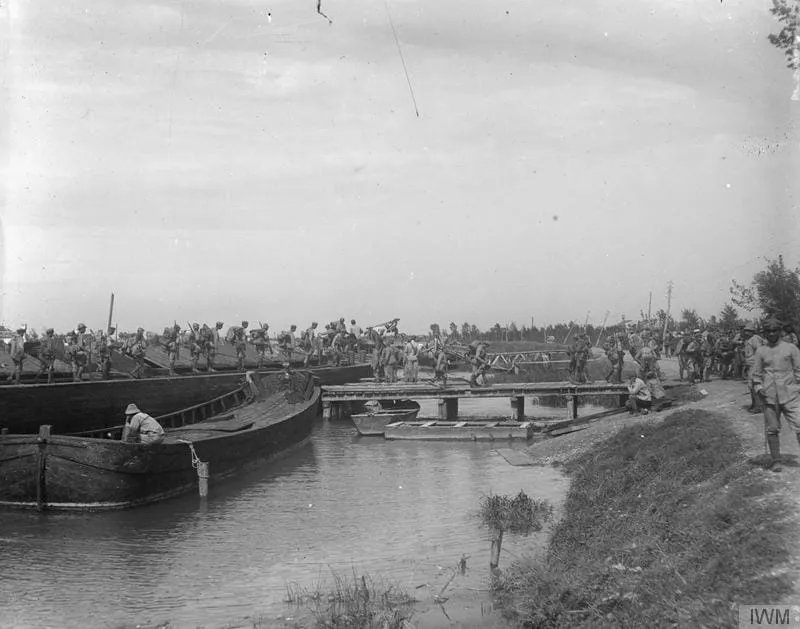
At three in the morning on 15 June 1918 thousands of Austro-Hungarian guns opened fire on a front more than a hundred kilometres long, from the Asiago plateau in the Alps to the mouth of the Piave on the Adriatic. The last great offensive of the Habsburg monarchy was beginning. Seven months after the First Battle of the Piave the Austrians wanted to finish the work of the autumn of 1917: break through the front in the mountains and on the river, descend into the Venetian plain and force Italy to make peace. By midday it was clear that in the mountains the attack had broken down. On the Piave, however, Austro-Hungarian troops crossed the river at several points, took part of the Montello hill and captured thousands of prisoners.
The night before the battle
The Italians knew what was coming. On 13 and 14 June their intelligence, using the statements of deserters and intercepts of Austrian telephone lines, established not only the day but the hour at which the bombardment would begin. On the morning of 14 June the commander of the British forces in Italy, Lord Cavan, warned his generals that the attack would come the next day, although according to intelligence the infantry was to strike only the neighbouring French and Italian sectors. The British had been preparing an attack of their own, set for 18 June, and it was now called off. In the evening an Austrian deserter came over to them and announced an attack at dawn, and at half past one in the morning a patrol captured a Hungarian who indicated by signs that the bombardment would begin at three.
On the Asiago plateau the Allied artillery did not wait. The French began shelling the Austrian batteries and infantry assembly areas a quarter of an hour before midnight, and soon after midnight the artillery of the Italian Sixth Army joined in. The pre-emptive fire, lasting several hours, broke up some of the units preparing to attack. Today 15 June is celebrated in Italy as Artillery Day.
The mountains
At three in the morning the Austrian bombardment began, with gas, high-explosive and shrapnel shells. The British official history judges that it was dispersed and much weaker than the German bombardments the British had grown used to in Flanders, although the roar echoed off the mountains and the shells snapped trees and scattered splinters of rock. The gas achieved little, because the Italians by now had good British masks. Behind the lines of the British 48th Division a large ammunition dump blew up, which hampered the bringing up of reinforcements all morning. A thick mist lay over the plateau.
At about seven the infantry of the Eleventh Army, under Field Marshal Franz Conrad von Hötzendorf, came up to the wire, cutting it with shears and blowing it with charges, and turned flamethrowers on the forward positions in the woods. The French of XII Corps repulsed the attack by fire alone. The British 23rd Division lost stretches of trench on its flanks but recovered them in the afternoon. The hardest fighting was in the 48th Division, which was ravaged by influenza: in some battalions companies numbered a few dozen men instead of 250, and at one point only the commander and the intelligence officer of the divisional staff were on their feet. Here the Austrians broke in at places several hundred metres deep into the woods. Counter-attacks at two in the afternoon, in the evening and during the night recovered part of the ground, and the rest was retaken at dawn on 16 June. On 15 June, the first day of the battle, Captain Edward Brittain, brother of the writer Vera Brittain, who described his death in her memoir, was killed on the plateau by a sniper’s bullet.
The Austrians had their greatest success on the eastern edge of the plateau, where by the gorge of the Brenta they broke into the sector of the Italian XIII Corps to a depth of one and a half to three kilometres and took hills the Italians had recaptured in January, among them Col del Rosso. East of the Brenta, in the Monte Grappa massif, five divisions attacked seven Italian divisions of General Gaetano Giardino’s Fourth Army. They took several summits above the Brenta valley, among them Col Moschin, but the attacks on Monte Asolone and Monte Spinoncia broke down, and the Italians retook most of the gains during the night and the following day. In the evening the Eleventh Army command ordered its divisions to stay where they stood. There was no question of resuming the attack.
On the Piave
On the river the battle was conducted by the army group of Field Marshal Svetozar Boroević. Here too the bombardment began at three, and according to the British official history it was modelled on the German preparation of 21 March, although there were far fewer guns. It destroyed little, because the Austrians did not know the exact positions of the Italian batteries, and the flat country was covered with vineyards and tall corn. The Italian artillery stayed silent for a long time, saving its fire for the moment of the crossing. The weather helped the Austrians: the river was shrouded in thick mist, mixed with the smoke of shells and an artificial smokescreen. Assault battalions dragged boats and pontoons across the stony shoals of a riverbed several hundred metres wide and crossed one branch of the river after another almost without loss.
Things went best on the Montello hill, where three divisions of Feldmarschalleutnant Goiginger’s XXIV Corps attacked a single Italian division, the 58th. The Austrians approached the Italian trenches on the bank unnoticed, and at 7.40 a.m., when the bombardment fell silent, went into the assault. By the afternoon they had taken the eastern part of the hill and advanced more than three kilometres. The Italians threw into the fight the reserve 48th Division, which occupied the railway embankment from Nervesa to Montebelluna.
Lower down, General Wenzel von Wurm’s Isonzo Army had mixed results. XVI Corps, which was to deliver the main blow across the island of Grave di Papadopoli, got only small groups across the river. After the only footbridge was destroyed they were wiped out, and one of its divisions lost more than 1,900 men. IV Corps, with two divisions of the Hungarian Honvéd, took the first line of Italian trenches, but in the afternoon, when airmen smashed its two bridges and the corps commander was badly wounded, it was thrown back to the riverbank. VII Corps crossed the Piave at Zenson, advanced about a kilometre and took about 2,400 prisoners. XXIII Corps, right by the sea, got furthest: in thick mist its two divisions crossed the river without much difficulty and formed a bridgehead about five kilometres wide and about four deep at San Donà di Piave, towards the small town of Meolo.
Airmen over the bridges
In the afternoon it became so cloudy over the mountains that the British squadrons from the Asiago plateau were switched to help the Italians on the Piave. At about one in the afternoon nine Sopwith Camel fighters bombed the ferries and pontoons at the Montello. By four in the afternoon 33 British aircraft were operating over the river, together with Italian squadrons that strafed the crossings from low altitude. The British broke the upper pontoon bridge at the Montello in two places, and its pontoons, swept away by the current, also wrecked a second bridge further down. At about six in the evening the airmen also caught a crowd of soldiers in boats. The British official history judged that this success of the air arm dashed the Austrians’ hopes of taking the whole hill, and by the morning of 16 June they had managed to repair only one bridge. That day two Austrian aircraft were shot down by Major Francesco Baracca, the leading Italian fighter ace. They were his last victories, the 33rd and 34th.
The first day’s balance
The Austrian high command considered that enough bridgeheads had been won on the Piave to build bridges and push on. The Italian Comando Supremo, however, was also satisfied. Its communiqué stressed that the front on the Asiago plateau had been held almost entirely, the attack on the Grappa had been stopped, and on the Piave the enemy’s strong blows had met stubborn resistance. General Armando Diaz began moving divisions from the reserve towards the Montello and the lower Piave, and further divisions were being readied for transfer by rail from the armies on the western wing, in the mountains. The failure of the attack in the mountains meant that he could safely send almost all his reserves to the river. The Austrians, cut off from their rear by the river and the airmen, faced difficult days. Over everyone hung the weather as well: on the evening of 15 June it began to rain.
Remember the articles you have read? Only in this browser; nothing is sent anywhere.How it works
Read ·
A voice from the front
“The conduct of our troops and of the Allied troops in the battle is admirable. From the Stelvio to the sea everyone has understood that the enemy absolutely must not pass: each of our brave men defending the Grappa has felt that every inch of the historic mountain is sacred to the Fatherland.”
Translated · Original (it)
Il contegno delle truppe nostre e alleste nella battaglia è ammirevole. Dallo Stelvio al mare, ognuno ha compreso che il nemico non deve assolutamente passare: ciascuno dei nostri bravi che difendono il Grappa, ha sentito che ogni palmo dello storico monte, è sacro alla Patria.
Spotted a mistake?Report an error
Meanwhile
(04)Elsewhere in the same days.
- 14 June 1918 · Western FrontEnd of the Battle of the MatzIn mid-June 1918 the Battle of the Matz died down. After Mangin's counter-attack of 11 June the Germans broke off their attack without reaching Compiègne.
- 12 June 1918 · Eastern FrontUkrainian–Russian armisticeOn 12 June 1918 in Kiev the Ukrainian State and Soviet Russia signed a preliminary agreement halting the fighting along the whole front during the talks.
- 12 June 1918 · Middle EastBaku Commune troops take KurdamirOn 12 June 1918 the troops of Bolshevik Baku took Kurdamir station after a short fight. The Turks, named by the chronology as its captors, entered it in July.
- 12 June 1918 · Middle EastGermans occupy TiflisIn June 1918 German battalions came to Tiflis at the Georgian government's invitation. On the night of 11/12 June they left to guard the Turkish border.
Related events
(04)The same battle, people or subject.
- 24 June 1918 · Italian FrontEnd of the Second Battle of the PiaveBy 24 June 1918 the Austrians had withdrawn over the Piave and the Italians had regained the whole right bank. Austria-Hungary's last offensive ended in defeat.
- 16 July 1918 · Italian FrontDismissal of ConradIn mid-July 1918 Karl I removed Field Marshal Conrad from command in the Tyrol, sweetening it with the title of count. Archduke Joseph August replaced him.
- 26 December 1917 · Italian FrontEnd of the First Battle of the PiaveOn 26 December 1917 the Austrians left the Zenson bridgehead over the Piave. After the last attacks on Asolone and Col del Rosso fighting in Italy died down.
- 11 November 1917 · Italian FrontCentral Powers on the PiaveOn 10–11 November 1917 the Austrians and Germans reached the Piave from sea to mountains, and Conrad attacked at Asiago. The fight for a new line began.