Austria-Hungary · The Central Powers
Svetozar Boroević
Commander of the Third Army (1914–1915), the Fifth Army on the Isonzo (1915–1917) and an army group on the Italian front (1917–1918), field marshal
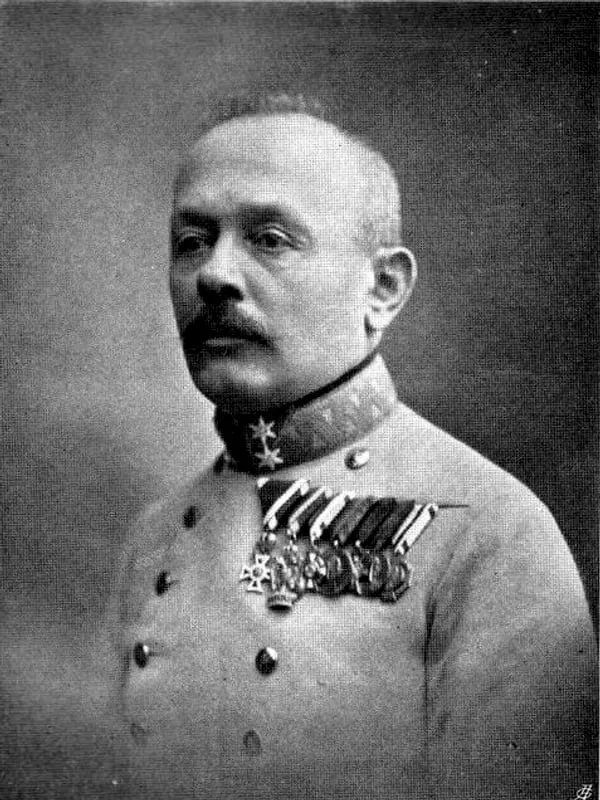
- Born:
- 13 December 1856, Umetić (Croatia)
- Died:
- 23 May 1920, Klagenfurt
- Author:
- Łukasz Skowroń
- Photo:
- autor nieznany, domena publiczna, Wikimedia Commons

Svetozar Boroević von Bojna was the most effective defender the Austro-Hungarian army had. From June 1915 to August 1917 his Fifth Army repulsed eleven Italian offensives on the Isonzo, although it almost always had fewer men and guns than its enemy. Earlier, in 1914 and 1915, he led the Third Army in Galicia and the Carpathians, and in 1918 he commanded an army group on the Piave. In the monarchy he was called the “Lion of the Isonzo”. The son of an officer from the Military Frontier, an Orthodox Slav from Croatia, he was the only field marshal of the imperial army of South Slav origin. After the collapse of the monarchy the new Yugoslav state would not take him in, and he died in poverty in Austria.
Before the war
He was born on 13 December 1856 in the village of Umetić near Kostajnica, in the Croatian Military Frontier. His father Adam served in the frontier troops. The family was Orthodox and, according to many sources, Serb, but Boroević himself identified as a Croat, and Serbian and Croatian historians still argue over which nation he belonged to. As a boy he was sent to a military boarding school and then to the cadet school in Graz. In 1875 he became a lieutenant in the Hungarian 52nd Infantry Regiment, and in 1878 he distinguished himself in the taking of Sarajevo during the occupation of Bosnia.
After the War School in Vienna he served on the General Staff, taught tactics at the Theresian Military Academy in Wiener Neustadt and was chief of staff of several divisions and, from 1898 to 1904, of VIII Corps in Prague. In 1905 he received Hungarian nobility with the predicate “von Bojna”. From 1907 he commanded the Croatian-Slavonian district of the Royal Hungarian Honvéd in Zagreb, and in 1912 he took over VI Corps in Kassa (Košice). In 1913 he became General of the Infantry. He was regarded as a strict, ambitious and vain officer, but also very conscientious and devoted to the dynasty.
1914–1915: Galicia and the Carpathians
He began the war at the head of VI Corps in the Fourth Army of General Moritz von Auffenberg. His corps advanced in the centre of the attack at the Battle of Komarów and suffered heavy losses there. At the beginning of September, when the Third Army, defeated on the Gniła Lipa, was falling back from Lviv, the Emperor dismissed its commander, General Rudolf von Brudermann, and entrusted it to Boroević. The army was demoralised, and at the Battle of Gródek and Rawa Ruska it failed to recover Lviv. On 11 September Franz Conrad von Hötzendorf ordered a retreat behind the San.
At the beginning of October the Third Army moved back towards the San. As it approached, the Russians broke off the first siege of Przemyśl, and on 9 October Austro-Hungarian cavalry entered the fortress. At the Battle of Chyrów, however, Boroević failed to push the Russians back from the San, and in November he had to retreat again and Przemyśl was encircled a second time. In December his troops took part in the victorious Battle of Limanowa, but they did not break through to the besieged fortress and at the end of the month were driven back into the Carpathians.
In the winter of 1915 the Third Army stood at the centre of the Carpathian Winter War. Conrad wanted to relieve Przemyśl across the mountains, and Boroević’s Third Army was to attack in snow and frost in the central Carpathians. The offensive failed, and his army bled itself white in fighting in which frost and disease killed more soldiers than bullets. Przemyśl capitulated on 22 March, and the Russians began to press towards Hungary. Boroević, supported by German reinforcements, nevertheless held the Carpathian ridges. In May his army took part in the pursuit after the breakthrough at Gorlice.
On the Isonzo
On 23 May 1915 Italy declared war on Austria-Hungary, and at the end of May Boroević arrived on the Isonzo and took command of the Fifth Army, subordinate to the commander of the South-Western Front, Archduke Eugen. The monarchy then had few troops on the Italian border, brought in a hurry from Serbia and Galicia. Boroević decided to defend the line of the river and the rocky Karst plateau, which barred the road to Trieste, and not to give up an inch of ground. His soldiers hacked trenches out of the rock and threw back every Italian penetration of the line with an immediate counter-attack.
General Luigi Cadorna attacked on the Isonzo for more than two years. In the first battle, in June and July 1915, the Italians won only scraps of ground at the foot of the Karst. The second battle in the summer and two more in the autumn of 1915 brought them little more, while both sides lost tens of thousands of men on the Doberdò plateau, which the soldiers called hell. In the spring of 1916 Conrad took several divisions from Boroević for the offensive in Tyrol, and in the summer more left for the east against Brusilov. In the sixth battle, in August 1916, the weakened Fifth Army lost the bridgehead of Gorizia and the town itself. Boroević, against his own principle, then agreed to give up Monte San Michele and the Doberdò plateau and to fall back to a new line a few kilometres to the east. But he could not be broken. In mid-October, after the eighth battle, he reported that since mid-August he had lost about 100,000 men and that his army was in crisis.
In May 1917 the Italians attacked for the tenth time, and in August for the eleventh, in the largest offensive of their army in the whole war. In the eleventh battle they crossed the Isonzo and took the Bainsizza plateau and Monte Santo. Boroević gave up the plateau and withdrew to a new line, but held Monte San Gabriele and the Karst. A colonel general since May 1916, at the end of August 1917 he took command of a new army group made up of two Isonzo armies. The Austro-Hungarian command concluded, however, that the army on the Isonzo would not withstand another such battle, and asked the Germans for help in a counter-offensive.
Caporetto and the Piave
On 24 October 1917 the Twelfth Battle of the Isonzo, known as the Battle of Caporetto, began. The main blow in the mountains was delivered by the German-Austrian Fourteenth Army of General Otto von Below, while Boroević’s armies set off in pursuit along the coast and across the Friulian plain. The Italians fell back more than a hundred kilometres, behind the Piave. The further advance was halted, however, by the First Battle of the Piave: Boroević’s troops failed to force the river, and in December Emperor Charles I ordered the offensive halted. In February 1918 Boroević was made a field marshal.
In the spring of 1918 he opposed another offensive. He believed that the exhausted and hungry army had to be spared to await the decision in France, and that if there was to be an attack at all, it should go across the Piave towards Treviso. Conrad, commanding in Tyrol, wanted instead to come down from the mountains. The high command would refuse neither of them and divided its forces. On 15 June both army groups struck at the same time. In the Second Battle of the Piave Boroević’s troops crossed the river and seized bridgeheads, among them on the Montello hill, but the swollen Piave swept away the bridges and Italian counter-attacks prevented them from going further. On 19 June Boroević proposed a retreat to the Emperor, which followed after another day of hesitation. After the defeat Conrad was dismissed, while Boroević kept his post.
In the autumn the monarchy was falling apart. When on 24 October the Italians opened the Battle of Vittorio Veneto, the troops on the Grappa still defended themselves fiercely, but on the Piave whole divisions refused to march to the front. On 28 October Boroević reported that his troops’ capacity to resist was dwindling “with terrifying speed”. His armies fell back behind the Livenza and the Tagliamento, and the Armistice of Villa Giusti ended the war on the Italian front on 4 November.
After the war
Boroević withdrew with the remnants of his staff to Velden in Carinthia. According to accounts from his circle, he proposed from there to the Emperor a march on Vienna with loyal units to prevent the proclamation of a republic, but the proposal was rejected in the name of Charles, who is said not even to have known of it. On 1 December 1918 he retired. He offered his services to the new Yugoslav state, but its authorities did not want a Habsburg field marshal and would not let him into the country, and his personal belongings were confiscated in Slovenia. In September 1918 his only son, a pupil at the military school in Maribor, had drowned. Poor and embittered, Boroević settled in Klagenfurt, where he died after a stroke on 23 May 1920. He was buried in the Vienna Central Cemetery, in a grave paid for by the former Emperor Charles.
Assessment
In Austria Boroević is regarded as one of the two most important commanders of the monarchy in this war, alongside Conrad, and as a master of defence. He held the Isonzo front through eleven battles with an army drawn from all the nations of the monarchy, including many Slovenes and Croats who were defending their own land there against Italian claims. His soldiers trusted him, and the South Slavs in the army called him “our Sveto”. For the defence of the Isonzo he received in 1917 the Commander’s Cross of the Military Order of Maria Theresa. According to German-language biographers, he then declined the title of baron to which it entitled him, because he wanted to be made a count, which he was not granted.
Historians also point to the price of his method. The principle of defending every metre and immediately retaking every lost trench cost the Fifth Army enormous losses and exhausted it so badly that in 1917 the monarchy had to ask the Germans for help. Critics reproach him for clinging to this principle even where an elastic defence would have saved the lives of thousands of soldiers. Others, such as the American historian John R. Schindler, author of a book on the Isonzo battles, see him above all as one of the best defensive commanders of the war. Nor was Boroević a strategist of the offensive. In the Carpathians and on the Piave his attacks failed, although in both cases he was carrying out plans he did not himself support. After 1918 his memory was for decades an awkward one in Yugoslavia. In recent decades his memory has been returning in Slovenia and Croatia, and in 2009 Ljubljana restored the honorary citizenship taken from him in 1919.
Sources
Spotted a mistake?Report an error
Commanded in battles
(26)- 23 August – 11 September 1914Battle of GaliciaEastern Front
- 26 August – 2 September 1914Battle of KomarówEastern Front
- 8–11 September 1914Battle of Gródek and Rawa RuskaEastern Front
- 24 September – 9 October 1914First siege of PrzemyślEastern Front
- 13 October – 2 November 1914Battle of ChyrówEastern Front
- 1–12 December 1914Battle of LimanowaEastern Front
- 23 January – 15 April 1915Winter Battle in the CarpathiansEastern Front
- 1–5 May 1915Battle of GorliceEastern Front
- 24 May – 3 June 1915Recapture of PrzemyślEastern Front
- 23 June 1915 – 9 November 1917Battles of the IsonzoItalian Front
- 23 June – 7 July 1915First Battle of the IsonzoItalian Front
- 18 July – 3 August 1915Second Battle of the IsonzoItalian Front
- 18 October – 4 November 1915Third Battle of the IsonzoItalian Front
- 10 November – 2 December 1915Fourth Battle of the IsonzoItalian Front
- 11–16 March 1916Fifth Battle of the IsonzoItalian Front
- 6–17 August 1916Sixth Battle of the IsonzoItalian Front
- 14–18 September 1916Seventh Battle of the IsonzoItalian Front
- 9–12 October 1916Eighth Battle of the IsonzoItalian Front
- 31 October – 4 November 1916Ninth Battle of the IsonzoItalian Front
- 12 May – 5 June 1917Tenth Battle of the IsonzoItalian Front
- 17 August – 12 September 1917Eleventh Battle of the IsonzoItalian Front
- 24 October – 9 November 1917Twelfth Battle of the IsonzoItalian Front
- 10 November – 26 December 1917First Battle of the PiaveItalian Front
- 15–24 June 1918Second Battle of the PiaveItalian Front
- 24 October – 4 November 1918Battle of Vittorio VenetoItalian Front
- 24 October – 1 November 1918Third Battle of Monte GrappaItalian Front
Mentioned in battles
(03)Often appears with
People who appear in the same events.
On the timeline
(38)1914
1915
January
May
- 24
- Fighting to retake Przemyśl beginsOn 24 May 1915 Mackensen's army struck at Radymno to cut Przemyśl off from the east. The Russians lost Radymno and thousands of men as prisoners.
- Italians cross the Austrian borderOn 24 May 1915 Italian troops crossed the border of Austria-Hungary along almost its whole length. The Austrians fell back behind the Soča, blowing up bridges.