1915: The Italian front and the Battles of the Isonzo
First Battle of the Isonzo
- Dates:
- 23 June – 7 July 1915
- Front:
- Italian Front
- Location:
- The Isonzo (Soča) valley from Tolmin to its mouth on the Adriatic, the Gorizia bridgehead (Sabotino, Oslavia, Podgora) and the western edge of the Karst plateau (Monte San Michele, Sei Busi), Austria-Hungary (now Italy and Slovenia)On the battle map →
- Sides:
- ItalyLuigi Cadorna, Pietro Frugoni, Prince Emanuele Filiberto, Duke of AostaAustria-HungarySvetozar Boroević, Archduke Eugen of Austria
- Result:
- Austro-Hungarian defensive victory. The Italians crossed the Isonzo at Sagrado and won small scraps of ground at the foot of the Karst, but nowhere broke the front.
- Author:
- Natalia
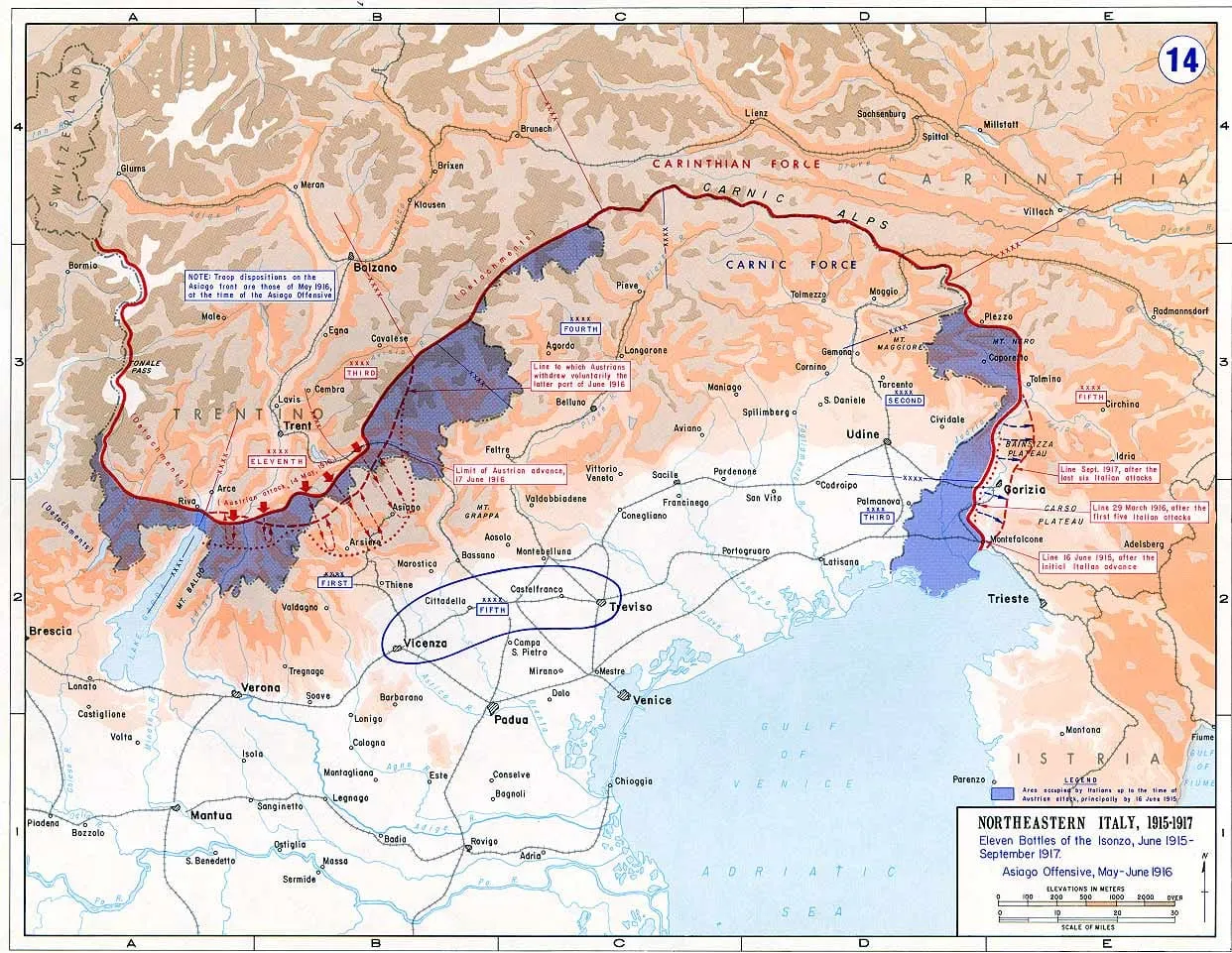
The First Battle of the Isonzo was the Italian army’s first great offensive of the First World War. From 23 June to 7 July 1915 the 2nd and 3rd Armies of General Luigi Cadorna attacked the Austro-Hungarian positions on the Isonzo, from the mountains above Tolmin to the Adriatic coast. The objective was Gorizia, and beyond it Trieste. The Italians had more than a two-to-one numerical superiority, but too little heavy artillery and ammunition, and the defenders had had time to dig in on the hills above the river and on the edge of the Karst plateau. After two weeks of attacks that broke down on the wire and under machine-gun fire, the front had hardly moved.
Name and dates
In Italian the battle is called the prima battaglia dell’Isonzo, in German the Erste Isonzoschlacht, and in Slovene the prva soška bitka. The Italian official history and most historians date it 23 June – 7 July 1915, and that is what we adopt on this page. The British chronology of the war gives 29 June as the start of the battle. We have not been able to establish where this date came from. The first week of fighting was taken up by artillery bombardment and attacks by individual brigades, and the heaviest, general attacks came only at the turn of June and July.
Background
Italy crossed the frontier on 24 May 1915. The Austrians, who at that time had very weak forces on the Isonzo, did not defend the border area. They withdrew behind the river, to the hills of the Gorizia bridgehead and to the edge of the Karst, blowing up the bridges behind them. The Italians advanced cautiously and for several weeks occupied the ground between the border and the Isonzo. On 9 June they entered Monfalcone, seized bridgeheads on the left bank of the river at Pieris and at Plava, and on 16 June the Alpini took the summit of Krn (Monte Nero) above Kobarid. Attempts to force the Isonzo at Sagrado and to take the edge of the plateau failed. The Austrians also cut the embankments of the de Dottori canal and flooded the plain at the foot of the Karst.
Austria-Hungary made full use of this time. The defence of the Isonzo was taken over by the 5th Army of General Svetozar Boroević, subordinate to the commander of the South-Western Front, Archduke Eugen. Divisions were brought to it from the Serbian front and from Galicia. Its soldiers built lines of trenches in the rock of the Karst 100–500 metres apart, surrounded by barbed-wire entanglements, with hidden machine-gun nests. The Gorizia bridgehead, that is the hills of Sabotino, Oslavia and Podgora on the right bank of the Isonzo, was defended by the 58th Division of General Erwin Zeidler, which had been fortifying these positions since March 1915.
Cadorna had two armies at his disposal. The 2nd Army of General Pietro Frugoni stood in the north, from Krn to Gorizia, and the 3rd Army of the Duke of Aosta, Emanuele Filiberto, from Gorizia to the sea. According to Italian historiography the two together numbered about 250 battalions, 110 cavalry squadrons and about 700 guns, that is, by various calculations, 225,000–250,000 soldiers. The 5th Army had about 115,000 men in 84–92 battalions and about 350 guns. The Italians thus had a superiority of more than two to one, but they lacked heavy guns, high-explosive shells, wire cutters and experience of trench warfare.
Course
The opening and the crossing at Sagrado (23–28 June)
The battle began at dawn on 23 June with an artillery bombardment along the whole front. On the Karst the infantry of the 3rd Army moved off that same morning. The Siena Brigade of the 19th Division crossed the de Dottori canal on pontoons and advanced towards Sagrado, Polazzo and Fogliano Redipuglia, while the Acqui and Pinerolo Brigades of the VII Corps attacked further south, towards Vermegliano and Selz. Beyond Fogliano and near Vermegliano the attack was stopped by the remains of the floods and by fire from the heights. The Pisa Brigade of the 21st Division tried to cross the Isonzo at Sagrado in boats. On the night of 23–24 June it reached an islet in the river, and in the morning its first battalion was ferried to the left bank. On 25 June the bridge at Sagrado was repaired and the whole brigade was moved across, and the Bologna Brigade took the village of Castelnuovo on the edge of the plateau.
The Italians got no further. On 26 June the artillery of the XI Corps shelled the positions on Monte San Michele and near San Martino del Carso, but the infantry advanced only a few steps. The attacks of 27 and 28 June ended in the same way and were halted. In the south the Austrians retook Selz on 28 June, and the Italians recovered it the next day.
On the 2nd Army’s sector the Emilia, Forlì and Spezia Brigades attacked for several days the positions above the Plava bridgehead, around the village of Globna and Hill 383. They briefly broke into Globna, but the defenders’ line did not give way. In front of the Gorizia bridgehead the Italian artillery shelled the wire for two days, and at 5 p.m. on 24 June the infantry went into the attack, although the obstacles had not yet been destroyed. It was stopped on the wire.
The last attacks (30 June – 7 July)
After a short pause the Italians resumed their attacks. On 30 June further attacks on San Martino again failed. Near Vermegliano the Acqui Brigade broke through the first belt of wire, but stuck in front of the second, and engineers of the Messina Brigade tried in vain to blow the wire with charges of blasting gelatine. In the north on 3 July the IV Corps attacked the Austrian bridgehead at Tolmin, but took only individual positions.
The heaviest fighting came on 4 July. On Monte San Michele the Siena Brigade broke into the Austrian positions and took 235 prisoners, but a counter-attack by fresh defending troops forced it back. The brigade lost more than half its strength. The same day the Cagliari Brigade attacked the Sei Busi hill above Redipuglia, took 260 prisoners and came up to the very summit, but did not take it. On 5 July the 2nd Army attacked Podgora near Gorizia. Engineers cut the first belt of wire at about 11 a.m., and the infantry of the Re Brigade passed the first and second lines of wire, but at 5 p.m. it was pinned down by close-range fire. The attacks on Sabotino also failed. On 6 July the Italians struck once more between San Michele and San Martino and advanced a little north of San Michele. At the beginning of July, however, reinforcements reached the defenders, and the Italian regiments were exhausted. On 7 July Cadorna halted all attacks.
Losses
According to Italian figures the Italians lost about 15,000 killed, wounded and missing, including about 2,000 dead and 454 officers. Austria-Hungary lost about 10,000 men, including about a thousand killed. Because the defenders were less than half as numerous, their losses were relatively higher: by Italian calculations they amounted to more than 9 per cent of their strength, against about 6 per cent on the Italian side. These figures should be treated as approximate.
Significance
The First Battle of the Isonzo brought Italy nothing resembling a breakthrough. The Italians won the bridgehead at Sagrado and scraps of ground at the foot of the Karst, but Gorizia, Monte San Michele and Sabotino remained in Austrian hands. The battle exposed the weaknesses of the Italian army: the lack of heavy artillery and ammunition, insufficient artillery preparation, outdated tactics of attacking in dense formations, which with numerical superiority only increased the losses, and the helplessness of the infantry against barbed wire. The defenders, for their part, learned that on the rocky Karst, even against a large enemy superiority, it was possible to hold on thanks to several lines of trenches and machine guns.
Cadorna did not give up and began preparing another blow at the same places. The Second Battle of the Isonzo began as early as 18 July 1915. The first opened a series of eleven battles in which, until the autumn of 1917, the Italians attacked on the Isonzo again and again, paying an enormous price for small gains of ground. On the Isonzo, as in France, positional warfare had begun.
Spotted a mistake?Report an error