1915: The Italian front and the Battles of the Isonzo
Second Battle of the Isonzo
- Dates:
- 18 July – 3 August 1915
- Front:
- Italian Front
- Location:
- The Karst plateau between Sagrado and Selz (Monte San Michele, San Martino del Carso, Sei Busi hill above Redipuglia), the Gorizia bridgehead (Podgora, Sabotino) and the Krn massif above Kobarid, Austria-Hungary (now Italy and Slovenia)On the battle map →
- Sides:
- ItalyLuigi Cadorna, Prince Emanuele Filiberto, Duke of Aosta, Pietro FrugoniAustria-HungarySvetozar Boroević, Archduke Eugen of Austria, Archduke Joseph August of Austria
- Result:
- Austro-Hungarian defensive victory. The Italians reached the western edge of the Karst and took Batognica above Kobarid, but Monte San Michele and Gorizia remained in the defenders' hands.
- Author:
- Natalia
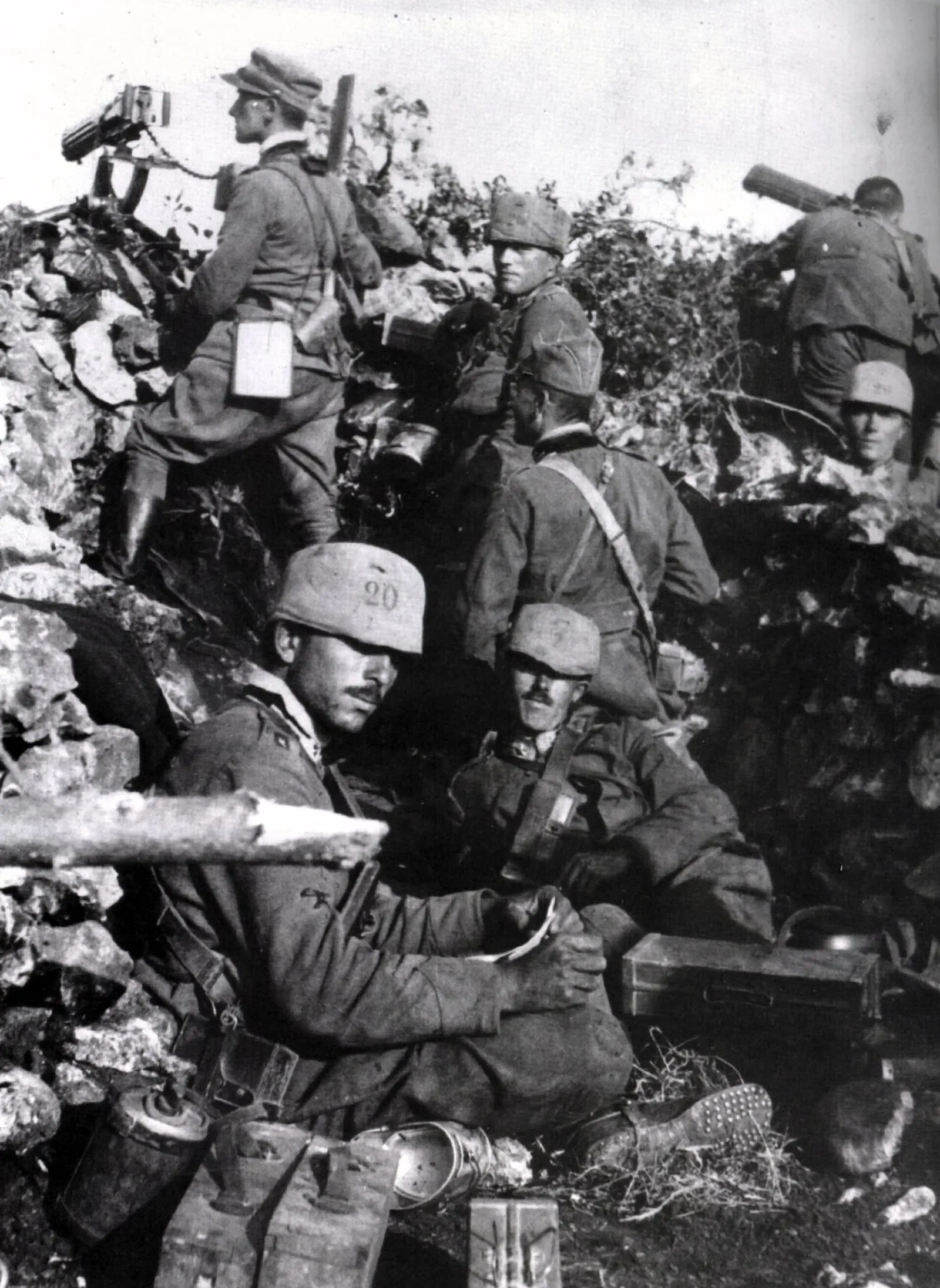
The Second Battle of the Isonzo was the Italian army’s second great offensive on the Isonzo. From 18 July to 3 August 1915 the 3rd Army of the Duke of Aosta, supported by the 2nd Army, attacked the Austro-Hungarian positions on the Karst plateau south of Gorizia. The main objective was the summit of Monte San Michele, which dominated the lower Isonzo and the Gorizia bridgehead. The Italians had twice as many battalions and twice as many guns as the defenders, and their artillery was much stronger than in June. Twice they broke onto the summit of San Michele and twice they were thrown off it. After two weeks of fighting on sun-scorched rocks the front had moved a few hundred metres, and each side had lost more than 40,000 men.
Name and dates
In Italian the battle is called the seconda battaglia dell’Isonzo, in German the Zweite Isonzoschlacht, and in Slovene the druga soška bitka. It is sometimes also called the Battle of Monte San Michele. The Italian official history and most historians date it 18 July – 3 August 1915, and that is what we adopt on this page. On 3 August the Italian supreme command issued the order to halt the offensive. The Austro-Hungarian official history extends it to 10 August, because the Duke of Aosta ordered a further advance “slowly and methodically” and fighting smouldered on for several more days.
Background
The First Battle of the Isonzo (23 June – 7 July) had won the Italians only a bridgehead at Sagrado and scraps of ground at the foot of the Karst. General Luigi Cadorna concluded that the attacks had lacked above all heavy artillery, and after less than two weeks he was ready for another blow, in the same place. His order of 15 July gave the 3rd Army the task of taking the two pillars of the defence on the Karst: Monte San Michele in the north and Sei Busi hill (hill 118 on Austrian maps) above Redipuglia in the south. Only after that would it be the turn of the Gorizia bridgehead. San Michele and the village of San Martino del Carso were to be taken by XI Corps (19th, 21st and 22nd Divisions), Sei Busi hill by VII Corps (13th and 14th Divisions), while X Corps (20th Division) attacked between them. Behind the 3rd Army stood the supreme command’s reserve, XIV Corps. The 2nd Army of General Pietro Frugoni was to pin down the enemy’s forces with attacks between Plava and the mouth of the Vipava, while its VI Corps methodically took the hills of the Gorizia bridgehead. In the north IV Corps was preparing to outflank the Austrian bridgehead at Tolmin from the direction of the Krn massif. According to Italian figures the two armies numbered about 260 battalions and 840 guns.
The Austrians expected a new attack. The 5th Army of General Svetozar Boroević, subordinate to the commander of the South-Western Front, Archduke Eugen, had received reinforcements from the Balkan front. From 10 July the whole sector on the Karst was commanded by the VII Corps of Archduke Joseph August. According to the Austrian official history, on 18 July the 5th Army had 105 battalions, about 103,000 rifles and 431 guns. There was little in reserve: the weak 93rd Division and one mountain brigade. Conditions were hardest on the Karst. Trenches could not be dug in the bare rock, so the defenders sheltered behind low walls of piled stones. Shells shattered them, and rock splinters greatly increased the casualties. In summer the plateau also lacked water.
Course
First attacks (18–19 July)
The battle began at four in the morning on 18 July with a massive bombardment of the whole plateau. Unlike in June, the infantry went forward the same day, between 11 a.m. and 2 p.m. The fighting quickly broke up into a series of hand-to-hand clashes, often decided by the bayonet. By evening the Italians had pushed back only a two-company sector of the 20th Honvéd Infantry Division, by less than two hundred paces. Before dawn on 19 July VII Corps broke into the Austrian lines along the road from Vermegliano to Doberdò, but by eight in the morning it had been stopped. In the afternoon X and XI Corps took a stretch of trench by the ruins on hill 143, while the evening assaults of VII Corps on Doberdò failed. At Gorizia VI Corps attacked the wire of the bridgehead for several hours without success. In two days the Austrian VII Corps lost about 5,500 men. The 20th Honvéd Division, which had entered the battle with 6,000 rifles, had only 2,000 left.
The summit of San Michele (20–24 July)
At dawn on 20 July General Adolf von Boog of the 93rd Division tried to retake the lost trenches, but achieved little. Before noon the Italians went over to the counter-attack, and after a heavy bombardment X and XI Corps struck at Monte San Michele. The defenders of the 20th Honvéd Division and the 17th Division fought in a cloud of smoke and dust until at 5.30 p.m. the Italians took the flattened summit. During the night Boog gathered 15 battalions and at four in the morning on 21 July, after a two-hour bombardment, launched a counter-attack. After a little over an hour he reported the summit retaken. He tried to push the Italians all the way back to the Isonzo, but was stopped by fire. By then Cadorna had given the 3rd Army his reserve, XIV Corps. On 22 July the Austrians threw the Italians back to the edge of the plateau near Sdraussina, but a counter-attack by the Italian 28th and 30th Divisions took this gain away from them. The defenders were left without food or water, as artillery fire cut off every approach. On 23 July both sides, utterly exhausted, broke off the fight for San Michele. The 20th Honvéd Division by then numbered only 1,200 rifles.
In the same days VI Corps attacked the Gorizia bridgehead. On 20 and 21 July its divisions stormed Podgora hill and Mount Sabotino. On the evening of 20 July the Italians briefly stood on the crest of Podgora, but General Erwin Zeidler’s 58th Division held its positions. Soldiers from Dalmatia particularly distinguished themselves in this fighting. From 18 to 24 July VI Corps lost about 3,400 killed, wounded and missing, and gave up further assaults.
The Italians won their only clear success in the mountains. On 19 July the Alpini attacked the Austrian positions in the Krn massif. On 21 July, after fierce hand-to-hand fighting in which both sides fought even with rock splinters, they took the summit of Batognica (PL) above Kobarid (hill 2163), later named Monte Rosso by the Italians. The defenders of the 3rd Mountain Brigade, who had lost about 1,300 men since 19 July, withdrew a few hundred metres to the east and repulsed all further attacks until 25 July.
The climax (25–26 July)
Convinced that the defenders of the Karst had already bled white, the Italian supreme command ordered the Doberdò plateau to be taken “at any cost” and handed the 3rd Army its last reserve, XIII Corps. At 9.30 a.m. on 25 July XI Corps struck at San Michele again, and VII Corps at Sei Busi hill. The Italian 22nd Division pushed the Austrian 9th Mountain Brigade, freshly committed to the fighting, all the way back to San Martino, but after heavy fighting the defenders held the summit of San Michele. In the south the Italians took the edge of the plateau between Redipuglia and Selz together with Sei Busi hill. The fire of both sides, however, did not allow them to hold it. On the morning of 26 July the hill was retaken by a Tyrolean regiment of Landesschützen (territorial rifles), hurriedly brought to the Isonzo.
26 July was the bloodiest day of the battle. The Italian 21st Division, reinforced by units of the 28th and 30th Divisions and battalions of Bersaglieri, was held up in front of unbroken wire, and the Austrian artillery inflicted enormous losses on it. The brigadier general leading the attack and many staff officers were killed. Even so, at about ten o’clock the Italians took the summit of San Michele. At noon a counter-attack by Colonel Schwarzenberg’s Austrian 12th Mountain Brigade threw them off it. The Italians also took the burning village of San Martino, but after losing the summit they had to abandon it. That afternoon Sei Busi hill again changed hands twice and remained with the Austrians. The Italians held on only to the positions they had won on the edge of the plateau east of Polazzo and between Vermegliano and Selz. Below San Michele itself they lost nearly 3,000 men that day, and the Austrian VII Corps about 6,000 over 25 and 26 July.
The battle dies down (27 July – 3 August)
After 26 July the 3rd Army no longer had the strength for a great attack. Cadorna moved further divisions to it from the 2nd Army and from the Dolomites, and until they arrived the Italian artillery shelled the plateau almost without pause. Smaller attacks, mainly at night, continued. In the fighting for Sei Busi hill and below San Michele the Austrian VII Corps was still losing more than a thousand men a day. The Austrians brought in reinforcements from the Tyrol and from the Eastern Front. On 29 July Archduke Eugen came to VII Corps headquarters at Kostanjevica to confer on how to reduce the losses. The front’s chief of staff, General Alfred Krauss, demanded that trenches be blasted into the rock instead of building stone walls, and the front command pressed for heavy artillery to match the Italians’. On 2 and 3 August the Italians tried once more to cut off a salient of the Austrian line between hills 197 and 118, but without success. On 3 August the Italian supreme command ordered the offensive on the middle and lower Isonzo to be halted.
Casualties
According to the Italian official history, from 18 July to 3 August the Italian army lost 41,866 men: 6,287 killed, 30,682 wounded and 4,896 missing. The Austro-Hungarian 5th Army, according to its own figures, lost 46,640 men from 15 July to 15 August. By 26 July alone its losses had reached 29,800 men, including 4,850 killed, and as many as 25,000 of them fell on VII Corps fighting on the Karst. Italian sources sometimes also give round figures of 42,000 Italian and 47,000 Austrian casualties. The Austrian official history points out that about 129 Austro-Hungarian battalions fought in the battle against about 260 Italian ones, so the defenders lost proportionally about twice as many men as the attackers.
Significance
The Italian general staff later wrote that the armour of the Austrian defence had been “dented here and there, but not pierced”. The Italians reached the western edge of the Doberdò plateau, widened their foothold on hill 170, a few hundred metres west of San Michele, and according to Italian sources moved the line forward as far as Sei Busi hill. The Austrians assessed this gain as a strip 200–600 paces wide, without the hill itself. In the mountains the Italians took Batognica above Kobarid. Monte San Michele, the Gorizia bridgehead and the Tolmin bridgehead nevertheless remained in Austrian hands.
The battle showed that even much stronger artillery was not enough to break the defence on the Karst when the infantry attacked frontally and the shells did not destroy the wire. The Italians ran short of ammunition and reserves, so they needed more than two months for the next offensive. For Austria-Hungary the defensive victory came at a high price. To hold the Isonzo front the high command took two divisions from the Balkans, even though it did not want to weaken the armies that were at the same time attacking the Russians in Congress Poland. The third of the Battles of the Isonzo began on 18 October 1915.
Spotted a mistake?Report an error