Italy · The Entente
Prince Emanuele Filiberto, Duke of Aosta
Commander of the Italian 3rd Army (1915–1919), Marshal of Italy (1926)
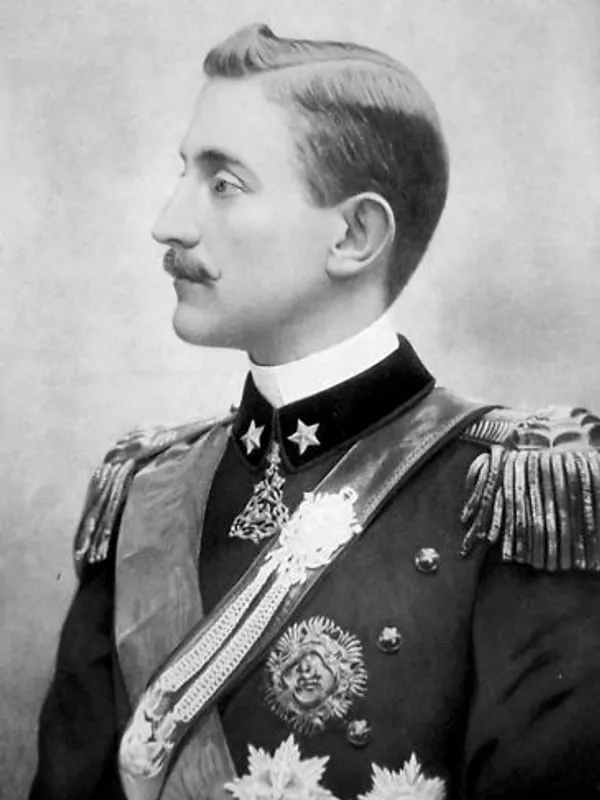
- Born:
- 13 January 1869, Genoa (Italy)
- Died:
- 4 July 1931, Turin (Italy)
- Author:
- Łukasz Skowroń
- Photo:
- autor nieznany, domena publiczna, Wikimedia Commons

Emanuele Filiberto, the second Duke of Aosta, was the only one of the Italian army commanders of May 1915 to keep his post until the end of the war. From the first day of fighting against Austria-Hungary in May 1915 to the armistice in November 1918 he commanded the 3rd Army, which fought the bloodiest of the Isonzo battles on the Karst plateau and at Gorizia, and then defended the lower Piave. His army took Gorizia in August 1916, and in the autumn of 1917, when the neighbouring 2nd Army was disintegrating at Caporetto, it withdrew in good order to the Piave. Hence the nickname of the “undefeated duke” (Duca invitto) and the “undefeated army”. As a cousin of King Victor Emmanuel III and, for some years, a possible heir to the throne, he was also a political figure: to some a symbol of victory in the war, to the king a rival whose popularity caused unease.
Before the war
He was born on 13 January 1869 in Genoa, the eldest son of Amedeo, Duke of Aosta, the younger son of King Victor Emmanuel II. When in 1870 the Cortes elected his father King of Spain as Amadeo I, the little Emanuele Filiberto became Prince of Asturias, heir to the Spanish throne. After his father’s abdication in 1873 the family returned to Italy. In 1890, after Amedeo’s death, he inherited the title of Duke of Aosta and took his seat in the Senate. Because his first cousin, the heir to the throne Victor Emmanuel, long had no son, the Duke of Aosta stood next in line to the crown after him, and after the assassination of King Umberto in 1900, until the birth of the new king’s son in 1904, he was heir presumptive. In 1895 he married Hélène of Orléans, daughter of the French pretender to the throne, despite the disapproval of Queen Margherita and some politicians.
He began his military career at the academy in Turin, and in 1888 became a lieutenant of artillery. He was promoted quickly, as befitted a member of the dynasty: by 1897 he was already a general, in 1905 a corps commander in Naples, where the ducal couple kept a splendid court in the Capodimonte palace, and in 1910 he was raised to the rank of army commander. He had no combat experience, however. The government did not allow him to go either to Abyssinia in 1896 or to Libya during the war with Turkey.
The Isonzo and the Karst
When Italy declared war on Austria-Hungary in May 1915, General Luigi Cadorna entrusted him with the 3rd Army, which was to attack on the lower sector of the front, from Gorizia to the sea. The duke’s chief of staff was General Giuseppe Vaccari, his closest adviser, and his headquarters were located at, among other places, Cervignano del Friuli. At the end of May units of the 3rd Army reached the lower Isonzo, and on 9 June they entered Monfalcone, abandoned by the Austrians. Beyond it, however, lay the Karst plateau, stony and waterless, on whose edge the army of Svetozar Boroević had dug in.
In the first, second, third and fourth battles of the Isonzo in 1915 it was the 3rd Army that bore the main burden of the fighting. Its infantry assaulted Monte San Michele, the Sei Busi hill above Redipuglia and the area of San Martino del Carso, losing tens of thousands of men for a few hundred metres of rock. The duke carried out Cadorna’s plans without questioning his method of frontal attacks, but gained a reputation as a commander who cared for his soldiers, was often in the front line and knew how to speak to them. From the end of January 1916 the Gorizia bridgehead was also subordinated to him, and in March he conducted the fifth battle, undertaken at the request of the French fighting at Verdun.
His greatest success came in August 1916. Cadorna, who had repelled the Austrian offensive in the Trentino, secretly moved huge forces to the Isonzo, and in the Sixth Battle of the Isonzo the 3rd Army, numbering 16 divisions according to the Austrian official history, took the weakened defenders by surprise. It captured Monte Sabotino and Monte San Michele, and on 9 August its units entered Gorizia. The next day the duke made a ceremonial entry into the town. In the autumn, in the seventh, eighth and ninth battles, his army moved the front on the Karst forward by a few more kilometres, but came no appreciably nearer to Trieste.
The duke also shared responsibility for the harsh discipline of the Italian army. Italian historians quote his circular of 1 November 1916, in which he approved the immediate shooting of soldiers, “guilty or not”, from units that had disgraced themselves by disobedience, and announced that he would do so “inexorably” whenever necessary. The commission that investigated the Caporetto defeat after the war condemned decimation, but did not scrutinise a member of the royal family.
In 1917 Cadorna shifted the centre of gravity north, to Gorizia and the Bainsizza plateau, where the army of General Luigi Capello was attacking. In the tenth battle, in May, the 3rd Army broke through the front at Jamiano and came up to the Hermada hill, the last great obstacle on the road to Trieste, but an Austrian counter-attack in June took back some of its gains. Depressed by the failure of the supporting attack of his XI Corps, the duke even proposed abandoning the offensive on the Karst. In the eleventh battle, in August, his four corps, among them the XXIII Corps of General Armando Diaz, again gained little, and Cadorna halted the attack on the Karst after three days.
Caporetto
When on 24 October 1917 the Germans and Austrians broke through the front at Caporetto, the 3rd Army stood intact from Gorizia to the sea. On the morning of 27 October Cadorna ordered it to retreat behind the Tagliamento. The task was extraordinarily difficult: the army had to cross the Friulian plain, outpacing an enemy descending from the mountains onto its flank, along roads choked by columns of the shattered 2nd Army and by refugees. The duke conducted the retreat efficiently. Most of his troops crossed the Tagliamento in good order, and by 9 November they stood behind the Piave, from the sea to the Montello hill. The 3rd Army lost part of its artillery and thousands of stragglers, but it was the only large formation from the Isonzo to keep its fighting capacity. On the new line it defended the lower Piave, and in the First Battle of the Piave in the autumn of 1917 the Austrians and Germans failed to push it back from the river.
After Cadorna’s dismissal many expected that the Duke of Aosta would take over the supreme command. The king, however, chose Diaz, one of his corps commanders. Some historians explain this by Victor Emmanuel’s fear of his cousin’s popularity. The king’s words are also quoted that the duke should not be diminished “because we may need him”. Some link them to thoughts of abdication and a regency in the event of defeat on the Piave.
1918: the Piave and Vittorio Veneto
In June 1918 the Austro-Hungarian Isonzo Army struck at the lower Piave. In the Battle of the Solstice the Austrians seized bridgeheads at Zenson, Fossalta and San Donà di Piave, but the 3rd Army, with the help of reserves, stopped them on the bank, and after the enemy’s defeat in the mountains and on the Montello forced them to retreat across the river. In the first days of July its units drove the Austrians out of the marshy triangle at the mouth of the Piave. In October, in the last offensive at Vittorio Veneto, the main blow was struck by the 4th, 8th, 10th and 12th Armies, while in the last days of the battle the 3rd Army crossed the lower Piave and set off in pursuit towards the Tagliamento. The Italian victory bulletin of 4 November said that the Duke of Aosta was advancing rapidly at the head of his “undefeated 3rd Army” to return to the positions it had won a year before and “never lost”. The duke himself is said to have admitted to the British commander Lord Cavan that without the British there would have been no Vittorio Veneto.
After the war
After the armistice the duke moved with his headquarters to Trieste, where he remained until July 1919. Promoted to general of the army, he took up the post of inspector-general of the infantry. He openly supported Italian claims to Fiume, which put him at odds with the government of Francesco Saverio Nitti, and his wife visited Gabriele D’Annunzio in Fiume. The king ordered them to go abroad, and in 1920 the post of inspector was abolished. In 1922 rumours circulated that the duke was ready to replace his cousin on the throne if the latter did not hand power to the Fascists. There is no evidence of this, but the king’s fear of his popular cousin was, in the view of some historians, one of the reasons why on 28 October 1922 he refused to sign the decree of a state of siege against the March on Rome. Mussolini’s regime surrounded the duke with honours, but gave him no real power. In 1926 the duke became a Marshal of Italy. He died of pneumonia on 4 July 1931 in Turin. In accordance with his wishes he was buried at Redipuglia on the former Karst front, among the fallen soldiers of the 3rd Army. His sons were Amedeo, Viceroy of Ethiopia during the Second World War, and Aimone, in 1941–1943 nominal King of Croatia as Tomislav II.
Assessment
In interwar Italy the Duke of Aosta was a living symbol of victory, and his tomb at Redipuglia became a place of veneration. The legend of the “undefeated” rested on the fact that his army suffered no defeat comparable to Caporetto, and on the efficient retreat of the autumn of 1917, which historians rate highly. Critics point out, however, that the 3rd Army lost hundreds of thousands of men on the Karst in attacks that achieved little, and that the duke carried out Cadorna’s methods without objection and in matters of discipline could be just as ruthless. He kept his post, some believe, partly thanks to his position in the dynasty, which shielded him from the dismissals that befell other generals. Most authors agree that he was a conscientious and brave commander, liked by his soldiers, but not an outstanding strategist.
Sources
Spotted a mistake?Report an error
Commanded in battles
(16)- 23 June 1915 – 9 November 1917Battles of the IsonzoItalian Front
- 23 June – 7 July 1915First Battle of the IsonzoItalian Front
- 18 July – 3 August 1915Second Battle of the IsonzoItalian Front
- 18 October – 4 November 1915Third Battle of the IsonzoItalian Front
- 10 November – 2 December 1915Fourth Battle of the IsonzoItalian Front
- 11–16 March 1916Fifth Battle of the IsonzoItalian Front
- 6–17 August 1916Sixth Battle of the IsonzoItalian Front
- 14–18 September 1916Seventh Battle of the IsonzoItalian Front
- 9–12 October 1916Eighth Battle of the IsonzoItalian Front
- 31 October – 4 November 1916Ninth Battle of the IsonzoItalian Front
- 12 May – 5 June 1917Tenth Battle of the IsonzoItalian Front
- 17 August – 12 September 1917Eleventh Battle of the IsonzoItalian Front
- 24 October – 9 November 1917Twelfth Battle of the IsonzoItalian Front
- 10 November – 26 December 1917First Battle of the PiaveItalian Front
- 15–24 June 1918Second Battle of the PiaveItalian Front
- 24 October – 4 November 1918Battle of Vittorio VenetoItalian Front
Often appears with
People who appear in the same events.