1917: The Italian front
Tenth Battle of the Isonzo
- Dates:
- 12 May – 5 June 1917
- Front:
- Italian Front
- Location:
- The Isonzo front from Plava to the Adriatic, about 40–50 km. In the north the Kuk–Vodice–Monte Santo ridge and Monte San Gabriele above Gorizia, in the centre the hills east of Gorizia (Sv. Katarina, Tivoli, San Marco, Sober), in the south the Karst plateau from Fajti hrib and Kostanjevica to Jamiano, Flondar, Medeazza and the mouth of the Timavo below Hermada, Austria-Hungary (now Slovenia and Italy)On the battle map →
- Sides:
- ItalyLuigi Cadorna, Luigi Capello, Prince Emanuele Filiberto, Duke of Aosta, Pietro BadoglioAustria-HungarySvetozar Boroević, Wenzel von Wurm, Ludwig von Fabini, Alfred von Schenk
- Result:
- Inconclusive. The Italians took the Kuk and Vodice ridge above Plava but not Monte Santo. On the Karst they advanced the front by 1–4 km, but the counter-attack of 4 June took back most of their gains below Hermada.
- Author:
- Natalia
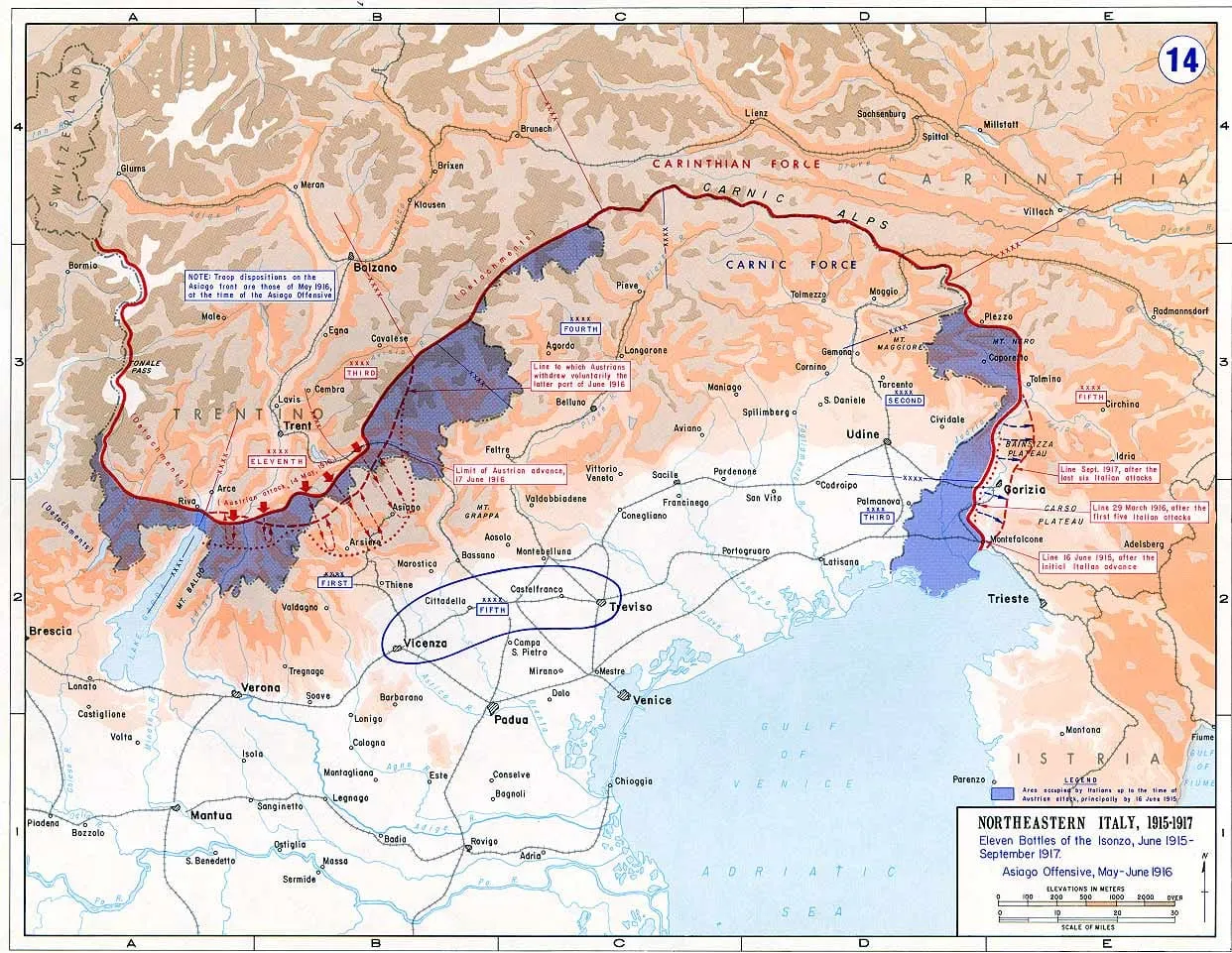
The Tenth Battle of the Isonzo was the first great Italian offensive of 1917 and the largest of all the battles on the Isonzo so far. General Luigi Cadorna committed about half the Italian army to it, and his artillery was stronger than ever before. This time the attack covered not only the Karst plateau and the area around Gorizia, but also the mountains above the Isonzo north of the town. From 14 May the newly formed army of General Luigi Capello stormed the hills between Plava and Gorizia and took the Kuk and Vodice ridge, but failed to take Monte Santo. On 23 May the Duke of Aosta’s 3rd Army struck on the Karst, broke through the Austro-Hungarian front at Jamiano and reached Hermada, the last great obstacle on the road to Trieste. On 4 June, however, a counter-attack by the troops of General Svetozar Boroević took back most of the Italian gains on the Karst. The two sides together lost more than 200,000 men.
Name and dates
In Italian the battle is called the decima battaglia dell’Isonzo, and Cadorna in his memoirs wrote simply of the “offensive on the Julian front in May 1917” or of the “spring offensive”. In German it is the zehnte Isonzoschlacht. The Austro-Hungarian official history (Österreich-Ungarns letzter Krieg) and most Italian studies date the battle to 12 May – 5 June 1917. The Austrians divided it into three parts: the first clash from 12 to 20 May, when the attack was led mainly by Capello’s army north of Gorizia; the second from 23 to 28 May, when the main weight passed to the 3rd Army on the Karst; and the Austro-Hungarian counter-attack from 28 May to 5 June. Cadorna himself wrote that the Austrian counter-offensive lasted three days, from 4 to 6 June, and some studies, especially English-language ones, end the battle only on 8 June. We adopt the dates 12 May – 5 June.
Background
After the Ninth Battle in the autumn of 1916, Cadorna spent the winter preparing a great spring attack. He counted on help from the Allies, but at the January conference in Rome the plan of the British prime minister, David Lloyd George, to support an offensive on the Karst with heavy artillery from the Western Front was set aside, and priority went to General Nivelle’s offensive in France. Only a small part of the promised help reached Italy: in April 1917 the British sent two groups of heavy artillery, ten batteries in all. After the collapse of the offensive on the Aisne, the French and British pressed all the more for the Italians to attack and pin down the forces of Austria-Hungary.
In May 1917 the Italian army was much stronger than a year earlier. According to the Austrian official history it had 59 divisions, about 850 battalions, 3,000 light and 2,100 heavy guns, not counting the batteries lent by the British and French, and 1,500 heavy trench mortars. In March Cadorna carved a new command out of the 2nd Army, the “Gorizia Zone” (Zona di Gorizia), and gave it to General Luigi Capello, the conqueror of Gorizia in August 1916. From then on Capello commanded the front from Plava to the valley of the Vipava, and from the Vipava to the sea stood the 3rd Army of the Duke of Aosta, Emanuele Filiberto.
The Italian high command’s directives of 19 April envisaged a battle in three phases. First the artillery was to bombard the whole front from Tolmin to the sea, to mislead the enemy about the direction of the main blow. Then Capello’s army, 12 divisions and 146 battalions, was to take the hills of Kuk, Vodice, Monte Santo, Monte San Gabriele and San Marco, which closed the Gorizia basin to the north and east. Finally the 3rd Army, 16 divisions and 186 battalions, was to deliver the decisive blow on the Karst and take the line from the Trstelj hill to Hermada. The heavy batteries were to pass from one army to the other during the battle. Capello later criticised this idea as too artificial. The attack was set for 7 May, but because of bad weather it was put off from day to day.
On the other side, Boroević’s 5th Army, also called the Isonzo Army, was according to the Austrian official history stronger than ever. On 50 kilometres of front from Avče to the sea stood 126 battalions and 301 batteries, with several more divisions in reserve. Boroević expected the main blow on the Karst and concentrated most of his reserves there. North of Gorizia, on the hills above Plava and on the Bainsizza plateau, the front was weaker: it was defended by the XVII Corps of General Ludwig von Fabini, made up largely of battalions of the Landsturm.
Course
The attack of Capello’s army (12–20 May)
At dawn on 12 May the Italian artillery opened fire along the whole front from Tolmin to the sea. The bombardment lasted two and a half days and on 14 May turned into a hurricane barrage. At noon on 14 May the infantry of Capello’s army went into the assault. From the bridgehead at Plava the Udine Brigade took hill 383, later named Poggio Montanari in honour of General Carlo Montanari, who fell there, and the Firenze Brigade reached spur 535 on the slopes of Kuk. A battalion of the 230th Infantry Regiment of the Campobasso Brigade crept up a hidden path through the scrub on the slopes of Monte Santo and in the evening broke into the ruins of the monastery on the summit, but without support it was driven out during the night by Austrian reserves. All the other attacks on Monte Santo and Monte San Gabriele broke down under the fire of the Austrian artillery. At Gorizia the Italian VIII Corps attacked the hills from Sv. Katarina to Vertojba for three days and did not advance a single step. The Milano Brigade bled especially heavily there.
On the night of 14/15 May two battalions, the 37th Bersaglieri Regiment and alpini of the Monte Cervino battalion, crossed the Isonzo between Loga and Bodrež north of Plava. The attack was only meant to draw away the defenders’ attention, but the Austrians took it for the start of a great operation and sent a whole Landsturm brigade there. On the night of 18/19 May the Italians withdrew unnoticed to the other bank. Meanwhile, just before the assault, Capello’s chief of staff, General Pietro Badoglio, had taken command of the Italian II Corps at Plava. His divisions stormed the Kuk ridge day and night; it was defended by the bleeding 121st Infantry Brigade, half of it Landsturm. According to Cadorna the Italians took the summit of Kuk (611 m) as early as 15 May, while according to the Austrian history the defenders lost the ridge only on the afternoon of 17 May, after three days of fighting without water and with food barely getting through.
On 16 May Cadorna changed the plan. He decided that Capello’s army should now only complete the capture of the Kuk–Monte Santo massif, after which both armies were to strike simultaneously from Monte Santo to the sea. But ammunition was short. On 13 May Cadorna had written to the minister of munitions that for the operations he needed at least 4–5 million medium and heavy calibre shells, and could count on two and a half million. On 17 May Capello declared that he had no shells for a new attack at Gorizia, and the Duke of Aosta, depressed by the failed subsidiary attack of his XI Corps on 14 and 15 May, even proposed giving up the offensive on the Karst. In the end Cadorna limited the task of Capello’s army to subsidiary attacks and left the main blow to the 3rd Army.
On 18 May Emperor Charles I came to the front. In an order to “his Isonzo Army” he wrote that he had been an eyewitness of the Italian army’s tenth assault and expressed his conviction that his soldiers would once again stand up to the enemy. That day General Maurizio Gonzaga’s 53rd Division and alpini attacked hill 652, the highest point of the Vodice ridge. The hill changed hands several times. Cadorna claimed that the Italians held the line through hills 592 and 652, while according to the Austrians the dome-shaped summit finally became no man’s land: both sides dug in on opposite edges and stopped fighting for it only on 30 May. On 20 May the Italians attacked Monte Santo once more and were again repulsed.
In the first phase of the battle the Italians took, according to Cadorna, 7,113 prisoners and 18 guns. But they suffered enormous losses: according to an Italian study cited by the Austrian history, in the fighting for Vodice alone 26 battalions lost 464 officers and more than 11,000 men. From 12 to 20 May Boroević’s army lost, including the sick, almost 30,000 men. The Austrian high command asked for more divisions from the Eastern Front.
The attack on the Karst (23–28 May)
The 3rd Army was reinforced with brigades from Capello’s army and the Tyrol front and with most of Capello’s heavy batteries. According to the Austrian history it now had 246 battalions, about 1,250 guns and 584 trench mortars on a front roughly 18 kilometres wide. On 23 May, from 6 a.m. to 4 p.m., all its artillery bombarded the Austro-Hungarian positions. Austrian authors estimated that more than half a million shells fell on them in those ten hours. 130 Italian aircraft took part in the attack, including navy seaplanes. At 4 p.m. the infantry went into the assault.
On the northern wing the attacks on the hills above the Vipava and on Fajti hrib broke down just as they had nine days earlier. The Italian 4th Division broke into the ruins of Kostanjevica, but Hungarian honvéds of the 41st Division threw it out with a counter-attack in the evening. The main weight, however, fell on the Austro-Hungarian XXIII Corps of General Alfred von Schenk, against which about 15 Italian brigades advanced. At Lukatič and in the Jamiano valley, regiments that had taken over their sectors of the front only the night before were broken through in the first attack, and three battalions were surrounded and taken prisoner. Reserves stopped the Italians on the Fornaza hills west of Selo, and during the night Schenk withdrew his troops to a rear line from Kostanjevica through Fornaza to Flondar, covering the artillery positions. That day Cadorna reported more than 9,000 prisoners.
On 24 May, supported by the fire of two monitors from the sea, the Italians fought for the Fornaza hills and for the salient at Hudi Log, which the Austrian 21st Infantry Regiment defended all day and abandoned only at night on orders. On 25 May the Italian VII Corps broke through the Flondar line south of the road from Jamiano to Brestovica and reached Medeazza and San Giovanni at the foot of Hermada. Austrian reserves counter-attacked. Battalion III/11 of Captain Stanisław Wieroński (PL), a Pole from Żółkiew and later a general of the Polish Army, retook the hill just west of Medeazza and captured 1,200 prisoners. For this Wieroński received the Knight’s Cross of the Military Order of Maria Theresa. The Austro-Hungarian 7th Infantry Division lost 190 officers and 5,200 men in three days.
On 26 May the Austrians retook the hills at Medeazza in the morning, but lost them again in the afternoon. The fighting came to a halt in the open field between the Flondar line and the last position at the western foot of Hermada. The Italian 4th Division briefly got beyond Kostanjevica. On 27 May, according to Cadorna, the Italians took the village of San Giovanni, and on 28 May units of the 45th Division crossed the Timavo river and took hill 28 on the seashore, but could not hold it. At Gorizia the Italians attacked on 23 and 25 May. The commander of the Austrian 58th Division reported that 23 May was the hardest day of the battle, but the front held. On the Vodice ridge and below Monte Santo the fighting went on until the end of May.
The attackers’ strength was now exhausted. According to Cadorna, from 14 to 28 May the Italians took 23,681 prisoners, including 604 officers, as well as 38 guns and 148 machine guns, and on the Karst they advanced the front by 1–4 kilometres. On 28 May Cadorna halted the offensive. He ordered the captured ground to be held and the positions improved with local attacks before the next offensive. The commanders of both armies, however, proposed “doing nothing”, and Cadorna agreed.
The Austro-Hungarian counter-attack (28 May – 5 June)
As early as 26 May Schenk argued that the new line right at the foot of Hermada would be hard to hold, because the artillery could not operate fully from there, and that the Flondar line had to be retaken. Boroević agreed only once reinforcements had arrived from the Eastern Front and the Tyrol and the attack had been carefully prepared. On the evening of 3 June the 17th Division attacked on Fajti hrib as a diversion and took 350 prisoners, and at Gorizia a Viennese Landsturm battalion retook a trench on San Marco and took about 600 prisoners.
On 4 June, before five in the morning, after only forty minutes of very heavy bombardment, six battalions of General Schneider von Manns-Au’s group struck the Italian positions between Flondar and San Giovanni. The battalions of the 12th Mountain Brigade at once regained the Flondar line, and in the evening the Prague 28th Infantry Regiment took the railway tunnels of the Trieste–Monfalcone line. This regiment had been disbanded in 1915 after its mass surrender to the Russians in the Carpathians and later re-formed. According to the Austrian history it now performed beyond expectations, although it lost almost two thirds of its strength. According to the same source, by the evening of 5 June about 10,000 Italians had been taken prisoner. Cadorna admitted that the right wing of the 3rd Army had to fall back to its starting positions, because the new line below Hermada was too weak. In the centre, between Versič and Jamiano, the Italians held on thanks to the Sardinian Grenadiers and the Siena and Bari Brigades, and on Fajti hrib the Tevere Brigade retook the lost trenches. On 5 and 6 June the Austrian 9th Division was still fighting for the Fornaza hills, but the attacks were called off, and the Italians did not attack any more either.
Losses
Figures for losses vary widely. The Austrian official history states that the Italians lost about 36,000 killed, 96,000 wounded and 27,000 prisoners, together nearly 160,000 men, and the Isonzo Army 76,300 men: 7,300 killed, 45,000 wounded and 23,400 prisoners. Italian studies give similar Italian losses, about 160,000, including 36,000 killed, but estimate the Austro-Hungarian losses higher, at about 90,000, including 17,000 killed, and some even at 125,000. Cadorna wrote of 24,260 prisoners taken and at least 100,000 Austrians put out of action.
Significance
The May offensive surpassed all the previous battles on the Isonzo in scale and in the expenditure of ammunition. According to the Austrians their artillery fired 37,800 tonnes of shells, and the Italian artillery probably even more. Even so, the Italians again failed to break the front. On the Karst, after the counter-attack of 4 June, they kept only part of their gains of 23 May, between Hudi Log and Jamiano. A lasting gain, on the other hand, was the Kuk and Vodice ridge above Plava, from which in August 1917 the attack on the Bainsizza plateau was launched in the Eleventh Battle of the Isonzo. Monte Santo, which dominated Gorizia, still remained in Austrian hands.
The battle also revealed the first serious signs of exhaustion in the Italian army. Capello wrote that during the Austrian counter-attack some units did not defend themselves at all, and three regiments went over to the enemy without a fight. Cadorna admitted in his memoirs that in some units there had been “for the first time unedifying episodes”, and he regarded the 27,000 prisoners lost mainly during the counter-offensive as a warning that the spirit of the troops was changing. In June he complained to the government about the propaganda of the “subversive parties”. The Austrians, for their part, concluded that they had held out only with difficulty: from then on their command understood ever more clearly that the Isonzo Army could not withstand more such battles indefinitely. Soon after the battle Cadorna moved part of his troops to the Trentino, where on 10 June the Italians attacked on the Asiago plateau.
Spotted a mistake?Report an error