1917: Arras and the Nivelle Offensive
Second Battle of the Aisne
- Dates:
- 16 April – 9 May 1917
- Front:
- Western Front
- Location:
- The Aisne front between Laffaux and Vauxaillon in the west and Courcy near Reims in the east, with the Chemin des Dames ridge, Craonne and the plain below Berry-au-Bac (Aisne and Marne departments, France)On the battle map →
- Sides:
- France and RussiaRobert Nivelle, Alfred Micheler, Charles Mangin, Olivier Mazel, Denis DuchêneGerman EmpireCrown Prince Wilhelm, Max von Boehn, Fritz von Below
- Result:
- French strategic defeat. There was no breakthrough. The French took part of the Chemin des Dames and about 28,000 prisoners, but suffered enormous losses, and mutinies swept the army.
- Author:
- Łukasz Skowroń
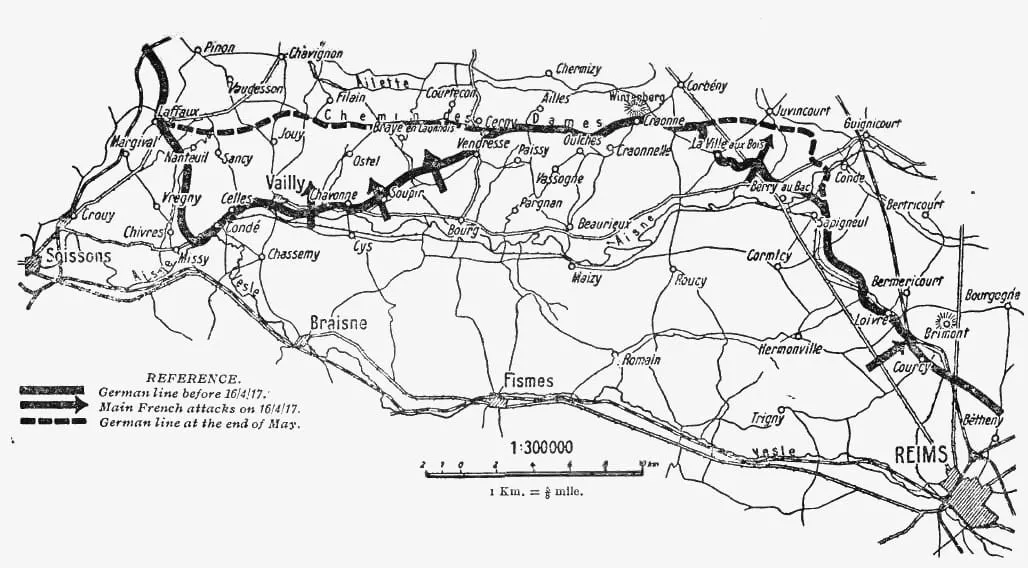
The Second Battle of the Aisne was the main blow of the great spring Nivelle Offensive, on which France staked everything in 1917. General Robert Nivelle, commander-in-chief of the French armies since December 1916, promised the government and the Allies that a violent blow would break the German front within 24, at most 48 hours, after which he would emerge into open country and destroy the German reserves. At six in the morning on 16 April 1917 the infantry of three French armies went forward against the Chemin des Dames ridge above the Aisne and onto the plain north of Reims. On the first day it was to pass through the German positions and descend into the valley of the Ailette, and soon afterwards take Laon. By evening, in most places, it had taken only the first lines of trenches. The battle went on for more than three weeks and brought the French considerable territorial gains, but the promise of a breakthrough lay in ruins, and with it the soldiers’ trust in their command.
Name and dates
The French speak of the “Nivelle Offensive”, the “offensive of 16 April” or the Battle of the Chemin des Dames. English historiography, and following it the Polish Wikipedia, calls this part of the offensive the Second Battle of the Aisne, in reference to the First Battle of the Aisne of September 1914, which was fought on the same heights. That is the name we use on this site. The simultaneous attack of the French Fourth Army on the Moronvilliers heights east of Reims, which began a day later, we describe separately as the Third Battle of Champagne.
The end of the battle is dated in different ways. The British chronology of the war on which our timeline is based says that the French offensive “was checked” on 20 April. It is true that around 20–22 April the great breakthrough attack was suspended, but the fighting went on. At the beginning of May the French carried out further large attacks, and on 8–9 May the offensive was halted. That date, 9 May, is accepted by the English and Polish Wikipedia and by many historians, and we take it as the end of the battle. The German Wikipedia speaks of fighting until the end of May. Some French authors extend the Battle of the Chemin des Dames as far as October 1917, when the French took the fort of La Malmaison and pushed the Germans off the whole ridge.
Background
The Chemin des Dames, the “Ladies’ Way”, is an old road running along the crest of a limestone plateau between the Aisne valley to the south and the Ailette valley to the north, roughly from Soissons to Craonne. It took its name from the daughters of King Louis XV, who drove along it in the 18th century. The Germans had sat on this ridge since September 1914, when after the retreat from the Marne they halted on the Aisne and took Craonne. Over two and a half years they turned it into a fortress. Their positions stood on the crest and on its reverse slope; the French lay lower down, on the slopes and in the valley. For centuries the plateau had been honeycombed with underground quarries, which the locals call “creutes”. The Germans linked them by tunnels to the front line and kept their reserves in them, safe from artillery fire. The largest of these caves, near the Hurtebise farm, they called the “Drachenhöhle”, the Dragon’s Cave (in French, Caverne du Dragon).
The plan that Nivelle presented in December and January developed ideas going back to Joffre. The British were to strike first at Arras, and the French Northern Army Group between the Oise and the Avre, to draw in the German reserves. The main blow was then to be delivered on the Aisne by the newly formed Reserve Army Group (GAR) of General Alfred Micheler. Nivelle wanted to repeat on a grand scale the method that in October and December 1916 had brought him victories at Verdun: to crush the defence with the fire of an enormous mass of guns and then, behind a creeping barrage, to take the enemy’s entire system of fortifications, as far as his artillery, in a single bound. After the breakthrough a reserve army with two cavalry corps was to go into action. The British even agreed that Haig would follow Nivelle’s directions for the duration of the offensive, which caused sharp disputes at the Calais conference and in London.
From the start the plan ran into obstacles. In March the Germans withdrew to the Hindenburg Line. The attack of the Northern Army Group lost its objective, and the Germans gained more than a dozen divisions of reserve. The British official history (Falls) notes, however, that the withdrawal also had a good side for the French: it allowed them to attack the German positions north of the Aisne from the flank as well, from the west, and the Northern Army Group handed Nivelle 11 infantry divisions, two cavalry divisions and about 550 heavy guns. In mid-March revolution broke out in Russia, which dashed hopes of an early Russian offensive. In Paris the Briand government fell, and in the new Ribot government the Minister of War was Paul Painlevé, who had distrusted Nivelle and his plan from the start.
Doubts and Compiègne
The commanders who were to carry out the plan also had doubts. On 22 March Micheler wrote to Nivelle that instead of two defensive positions the Germans had built four, had far more reserves and were clearly expecting an attack, so a rapid breakthrough could not be counted on. General Philippe Pétain, commander of the Centre Army Group, proposed another solution: a great attack east of Reims, on the river Suippe, in place of the weakened operation of the Northern Army Group. He could not be ready until May, however, and Nivelle did not want to wait. On 1 April he replied to Micheler that “nothing has changed in the conditions for a breakthrough”. Painlevé talked to the army group commanders over the head of the commander-in-chief and heard from them that they did not believe in the promised breakthrough.
On 5 April the prime minister received a note from Colonel Adolphe Messimy, a deputy and former Minister of War, who commanded the infantry of one of the divisions of the Tenth Army. It was a sharp criticism of the whole plan, according to Messimy almost dictated to him by one of its principal executors, which pointed to Micheler. The next day, 6 April, a council of war met at Compiègne, attended by President Raymond Poincaré, Prime Minister Alexandre Ribot, ministers, Nivelle and the four army group commanders. Painlevé repeated that after the revolution in Russia, and with the United States about to enter the war (it declared war on Germany that very day), the offensive should be conducted so as not to cost losses out of proportion to the results. Micheler said that the first and second German positions would be taken, but he would not vouch for a breakthrough of the front. Pétain spoke in favour of an attack with limited objectives. Poincaré summed up that they must attack and, if the front could not be broken, call off the offensive. Nivelle then offered his resignation, which the ministers did not accept. The meeting broke up without having settled the most important question: whether the plan matched the country’s means.
Meanwhile the Germans knew perfectly well what was in preparation. As early as 15 February they had captured in Champagne an order announcing a great operation, and the French preparations, the new roads, railway lines, airfields and camps, could not be hidden. On 4 April, in a local attack at Sapigneul south of the Aisne, they captured the attack plan of a battalion of the 3rd Zouave Regiment, with a general description of the operations of the whole Fifth Army. A company commander had given it to a sergeant to take to the rear, and the sergeant went missing in the confusion of the fighting. Nivelle learned of this on 7 April and decided to change nothing. The Germans reinforced this sector with new divisions and heavy artillery, and at the beginning of April they put into practice their new method of elastic defence, with a thinly held front line and counter-attack divisions (Eingreifdivisionen) in depth. According to Falls, on the whole threatened front on the Aisne and in Champagne the Germans had 21 divisions in the front line and 17 in reserve against 53 French divisions.
Forces
Micheler’s Reserve Army Group had three armies. In the west the Sixth Army of General Charles Mangin, the conqueror of Douaumont, held the curve of the front from Laffaux to Oulches. In the east, from Craonne across the Aisne valley at Berry-au-Bac to the outskirts of Reims, stood the Fifth Army of General Olivier Mazel. Two brigades of the Russian Expeditionary Force, which had arrived in France in 1916, fought within it. Behind them waited the Tenth Army of General Denis Duchêne, intended to exploit the breakthrough. The French assembled about 5,000 guns. The preparatory bombardment went on from the beginning of April, but cloudy weather with rain and snow hampered observation, and many German wire entanglements and machine-gun nests survived. The attack, originally set for 12 April, was postponed several times. On 13 April it was finally settled that Micheler’s group would go forward on the 16th and the Fourth Army in Champagne on 17 April.
On the German side the front from the Oise to the Argonne belonged to the army group of Crown Prince Wilhelm. The Chemin des Dames was defended by the Seventh Army of General Max von Boehn, while the sector from the Aisne at Berry-au-Bac to Reims and further east was taken over just before the battle by the First Army of General Fritz von Below, whose staff had been freed by the shortening of the front on the Somme. The Germans also had superiority in the air.
Course
16 April. The attack began at six in the morning, on a cold, misty dawn. According to the British official history it was clear from the first minutes that the artillery preparation had not been enough. The German barrage was weak, but surviving machine guns, often hidden in caves and on reverse slopes, mowed down the French infantry, which had to climb uphill. The Germans counter-attacked at once, and where the French had got further, in the evening they launched stronger, prepared counter-attacks. In the afternoon it began to snow.
The Fifth Army did best on the flat ground north of the Aisne. Between the Aisne and the Miette stream the 42nd and 69th Divisions reached the second German position and advanced about 4 kilometres north of Berry-au-Bac. Here, for the first time in the history of the French army, tanks went into battle. The group of Commandant Louis Bossut, about 80 heavy, slow Schneider CA1 tanks, was to take the infantry through the third German position. It arrived too late, the exhausted infantry could no longer follow it, and the German artillery destroyed the vehicles one after another. Bossut was killed at the head of his tanks. The second group, under Commandant Chaubès, with 48 Schneiders, set off from the Bois de Beau Marais west of the Miette under the eyes of German observers on the Craonne heights and was shattered before it had properly reached the German lines. According to French figures, of about 130 tanks that went into action 57 were destroyed and several dozen more got stuck or broke down. On the right wing of the Fifth Army the Russian 1st Brigade took the village of Courcy, but the attack stopped at the Aisne–Marne canal. Between Courcy and the Aisne the attack mostly failed, partly because the 37th Division, worn out by the fighting at Sapigneul, did not advance at all.
Mangin’s Sixth Army, attacking without tanks, achieved less. II Colonial Corps, with numerous battalions of Senegalese tirailleurs, gained at most a few hundred metres on the slopes between Oulches and Hurtebise and came to a halt after an hour. The Senegalese, who had trained on the Côte d’Azur, were overcome by the cold, and Germans emerging from the underground caves, among them the Dragon’s Cave, struck them in the back. XX Corps did better: the 153rd Division reached the Chemin des Dames road near Courtecon. On the western wing, at Laffaux, I Colonial Corps penetrated only a few hundred metres into the German fortifications. By evening the French held at most the first line of trenches on the ridge, and even where the attack had gone best they had not reached the objectives that were to have been taken by 9.30 in the morning. Over 10,000 Germans, however, were taken prisoner.
17–20 April. Nivelle, convinced that the Germans would hold at all costs opposite the Sixth Army, ordered the Fifth Army to push on to the north-east. It achieved little more, but the Sixth Army, pressing on without a pause even after dark, brought the most spectacular success of the battle. Threatened from the south and west, on 17–18 April the Germans suddenly abandoned the whole triangle between Braye, Condé-sur-Aisne and Laffaux and fell back to the Hindenburg Line running from the Laffaux mill to the Chemin des Dames. The French took the fort of Condé, many guns and huge stocks of ammunition, and by 20 April had advanced about 6 kilometres in this area. On 17 April the Fourth Army of General François Anthoine attacked east of Reims. By 20 April the French had taken in all over 20,000 prisoners and 147 guns, freed the Soissons–Reims railway and driven the Germans out of the Aisne valley west of the Oise–Aisne canal. But there was no breakthrough, and around 20 April the attack was halted.
21 April – 9 May. On 21 April Micheler proposed a change of objectives: instead of a breakthrough, to take and hold the whole Chemin des Dames ridge and then Fort Brimont north of Reims. Nivelle agreed in principle, and the offensive changed its character, from an attempt at a decision into an operation with limited objectives. The same day Duchêne’s Tenth Army went into line between the Fifth and Sixth Armies. In the following days there was local fighting, while in Paris hostility towards the commander-in-chief grew. On 29 April the government appointed Pétain Chief of the General Staff, that is, its military adviser, and at the beginning of May Mangin lost command of the Sixth Army. On 4 and 5 May the French carried out their last great attack. The attack on Brimont was “postponed” by the government at Painlevé’s request and never took place. The Tenth Army took Craonne and the Californie plateau at the eastern end of the ridge, and the Sixth Army broke into the Hindenburg Line on a front of about 4 kilometres on the Chemin des Dames and at Laffaux, where it took the Laffaux mill, capturing over 4,000 prisoners. In the nights from 6 to 9 May the Germans counter-attacked on the ridge, and on 8–9 May the offensive was halted. In Champagne the Fourth Army was still fighting for the heights, and on the Chemin des Dames ridge bloody fighting for observation points went on all summer.
Losses
The casualty figures were a matter of political dispute from the start. The British official history gives Nivelle’s corrected figures up to 25 April, later accepted by the French historical service: 96,125 men, including 15,589 killed, 60,086 wounded and 20,500 missing, many of whom had died. Other authors give more: Jean de Pierrefeu about 118,000, the American historian Robert Doughty about 134,000, including 30,000 killed, on the Aisne front alone between 16 and 25 April. In the whole offensive on the Aisne and in Champagne up to May, according to the Canadian official historian Gerald Nicholson, whose figures are the most often quoted, the French lost about 187,000 men. The Russian brigades lost over 5,000 soldiers, and the Senegalese tirailleurs, according to the French historian Jean-Yves Le Naour, over 7,000 of the roughly 16,500 who went into action. The medical service, prepared according to Doughty for about 10,000 wounded, collapsed, and crowds of wounded waited for help just behind the front line.
The Germans too suffered heavy losses. According to their official history, by the end of June they had lost about 163,000 men in the fighting against the French spring offensives. By 10 May the French had taken about 28,500 prisoners and 187 guns in the offensive on the Aisne and in Champagne.
Significance
By the standards of trench warfare the Second Battle of the Aisne was not a disaster. The French took strongly fortified positions, including a large part of the Chemin des Dames ridge, and the British official history concedes that compared with earlier offensives their gains were large. The German divisions came out of the battle bled white. But Nivelle had promised a decision, and the result was measured against that promise. The British official history wrote that all the gains were nullified by “the terrible shock of disappointment”. Anger and bitterness took hold in political circles, and the government began to control every step of the commander-in-chief. On 15 May Nivelle was replaced by Pétain.
The most dangerous consequences appeared in the army itself. On 29 April came the first collective act of indiscipline, and in May and June a wave of mutinies swept through several dozen divisions: the soldiers did not refuse to defend, but refused to take part in further pointless attacks. Pétain calmed the army with a combination of severity and reforms, but until the end of the year France was incapable of a major offensive. The weight of the fighting on the Western Front passed to the British. The name Chemin des Dames became in France a symbol of senseless slaughter, and one of its memorials is the anti-war “Song of Craonne” (La Chanson de Craonne), sung by the soldiers in 1917.
Spotted a mistake?Report an error