Key event
The French recapture Fort Douaumont
- Category:
- Military operations
- Front:
- Western Front
- Date:
- 24 October 1916
- Author:
- Natalia
- Battle:
- First Offensive Battle of Verdun
- Tags:
- France, Germany, siege artillery, prisoners of war
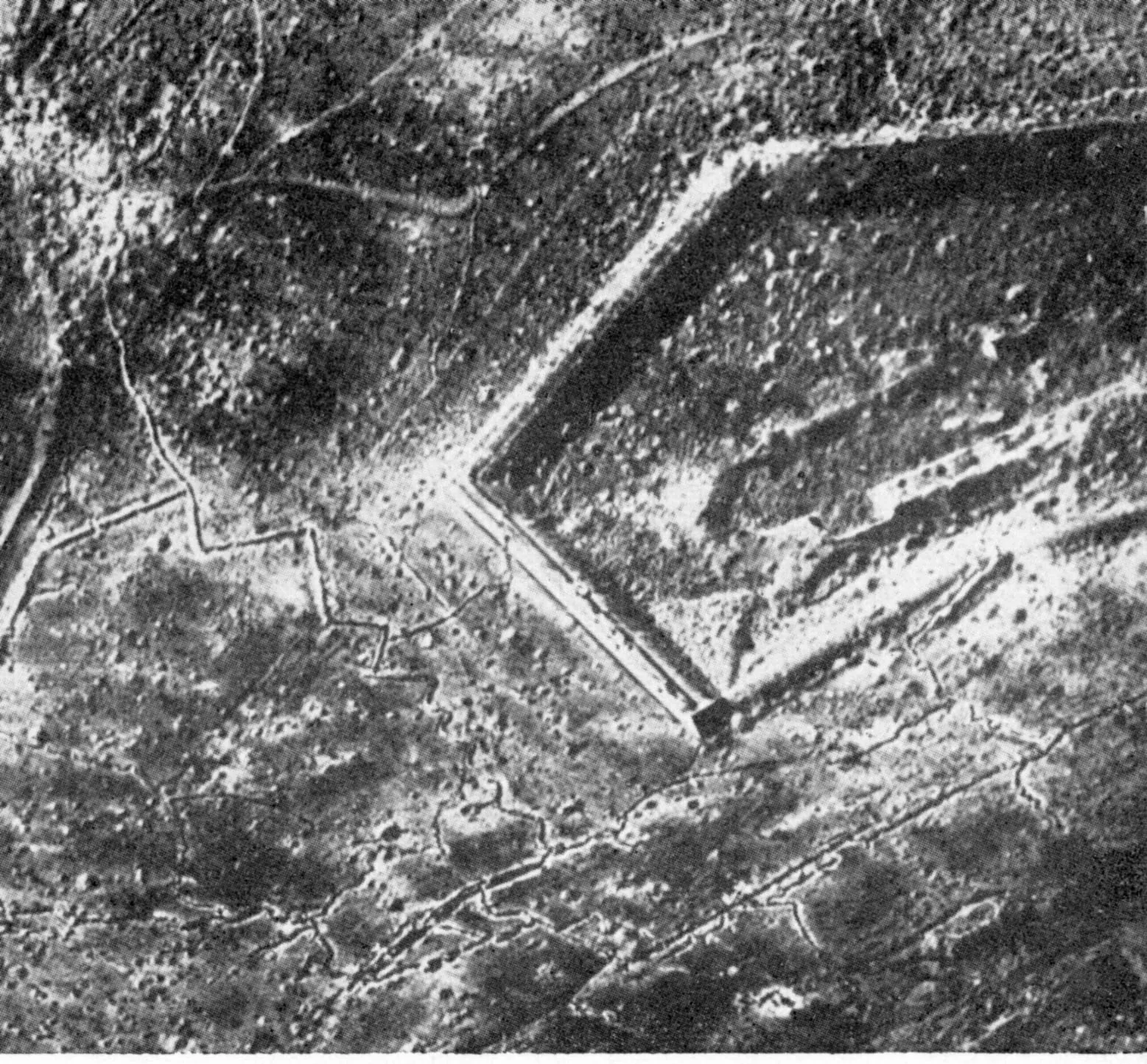
At 11.40 a.m. on 24 October 1916 three French divisions left their trenches on the right bank of the Meuse at Verdun and, in thick fog, advanced behind a creeping barrage against the German positions. In the afternoon soldiers of the Moroccan Colonial Infantry Regiment entered Fort Douaumont, the largest fort of the fortress, which the Germans had taken without a fight on 25 February. The same day the French recovered the ruins of the village of Douaumont, the Thiaumont works and almost all the ground between Forts Douaumont and Vaux over which the Battle of Verdun had been fought for eight months. In two days they took more than 6,000 prisoners. For France, which had been bleeding itself white in defence since February, it was one of the most joyful pieces of news of the whole war.
A fort under 400 mm fire
For eight months Fort Douaumont served the Germans as a shelter, depot and dressing station just behind the front line. The first French attempt to retake it, in May, ended in failure, because the French mortars could not penetrate its concrete roofs. This time General Robert Nivelle, commander of the Second Army, and General Charles Mangin, who led the attack, had a new weapon: two 400 mm railway howitzers, set up on sidings near Baleycourt, about 13–14 km from the fort, and firing shells weighing up to about 900 kilograms. General Philippe Pétain, commander of the Central Army Group, who regarded such guns as a precondition for retaking the forts, had been pressing since the summer for them to be brought up.
The preparatory bombardment began on 20 October, and according to the French official history, by 26 October the artillery had fired more than 800,000 shells on the attack sector. On 22 October the French feigned the start of the assault, and the German batteries that replied gave away their positions and were smothered with shells the next day. At noon on 23 October a 400 mm shell pierced the roof of the fort and exploded in the sick bay, killing, according to French studies, about fifty Germans. Further shells brought down casemates and the main corridor, and one started a fire in a store of grenades and ammunition. The galleries filled with choking smoke, the lights went out, and there was no water to put out the fire. Pétain later wrote, following the German author Werner Beumelburg, that the garrison poured on the flames the mineral water intended for the wounded. In the evening, or according to Pétain only towards morning on 24 October, the commandant of the fort, Major Rosendahl, led the garrison out with the consent of his superiors. On the morning of 24 October only a small detachment of pioneers under Captain Prollius, 26–30 men according to various sources, returned to the ruined fort.
The attack in the fog
Mangin attacked on a front about 7 km wide. The 38th Division of General Guyot de Salins was to take Fort Douaumont, the 133rd Division of General Passaga the ground between the forts, and the 74th Division of General de Lardemelle Fort Vaux. The soldiers, loaded with four days’ food, two gas masks, ammunition and tools, had practised for several weeks behind the lines advancing behind a barrage, and the officers were issued with compasses. In the morning thick fog lay over the battlefield. It made observation from aircraft and balloons impossible, but it also hid the attackers. At 11.40 a.m. the artillery blinded the German observation posts with smoke shells, and the 75 mm field guns shifted their fire into a creeping barrage, moved forward 100 metres every four minutes. According to the French official history the German barrage opened only after twelve minutes. The first German trenches fell almost at once, and many of their defenders came out of their shelters with their hands up.
Fort Douaumont fell to the lot of the Moroccan Colonial Infantry Regiment (Régiment d’infanterie coloniale du Maroc, RICM) of Lieutenant-Colonel Régnier. Despite its name it was not a regiment of Moroccans but of French colonial infantry, formed in Morocco in 1914 from soldiers mostly from France. For 24 October it was reinforced with the 43rd Senegalese Tirailleurs Battalion and two companies of Somalis. The regiment attacked with three battalions. The first, under Major Modat, who was wounded, took the first German line. The second, under Major Croll, passed through it after 1.40 p.m. and surrounded the fort, and its soldiers went down into the ditches and climbed onto the top of the fort, where they met soldiers of the neighbouring 321st Infantry Regiment. The third battalion, under Major Nicolaÿ, which was to clear the inside of the fort, lost its way in the fog, reportedly because the metal of the equipment upset the compass readings. It reached the spot only later, guided by a German prisoner.
At around 3 p.m. soldiers of the RICM entered the fort together with sappers and a detachment of Paris firemen with flamethrowers. Resistance was slight. According to French accounts the first to go inside was the sapper Paul Dumont, who with a few soldiers took four officers and twenty-four men prisoner, and his comrade Jean Ygon captured twenty Germans and two machine guns. Both later received the Legion of Honour, rarely awarded to private soldiers. Captain Prollius was also taken prisoner. The fort, which in February had fallen without a single shot, returned to the French almost as easily, because the artillery had done its work before the infantry came up.
Douaumont, Thiaumont and Vaux
To the left of the RICM the 4th Mixed Regiment of Zouaves and Tirailleurs took the Thiaumont works, over which there had been more than a dozen fights since June, and the ruins of the village of Douaumont. Passaga’s division occupied the ground from the eastern part of Fort Douaumont to the outskirts of the village of Vaux. Only on the right wing did the attack stall. The 74th Division took the Vaux pond, the eastern edge of the Bois Fumin and the Damloup battery, but Fort Vaux, less damaged by the bombardment, held it off with machine-gun fire, and its battalions suffered heavy losses. The fort was not taken that day.
In the evening the French consolidated the ground they had won. According to the war diary of the Central Army Group, by the end of the day they had taken more than 4,000 prisoners, including more than a hundred officers, and by 25 October, according to the Michelin guide to the battlefield, more than 6,000 prisoners and 15 guns. The RICM itself, according to its war diary, lost 111 killed and 389 wounded. On 25 October Major Nicolaÿ became commandant of the recovered fort, and Lieutenant-Colonel Régnier moved his command post into it. The sappers at once began adapting the fort for defence. German counter-attacks over the following days were repulsed.
Echoes of victory
On 25 October Nivelle announced in an order of the day that the soldiers of Mangin’s group had, “in four hours, in one magnificent assault”, taken from the enemy ground whose capture had cost him eight months. The German communiqué of 26 October admitted the loss of the fort and explained it by the foggy weather, which had favoured the French. In France the news was received with enthusiasm. By a decree of 13 November the colour of the RICM received the Legion of Honour, and the name “Verdun-Douaumont” was inscribed on the colours of the regiments that had been first to reach the fort. The Marine Infantry Tank Regiment (Régiment d’infanterie chars de marine), which continues the traditions of the RICM, still celebrates 24 October as its regimental day.
The fighting did not end that day, however. The Germans abandoned Fort Vaux only at the beginning of November, and in December Mangin struck again and pushed them back from Douaumont by several more kilometres. The success of 24 October made heroes of Nivelle and Mangin, and the method of a short, carefully prepared attack behind a creeping barrage seemed a recipe for victory. In mid-December Nivelle became commander-in-chief of the French army.
Remember the articles you have read? Only in this browser; nothing is sent anywhere.How it works
Read ·
Voices from the front
“At the end of October the Frenchman broke out on the east bank of the Meuse in a large-scale, boldly executed counter-thrust and overran our lines. We lost Douaumont and no longer had the strength to retake this point of honour of German heroism. […] On the whole the enemy this time beat us with our own former method of attack.”
Translated · Original (de)
Ende Oktober brach der Franzose auf dem Ostufer der Maas zu einem großangelegten, kühn durchgeführten Gegenstoß vor und überrannte unsere Linien. Wir verloren Douaumont und hatten keine Kräfte mehr, um diesen Ehrenpunkt deutschen Heldentums wieder zu nehmen. [...] Im großen und ganzen schlug uns der Gegner diesmal mit unserem eigenen bisherigen Angriffsverfahren.
“On 24 October excellent news reaches us from Verdun. An attack mounted by General Nivelle with three divisions on the Douaumont side has fully succeeded. We no longer merely repel the attackers. It is the enemy who is besieged. It is a splendid success. But the next day, the 25th, the Germans take their revenge on Reims, which they bombard violently.”
Translated · Original (fr)
Le 24 octobre, nous arrive une excellente nouvelle de Verdun. Une attaque montée par le général Nivelle avec trois divisions du côté de Douaumont a pleinement réussi. Nous ne nous bornons plus à repousser les assaillants. C’est l’ennemi qui est assiégé. C’est un splendide succès. Mais le lendemain 25, les Allemands se vengent sur Reims, qu’ils bombardent violemment.
Spotted a mistake?Report an error
Meanwhile
(03)Elsewhere in the same days.
- 22 October 1916 · Balkan FrontBulgarians and Germans take ConstanțaOn 22 October 1916, after three days of Mackensen's offensive in Dobruja, Bulgarian and German troops entered Constanța, Romania's main port.
- 26 October 1916 · War at seaFirst German destroyer raid in the Strait of DoverOn the night of 26–27 October 1916 German destroyers from Zeebrugge struck the Dover Strait barrage, sinking Flirt, several drifters and the transport Queen.
- 21 October 1916 · PoliticsAssassination of Prime Minister StürgkhOn 21 October 1916 in a Vienna restaurant the socialist Friedrich Adler shot Austrian Prime Minister Karl Stürgkh, who had ruled without parliament since 1914.
Related events
(04)The same battle, people or subject.
- 18 December 1916 · Western FrontEnd of the Battle of VerdunOn 18 December 1916 Zouaves retook Les Chambrettes farm, ending Mangin's December attack and the Battle of Verdun, under way since February, the war's longest.
- 3 November 1916 · Western FrontThe French recapture Fort VauxEarly on 3 November 1916 the French entered the empty Fort Vaux at Verdun. The day before, the Germans had abandoned it, blowing up part of the works.
- 12 December 1916 · Western FrontNivelle becomes commander-in-chiefOn 12 December 1916 Briand reshaped his government and set up a five-man war committee. Nivelle replaced Joffre in command of the French armies in France.
- 16 April 1917 · Western FrontNivelle offensive beginsAt 6 a.m. on 16 April 1917 the French attacked on the Chemin des Dames. Meant to break through in two days, by evening they were stuck below the ridge.