1916: Verdun
First Offensive Battle of Verdun
- Dates:
- 24 October – 18 December 1916
- Front:
- Western Front
- Location:
- Right (east) bank of the Meuse north-east of Verdun, from Vacherauville and the Côte du Poivre to Louvemont, Douaumont, Vaux and Bezonvaux, Meuse department, FranceOn the battle map →
- Sides:
- German EmpireCrown Prince Wilhelm, Ewald von Lochow
- Result:
- French victory. The French recovered Forts Douaumont and Vaux, the Côte du Poivre and Louvemont heights and Bezonvaux, took well over ten thousand prisoners and pushed the Germans several kilometres back from the city.
- Author:
- Łukasz Skowroń
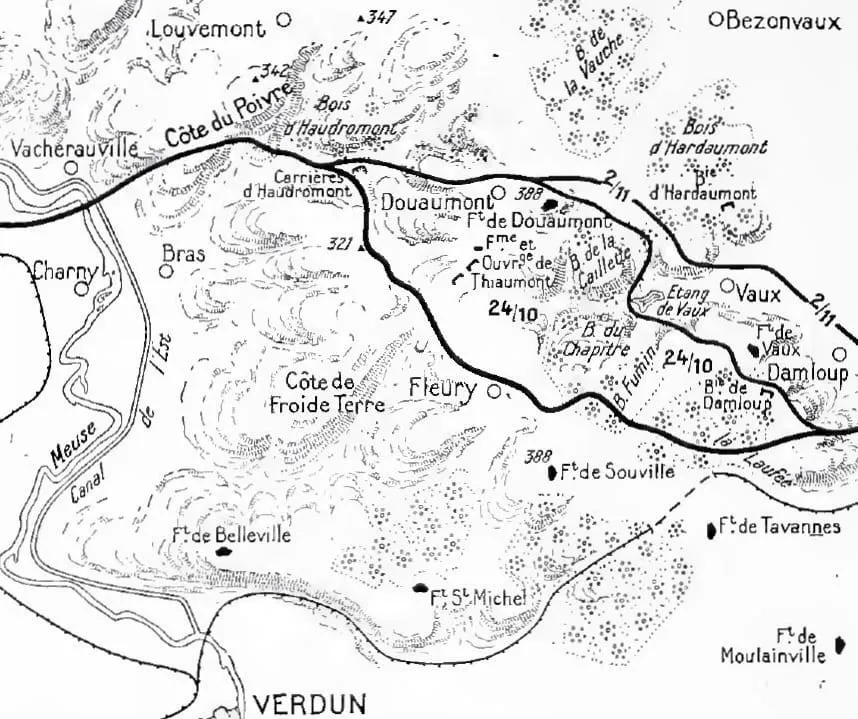
The First Offensive Battle of Verdun was the autumn counter-offensive with which the French brought the Battle of Verdun to a close. After eight months on the defensive, Generals Robert Nivelle, commander of the 2nd Army, and Charles Mangin, commander of the grouping on the right bank of the Meuse, prepared two carefully planned attacks with limited objectives. On 24 October three divisions, preceded by a bombardment lasting several days in which two heavy 400 mm railway howitzers smashed the roofs of Fort Douaumont, advanced in fog behind a creeping barrage. Within a few hours they had recovered the fort, the village of Douaumont and the Thiaumont works, and with them ground the Germans had been fighting for since February. On 2 November the Germans abandoned the wrecked Fort Vaux. On 15 December Mangin struck again, with four divisions, and by 18 December had driven the Germans off the heights of Louvemont and the Côte du Poivre and out of Bezonvaux. In the two attacks the French took well over ten thousand prisoners. The success raised Nivelle to the post of commander-in-chief of the French army.
Name and dates
The name comes from the British chronology of the war on which our timeline is based. Following the French division, it splits the fighting at Verdun in 1916 into the “defensive battle” (21 February to 31 August) and the “First Offensive Battle”, lasting from 24 October to 18 December 1916. Within it, it distinguishes two actions: the “actions of Douaumont and Fort Vaux” on 24 October and the “actions of Louvemont and Bezonvaux” on 15–18 December. The chronology reserves the name “Second Offensive Battle” for the French attack of August 1917, in which the French recovered the Mort-Homme and Hill 304. Some works, however, including the English Wikipedia, count the December attack as a separate, second offensive battle and move the start of the first to 20 October, when the preparatory bombardment began. The French usually speak of the offensive of 24 October (the recapture of Douaumont) and the offensive of 15 December. We adopt the chronology’s dates, 24 October – 18 December 1916, which coincide with the end of the Battle of Verdun as a whole.
Background
In the summer of 1916 the initiative at Verdun passed to the French. The offensive on the Somme and the Russian Brusilov offensive forced the Germans to transfer divisions and heavy artillery to other fronts. After the last assault on Fort Souville in July, the German 5th Army of Crown Prince Wilhelm went over to the defensive, and at the beginning of September the new supreme command, Paul von Hindenburg and Erich Ludendorff, halted all attacks there. The Germans still held Fort Douaumont, taken on 25 February, and Fort Vaux, which fell in June, and with them the heights from which they observed the French rear. The first attempt to retake Douaumont, made by Mangin’s division on 22 May, ended in a bloody defeat, because the French artillery was too weak and the 370 mm mortars could not pierce the fort’s concrete.
General Philippe Pétain, commander of the Group of Armies of the Centre, drew the lessons from this. As he wrote in his memoir of Verdun, in the summer he asked the high command for two 400 mm mortars, without which he considered the recapture of the forts impossible, and decided to wait with a larger attack until the autumn, when he would receive them. In September the French improved their positions around Fleury and Thiaumont with small attacks. On 4 September a fire broke out in the Tavannes railway tunnel, used as a shelter, depot and dressing station, and set off an explosion of ammunition. 474 French soldiers died in it. At the beginning of October, according to Pétain, he and Nivelle agreed that the time had come to retake the forts. The operation was entrusted to Mangin, who since September had commanded the so-called D-E grouping, that is, the sector from the Meuse to Fort Tavannes.
Preparations
The attack was prepared for several weeks. Regiments were trained behind the lines on scale models of the ground, where they practised advancing close behind a creeping barrage. Platoons were reorganised to have their own riflemen, grenadiers and automatic riflemen, and the infantry received more machine guns, rifle-grenade launchers and light 37 mm guns. Officers were issued compasses, because in ground churned up by shell holes, with no roads or landmarks, it was easy to get lost. Roads, narrow-gauge light railways and ammunition dumps were built under fire.
Pétain states that for the attack the French assembled some 300 field guns and 300 heavy guns, and identified some 200 batteries, that is 800 guns, in the German sectors on the right bank. Other sources, for example the post-war Michelin guide to the battlefield, speak of 650 guns, and the historian Christina Holstein of more than 700. The most important were two new 400 mm railway howitzers from the Saint-Chamond works, positioned on sidings near Baleycourt, some 13–14 km from the fort. Their shells weighed up to about 900 kilograms. Counter-battery fire began as early as the start of October. The attack was set for 17 October, but torrential rain forced its postponement. When the weather improved on 20 October, the preparatory bombardment began and the day of the attack was fixed for 24 October. According to the French official history, from 21 to 26 October the artillery fired some 530,000 75 mm shells, more than 100,000 155 mm shells and more than 170,000 of other calibres on the attack sector.
On 22 October at 3 p.m. the French artillery opened fire as if an attack were beginning, and the infantry feigned leaving the trenches. The Germans replied with barrage fire, revealing, according to the official history, 158 new battery positions, which the French smothered with shells the next day. The Crown Prince announced in a communiqué that a strong French attack had been repulsed. On 23 October 400 mm shells pierced the roofs of Fort Douaumont. One exploded in the infirmary, killing several dozen Germans, others brought down casemates and the main corridor, and one started a fire in a store of grenades and ammunition. The fort filled with smoke and gases, and there was no water to put out the fire. In the evening and during the night the commandant, Major Rosendahl, led the garrison out. On the morning of 24 October only a small detachment of pioneers under Captain Prollius returned to the fort, some 26–30 men according to various sources.
The recapture of Douaumont (24 October)
Three divisions went into the attack on a front some 7 km wide: General Guyot de Salins’s 38th Division against Fort Douaumont, General Passaga’s 133rd Division, known as “the Gaulish” (La Gauloise), into the gap between the forts, and General de Lardemelle’s 74th Division against Fort Vaux. Behind them stood three divisions in reserve. On the German side the sector was held by General Ewald von Lochow’s Maas-Ost group, subordinate to the 5th Army. According to Pétain, the 34th, 54th and 9th Divisions and the 33rd Reserve Division stood in the first line, with the 10th and 5th Divisions in the second.
At 11.40 a.m. the infantry left the trenches in thick fog. The fog prevented observation from aircraft, but it also hid the attackers, and the German barrage, according to the French official history, opened only after a dozen or so minutes. In front of the infantry moved a creeping barrage of 75 mm shells, lifted 100 metres every four minutes, with heavy artillery fire beyond it. The first German trenches fell almost at once, and many Germans came out of their shelters with their hands up.
Fort Douaumont was the task of Lieutenant-Colonel Régnier’s Moroccan colonial infantry regiment (Régiment d’infanterie coloniale du Maroc, RICM), reinforced by the 43rd Senegalese Tirailleurs Battalion and two companies of Somalis. Despite its name it was a regiment of French colonial infantry, formed in Morocco in 1914 from soldiers mostly from France. Its battalion under Major Croll reached the fort first and occupied the ditches and the superstructure, while Major Nicolaÿ’s battalion, which was to clear the interior, strayed in the fog because its compasses, as was later explained, were disturbed by the metal of the men’s equipment. At around 3 p.m. RICM soldiers, sappers and a detachment of Paris firemen with flamethrowers entered the fort and captured Prollius’s detachment. To their left the 4th Mixed Regiment of Zouaves and Tirailleurs took the Thiaumont works and the ruins of Douaumont village, and to their right the 321st Infantry Regiment of the 133rd Division came up to the fort’s eastern face. Passaga’s division took all the ground between the forts as far as north of the village of Vaux.
Only the 74th Division failed to reach its objective. Fort Vaux, less damaged by the bombardment, defended itself with machine-gun fire, and the French battalions that took the Vaux pond, the edge of the Fumin wood and the Damloup battery suffered heavy losses. By the evening of 24 October the French had taken more than 4,000 prisoners, including more than a hundred officers, according to the war diary of the Group of Armies of the Centre, and by 25 October, according to the Michelin guide, more than 6,000 prisoners and 15 guns. On 25 October Nivelle announced in an order of the day that Mangin’s soldiers had taken back “in four hours” ground whose capture had cost the Germans eight months. German counter-attacks in the following days were repulsed.
Fort Vaux (25 October – 3 November)
Over the following week the 74th Division, and after it the 63rd Division, approached Fort Vaux several times. A few soldiers even reached its superstructure, but under fire from the fort and from German batteries on the Woëvre plain they could not hold on. Rain turned the trenches into mud, and supplying the front line was almost impossible. French heavy artillery shelled the fort incessantly. On 2 November at around 11 a.m. a 220 mm mortar shell set off a powerful explosion inside it. The Germans, almost cut off from their own lines, decided that the fort could no longer be defended, and its commandant, Lieutenant-Colonel Bellmann, led the garrison out. French listening posts intercepted a radio message about the abandonment of the fort. During the night of 2–3 November a French patrol entered the empty fort through a blocked opening near the gate. The dates in the sources differ: German ones give 1 November as the day of the decision to evacuate, the British chronology records the recapture of the fort under 1 November, Pétain and the Michelin guide under 2 November, and the diaries of the French regiments describe the occupation of the fort in the early hours of 3 November.
By 5 November the French had come almost back to the line they had held on 24 February. On 2 November Mangin received the grand officer’s cross of the Legion of Honour, and by a decree of 13 November the Legion of Honour was awarded to the colours of the RICM. On the attack sector the French took, according to their own tallies, 5,554 prisoners, including 138 officers.
The December attack (15–18 December)
Fort Douaumont was still close to the front line, and German observers on the heights north of it directed fire on the recovered forts. On 18 November Nivelle ordered Mangin to prepare a new attack by mid-December to push the Germans back from the forts. For four weeks, often under fire, roads were built (one of logs laid crosswise for the artillery), several kilometres of narrow-gauge light railway, jumping-off trenches and dumps. The preparatory bombardment lasted six days. According to English-language works some 830 guns fired more than a million shells, while Pétain writes of 740 heavy guns supporting the attack.
On the German side there had been changes in the meantime. At the end of November the Crown Prince took command of the army group bearing his name and handed the 5th Army over to Lochow. The front line between Vacherauville and Bezonvaux, on a sector some 10 km wide, was held by five divisions, with four in reserve. According to the British historian Graeme Wynne, two of them had only some 3,000 infantrymen instead of the normal 7,000, most of the infantry was crowded into the battle zone, and the reserves stood 10–16 km to the rear.
On 15 December at 10 a.m., in bad weather, four French divisions (the 126th, 38th, 37th and 133rd), with four more in reserve, advanced behind a double creeping barrage. They were supported, among others, by the armoured turret of Fort Douaumont with its 155 mm gun, repaired by the French. Vacherauville, the Côte du Poivre and the first lines before Louvemont fell within minutes. The woods in front of Douaumont held out longer, but the German defence collapsed. Many soldiers were captured in their dugouts before they could get out, and the German reserves reached the front only in the evening. By the night of 16–17 December the French had consolidated a new line from Bezonvaux to the Côte du Poivre, 2–3 km north of Douaumont. In the following days they took the Les Chambrettes farm and the rest of the ruins of Bezonvaux. The point of the German front nearest Verdun was pushed several kilometres further from the city, and all the dominant observation points on the right bank returned to French hands.
The French took 11,387 prisoners and 115 guns according to Robert Doughty, and more than 11,000 prisoners, including 300 officers, and hundreds of machine guns according to the Michelin guide. The attack coincided with the German offer of peace talks of 12 December, and Mangin, congratulating his soldiers, called them “true ambassadors of the Republic”. According to an anecdote cited by historians, when captured German officers complained about the conditions of their captivity, Mangin replied, paraphrasing the words of Frederick the Great after the Battle of Rossbach, that so many of them had not been expected. The German command dismissed several commanders. Lochow lost his post, and on 17 December General Max von Gallwitz took over the 5th Army.
Losses
We have not been able to find complete figures for French losses in the two attacks in the available sources, and the overall figures for French losses at Verdun in 1916 include this fighting as well. Pétain wrote that in December the French gained ground “almost without losses”, and French biographies of Mangin stress that the well-prepared attacks cost little. They were not bloodless, however. According to the RICM war diary, that regiment alone lost 111 killed and 389 wounded on 24 October, and in the regiments and battalions fighting for Fort Vaux from 24 October to 3 November, according to their diaries, 881 soldiers were killed, including 34 officers. Among those killed in the fighting for Louvemont (15–16 December; sources differ on the day) was Major Nicolaÿ, who in October had become the first French commandant of the recovered Fort Douaumont.
German losses were much higher. In October the Germans lost more than 6,000 men as prisoners, and the French command estimated their total losses at some 20,000 men. In December, according to Wynne, of some 21,000 soldiers of the five front-line divisions they lost 13,500, most of them as prisoners.
Significance
In a few days the autumn attacks took from the Germans almost everything they had gained on the right bank of the Meuse in eight months. For the French, bled white in the defence, the recapture of Douaumont was a great moral victory and a symbolic end to the Battle of Verdun. The attacks also demonstrated a method with a future: a short, carefully prepared attack with a limited objective, preceded by the destruction of the enemy’s artillery and conducted close behind a creeping barrage. On the German side, the December defeat, in which the infantry crowded into the front lines was captured before the reserves arrived, was cited in the literature as an argument for elastic defence in depth, with a more lightly held front line and counter-attack divisions ready in the rear. The Germans introduced this doctrine at the turn of 1916 and 1917.
The most important consequences, however, were political. On 12 December, during the preparations for the second attack, the government of Aristide Briand, disappointed with the results of the 1916 offensives, gave Nivelle command of the French armies on the North and North-East front in place of Joseph Joffre, who at the end of the month received a marshal’s baton. Nivelle, self-assured, persuasive and a fluent speaker of English, promised that with the Verdun method he would break through the front within two days. His spring offensive of 1917 on the Aisne, in which Mangin commanded the 6th Army, ended, however, in heavy losses and a crisis in the French army, and both generals lost their posts.
Spotted a mistake?Report an error