Germany · The Central Powers
Max von Gallwitz
Army and army group commander on the Eastern Front, in Serbia and on the Western Front (1915–1918), general of artillery
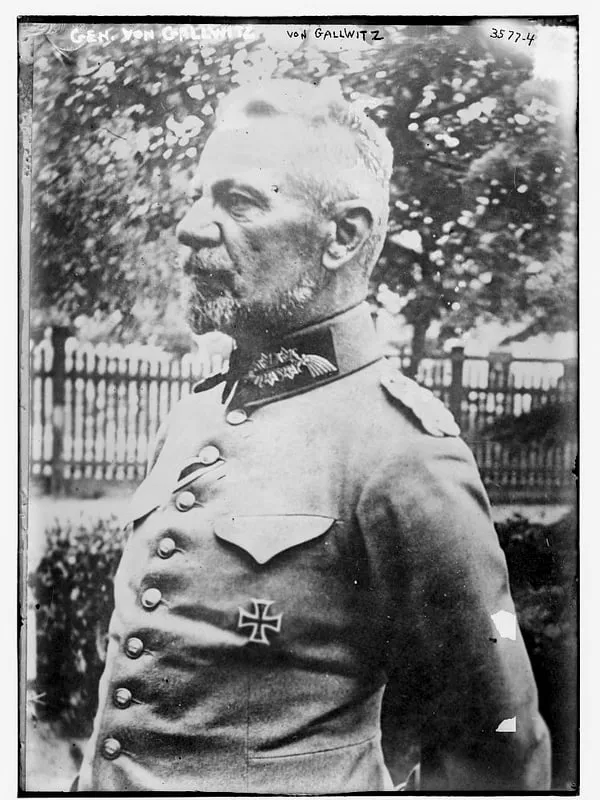
- Born:
- 2 May 1852, Breslau (Prussia)
- Died:
- 18 April 1937, Naples
- Author:
- Łukasz Skowroń
- Photo:
- Bain, domena publiczna, Wikimedia Commons

Max von Gallwitz was one of the few German generals who commanded large formations in the First World War on all of Germany’s main fronts: in Belgium, in East Prussia and in Poland, in Serbia, on the Somme, at Verdun and finally against the Americans. An artilleryman by profession, in August 1914 he took the Belgian fortress of Namur with heavy guns. In July 1915 his army group broke through the Russian front at Przasnysz and on the Narew, which contributed to the Russians’ loss of Warsaw and the whole of Congress Poland. In the autumn of that year he led a German army across the Danube into Serbia. From 1916 he fought in the west, and in 1918 his army group bore the first great American offensives at Saint-Mihiel and in the Argonne.
Before the war
He was born on 2 May 1852 in Breslau, into a middle-class Catholic family. His father was a tax official. His background alone set him apart in the Prussian officer corps, which was dominated by the Protestant nobility. In August 1870, straight after his school-leaving examinations, he volunteered for the field artillery and took part in the Franco-Prussian War.
He became a regular officer, graduated from the War Academy and in 1883 joined the Great General Staff. He then served by turns on staffs, in the Prussian War Ministry and in artillery commands. From 1903 he headed the ministry’s military administration department, and from 1906 to 1911 he commanded the 15th Division in Cologne. In 1911 he became inspector of field artillery and a general of artillery. In 1913, on the 25th anniversary of the reign of Wilhelm II, he received hereditary nobility.
1914: Namur and the Eastern Front
On mobilisation Gallwitz took over the Guards Reserve Corps, which became part of General Karl von Bülow’s 2nd Army. Bülow entrusted him with the capture of the Belgian fortress of Namur at the confluence of the Sambre and the Meuse. At Liège the Germans had spent more than ten days taking the forts one after another, and Gallwitz, drawing on the experience of that fortress, concentrated the fire of his heavy artillery, including German 420 mm mortars and Austro-Hungarian Škoda mortars, on a chosen sector of the ring. The bombardment began on 20 August, and on 25 August the last forts fell. The fortress, whose garrison was supposed by the plans to hold out for a long time, was taken in five days.
Immediately afterwards, when the Russians entered East Prussia, Gallwitz’s corps was moved east by rail. It arrived only in time for the Battle of the Masurian Lakes in September. In October, as part of the new 9th Army, it advanced on the Vistula and reached the area of Ivangorod, but faced with Russian superiority it had to withdraw.
1915: Przasnysz, the Narew and Warsaw
In February 1915 Army Group Gallwitz was formed from the troops south of the East Prussian border. While the winter battle was being fought in Masuria, Gallwitz was to tie down as many Russian forces as possible in Mazovia. His corps took Przasnysz, but a few days later Russian Siberian corps retook the town, and on 27 February Gallwitz ordered a retreat towards the border.
In the summer he returned to the same battlefield with much larger forces. The Supreme Army Command decided to trap the Russians in Congress Poland in a pincer: August von Mackensen attacked from the south and Army Group Gallwitz, reinforced with corps from other fronts and heavy artillery, from the north. On 13 July, after a hurricane bombardment, its infantry attacked at Przasnysz and within a few days pushed the Russian 1st Army back to the Narew bridgeheads. In the following days the Germans forced the river and took Różan and Pułtusk. The pincers, however, did not close in time. The Russians held out on the Narew long enough to withdraw their armies from the Vistula bend, and on 5 August the Germans entered Warsaw. According to the Encyclopaedia Britannica, between 13 July and 3 August Gallwitz’s group took about 50,000 prisoners but only 14 guns, which showed that the Russians were withdrawing their artillery in good time. On 7 August the group was renamed the 12th Army, which pursued the Russians further east, towards Białystok. Gallwitz received the Pour le Mérite in July and the oak leaves to it in September.
1915: Serbia
At the end of September 1915 Gallwitz took over the 11th Army, hitherto commanded by Mackensen, who had been promoted to command the whole expedition against Serbia. His seven divisions deployed on the Danube opposite Smederevo, east of Belgrade. On 6 October the crossing of the Sava and the Danube began. The crossings at Smederevo, Ram and Kostolac went with difficulty: from 12 October the košava, a violent east wind, raged over the Danube and at times halted traffic on the river. After the fall of Belgrade, taken by the Austro-Hungarian 3rd Army of General Hermann Kövess, the 11th Army advanced up the Morava valley. At the end of October it struck straight at Kragujevac, the seat of the Serbian arsenal, which fell on 1 November, and in the second half of November its units entered Priština. The Serbian army, however, avoided encirclement, and the conquest of Serbia ended with its retreat through Albania. At the beginning of 1916 most of the German divisions left the Balkans.
Verdun and the Somme
In the spring of 1916 Gallwitz returned to the west. At Verdun, where the attack along the right bank of the Meuse had stalled, he commanded an assault group on the left bank of the river, which fought heavy battles for the hills of Mort-Homme and Hill 304. The Germans took them only in May.
When the British and French offensive on the Somme began on 1 July, the Supreme Army Command split the front between two armies. On 19 July Gallwitz took over the 2nd Army south of the river and at the same time command of the whole grouping, including General Fritz von Below’s 1st Army north of the Somme. At the end of August both armies were placed under the army group of the Crown Prince of Bavaria, Rupprecht, and Gallwitz remained with the 2nd Army. Throughout the summer and autumn his troops defended themselves under heavy artillery fire and against the enemy’s superiority in the air.
In December 1916, after the French had retaken Forts Douaumont and Vaux in their autumn counter-offensive at Verdun, the commander of the 5th Army, Ewald von Lochow, lost his post, and on 17 December Gallwitz took his place. He commanded this army almost to the end of the war. In August 1917 he had to accept another defeat, when the French 2nd Army retook Mort-Homme and Hill 304. One of the tunnels through which the Germans brought up supplies in this sector bore his name.
1918: against the Americans
On 1 February 1918 Gallwitz took over a newly formed army group, which included the 5th Army at Verdun and Army Detachment C, defending the Saint-Mihiel salient. Gallwitz had long regarded this narrow wedge, driven into the French front since 1914, as a trap. When intelligence reported an American concentration in September, the Supreme Army Command agreed to withdraw the troops to the base of the salient. On 12 September the American First Army attacked in the middle of this withdrawal and eliminated the salient within a day, taking thousands of prisoners. Gallwitz later wrote that he had been through a great deal in five years of war, but had to count 12 September among his “few black days”.
Two weeks later the Americans of General John Pershing and the French began the Meuse–Argonne offensive. At the end of September Gallwitz handed over the 5th Army to General Georg von der Marwitz, but as army group commander he directed the defence until the armistice. His troops, relying on the fortifications in the Argonne forests and on the heights above the Meuse, inflicted heavy losses on the Americans for several weeks and gave ground slowly. On 28 October 1918, summoned to Berlin, where the government of Prince Max of Baden was deliberating over the armistice terms, he spoke in favour of continuing the fight.
After the war
After the armistice he led his troops back to Germany and in December 1918 left the army. He went into politics. From 1920 to 1924 he was a member of the Reichstag for the German National People’s Party, fought the Treaty of Versailles and repeated the slogan of an army “undefeated in the field”, which helped to spread the stab-in-the-back myth. In 1931 he took part in the founding meeting of the Harzburg Front, an alliance of the nationalist right with the NSDAP. He published two volumes of memoirs: on the years 1914–1916 and on the fighting in the west in 1916–1918. He died on 18 April 1937 in Naples, during a holiday trip to Italy. He was buried in Freiburg im Breisgau.
Assessment
Gallwitz was one of the commanders to whom the Supreme Army Command entrusted the most difficult tasks, now in the east, now in the west. Writers on him stress his artillery expertise, evident at Namur and on the Narew, and his calm, matter-of-fact handling of defence on the Somme and in the Argonne. At the same time his greatest victory, the breakthrough on the Narew, did not achieve its aim, because the Russians managed to withdraw from Congress Poland. Historians argue over whether the fault lay in the pace of his attack, in Russian resistance on the Narew, or in the plan itself, which directed the pincers too close to Warsaw. Nor did he win an independent victory in Serbia, where he was under Mackensen, and in 1916–1918 his armies were mainly on the defensive, several times losing ground, as at Verdun in 1917 and at Saint-Mihiel.
His post-war activity casts a shadow over this record. The German historian Holger Afflerbach describes him as a representative of political Catholicism to the right of the Centre Party and an avowed antisemite. In 2018 Freiburg renamed the street named after him, citing the general’s share of responsibility for prolonging a hopeless war and his later support for the Nazi movement. Gallwitz is also often credited with the remark that the British on the Somme were lions led by lambs. These words, however, appear neither in his memoirs nor in his diaries, and are most probably a legend.
Sources
Spotted a mistake?Report an error
Commanded in battles
(12)- 20–25 August 1914Siege of NamurWestern Front
- 22–27 February 1915First Battle of PrzasnyszEastern Front
- 13–26 July 1915Battle of the Narew and BiebrzaEastern Front
- 13–17 July 1915Second Battle of PrzasnyszEastern Front
- 6 October – 4 December 1915Conquest of SerbiaBalkan Front
- 1 July – 18 November 1916Battle of the SommeWestern Front
- 15 July – 3 September 1916Battle of Delville WoodWestern Front
- 3–6 September 1916Battle of GuillemontWestern Front
- 20 August – 15 December 1917Second Offensive Battle of VerdunWestern Front
- 8 August – 11 November 1918Hundred Days OffensiveWestern Front
- 12–16 September 1918Battle of Saint-MihielWestern Front
- 26 September – 11 November 1918Meuse–Argonne offensiveWestern Front
Mentioned in battles
(03)Often appears with
People who appear in the same events.
On the timeline
(22)1914
1915
February
July
- 13
- Central Powers' great offensive in the east beginsOn 13 July 1915 the Germans struck from East Prussia towards the Narew. An offensive began that was to drive the Russians out of the Kingdom of Poland.
- Battle of the Narew and Biebrza beginsOn 13 July 1915 Gallwitz's and Scholtz's armies attacked the Russian front between the Vistula and Biebrza, aiming at the Narew crossings and Warsaw's rear.
- Second Battle of Przasnysz beginsOn 13 July 1915, after a bombardment of several hours from some 800 guns, Army Group Gallwitz broke the Russian First Army's main defence line at Przasnysz.