Key event
End of the Battle of Verdun
- Category:
- Military operations
- Front:
- Western Front
- Date:
- 18 December 1916
- Author:
- Łukasz Skowroń
- Battle:
- First Offensive Battle of Verdun
- Tags:
- France, Germany, trench warfare, prisoners of war
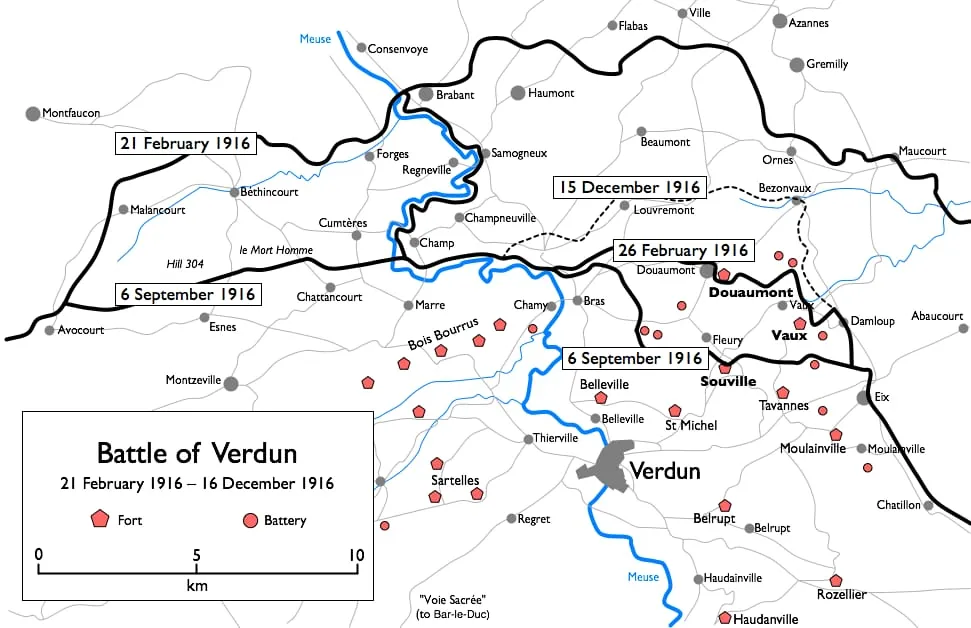
On 18 December 1916, at three in the afternoon, a battalion of French Zouaves, without shelter or hot food for several days, in snow and mud, retook the ruins of Les Chambrettes farm on the plateau north of Verdun. It was the last act of General Charles Mangin’s December attack, which in four days had driven the Germans off the heights on the right bank of the Meuse, and at the same time the end of the Battle of Verdun. The battle had lasted since 21 February, nearly ten months, longer than any other in the war. The British chronology of the war, on which our timeline is based, ends it on 18 December. German studies often give 19 December, and French casualty returns run to 20 December.
A victory announced in advance
The attack had been in preparation since mid-November. It was meant to push the Germans back from the forts of Douaumont and Vaux, recovered in October and at the beginning of November, and to deprive them of their last observation points, from which they directed fire on the French rear. Before the attack it was windy and wet, snow fell, and the preliminary bombardment, which according to the British writer and historian John Buchan was to have begun on 2 December, had to be postponed by a week. It began on 11 December and lasted four days, with breaks for bad weather. According to Pétain, Mangin had 740 heavy guns at his disposal, and according to English-language studies about 830 guns in all, which fired more than a million shells.
General Robert Nivelle, commander of the Second Army, who on 12 December was appointed commander-in-chief of the French armies in France, was so sure of success that he announced it to the government. As Buchan wrote, he told the ministers: “Prepare for good news. Before the evening of 15 December I shall send you a telegram with the details of this or that success.” Meanwhile, on 12 December the German Chancellor proposed peace talks, boasting in the Reichstag that the German front remained unshaken. General Philippe Pétain, commander of the Centre Army Group, later wrote that the attack of 15 December was the French answer to this proposal.
15 December
At 10 a.m., on a grey and cold day, four French divisions went into the attack on a front about 10 kilometres wide, from the Meuse to the Hardaumont wood. On the left wing General Muteau’s 126th Division, made up largely of older reservists, took the village of Vacherauville and the Côte du Poivre ridge with Hill 342 in less than half an hour, taking, according to Buchan, about 1,200 prisoners. Next to it the colonial Moroccan brigade of General Guyot de Salins’s 38th Division captured the ruins of the village of Louvemont. In the fighting for the trenches in front of the village Major Nicolaÿ was killed, who in October had been one of the first to enter the recaptured Fort Douaumont. The Zouaves of the same division climbed Hill 378, the highest point in the area after Douaumont, in three-quarters of an hour, and at 1.20 p.m. took Les Chambrettes farm.
Further east the going was harder. General Garnier-Duplessix’s 37th Division was held up before the trenches the Germans called Weimar and Chemnitz, and with it General Passaga’s 133rd Division, which had taken the Hardaumont wood in the morning. Even so, the German defence collapsed. According to the British historian Graeme Wynne, in the five German front-line divisions most of the infantry had been crowded into the combat zone, while the reserves stood 10–16 kilometres to the rear. Many Germans, stunned by the four-day bombardment, were taken prisoner in their dugouts. The two divisions earmarked for the counter-attack were still more than 20 kilometres from the battlefield at noon.
The last days
At dawn on 16 December two battalions from Passaga’s division broke into the ruins of the village of Bezonvaux, and the Zouaves turned the Weimar trench from the rear. According to Buchan, disaster was narrowly averted when some six hundred prisoners, sent to the rear without an escort, realised how few the attacking chasseurs were at that point and took up arms again. A company of Zouaves saved the situation. By evening the French stood in the Caurières wood and on the edge of the plateau, on the line they had held on 24 February, the fourth day of the battle. The point of the German front nearest Verdun had moved several kilometres away from the city.
What remained was to hold the ground won, which in December weather was perhaps harder than taking it. The soldiers lay in water-filled shell holes, without dugouts or hot food. The British official history writes of mud “of the consistency of soft soap” and of many soldiers on both sides falling victim to trench foot. The Germans counter-attacked mainly against the salient at Les Chambrettes and on 17 December retook the ruins of the farm. Lieutenant-Colonel Richard’s battalion of Zouaves refused to be relieved until it had recovered them. On 18 December at 3 p.m. it went into the attack. Buchan described the soldiers, their feet frostbitten, advancing on their knees or leaning on their rifles like crutches, while their commander is said to have shouted: “Forward, the frozen feet!” The farm was French again.
The balance of the attack
According to Buchan, in four days the French took 11,387 prisoners, including 284 officers, and captured or destroyed 115 guns, 44 trench mortars and 107 machine guns. The numbers of prisoners and guns are confirmed by the American historian Robert Doughty. Buchan estimated French losses on the first day at about 1,500 men. Pétain wrote that the ground had been taken “almost without losses”, but in the following days, once the front had come to a halt, losses mounted. In an order to his troops Mangin recalled that their forefathers of the Revolution did not parley with the enemy as long as he stood on French soil: “Through the mouths of your guns and the points of your bayonets France has given her answer. You have been the ambassadors of the Republic. The Republic thanks you.”
On the German side the defeat was painful. The commander of the Fifth Army, General Ewald von Lochow, lost his post, and his place was taken by General Max von Gallwitz. Crown Prince Wilhelm, the face of the German offensive since February, recalled: “For the first time I understood what it means to lose a battle.” Erich Ludendorff, who was just then triumphing in Romania, admitted in his memoirs that the blow was particularly painful because on the Western Front the Germans were already “completely exhausted”.
Ten months
From the battle that had begun with the German assault on the forts of Verdun, neither side came away with what it wanted. The Germans took neither the city nor the heights above the Meuse, and in the autumn they lost almost everything they had taken on the right bank of the river. Only Mort-Homme and Hill 304 on the left bank remained in their hands. France held Verdun, but bled for it. According to the most frequently cited figures, from 21 February to 20 December the French lost about 377,000 killed, wounded, missing and prisoners, and the Germans about 337,000, more than 700,000 men in all. Other estimates are higher or lower, but almost all show that the losses of the two sides were similar, and not, as the chief of the German General Staff Erich von Falkenhayn had reckoned, many times higher on the French side.
Almost the whole French army passed through Verdun. The French rotated their divisions frequently, before they were bled white, in a system likened to a water wheel (noria). Pétain wrote that by mid-July they had committed 70 divisions against 46 German ones, and according to the German historian Holger Afflerbach a total of 85 French divisions fought at Verdun. According to frequently cited calculations, about three-quarters of the infantry regiments of the French army served there. That is why Verdun became for the French a symbol of the whole war, a shared experience of millions of soldiers. So too did the “Voie Sacrée” (Sacred Way) from Bar-le-Duc, along which men and ammunition were brought up, and the slogans “On les aura!” (“We’ll get them!”) from Pétain’s April order and “Ils ne passeront pas” (“They shall not pass”), which grew out of Nivelle’s June order.
The victories of October and December gave the French the feeling that after years on the defensive they had found a way to deal with the German trenches. Nivelle believed that the Verdun method could be repeated on a much wider front, and he based his plan for the spring offensive of 1917 on it. The battlefield, churned up by millions of shells, never regained its former appearance. Six destroyed villages, among them Louvemont and Bezonvaux, were never rebuilt. After the war the Douaumont Ossuary was built here, in which the remains of about 130,000 unidentified soldiers of both sides were laid.
Remember the articles you have read? Only in this browser; nothing is sent anywhere.How it works
Read ·
Spotted a mistake?Report an error
Meanwhile
(04)Elsewhere in the same days.
- 17 December 1916 · Balkan FrontArrest warrant for VenizelosOn 17 December 1916 Athens issued a warrant for the arrest of Venizelos for high treason. To royalists the Salonika government leader was just "the Traitor".
- 19 December 1916 · Balkan FrontBritain recognises the Venizelos governmentOn 19 December 1916 Lloyd George announced in the Commons that Britain would receive representatives of Venizelos's government. France followed London's lead.
- 20 December 1916 · PoliticsClam-Martinic becomes Austrian prime ministerOn 20 December 1916 Emperor Charles I appointed Count Heinrich Clam-Martinic, a Bohemian aristocrat from Franz Ferdinand's circle, prime minister of Austria.
- 15 December 1916 · SocietyBarbusse's Under Fire wins the Prix GoncourtOn 15 December 1916 the Prix Goncourt went to Henri Barbusse's Under Fire, a stark picture of a French squad in the trenches, by a volunteer from the front.
Related events
(04)The same battle, people or subject.
- 3 November 1916 · Western FrontThe French recapture Fort VauxEarly on 3 November 1916 the French entered the empty Fort Vaux at Verdun. The day before, the Germans had abandoned it, blowing up part of the works.
- 24 October 1916 · Western FrontThe French recapture Fort DouaumontOn 24 October 1916 three French divisions attacked in fog at Verdun. The colonial regiment from Morocco retook Fort Douaumont, lost eight months earlier.
- 31 August 1916 · Western FrontEnd of the French defence at Verdun31 August 1916 is the nominal end of the defensive phase of Verdun. In August the French retook Fleury and the Germans stopped seeking a decision on the Meuse.
- 2 June 1916 · Western FrontGermans take Fort VauxOn 2 June 1916 the Germans broke into Fort Vaux at Verdun. Major Raynal's garrison held out underground until 7 June, when the water ran out.