United States · The Entente
John Pershing
Commander of the American Expeditionary Forces in France (1917–1919), General of the Armies of the United States
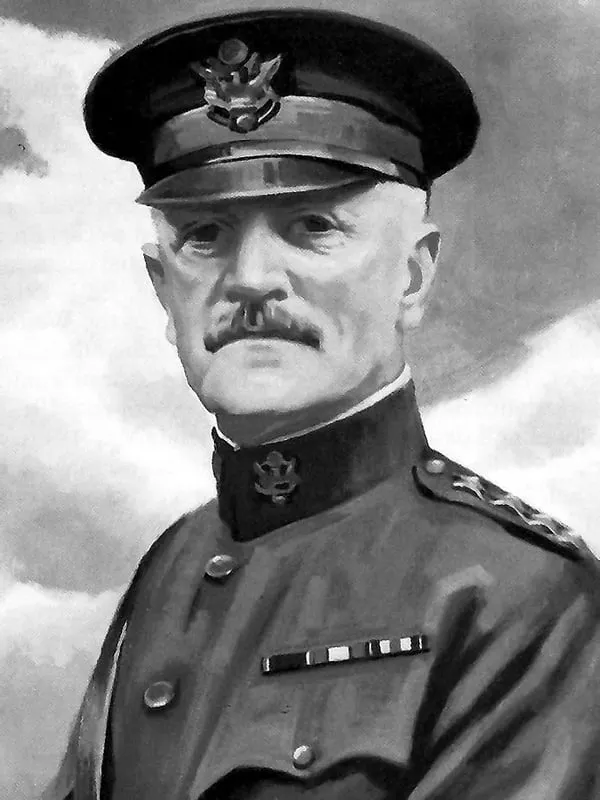
- Born:
- 13 September 1860, Laclede (Missouri, United States)
- Died:
- 15 July 1948, Washington, D.C.
- Author:
- Łukasz Skowroń
- Photo:
- Richard Leopold Seyffert, domena publiczna, Wikimedia Commons

John Joseph Pershing, known as “Black Jack”, commanded the forces of the United States in France from the first weeks after America entered the war until its end. When he arrived in Europe in June 1917 he had only a staff behind him, and the army he was to lead did not yet exist. By November 1918 he commanded almost two million soldiers in two field armies. Throughout that time he stubbornly refused the French and British, who wanted to feed Americans into their own divisions as replacements, and won for them an independent army with its own sector of the front. He led it at Saint-Mihiel and in the Meuse–Argonne offensive, the bloodiest battle in the history of the American army. To some he was a great organiser who gave America an army worthy of a great power; to others a stubborn general who paid for independence with the lives of thousands of soldiers.
Before the war
He was born on 13 September 1860 on a farm near Laclede in Missouri, into the family of a farmer and storekeeper whose ancestors had come from Alsace. As a teenager he taught at a school for Black children, then graduated from the teachers’ college in Kirksville. He applied to the military academy at West Point, as he himself admitted, not out of love for soldiering but because the education there was free and better than in rural Missouri. He graduated in 1886 as First Captain of the Corps of Cadets, the highest-ranking cadet of his class.
In his first years he served in the cavalry on the frontier, fighting the Apache and the Sioux. Later he was a military instructor at the University of Nebraska, where he also took a law degree, and commanded a troop of the 10th Cavalry Regiment, made up of Black soldiers, the so-called Buffalo Soldiers. This service gave rise to his nickname, at first an insult, bestowed on him by the West Point cadets, among whom he was a strict and none too popular instructor. In the Spanish–American War of 1898 he fought in Cuba at San Juan, and then spent several years in the Philippines suppressing the resistance of the Muslim Moros. He was an observer with the Japanese army in the Russo-Japanese War. In 1906 President Theodore Roosevelt promoted him straight from captain to brigadier-general, passing over more than eight hundred more senior officers. Critics pointed out that Pershing’s father-in-law was the influential Republican senator Francis E. Warren of Wyoming, chairman of the Senate Committee on Military Affairs.
From 1909 to 1913 he was military governor of the Moro Province in the Philippines. In the spring of 1914 his brigade was posted to the border with Mexico, then in the throes of revolution. On 27 August 1915 his wife Frances and three daughters died in a fire at his house in the Presidio of San Francisco. Only his six-year-old son Warren survived. In March 1916, after a raid by Pancho Villa’s men on the small town of Columbus in New Mexico, Pershing led a punitive expedition deep into Mexico, numbering about 10,000 soldiers at its peak. He did not catch Villa, and the expedition almost led to war with the Mexican government. He withdrew the last units at the beginning of February 1917. In September 1916 he became a major-general.
Chosen to command
When on 6 April 1917 the United States declared war on Germany, the natural candidate to command the troops sent to Europe, General Frederick Funston, was already dead. He had died suddenly in February, and Pershing had taken over his command on the Mexican border. President Woodrow Wilson and Secretary of War Newton Baker chose him, although there were several generals senior to him. The Mexican expedition had shown them that Pershing could maintain discipline, command a large force and carry out the instructions of the civil authorities even when he disagreed with them. On 10 May he arrived in Washington, and at the end of the month he took command of the American Expeditionary Forces (AEF). Baker’s instructions of 26 May told him to co-operate with the Allies but to preserve the identity of the American forces as “a separate and distinct component” of the combined forces. Pershing defended this principle to the end of the war.
On 28 May he sailed from New York with his staff. After a few days in London, where he was received by the King and ministers, on 13 June he arrived in Paris, greeted by crowds as a saviour. A visit to the headquarters of General Philippe Pétain, who was just then calming the mutinous French army, showed him how much the Allies were counting on the Americans and how little he had to offer them. The country, which in April had about 130,000 soldiers in the regular army, was only now passing conscription.
Building an army
In the first months Pershing was occupied mainly with organisation. He chose ports on the west coast of France, railway lines, depots and training areas in Lorraine, away from the British supply lines in the north. In September he moved his headquarters to Chaumont in the Haute-Marne. As early as the summer of 1917 he demanded that a million soldiers be sent to him by the spring of 1918, and ultimately many more, and he planned divisions twice the size of European ones, about 28,000 men each. He believed that the Allies, exhausted by three years of trench warfare, had forgotten mobile warfare, and he had the Americans trained above all in marksmanship and the attack. European commanders, and quietly some American generals too, regarded this as naive.
On 6 October 1917 he became a full general, the first in the American army since Philip Sheridan. The first units of the 1st Division had landed in France as early as June; in October they entered a quiet sector of the front near Nancy, and on the night of 2–3 November the first American soldiers were killed. Even so, at the end of 1917 there were fewer than 200,000 Americans in France, and divisions ready for combat were still lacking. Pershing sat on the Supreme War Council alongside Douglas Haig and Pétain, and the Allies demanded ever more insistently that he send them nothing but infantry and machine-gunners, who would go straight into their exhausted divisions.
The amalgamation dispute
The spring of 1918 was the most difficult period of the war for Pershing. On 21 March the Germans struck on the Somme in Operation Michael and broke through the British front. On 28 March Pershing went to the headquarters of General Ferdinand Foch at Clermont and placed all the American forces in France at his disposal. He also supported Foch’s appointment as the commander co-ordinating the Allied operations. He had no intention, however, of giving up an independent army. At the session of the Supreme War Council at Abbeville at the beginning of May, the French and British prime ministers and generals tried to force him to hand over the American infantry to them permanently. According to his memoirs, Foch then asked him whether he was willing to risk the Allies being driven back beyond the Loire. Pershing is said to have replied that he was, and that the time might come when the whole burden of the war would fall on the American army, so it must not be squandered. It ended in a compromise: through May and June mainly infantry and machine-gunners were to be shipped across the Atlantic, but the principle of an independent army was put in writing.
In practice, in the spring and summer the Americans fought wherever they were needed. On 28 May the 1st Division took Cantigny, the first village recaptured by Americans in this war. A few days later, when the Germans reached the Marne, Pershing gave the French the 2nd and 3rd Divisions, which stopped them at Château-Thierry and in Belleau Wood. At the June conference at Versailles the three prime ministers asked Wilson for an army of a hundred divisions. Two American divisions, the 27th and 30th, stayed with the British army until the end of the war and in September broke through the Hindenburg Line on the St Quentin Canal. Pershing nevertheless made sure that the use of his soldiers did not slip out of his control. When he learned that the Australian general John Monash had assigned American platoons to the attack at Hamel on 4 July, he ordered them withdrawn, and when his order was disregarded he stipulated that from then on such matters would be decided by his headquarters. In the Second Battle of the Marne in July eight large American divisions were already fighting.
Saint-Mihiel and the Meuse–Argonne
On 10 August Pershing at last formed the American First Army and took command of it himself. He wanted to begin by eliminating the German salient at Saint-Mihiel, which he had already marked out in 1917, and then advance on Metz. On 30 August Foch came to his headquarters with a different plan: to limit the operation and distribute the American divisions among the French armies. Pershing refused firmly. The compromise of 2 September set him an enormous task: to carry out the attack at Saint-Mihiel and, by 25 September at the latest, to open a second, much larger offensive between the Meuse and the Argonne, some 60 kilometres away. On 12 September, the day before his 58th birthday, the First Army, with a French colonial corps, struck the salient and eliminated it in two days, taking, according to Pershing’s report, almost 16,000 prisoners.
On 26 September the Meuse–Argonne offensive began. Pershing wrote that he himself had chosen this more difficult sector, because only his fresh troops had enough spirit to break through it. After a successful first day the attack bogged down in traffic jams on the ruined roads, under fire from both banks and in the forests of the Argonne. Inexperienced divisions and staffs made mistakes, and frontal attacks on successive German positions were costly. The French openly doubted Pershing’s abilities, and in October Prime Minister Georges Clemenceau demanded that Foch seek his removal. Foch did not do so. By mid-October the army had grown to about a million men, and Pershing divided it in two: the First Army went to General Hunter Liggett and the newly formed Second Army to General Robert Bullard. As commander of the army group he himself kept direction of the whole. On 14–17 October the Americans broke through the main German position, and on 1 November they advanced again and reached the Meuse and the heights above Sedan. The ambition to have Americans enter the town where Napoleon III had capitulated in 1870 led to the chaotic march of the 1st Division across the attack sectors of its neighbours. In 47 days of fighting the First Army lost about 117,000 killed and wounded.
Pershing was opposed to an armistice. On 30 October, without consulting the President, he sent the Supreme War Council a letter arguing that Germany must be forced into unconditional surrender. In Washington this was seen as an intrusion into politics, and Colonel Edward House, Wilson’s representative in Paris, demanded an explanation from him. The fighting went on to the last moment. On the morning of 11 November American divisions were still attacking, although it was already known that the armistice would come into force at 11 o’clock. According to frequently cited estimates this cost about three thousand killed and wounded. Pershing explained before a congressional committee in 1919 that no sensible commander could have halted operations until it was certain when, and whether, the armistice would be signed.
After the war
After the armistice the American Third Army marched through Luxembourg to the Rhine and occupied the area around Koblenz. Pershing remained in France until September 1919. On 14 July he rode at the head of the American contingent in the victory parade in Paris. On 3 September 1919 Congress conferred on him the rank of General of the Armies of the United States, created especially for him. In 1920 some Republicans wanted to run him in the presidential election, but he did not seek the nomination himself. From 1921 to 1924 he was Chief of Staff of the Army, and from 1923 until his death he chaired the American Battle Monuments Commission, which laid out the American war cemeteries in France. His memoirs, My Experiences in the World War (1931), won the Pulitzer Prize. In 1940 he publicly called for aid to Britain in its fight against Hitler. He spent his last years at the Walter Reed military hospital in Washington, where he died on 15 July 1948. He was buried in Arlington National Cemetery, among the graves of the soldiers he had commanded.
Assessment
In his lifetime Pershing was regarded as the most outstanding American commander of the war, and most American historians consider his position in the amalgamation dispute to have been right. Had the Americans gone into other nations’ divisions as replacements, the United States would not have had the same standing at the peace table, and the country would not have built its own modern army. Attention is also drawn to his organisational abilities and to the fact that he trained a whole generation of Second World War commanders, among them George Marshall, Douglas MacArthur and George Patton.
Critics, among them some British and French historians, point out that his doctrine of “open warfare” and his disregard for the Allies’ experience cost the Americans heavy casualties, especially in the first weeks of the Meuse–Argonne offensive, and that the First Army staff long struggled to manage troop movements and supply. They note that the Americans were fighting a German army that was already weakening, and that Pershing’s claim in his memoirs that their breakthrough at the beginning of November decided the armistice is an exaggeration. His obstinacy towards Foch at moments of crisis and the decision to attack on the last day of the war also remain controversial. Historians agree, however, that without his will and organising talent America would not have put into the field, within a year and a half, an army that in 1918 tipped the balance on the Western Front, if only through the Germans’ awareness that further millions stood behind it.
Sources
Spotted a mistake?Report an error
Commanded in battles
(03)Mentioned in battles
(02)Often appears with
People who appear in the same events.