United States · The Entente
Edward House
Personal adviser and envoy of President Woodrow Wilson (1912–1919), member of the American delegation to the Paris Peace Conference
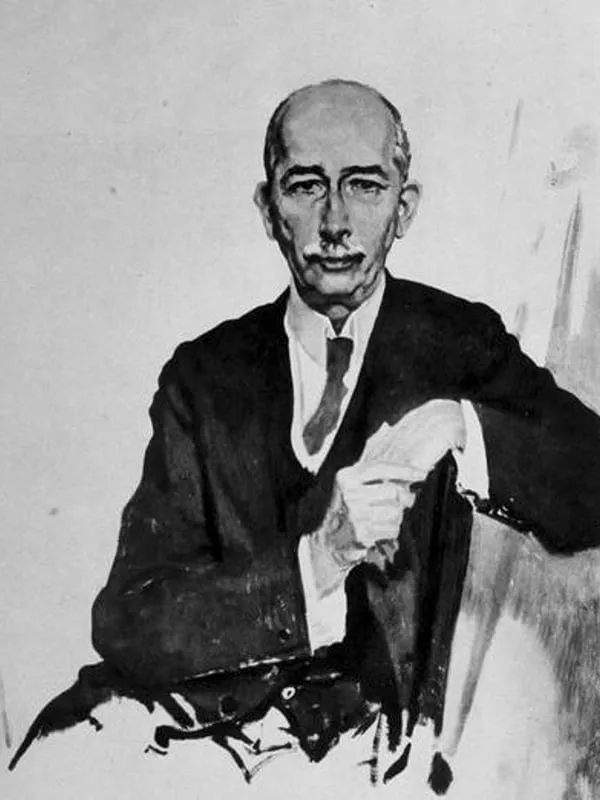
- Born:
- 26 July 1858, Houston (Texas, United States)
- Died:
- 28 March 1938, New York
- Author:
- Natalia
- Photo:
- William Orpen, domena publiczna, Wikimedia Commons

Edward Mandell House, known to everyone as “Colonel House”, was for most of the war the most influential man in American foreign policy, although he held no office and never served in the army. He was the friend and confidant of President Woodrow Wilson, who said of him that he was his “second personality”. In 1914–1916 he travelled around the capitals of Europe, looking for a road to peace through American mediation. After the United States entered the war he represented the president at Allied conferences, directed preparations for the future peace conference and helped write the Fourteen Points. In the autumn of 1918 in Paris he persuaded the Entente prime ministers to accept Wilson’s programme as the basis of the armistice. At the peace conference, however, his compromises led to a break with the president, whom he never saw again.
Before the war
He was born on 26 July 1858 in Houston, Texas, the youngest of seven children of a wealthy merchant, banker and planter who had come to America from England. He was educated at schools in England and on the East Coast and studied at Cornell University, but broke off his studies to look after his sick father. The fortune he inherited made him financially independent. In the 1890s he became the most skilful behind-the-scenes Democratic politician in Texas and helped four successive governors of the state win election. The first of them, James Hogg, appointed him in 1893 an officer on his staff with the rank of lieutenant-colonel. Hence the title of colonel, which House used for the rest of his life, although it was purely ceremonial.
Around 1902 he moved to New York and looked for a politician through whom he could influence the affairs of the whole country. In November 1911 he met the governor of New Jersey, Woodrow Wilson, and quickly won his trust. He helped him win the nomination and the 1912 election. In the same year he published anonymously a political novel, “Philip Dru: Administrator”, in which the hero seizes power in America and carries out great social reforms. After Wilson’s victory he declined a cabinet post. He preferred to be a personal adviser, without an official’s duties, with access to the president at any hour. He helped choose ministers and ambassadors, and had a room of his own in the White House.
Missions to Europe
In the spring of 1914 House went to Europe with a plan he called the “great adventure”: he wanted to bring Germany and Britain to an agreement on naval armaments. From Berlin he wrote to Wilson that the situation was extraordinary, because it was “militarism run stark mad”. On 1 June at Potsdam he talked with the Kaiser, Wilhelm II, and then in Paris and in London, where he met the Foreign Secretary, Sir Edward Grey. A few weeks later war broke out.
From its first days House was convinced that a German victory would be dangerous for America, and his sympathies lay with the Entente. At the same time he believed that the United States, as a neutral power, could bring about peace. At the beginning of 1915 Wilson sent him to Europe for the second time. House sailed to Liverpool on the Lusitania and held talks in London, Paris and Berlin, where he met, among others, the Chancellor, Theobald von Bethmann Hollweg, and Arthur Zimmermann. Everywhere he heard that it was too early for talks. He was still in London when in May a German submarine sank the Lusitania, and he advised the president to be firm with Berlin. In June, after the resignation of Secretary of State William Jennings Bryan, he advised Wilson to choose Robert Lansing, a man who did not have “too many ideas of his own”.
The third mission, at the turn of 1915 and 1916, produced the most famous of his plans. On 22 February 1916 House and Grey initialled a memorandum under which Wilson, at the invitation of Britain and France, would call a peace conference. If Germany refused to take part or rejected reasonable terms, the United States would “probably” enter the war. The word “probably” in the key sentence was added by Wilson himself. London and Paris, counting on victory, never took up the offer. Historians still argue over whether House promised the British more than the president was prepared to give, and whether in his talks with both sides he painted the situation for them in too rosy colours.
The last attempt at mediation
In the autumn of 1916 House was the chief strategist of the election campaign that gave Wilson a second term. Afterwards, however, he advised him against issuing a peace note, believing that the Allies would regard it as an unfriendly gesture. When Wilson decided to go further, House helped him prepare the “peace without victory” speech of January 1917. In those weeks his New York apartment was the scene of confidential talks with the German ambassador, Johann Heinrich von Bernstorff, to whom he passed an offer of mediation and a request for Germany’s peace terms. Berlin’s answer was the declaration of unrestricted submarine warfare. House took part in the discussions after which Wilson broke off relations with Germany, and in April he supported the decision for war.
During the war
After America entered the war House became the president’s main link with the Allied governments. Correspondence with London passed through his hands, because Wilson preferred this to the official channels of the State Department. In the autumn of 1917, at the president’s request, he set up in New York a team of scholars, called the Inquiry, which gathered historical, geographical and ethnographic material for the future peace conference. In the autumn of 1917 he sailed to Europe at the head of an American military and economic mission. In London and Paris he agreed the allocation of tonnage, supplies and deliveries, and at the great inter-Allied conference in Paris he tried in vain to persuade the Allies to issue a joint, liberal declaration of war aims that would keep Russia in the war. On 1 December he took part in the first session of the Supreme War Council at Versailles.
After his return he and Wilson prepared the programme that the president presented on 8 January 1918 as the Fourteen Points. It was House who brought the Inquiry’s maps and memoranda to the White House, and on 5 January the two men drew up the final list of points. He was a determined advocate of the Polish cause. From 1915 he maintained close relations with Ignacy Jan Paderewski, who won him over to the idea of an independent Poland with access to the sea, and House passed the memoranda of Polish activists on to the president. In the summer of 1918 he prepared the first draft of the Covenant of the League of Nations, on which Wilson later based his own text.
The armistice
When in October 1918 Germany asked Wilson for an armistice, the president decided to send House to Europe as his special representative. At the end of the month House arrived in Paris and took his seat on the Supreme War Council alongside the prime ministers Georges Clemenceau, David Lloyd George and Vittorio Emanuele Orlando. His task was to persuade them to accept the Fourteen Points as the basis of peace. Lloyd George would not agree to the freedom of the seas, and Clemenceau and the Italians had reservations of their own. House threatened that if the Allies rejected the president’s programme, the United States might consider concluding a separate peace. In the end the prime ministers accepted the Fourteen Points with two reservations, on the freedom of the seas and on reparations, which were passed to Germany in the Lansing Note of 5 November. The day before, at a meeting in House’s Paris headquarters, it was agreed that Marshal Ferdinand Foch would take supreme command of all the armies against Germany. House regarded the pre-armistice agreement as his greatest diplomatic success.
The peace conference and the break
House was one of the five members of the American peace delegation, alongside Wilson, who sailed to Europe in December, Lansing, the diplomat Henry White and General Tasker Bliss. He worked on the commission that prepared the Covenant of the League of Nations and on the commission on mandates. When in mid-February 1919 Wilson sailed to America for several weeks, House stood in for him on the Council of Ten and conducted talks with the prime ministers. He wanted to speed up the work and was ready to make concessions, among others on the Rhineland, reparations and Germany’s borders. On his return in March the president decided that House had gone too far and given away too much of his programme. The rift was also fed by the president’s second wife, Edith, who disliked House, and by House’s son-in-law Gordon Auchincloss, who spoke disparagingly of the president. Wilson sidelined his adviser from the most important matters. They saw each other for the last time in Paris on 28 June 1919, the day the Treaty of Versailles was signed. When in the autumn the president, after his stroke, was fighting the Senate over ratification, House advised him to compromise with the Republicans, but his letters did not reach him.
After the war
In the 1920s House supported American membership of the League of Nations and the Permanent Court of International Justice. Together with the historian Charles Seymour he published a volume of recollections of the peace conference, and in 1926–1928 Seymour published his diary and correspondence in four volumes. They became one of the most important sources for the history of American wartime diplomacy. In 1932 he supported the candidacy of Franklin Delano Roosevelt, but did not join his inner circle. In Poland he was very popular as a friend of the Polish cause. In 1932 a monument to him, funded by Paderewski, was unveiled in Warsaw’s Skaryszewski Park. He died on 28 March 1938 in New York and was buried in his native Houston.
Assessment
House remains one of the most enigmatic figures of the era. His admirers, among them Charles Seymour and the biographer Charles Neu, see him as a skilful and sensible diplomat who softened Wilson’s severity and mistrust, understood that politics requires concessions, and without whom the Fourteen Points would not have become the basis of the armistice in November 1918. They stress that in Paris he sought compromises that might have saved the treaty in the Senate, and that Wilson made a mistake in sidelining him.
His critics accuse him of working behind the scenes, without any accountability, of overrating his own influence and of often telling each European what he wanted to hear. Some historians, most recently Philip Zelikow for example, believe that in 1916–1917 House misinformed the president about the readiness of the two sides to negotiate and through his manoeuvres delayed, and in the end squandered, the American peace initiative. Others point out that his one-sided sympathy for the British weakened Wilson’s position as an impartial mediator. The 1956 psychological study by Alexander and Juliette George portrayed his relationship with Wilson as one in which the adviser skilfully flattered the president until he dared to act on his own. Whatever the verdict, House was the first informal “national security adviser” in the history of the United States, a model for many later presidential confidants.
Sources
Spotted a mistake?Report an error
Often appears with
People who appear in the same events.
On the timeline
(21)1915
1916
1917
1918
January
October
November
- 05
- Foch supreme commander against GermanyAfter Austria-Hungary's surrender the Entente leaders gave Foch strategic direction of the war against Germany on all fronts, including the Italian and Balkan.
- Lansing noteOn 5 November 1918 Lansing passed to Germany the Allies' reservations on freedom of the seas and reparation and told it to apply to Foch for armistice terms.