Key event
Armistice of Villa Giusti
- Category:
- Diplomacy
- Front:
- Italian Front
- Date:
- 3 November 1918
- Author:
- Łukasz Skowroń
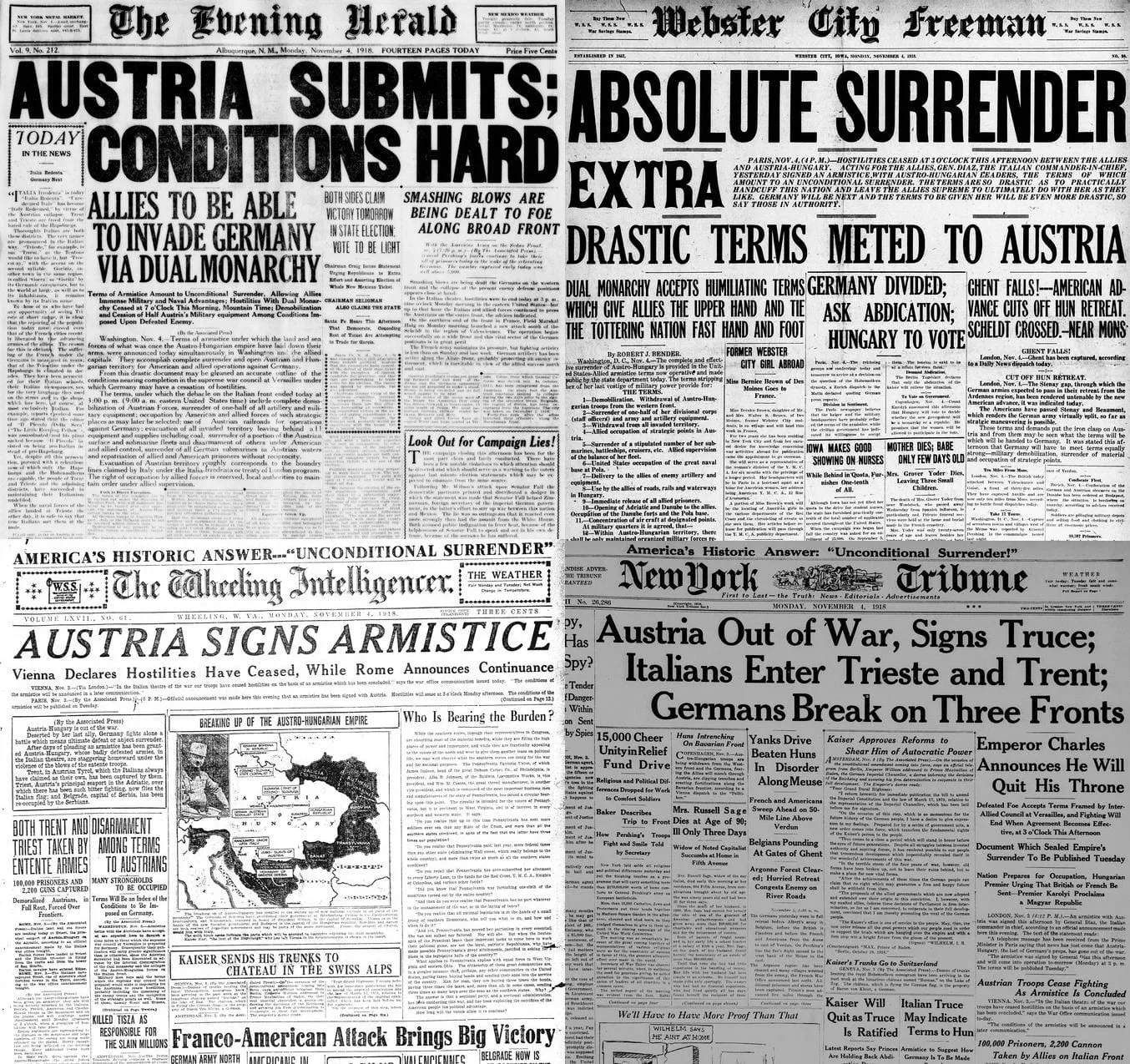
On 3 November 1918, at the villa of Count Vettor Giusti del Giardino on the outskirts of Padua, the Austro-Hungarian armistice commission under General of Infantry Viktor Weber von Webenau signed an armistice with the Allies. It was signed on their behalf by the deputy chief of the Italian General Staff, Lieutenant-General Pietro Badoglio. Fighting on land, at sea and in the air was to cease the next day, 4 November, at 3 p.m. Austria-Hungary, which had begun the war in 1914 by declaring it on Serbia, was leaving it as a state in dissolution, and for several days its army had been retreating in disorder before the Italians, British and French. The last day and a half of the war, when the Austro-Hungarian troops had stopped fighting but the Italians kept advancing, was to cost the monarchy hundreds of thousands of prisoners and poison the memory of this armistice for years.
Three days at Villa Giusti
Weber’s commission, sent by the Emperor on 28 October, did not reach Villa Giusti until the evening of 31 October. That same day at Versailles the prime ministers of France, Britain and Italy, together with President Wilson’s representative, Colonel Edward Mandell House, approved the armistice terms, and in the afternoon the Supreme War Council adopted them. Prime Minister Vittorio Emanuele Orlando passed them by telephone to the Italian Supreme Command during the night of 31 October to 1 November, and the full French text was sent to Italy by train with an officer. General Armando Diaz was to present them to the Austrians on behalf of all the Allies.
The first session took place on 1 November at 10 a.m. Badoglio read out an Italian summary of the terms and declared that they were not open to discussion: the commission could only accept or reject them. Weber found them so harsh that he did not feel authorised to sign them. He found the complete demobilisation of the army, the surrender of half the artillery, the free passage of Allied troops through the monarchy’s territory and all the naval terms particularly hard to accept. The commission had no cipher and no fast communication with Vienna, so at 3 p.m. Weber sent Colonel Karl Schneller by car to Trento, from where he was to telegraph the terms to headquarters at Baden near Vienna. Weber also pressed for an immediate cessation of hostilities, but was told that fighting would stop only once the terms had been accepted.
On 2 November at 5 p.m. the full text arrived from Paris. It turned out to include an implementing protocol of which the Austrians had known nothing. Its first point stated that hostilities would cease only 24 hours after the armistice was signed. Weber asked for this period to be shortened to 12 hours on the Italian front, but the Italians replied that news of the armistice needed a day to reach units on the move. Weber also learned that the Allies were giving Austria-Hungary until midnight of 3–4 November to accept the terms, and that any request for changes would be treated as a refusal. Meanwhile the line to Trento had been cut, because fighting was already under way in the Adige valley, and telegrams sent through the radio station in Padua travelled to Vienna via Pola and Budapest, sometimes taking a dozen hours or more.
Night of decision in Vienna
The summary of the terms reached Baden during the night of 1–2 November. Emperor Karl I was ready to accept them but hesitated over one point. A few days earlier he had promised Emperor Wilhelm II in a personal telegram that he would never allow the Italians to pass through the Tyrol to attack Germany. The chief of the General Staff, Arthur Arz von Straußenburg, argued that the military situation was hopeless. The Hungarians settled the matter. The new Hungarian war minister in Mihály Károlyi’s government, Colonel Béla Linder, ordered Hungarian soldiers on 2 November to lay down their arms, and Hungarian telegraphists passed on his orders faster than the counter-orders of the Supreme Command.
Karl wanted to shift responsibility for the capitulation onto the new national authorities. On the afternoon of 2 November representatives of the national councils gathered at his residence, but they declared that the war had been waged by the old government without asking the nations’ opinion, and that it was the old government that must end it. Arz went to ask the State Council of German Austria for its support, but to no avail. In the evening a crown council met. Around midnight it was decided to accept the terms, as the Austrian official history notes, on the strength of the opening words of the summary: “immediate cessation of hostilities”. At 1.20 a.m. a telegram accepting the terms was sent to the commission, and at about 2 a.m. the head of the operations section, General Alfred von Waldstätten, telephoned an order to both army groups: armistice terms accepted, operations on land and in the air to cease immediately.
Soon afterwards the Emperor hesitated again, because the State Council had not supported the armistice, and ordered the order to be revoked. The chief of staff of the army group in the Tyrol replied, however, that the order to cease fighting had already gone out to the troops and that revoking it would end in disaster. At 3.45 a.m. the order was repeated to both army groups. The telegram authorising Weber to sign was not sent, because the Emperor still hoped for the State Council’s consent. On the morning of 3 November Karl laid down the supreme command of the army. Arz took it over temporarily until the arrival from the Balkans of Field Marshal Hermann Kövess, who was to become the last commander-in-chief of the Austro-Hungarian army. At the front, from the morning of 3 November, the monarchy’s soldiers were convinced that the war was over.
The signing
At 1 p.m. on 3 November Schneller reached Villa Giusti. He brought news that the Emperor had accepted the terms and then revoked his acceptance, and that the troops had been ordered to stop fighting. Weber decided to take the responsibility upon himself. At the 3 p.m. session he declared that he accepted the terms, with the reservation that the questions of free passage through the monarchy’s territory, navigation on the Adriatic and the Danube and the continuation of the blockade would be raised again at the peace conference. He also informed the Italians that the Austro-Hungarian army had already stopped fighting and asked for the same on the Italian side. Badoglio replied that this was not possible before 24 hours had passed. According to the British official history, he looked at his watch, which showed 3.20 p.m., and proposed taking 3 p.m. the next day as the hour for the end of hostilities. At 4.20 p.m. Arz’s telegram authorising Weber to sign arrived.
The armistice protocol, with a map of the demarcation line, and the implementing protocol were formally signed at about 6 p.m. Italian sources often give 3.20 p.m., the moment the terms were accepted, as the time of signing, and the document itself is headed “signed at 3 p.m.”. On the Austro-Hungarian side it was signed by Weber, Schneller and five other officers, including Captain Camillo Ruggera, who on 29 October had crossed the front line under a white flag. On the Italian side six officers signed it alongside Badoglio, including a representative of the navy.
The terms
The military terms began with the immediate cessation of hostilities. The Austro-Hungarian army was to be completely demobilised and reduced to no more than 20 divisions on a peace footing, and all its units fighting on the Western Front, from the North Sea to Switzerland, were to be withdrawn at once. Half of the divisional and corps artillery was to be handed over to the Allies. The monarchy was to evacuate all territory occupied since the start of the war and withdraw its troops behind a line running along the crest of the Alps through the Brenner Pass, Toblach and Tarvis, and then across the Julian Alps to the sea west of Fiume. On the Italian side of the line lay South Tyrol (PL), Gorizia, Trieste and the whole of Istria, as well as northern Dalmatia with most of its islands. This was almost exactly the frontier promised to Italy in the Treaty of London of 1915. These lands were to be occupied by Allied troops.
The Allied armies received the right to move freely on the monarchy’s roads, railways and rivers and to occupy any strategic points, which Germany feared most of all, since it opened the road to Bavaria. All German troops were to leave Austro-Hungarian territory within 15 days or face internment. Allied prisoners were to be returned home immediately and without reciprocity. The naval terms required the surrender of 15 submarines, 3 battleships, 3 light cruisers, 9 destroyers, 12 torpedo boats, a minelayer and 6 Danube monitors, with the rest of the fleet to be disarmed in ports designated by the Allies. The Allies would occupy the fortifications and arsenal of Pola, gain freedom of navigation on the Adriatic and the Danube, and the naval blockade would continue. The fact that on 31 October the Emperor had handed the fleet over to the National Council of Slovenes, Croats and Serbs was ignored by the Allies.
The implementing protocol set the end of hostilities for 3 p.m. Central European Time on 4 November. From that moment Allied troops were to halt and the Austro-Hungarian troops to withdraw at least 3 kilometres. The crucial sentence proved to be the one stating that all Austro-Hungarian units which, at the moment of the suspension of hostilities, found themselves behind the line reached by the Italians would be regarded as prisoners of war.
The last day and a half
Arz learned of the 24-hour interval only at 11 p.m. on 3 November. He protested to Diaz, who replied that the terms, including this interval, had been accepted by duly authorised plenipotentiaries and that taking prisoners before 3 p.m. on 4 November was entirely legitimate. On the evening of 3 November the Italian Supreme Command sent the armies an order to keep advancing to the last moment. Meanwhile whole Austro-Hungarian divisions, convinced that the war was over, laid down their arms, protesting that the armistice was just coming into force. According to an Italian communiqué, some 300,000 men were taken prisoner in the last 36 hours, a large proportion of them soldiers of rear-area units. The dispute over whether the prisoners taken after the order to cease fighting had been taken fairly went on in Austria for years.
Significance
The Armistice of Villa Giusti ended the war on the Italian front and closed Austria-Hungary’s part in the war, after the capitulation of Bulgaria at the end of September and of Turkey on 30 October. Germany was left alone, and its southern frontier lay open. As early as 4 November the Italian Supreme Command began planning a march through the Tyrol into Bavaria, and Lord Cavan informed London of it. The expedition never took place, because a week later Germany itself signed an armistice.
The armistice was signed by a state that had all but ceased to exist. Czechoslovakia, the State of Slovenes, Croats and Serbs and Hungary had proclaimed their separate existence in the last days of October, and the new Hungary held that the Padua agreement did not bind it and soon concluded a separate military convention with the Allies. The Villa Giusti demarcation line in turn became the starting point of the dispute over the eastern shore of the Adriatic. On its basis the Italians began occupying Trieste, Istria and Dalmatia, coming into conflict with the Yugoslavs, and the final frontier between Italy and its new neighbours was fixed only by the peace treaties, including the Treaty of Saint-Germain-en-Laye of 1919.
Remember the articles you have read? Only in this browser; nothing is sent anywhere.How it works
Read ·
A voice from the front
““What happened was that our men laid down their arms and only then did the Italians really start shooting. With heavy guns they mowed down whole regiments and surrounded whole divisions. They report 300,000 prisoners and about a thousand guns. Everything is lost.” […] “More men died in this laying down of arms than in the bloodiest battle,” one of the officers muttered to himself.”
Translated · Original (hu)
— Úgy történt, hogy a mieink lerakták a fegyvert és az olaszok akkor kezdtek csak igazán lőni. Nehéz ágyúkkal egész ezredeket lőttek halomra és egész hadosztályokat fogtak körül. 300.000 fogolyt jelentenek s vagy ezer ágyút. Minden odaveszett. […] — Több ember halt meg ennél a fegyverletételnél, mint a legvéresebb ütközetben, — dörmögte magában az egyik tiszt.
Spotted a mistake?Report an error
Meanwhile
(04)Elsewhere in the same days.
- 3 November 1918 · War at seaKiel mutinyOn 3 November 1918 a patrol in Kiel fired on a march of sailors and workers. Next day the city was in the hands of soldiers' councils. The revolution had begun.
- 4 November 1918 · Western FrontBattle of the Sambre beginsOn 4 November 1918 the British crossed the Sambre–Oise Canal and Mormal Forest in fog, and the New Zealanders took Le Quesnoy. Wilfred Owen fell at Ors.
- 2 November 1918 · PoliticsSlovenes take over CarniolaAt the turn of October and November 1918 the Slovene National Government in Ljubljana removed the Austrian governor and took power in Carniola.
- 2 November 1918 · War at seaSinking of *Surada* and *Murcia*On 2 November 1918 UC-74 torpedoed the steamers Surada and Murcia off Port Said, the last British merchant ships sunk by the enemy in the war.
Related events
(04)The same battle, people or subject.
- 27 October 1918 · DiplomacyAustria-Hungary asks for an armisticeOn 27 October 1918 Andrássy asked Wilson for a separate peace and an immediate armistice. A day later Emperor Karl sent an armistice commission to the Italians.
- 4 November 1918 · Italian FrontEnd of the Battle of Vittorio VenetoAt 3 p.m. on 4 November 1918 the guns fell silent on the Italian front. Before that the Allies crossed the Tagliamento and whole enemy divisions surrendered.
- 23 October 1918 · DiplomacyWilson's third noteOn 23 October 1918 Wilson passed the armistice question to the Allies and warned that with Germany's old rulers he could discuss only surrender.
- 24 June 1918 · Italian FrontEnd of the Second Battle of the PiaveBy 24 June 1918 the Austrians had withdrawn over the Piave and the Italians had regained the whole right bank. Austria-Hungary's last offensive ended in defeat.