Key event
Revolution in Berlin
- Category:
- Politics
- Date:
- 9 November 1918
- Author:
- Łukasz Skowroń
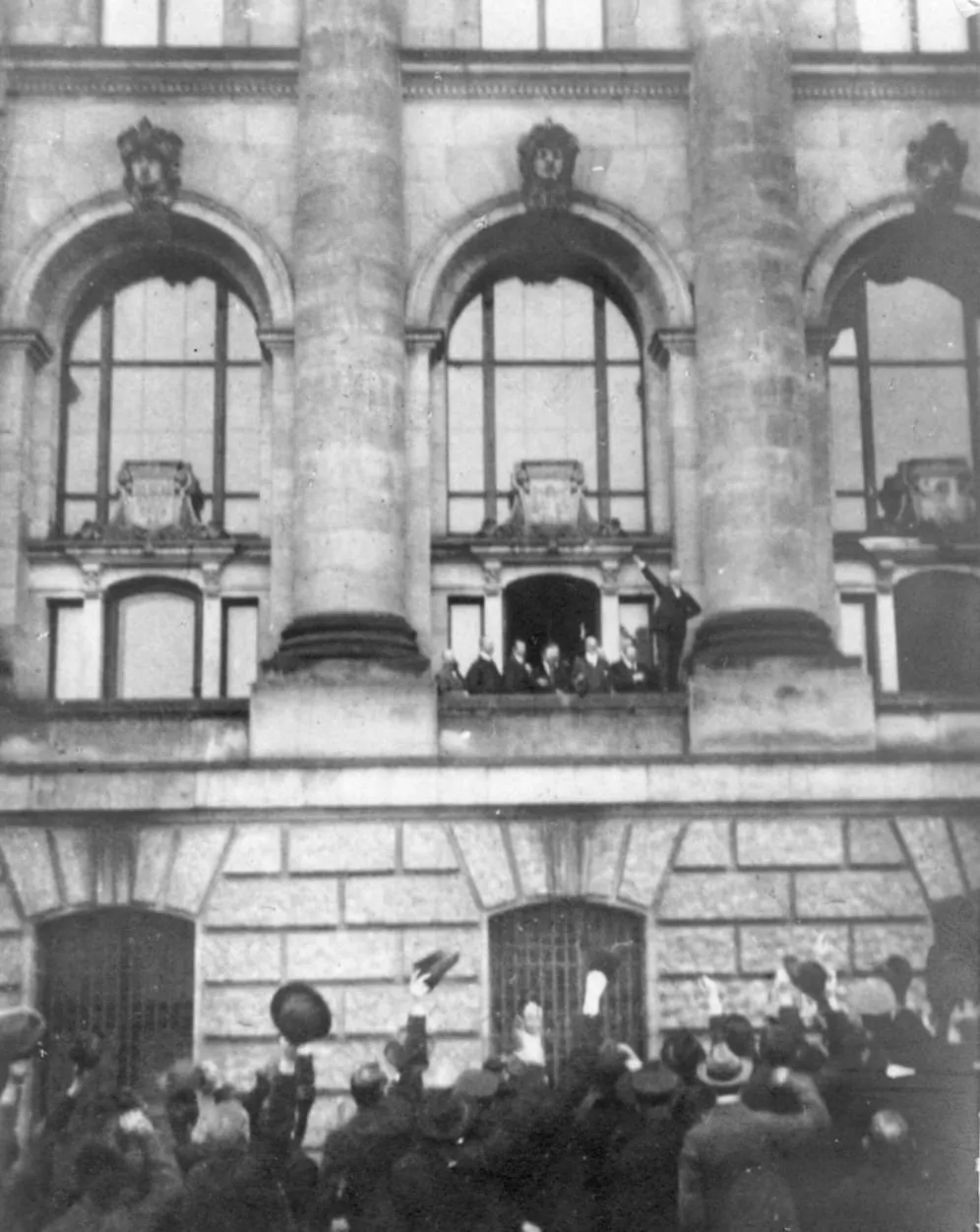
On 9 November 1918 the German Empire collapsed within a few hours. In the morning a general strike began in Berlin, and hundreds of thousands of workers and soldiers marched towards the city centre. Before noon the chancellor, Prince Max von Baden, announced on his own authority that Kaiser Wilhelm II was renouncing the throne. At midday he handed over his office to the Social Democratic leader Friedrich Ebert. At about 2 p.m. Philipp Scheidemann proclaimed the German republic from a window of the Reichstag, and two hours later Karl Liebknecht proclaimed a “free socialist republic” in front of the imperial palace. Meanwhile, at headquarters in Spa, General Wilhelm Groener told the Kaiser that the army would no longer follow him. That same day the German delegation in the Forest of Compiègne was considering the armistice terms it had heard from Marshal Foch.
The Kaiser at Spa
Ever since Wilson’s note of 23 October everyone in Berlin understood that the Kaiser stood in the way of peace. Wilhelm II would not hear of it. On 29 October he left Potsdam for Supreme Army Command headquarters at Spa, which Germans saw as a flight into the generals’ protection. On 1 November the chancellor sent the Prussian interior minister Bill Drews to persuade him to abdicate. The Kaiser refused. According to a letter he wrote two days later, he warned Drews that if he went, all the dynasties would fall, the army would disintegrate and the front would “pour across the Rhine”. Field Marshal Paul von Hindenburg and Groener, Ludendorff’s successor, sided with the monarch at that point. In the days that followed Wilhelm II made plans to place himself at the head of the front-line troops once the armistice was signed and to crush the revolution at home.
Meanwhile the revolution, which had begun with the sailors’ mutiny in Kiel, was taking one city after another. On 7 November the monarchy fell in Bavaria. That same day the Social Democratic leaders gave the chancellor an ultimatum: if the Kaiser did not abdicate, they would leave the government. Ebert then told Prince Max: “If the Kaiser does not abdicate, the social revolution is unavoidable. But I do not want it; indeed I hate it like sin.” The Social Democrats demanded that the Kaiser and the crown prince go, but not that the monarchy be abolished. They were ready to accept a parliamentary monarchy with a regency on behalf of one of the younger Hohenzollerns. On the evening of 8 November the Independent Social Democratic Party of Germany called, at 26 meetings, for a general strike and demonstrations the next day. The chancellor brought into the capital riflemen (Jäger) from Naumburg who were regarded as reliable.
Morning in Berlin
On the morning of 9 November the great factories came to a standstill, and the workers of many of them poured into the streets, many of them armed. Their banners read “Unity” and “Brothers, don’t shoot!”. The Naumburg Jäger, to whom their officers had issued hand grenades, sent a delegation to the offices of the Social Democratic daily Vorwärts to find out what was going on. They were received by the deputy Otto Wels, who persuaded them to support the Social Democrats and then toured one barracks after another. Regiment by regiment, the soldiers went over to the revolution or declared that they would not shoot. Military power in the capital slipped out of the old regime’s hands.
Prince Max kept telephoning Spa, crying that abdication was now a matter not of hours but of minutes. He still received no answer. At 11.30 a.m. the Wolff news agency put out his statement: “The Kaiser and King has decided to renounce the throne. The Reich Chancellor will remain in office until the questions connected with the Kaiser’s abdication, the renunciation of the throne by the Crown Prince of the German Empire and of Prussia, and the setting up of a regency have been settled.” The chancellor also announced that he would propose to the regent that Ebert be appointed chancellor and that elections be called to a national assembly, which would decide Germany’s future form of government. Wilhelm II had not agreed to this. Most historians regard the step as the chancellor acting on his own authority. The German historian Lothar Machtan, however, points to an account according to which Groener had earlier given Berlin to understand by telephone that full abdication was a matter of moments.
Ebert becomes chancellor
At noon Ebert and other party leaders came to the Reich Chancellery and demanded power, since the Berlin garrison now stood behind the Social Democrats. Prince Max handed him the office of chancellor. The constitution made no provision for such a hand-over of power, so it was a revolutionary act, carried out by men who did not want a revolution. Ebert asked the prince to stay on as regent until the question of the throne was settled, but he declined the role and soon left Berlin. Special editions of Vorwärts called on the demonstrators to return to their homes and barracks. No one listened, and more and more people demanded the abolition of the monarchy.
In the early afternoon Scheidemann, who was having lunch in the Reichstag restaurant, learned that Liebknecht, leader of the Spartacus League, recently released from prison, intended to proclaim a soviet republic. He did not want to leave the initiative to the far left. A few minutes after 2 p.m. he went to a first-floor window of the Reichstag building and addressed the crowd. According to the report in the Vossische Zeitung, he said: “We have won all along the line; the old order is no more. Ebert has been appointed Reich Chancellor (…). The Hohenzollerns have abdicated. See to it that nothing sullies this proud day. Let it be for ever a day of glory in the history of Germany. Long live the German republic!” The longer, better-known version of the speech is a reconstruction that Scheidemann recorded on a gramophone disc only in 1920. Ebert was furious. He wanted a national assembly to decide the form of the state. The cheering of the crowd showed, however, that it was already too late for the monarchy.
At about 4 p.m. Liebknecht spoke in the Lustgarten and then from a window of the imperial palace, which the crowd had occupied. “The day of revolution has come. We have forced peace (…). The rule of the Hohenzollerns, who lived in this palace for centuries, is over. In this hour we proclaim the free socialist republic of Germany,” he cried, announcing that where the imperial standard had flown the red flag would now fly. His proclamation, however, had no real force behind it. In the evening about a hundred Revolutionary Stewards from the Berlin factories occupied a hall of the Reichstag and called elections to workers’ and soldiers’ councils for the following day. Ebert, meanwhile, offered the Independent Socialists a joint government.
The Kaiser’s last day
That morning at Spa, in the Hôtel Britannique, the fate of Wilhelm II was being decided. The generals around him still believed that the army would help the Kaiser regain power. Colonel Wilhelm Heye questioned 39 officers summoned from the front. According to German studies, only one thought a march on Berlin possible, 23 saw no chance at all, and 15 considered it highly doubtful. The soldiers, Heye reported, were dead tired and wanted only to go home. Groener then told the Kaiser bluntly that the army would march home in good order under its own commanders, “but not under the command of Your Majesty. The army no longer stands behind Your Majesty.” Hindenburg mostly kept silent.
Wilhelm II then came up with the idea of abdicating as Kaiser but remaining King of Prussia. Under the constitution of 1871, however, the two crowns were inseparable, and such an arrangement could have torn the Reich apart. His advisers were still drafting the document when, at about 2 p.m., news arrived from Berlin. Over the telephone the Kaiser called the chancellor a “scoundrel”, but there was nothing more he could change. Hindenburg, moved to tears, advised him to leave. Rumour had it that mutinous units were approaching Spa, and everyone remembered the fate of Tsar Nicholas II, murdered a few months earlier. At about 4 p.m. Wilhelm II took leave of the commanders, refusing to shake hands with Groener, and moved to his train. In a letter to his wife he wrote that Max had “committed treason” and that Berlin was “in the hands of the Bolsheviks”. At dawn the next day he set off towards the Dutch border.
The end of the monarchy
Neither the chancellor’s announcement of the abdication, nor the hand-over of power to Ebert, nor Scheidemann’s proclamation had any basis in the constitution. Yet all of them created lasting facts. On 10 November the assembly of Berlin councils confirmed a six-member Council of the People’s Deputies made up of both socialist parties, headed by Ebert and Hugo Haase. That same evening Ebert reached an understanding with Groener by telephone: the army recognised the new government, and the government promised to help it maintain order and discipline. By 25 November the remaining German dynasties had also lost their thrones. In losing its monarchy Germany was becoming a republic, later called the Weimar Republic.
For opponents of the new state, however, 9 November became a date of “treason”. The generals who had themselves demanded an armistice in September were soon proclaiming that the undefeated army had been stabbed in the back by revolutionaries at home. This legend hung over the Weimar Republic throughout its existence.
Remember the articles you have read? Only in this browser; nothing is sent anywhere.How it works
Read ·
Spotted a mistake?Report an error
Meanwhile
(04)Elsewhere in the same days.
- 9 November 1918 · AfricaLettow-Vorbeck takes KasamaOn 9 November 1918 Lettow-Vorbeck's vanguard took the abandoned town of Kasama in Northern Rhodesia. The Germans pushed south towards the Chambeshi depots.
- 9 November 1918 · Middle EastOccupation of AlexandrettaOn 9 November 1918 British and French warships entered the Gulf of Alexandretta. Mustafa Kemal wished to defend the port, but Constantinople made him yield.
- 8 November 1918 · Western FrontBritish retake MaubeugeOn the night of 8/9 November 1918 a Grenadier Guards battalion entered Maubeuge unopposed, the Sambre fortress the French had surrendered in September 1914.
- 8 November 1918 · Western FrontGerman envoys before FochOn 8 November 1918 Erzberger's delegation stood before Foch in the Forest of Compiègne. It heard the armistice terms and was given 72 hours to reply.
Related events
(04)The same battle, people or subject.
- 3 October 1918 · PoliticsMax von Baden becomes chancellorOn 3 October 1918 Prince Max von Baden became Reich chancellor. For the first time in the Empire's history Social Democrats joined the government.
- 16 December 1918 · PoliticsCongress of Councils in BerlinOn 16 December 1918 the first Reich congress of workers' and soldiers' councils met in Berlin. It rejected a council republic and set elections for 19 January.
- 24 December 1918 · PoliticsChristmas fighting in BerlinOn 24 December 1918 troops shelled the Berlin Palace, held by mutinous sailors. The attack failed, and the coalition of the socialists broke up.
- 11 November 1918 · DiplomacyArmistice of CompiègneAt dawn on 11 November 1918 Germany signed an armistice with the Entente in Foch's railway carriage in the Forest of Compiègne. At 11 a.m. the guns fell silent.