Germany · The Central Powers
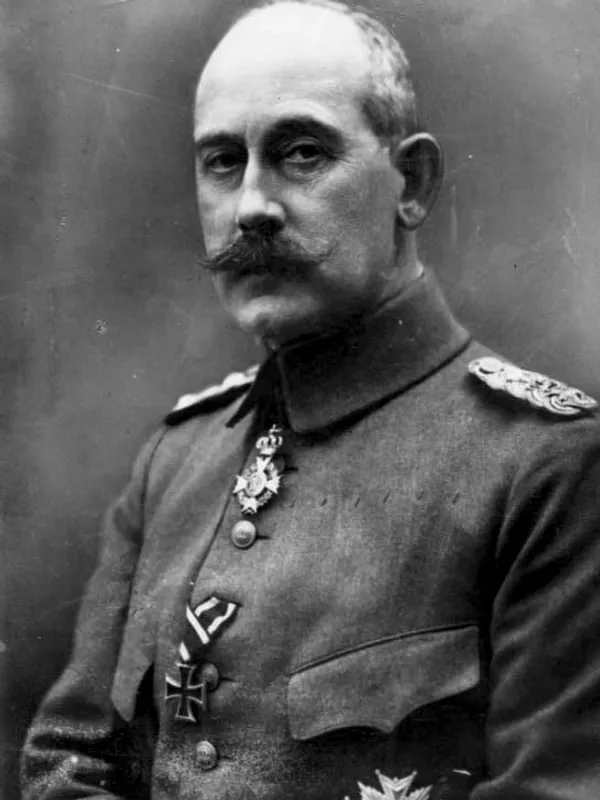
Max von Baden
Chancellor of the German Empire and Minister-President of Prussia (3 October – 9 November 1918), heir to the throne of the Grand Duchy of Baden
- Born:
- 10 July 1867, Baden-Baden (Grand Duchy of Baden)
- Died:
- 6 November 1929, Konstanz (Baden)
- Author:
- Łukasz Skowroń
- Photo:
- Bundesarchiv, Bild 183-R04103, CC BY-SA 3.0 DE, Wikimedia Commons

Prince Maximilian of Baden, commonly known as Max von Baden, was the last chancellor of the German Empire. He held office for only five weeks, from 3 October to 9 November 1918, but that short time held more turning points than all the earlier years of the war. His government sent the President of the United States a request for an armistice, brought the Social Democrats into power for the first time, carried out reforms that made Germany a parliamentary monarchy, and secured the dismissal of General Erich Ludendorff. On 9 November, when the revolution reached Berlin, the prince announced the Emperor’s abdication on his own authority and handed his office to the leader of the Social Democrats. He wanted to save the monarchy and unwittingly opened the way to the republic. An aristocrat and a general without political experience, regarded by some as a noble liberal and by others as a weak and bewildered man, he still divides historians today.
Before the war
He was born on 10 July 1867 in Baden-Baden, the son of Prince Wilhelm of Baden, a Prussian general, and of Maria, Princess of Leuchtenberg, a granddaughter of Napoleon’s stepson Eugène de Beauharnais and a niece of Tsar Alexander II. Through his mother he was related to the Russian court; through his cousin Victoria, wife of the heir to the throne and later King Gustav V of Sweden, to the Swedish court; and Emperor Wilhelm II was a distant cousin. After a classical gymnasium he studied law and cameralistics, among other places at the University of Leipzig, and then joined the Prussian army. He served in the cavalry, commanded a dragoon regiment and a brigade, and in 1911 retired from active service with the rank of general. In 1900 he married Marie Louise, Princess of Hanover of the Cumberland line, with whom he had a daughter and a son.
In 1907, after the death of his uncle, Grand Duke Frederick I, Max became heir to the throne of the Grand Duchy of Baden, because his cousin, the new Grand Duke Frederick II, had no children. He then also became president of the Baden First Chamber. He was interested in philosophy, religion and education. He was considered a gentle, sensitive and tolerant man, though he had practically no experience of politics.
The prisoners’ prince
When war broke out in August 1914, Max joined the staff of the XIV Army Corps, in which the Baden troops fought, as the Grand Duke’s representative. He did not last there long. Dissatisfied with his ill-defined position and suffering from poor health, he returned to Karlsruhe as early as the autumn. In December 1914 the Emperor made him a general of cavalry, but the prince did not go back to the front, for which military circles reportedly mocked him as a “medical-corps general”.
From October 1914 he was honorary chairman of the Baden Red Cross, and throughout the war he concerned himself with the fate of prisoners of war, both Germans in enemy hands and foreign prisoners in Germany. In this he made use of his family ties with the courts of Petrograd and Stockholm and his acquaintances in Switzerland. He travelled several times to neutral Sweden, and from 1916 he was honorary president of the American-German relief for prisoners run by the World Alliance of the YMCA. This work earned him the reputation of a cultured and moderate man who kept away from war propaganda and narrow nationalism.
The prince was no pacifist, however. He supported a defensive war and long believed in victory, but in 1917 he openly opposed unrestricted submarine warfare, which drew America into the war. A moderate political circle opposed to the Supreme Army Command of Paul von Hindenburg and Erich Ludendorff began to gather around him. The greatest role here was played by the young diplomat Kurt Hahn, who from the spring of 1917 worked in the military department of the Foreign Office. It was he who drew the prince into politics, wrote his speeches and promoted his candidacy among deputies, including the Social Democrat Eduard David and the liberal Conrad Haußmann of the Progressive People’s Party. David proposed Max as chancellor as early as July 1917, after the fall of Theobald von Bethmann Hollweg. Hahn also suggested to the prince the slogan of “ethical imperialism”: Germany was to gain a moral, and not merely a military, advantage over its opponents.
The prince’s views at this time were more conservative than his supporters believed. In a private letter of early 1918 to his cousin, Prince Alexander Hohenlohe-Schillingsfürst, who was living in Switzerland, he criticised parliamentarisation and the Reichstag’s peace resolution of July 1917. At the beginning of September 1918 he put himself forward to the Emperor as chancellor, citing his contacts with the Social Democrats, but Wilhelm II turned him down.
Chancellor by necessity
When on 29 September 1918 Hindenburg and Ludendorff demanded an immediate request for an armistice and the Emperor accepted the resignation of Chancellor Georg von Hertling, Berlin searched feverishly for a man who could head a government based on a Reichstag majority and credibly approach President Woodrow Wilson. Max’s candidacy was put forward by Hertling after a conversation with Vice-Chancellor Friedrich von Payer, and it was backed by Haußmann, by the Supreme Army Command’s representative in Berlin, Colonel Hans von Haeften, and by Ludendorff himself. It was hoped that a prince known for his help to prisoners and his opposition to submarine warfare would make a good impression in Washington.
Max arrived in Berlin on 1 October and only there learned that the army was demanding an immediate request for an armistice. He was horrified. He believed that such a step would reveal the scale of the defeat to the enemy, and he preferred first to announce the new government’s peace programme. He also admitted openly to his supporters that he was no politician and did not consider further democratisation in wartime sensible. Hindenburg, however, came to the capital and on 3 October, at the first meeting of the new cabinet, presented a written statement that the Supreme Army Command maintained its demand. The prince gave way. During the night of 3–4 October he signed the note to Wilson requesting an armistice and negotiations on the basis of the Fourteen Points, and on 5 October he announced it in his first speech to the Reichstag.
Five weeks of reform
The new government rested on the majority parties that had passed the peace resolution in 1917. For the first time in the Empire’s history Social Democrats entered it, Philipp Scheidemann and Gustav Bauer, alongside politicians of the Centre, among them Matthias Erzberger, and liberals. Foreign affairs were taken over by Wilhelm Solf. The Social Democrats’ participation in the government owed most to their leader Friedrich Ebert, with whom the chancellor quickly established good relations based on trust. The real decisions were taken in the war cabinet, in which representatives of the parties sat, and the chancellor, advised by Hahn, Haußmann and the diplomat Walter Simons, often moderated rather than led.
Within a few weeks this government did more than earlier cabinets had done during the whole war. Under the chancellor’s pressure War Minister Hermann von Stein, regarded as the Supreme Army Command’s man, resigned, as did the head of the Emperor’s Civil Cabinet, Friedrich von Berg. The government proclaimed a broad amnesty for political prisoners, which freed among others Karl Liebknecht, appointed Alsatians to the highest offices in Alsace-Lorraine and brought about the final decision to introduce equal suffrage in Prussia. Constitutional amendments passed by the Reichstag in the last days of October came into force on 28 October: from then on the chancellor needed the confidence of parliament, and appointments of officers required the countersignature of the war minister. Germany had become a parliamentary monarchy.
Opponents, however, did not trust a prince of a reigning dynasty. On 10 October Hohenlohe-Schillingsfürst published in Switzerland his private letter of January, which undermined the new chancellor’s credibility at the very moment he was assuring the world of Germany’s transformation. Wilson answered the German notes ever more harshly. After his first reply of 8 October, he demanded in his second note an end to submarine warfare against passenger ships, and in the third, of 23 October, he made it clear that with Germany’s “military masters and monarchical autocrats” he could discuss only surrender. The chancellor forced the admirals to recall the U-boats from commerce warfare.
Clash with Ludendorff
The most important trial of strength was the showdown with the Supreme Army Command. In mid-October Ludendorff, who a few weeks earlier had himself demanded an armistice, decided that the army could still fight. At the war cabinet meeting of 17 October the chancellor stood up to him. On 24 October Hindenburg and Ludendorff issued an order to the army calling Wilson’s third note unacceptable, and the next day, against the chancellor’s express request, they came to Berlin. The prince, ill with influenza, gave the Emperor an ultimatum: if Ludendorff did not go, the whole government would resign. On 26 October Wilhelm II accepted the general’s resignation while keeping Hindenburg. German historians see in this act the restoration of the primacy of politics over the military, lost since 1916. Ludendorff was succeeded by General Wilhelm Groener.
The question of the Emperor
After the note of 23 October it became clear that the Emperor stood in the way of peace. The chancellor did not want the end of the monarchy. He hoped that if Wilhelm II and his son renounced the throne voluntarily, the dynasty could be saved: the crown was to pass to the Emperor’s young grandson, Prince Wilhelm, and the regent was to be, as historians suppose, Max himself or one of the Emperor’s younger sons. On 29 October, however, Wilhelm II left for headquarters at Spa, beyond the government’s reach. On 1 November the chancellor sent the Prussian interior minister Bill Drews to him with a suggestion of abdication and asked the reigning princes of the Empire by letter whether they would agree to it. The Emperor refused.
At the turn of October and November the prince was completely out of action for several days. According to some authors he was struck down by the Spanish flu. The German historian Lothar Machtan, author of his 2013 biography, has put forward another hypothesis: on 1 November Empress Augusta Victoria allegedly threatened the prince with exposing his homosexuality if he forced her husband to abdicate, and Max suffered a nervous breakdown and was sedated by his doctors with an opiate. This hypothesis rests partly on circumstantial evidence and not all scholars accept it. The chancellor returned to work on 3 November, the day on which the first shots of the revolution were fired in Kiel. On 6 November he sent Erzberger at the head of the armistice delegation.
9 November
On 7 November, in the garden of the Reich Chancellery, Ebert warned the prince that if the Emperor did not abdicate, revolution was inevitable. The Social Democrats issued an ultimatum and threatened to leave the government. On the morning of 9 November Berlin was gripped by a general strike, and the regiments of the garrison were going over to the workers. The chancellor pleaded in vain for a decision from Spa. At about 11.30 a.m. the Wolff agency issued his statement that the Emperor and King had decided to renounce the throne and that the Crown Prince also renounced his rights. Wilhelm II had not agreed to this, and at Spa he was still considering whether to abdicate only as Emperor while remaining King of Prussia. According to some historians the chancellor acted in the belief, reinforced by a telephone call from headquarters, that full abdication was a matter of moments. Machtan called this step a “half coup d’état”.
At about noon Ebert came to the Chancellery with other Social Democratic leaders and demanded power. The prince, after consulting the state secretaries, handed him the office of chancellor, which the constitution did not entitle him to do. Ebert asked him to remain as regent until a national assembly settled the question of the form of the state. Max refused, judging that matters had gone too far. Shortly afterwards Scheidemann proclaimed the republic from a window of the Reichstag. In the evening the prince left Berlin for Baden. That day Wilhelm II called him a scoundrel over the telephone, and in a letter to his wife wrote of his “treachery”. The Emperor signed the formal act of abdication only on 28 November, in the Netherlands.
After the war
Max withdrew from politics. In December 1918 he declined to stand for the National Assembly on the list of the liberal German Democratic Party, even though the offer was brought to him by the sociologist Max Weber himself. In 1920, together with Hahn, he founded a boarding school in the castle at Salem near Lake Constance, which was meant to educate a new elite and became one of the best-known schools in Germany. With Hahn’s help he published books, including his “Memoirs and Documents” in 1927, in which he defended his policy. Wilhelm II considered him an “arch-traitor” to the end, and part of the aristocracy and the officer corps broke off contact with him. The prince died after several strokes on 6 November 1929 in a hospital in Konstanz.
Assessment
Max von Baden divided historians and his contemporaries from the start. For the right and for Wilhelm II himself he was a traitor who had overthrown the monarchy without authority. For many liberals he was a noble but too soft man, pushed onto the stage at a moment when nothing could be saved any longer. His memoirs, republished in 1968 by the historian Golo Mann, long shaped the picture of those weeks. The German historian Gerhard Schulz acknowledged that he did not go down in history as a strong chancellor, but that his tolerance and his ability to work with the parties made it possible to keep the state united for a few weeks and to prepare the transition to a new system. Schulz stressed that in removing Stein and Ludendorff the prince showed clear judgement and firmness.
More recent research is harsher. Lothar Machtan presents him as a man without a programme and without a fallback plan, who overrated the strength of his “message of peace” and whose course in the decisive days was set more often by his nerves and his entourage than by his own will. Correspondence with the racist ideologue Houston Stewart Chamberlain, discovered in 2004 by the historian Karina Urbach and Bernd Buchner, also showed that the prince did not object to his friend’s antisemitic arguments, and in 1916 himself wrote of the “danger of Judaisation”, even though his closest collaborator was Hahn, who came from a Jewish family. The dispute over whether the last chancellor of the Empire was an advocate of peace and democracy or rather a monarchist trying to save the throne cannot be settled unequivocally. What is certain is that it was he who made the first German request for an armistice, and from his hands that power passed to the Social Democrats, who built the Weimar Republic.
Sources
Spotted a mistake?Report an error
Mentioned in battles
(01)Often appears with
People who appear in the same events.
On the timeline
(16)1916
1917
1918
September
October
- 03
- Key eventStart of the battle of the Beaurevoir LineOn 3 October 1918 the British and Australians broke the Beaurevoir Line, the Hindenburg Line's last position. Montbrehain fell, but the Germans retook it.
- Max von Baden becomes chancellorOn 3 October 1918 Prince Max von Baden became Reich chancellor. For the first time in the Empire's history Social Democrats joined the government.