Germany · The Central Powers
Friedrich Ebert
Chairman of the Social Democratic Party of Germany (from 1913), Chancellor of Germany (9–10 November 1918), chairman of the Council of the People's Deputies (1918–1919), President of Germany (1919–1925)
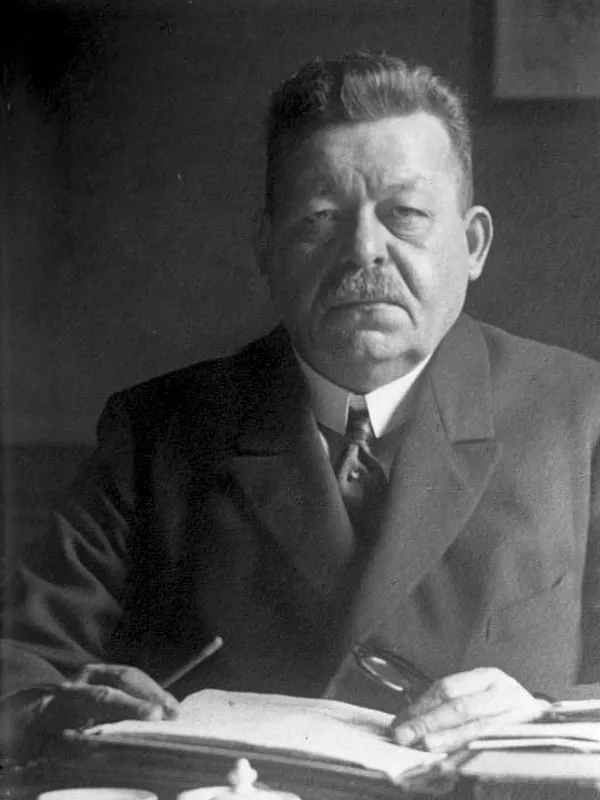
- Born:
- 4 February 1871, Heidelberg (Grand Duchy of Baden)
- Died:
- 28 February 1925, Berlin
- Author:
- Łukasz Skowroń
- Photo:
- Bundesarchiv, Bild 102-00015 / Georg Pahl, CC BY-SA 3.0 DE, Wikimedia Commons

Friedrich Ebert, the son of a Heidelberg tailor and a saddler by trade, had led Germany’s largest party, the Social Democratic Party of Germany, since 1913. Throughout the war he supported the defence of the country and the policy of the “castle peace” (Burgfrieden), and at that price he watched his party split into two hostile halves. At the same time he patiently built in the Reichstag the coalition that forced through the peace resolution of 1917 and the parliamentarisation of the Reich in the autumn of 1918. On 9 November 1918, the day of the revolution, he took over the office of chancellor from Prince Max of Baden, and then led the revolutionary government that ended the war, held elections to the National Assembly and relied on the old army against the radical left. In 1919 he became the first President of Germany. To some he is the father of German democracy; to others, the man who betrayed the revolution and left the republic an army of generals hostile to it.
Before the war
He was born on 4 February 1871 in Heidelberg, the seventh of nine children of a poor master tailor. He trained as a saddler and wandered across Germany as a journeyman. In 1889 he joined the Social Democrats and became active in the saddlers’ trade union, for which he repeatedly lost his job. He settled in Bremen, where he edited the local party newspaper and ran a tavern that became a centre of the labour movement; from 1900 he was a workers’ secretary and a member of the city’s Bürgerschaft. In 1894 he married a factory worker, Louise Rump. They had four sons and a daughter.
In 1905 he was elected to the party executive and moved to Berlin. He was an organiser, not a theorist: he put the party’s finances and apparatus in order, smoothed disputes between the party and the trade unions, and dealt with the working-class youth. He won the trust of every wing except the radical left. In 1912 he won a Reichstag seat for the Elberfeld-Barmen constituency (today Wuppertal), and on 20 September 1913, after the death of August Bebel, the party congress in Jena elected him co-chairman of the party, by 433 votes out of 473, alongside Hugo Haase.
August 1914
The July Crisis caught Ebert on holiday on the Baltic. He returned to Berlin and then, together with the party treasurer Otto Braun, went to Zurich to take the party’s funds and papers abroad and prepare a leadership in exile in case the authorities banned the party, as had been expected before the war. For this reason he was absent from the parliamentary group’s meeting on 3 August, at which the majority of deputies decided to vote for the war credits. On 4 August the whole Social Democratic group, in line with party discipline, backed the credits in the Reichstag. Ebert sided with the majority at once. Like most German workers, he believed that Germany was fighting a defensive war, above all against Tsarist Russia, and he hoped that in return for its loyalty the party would obtain reforms, above all the abolition of the three-class franchise in Prussia.
The split
During the first years of the war Ebert tried both to hold to the line of national defence and to prevent a split. In December 1914 Karl Liebknecht was already voting against the credits, and the opposition within the group grew month by month. Ebert defended above all the principle that the group voted as one, according to the will of the majority. In June 1915, when Haase, together with Eduard Bernstein and Karl Kautsky, publicly attacked the government’s annexationist war aims, Ebert had him condemned by the party leadership. Ebert’s rival in the leadership, Philipp Scheidemann, noted at the time that Ebert treated Haase “downright brutally”.
In December 1915 Haase stepped down as chairman of the parliamentary group, and on 11 January 1916 Ebert and Scheidemann became its chairmen. When in March 1916 Haase spoke in the plenary session against the war budget, Ebert had his group expelled from the parliamentary party. In January 1917 the oppositionists were also expelled from the party, and in April they founded the Independent Social Democratic Party of Germany (USPD). From then on Ebert led the so-called Majority Social Democrats. He favoured a peace without annexations, but defended the inviolability of the Reich’s borders, including Alsace-Lorraine, and to the end of the war regarded the defence of the country as a duty. The war also struck him personally. In 1917 two of his sons, Georg and Heinrich, were killed.
Builder of a majority
Since he did not want a revolution, Ebert put his faith in parliament. Together with Matthias Erzberger of the Centre and the liberals of the Progressive People’s Party, he set up in 1917 an inter-party committee that united the parties holding a majority in the Reichstag. Its first fruit was the peace resolution of 19 July 1917, calling for a negotiated peace without annexations, which Ebert personally helped to prepare. On 9 October 1917 he sharply attacked in the Reichstag Chancellor Georg Michaelis, who had accused the Independent Socialists of complicity in the sailors’ mutiny, and contributed to his fall. When Georg von Hertling was appointed, the majority parties for the first time demanded that the Emperor consult them. Ebert was soon disappointed, however. Hertling’s government dragged its feet over the reform of the Prussian franchise and remained obedient to the Supreme Army Command, and the Treaty of Brest-Litovsk showed that it was the generals who decided on peace.
In January 1918 a great strike in the armaments works broke out in Berlin. Ebert did not want it, but together with Scheidemann and Braun he joined the strike committee in order, as he later claimed, to end it as quickly as possible and not to leave the workers in the hands of the far left. The decision cost him dearly. The left considered him a traitor to the workers, the right a traitor to the fatherland.
Autumn 1918
When at the end of September 1918 the Supreme Army Command demanded an armistice and a government based on parliament, many Social Democrats did not want to take responsibility for someone else’s defeat. Scheidemann still opposed entering the government on 3 October. Ebert persuaded the party that if it did not come to terms with the bourgeois parties, revolution would decide, and that anyone who had seen what had happened in Russia could not want one. He called entering the government a “damned duty”. His party joined the government of Prince Max of Baden, though Ebert himself remained in the Reichstag. He and the new chancellor, Max von Baden, trusted each other. At that time Ebert was, as his biographers put it, rather a “monarchist by reason”: the parliamentary monarchy brought about by the October constitutional reforms was enough for him.
At the beginning of November, as the revolution spread across the country from Kiel, Ebert concluded that only the abdication of Wilhelm II could stop it. On 6 November he tried to convince the new Quartermaster-General, Wilhelm Groener, of this, but Groener refused. On 7 November the Social Democrats gave the government an ultimatum, and Ebert, according to the chancellor’s memoirs, told him: “If the Kaiser does not abdicate, the social revolution is unavoidable. But I do not want it; indeed I hate it like sin.”
9 and 10 November
On 9 November the revolution reached Berlin. The chancellor announced the Emperor’s abdication, and around noon Ebert, with the Berlin garrison behind him, came to the Chancellery and demanded power. The prince handed him the office of chancellor. Ebert assured the vice-chancellor that he would govern on the basis of the existing constitution, and asked the prince to stay on as regent. He wanted to leave the decision on whether Germany would be a monarchy or a republic to a national assembly. That is why he was furious when, a few hours later, Scheidemann proclaimed the republic from a window of the Reichstag.
On 10 November a meeting of the Berlin workers’ and soldiers’ councils confirmed a six-member Council of the People’s Deputies, made up of three Social Democrats and three Independents, with Ebert and Haase as co-equal chairmen. In practice it was led by Ebert, who kept internal and military affairs for himself. That same evening General Groener telephoned him from headquarters at Spa. The army recognised the new government and promised to withdraw from the front in good order, while the government was to support the officer corps in maintaining discipline and fighting Bolshevism. This agreement, kept secret for years, went down in history as the Ebert–Groener pact. On 11 November, in the Forest of Compiègne, Erzberger signed the armistice, for which the new government had authorised him.
Against a council republic
Ebert saw his government as the receiver of the bankrupt estate of the Empire. Above all he wanted to bring millions of soldiers back from the front, feed the country and hand power as soon as possible to an assembly chosen in free elections. On 10 December, greeting returning Guards units at the Brandenburg Gate, he told the soldiers that “no enemy has vanquished you”. He meant to honour them, but unwittingly fed the nascent stab-in-the-back myth. At the congress of councils in mid-December a large majority of the delegates backed his line and set elections for 19 January 1919.
At the end of December, when mutinous sailors imprisoned the Berlin city commandant, Ebert called in the army. The Christmas fighting ended in defeat for the government troops, and the Independent Socialists left the government. Their places were taken by Social Democrats, among them Gustav Noske, who took charge of military affairs. In January 1919, after the founding of the KPD, the Spartacist uprising broke out in Berlin. Ebert agreed to its suppression by volunteer Freikorps (PL) units. On 15 January their officers murdered Liebknecht and Rosa Luxemburg. To the radical left, Ebert and Noske became from then on the murderers of the revolution.
After the war
On 11 February 1919 the National Assembly sitting in Weimar elected Ebert provisional President of Germany, and in 1922 the Reichstag extended his term. In June 1919, after consulting the Supreme Army Command, he came out in favour of signing the Treaty of Versailles. He defended the republic both against communist uprisings and against the right: in 1920 during the Kapp Putsch, and in 1923, the year of hyperinflation, the occupation of the Ruhr and the Beer Hall Putsch, when he entrusted executive power to General Hans von Seeckt. In doing so he made wide use of Article 48 of the constitution on the state of emergency.
The right hounded him with slander and lawsuits. One journalist accused him of treason for his part in the January strike. In December 1924 a court in Magdeburg convicted the journalist of insulting the president, but stated in its reasoning that Ebert had, in the legal sense, committed high treason. Shaken, the president put off an operation so as to remain at the court’s disposal. He died in Berlin on 28 February 1925 of peritonitis following a ruptured appendix, aged 54. Paul von Hindenburg was elected his successor.
Assessment
Ebert remains one of the most contested figures in German history. In his lifetime the left called him a traitor to the working class, and the nationalists a “November criminal” who had signed the defeat. In the GDR he was portrayed as a servant of the generals and the bourgeoisie. In the Federal Republic he was regarded as the father of German parliamentary democracy. Theodor Heuss even compared him to Abraham Lincoln.
Historians today judge him more cautiously. No one disputes that in November 1918 Ebert prevented chaos and a civil war on the Russian model, secured the army’s return from the front and brought about elections. The dispute is about the price. Gerhard A. Ritter, Susanne Miller and Heinrich August Winkler argue that Ebert, fearing Bolshevism, trusted the old elites too much: he made no attempt to democratise the army, the administration or the judiciary, although the workers’ and soldiers’ councils gave him the backing to do so, and his alliance with the generals and the Freikorps deepened the gulf between Social Democrats and Communists. Hagen Schulze and others point out that the trained bureaucracy and the army were indispensable in 1918, and that radical change could have ended in the break-up of the state. The paradox of his career also remains in memory: a man who throughout the war wanted reform, not revolution, at the moment of defeat put himself at the head of the revolution in order to stop it.
Sources
Spotted a mistake?Report an error
Often appears with
People who appear in the same events.