Germany · The Central Powers
Hans von Seeckt
Chief of staff of the Eleventh Army and of Mackensen's army group (1915), chief of staff of the Ottoman army (1917–1918), major general
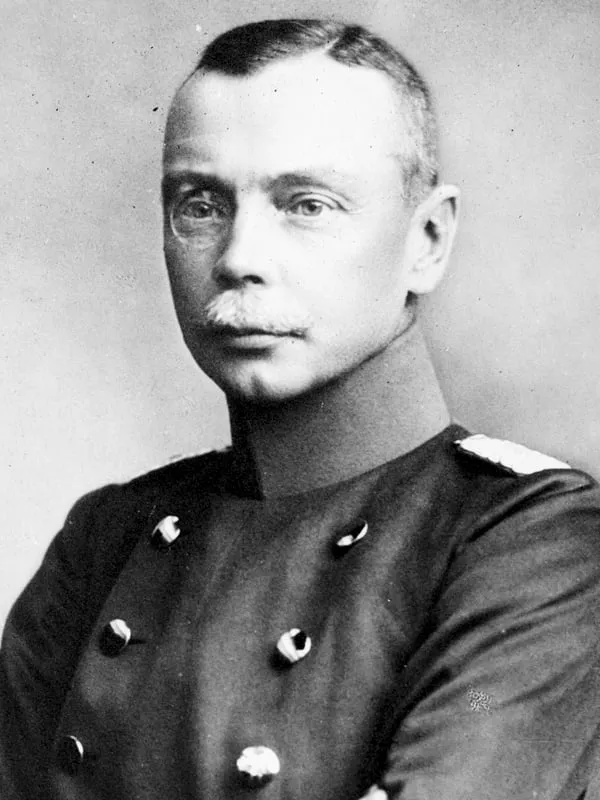
- Born:
- 22 April 1866, Schleswig (Prussia)
- Died:
- 27 December 1936, Berlin
- Author:
- Natalia
- Photo:
- Ernst Sandau, domena publiczna, Wikimedia Commons
Throughout the First World War Hans von Seeckt was a staff officer, never a commander, and yet he was among the most influential German soldiers of his time. As chief of staff to August von Mackensen he helped to plan the breakthrough of the Russian front at Gorlice in 1915 and the conquest of Serbia. In the German army it was said at the time that where Mackensen was, there was Seeckt, and where Seeckt was, there was victory. In 1916–1917 he shored up the Austro-Hungarian front in the Carpathians, and in the last year of the war he was chief of staff of the Ottoman army. After the war he became head of the army of the Weimar Republic and built the 100,000-strong Reichswehr, from which came the commanders of the German army of the Second World War.
Before the war
He was born on 22 April 1866 in Schleswig, into a family of Pomeranian nobility with military traditions. His father rose to the rank of general of infantry. In 1885 Seeckt joined an elite regiment of guard grenadiers in Berlin. In 1893–1896 he completed the War Academy, and then for twenty years he made his career on the General Staff and on corps staffs. He travelled a great deal, read widely and was regarded as an educated, cool and reserved officer, later nicknamed “the Sphinx”. In 1913 he became chief of staff of III Corps in Berlin, commanded by General Ewald von Lochow.
1914: France and Soissons
With III Corps Seeckt marched through Belgium in August 1914 as part of Alexander von Kluck’s First Army, fought on the Marne and, after the retreat, on the Aisne. In the winter the corps held the trenches near Soissons. When at the beginning of January 1915 the French took the heights north of the town, Seeckt prepared a counter-attack which in the middle of the month pushed them back across the Aisne and brought the Germans several thousand prisoners. The Battle of Soissons was small, but it drew the high command’s attention to the chief of staff. Seeckt was promoted to colonel.
1915: Gorlice and Serbia
In March 1915 Erich von Falkenhayn decided to rescue Austria-Hungary, which the Russians were threatening in the Carpathians, with a blow in western Galicia. A new Eleventh Army was formed from picked divisions brought from the west; Mackensen became its commander and Seeckt its chief of staff. The preparations were made in secret, with a huge concentration of heavy artillery on a narrow sector. On 2 May Mackensen’s troops struck at Gorlice and within a few days they had smashed the Russian Third Army.
According to Liddell Hart, Seeckt required the corps not to wait for the line to be straightened but to push on as far as they could, and he sent the reserves to where the front had already broken, not to where the Russians were still holding out. The Russians were therefore unable to dig in on any of the successive lines. The offensive crossed the San, retook Przemyśl and Lviv, and in the summer, now as Mackensen’s army group, whose chief of staff was still Seeckt, it turned north, between the Vistula and the Bug, and reached Brest-Litovsk. Seeckt received the Pour le Mérite in May, and in June, on Mackensen’s recommendation, early promotion to major general.
In the autumn Mackensen and Seeckt led the campaign against Serbia, in which German and Austro-Hungarian troops attacked from the north and Bulgarian troops from the east. Belgrade fell in October, and at the end of November the Serbian army, with its king and government, had to retreat across the mountains of Albania to the Adriatic. It could not, however, be encircled. For the Serbian campaign Seeckt received the oak leaves to the Pour le Mérite.
1916–1917: rescuing the Austro-Hungarian front
When in June 1916 the Brusilov offensive shattered the Austro-Hungarian front, the Germans sent Seeckt as chief of staff to General Karl Pflanzer-Baltin’s Austro-Hungarian Seventh Army, which had just lost Czernowitz and Bukovina. In mid-June he wrote to Conrad von Hötzendorf that an army which was to cover both Bukovina and the road to Kolomyia at the same time “will tear apart in the middle”. In the summer he became chief of staff of the new army group of the heir to the throne, Archduke Charles, which defended eastern Galicia and the Carpathians. Formally the archduke commanded it, but in practice Seeckt directed the operations, which the Austrians found hard to accept. When in August the Russians took Stanislau again, he asked Hindenburg for German reinforcements.
In the autumn of 1916, after Romania entered the war, his army group was also responsible for the front in Transylvania. Seeckt, who in November visited Târgu Jiu just after its capture, pressed for a swift strike into Wallachia before snow blocked the roads. When Charles became emperor, command of the army group passed to Archduke Joseph August, and Seeckt remained his chief of staff for most of 1917.
1917–1918: Turkey
In December 1917 Seeckt replaced General Friedrich Bronsart von Schellendorf as chief of staff of the Ottoman army, formally deputy to the Minister of War, Enver Pasha, who was also chief of staff. In this post he often clashed with the other German general in Turkey, Otto Liman von Sanders, over influence and over the direction of Turkish strategy. He had hoped to direct the whole strategy of the empire, but he soon found that Enver listened to German advice only when it agreed with his own intentions. In 1918 the Turks sent their best forces to the Caucasus, towards Baku, instead of reinforcing the threatened fronts in Palestine and Mesopotamia. In June Seeckt sailed with Enver to Batum, where Turkey had just imposed treaties on the Transcaucasian republics, to seek a compromise with the Germans, who had interests of their own in Georgia.
Seeckt’s attitude to the Armenian genocide is today one of the most often recalled parts of his biography. According to researchers who quote his correspondence, in the summer of 1918 he replied to Berlin that one could not be an ally of the Turks and at the same time stand up for the Armenians, and that Christian and sentimental considerations must give way to the needs of war. After the Armistice of Mudros he returned to Germany in November 1918.
After the war
In 1919 he was chief of staff of the troops guarding Germany’s eastern border, and in the spring military expert of the German delegation at Versailles. He tried in vain to persuade the Allies to let Germany keep an army larger than 100,000 men. In the autumn of 1919 he became head of the Truppenamt (Troops Office), that is, the general staff forbidden by the treaty under a new name. During the Kapp Putsch in March 1920 he refused to use the army against the putschists; according to an often quoted account, he said that “troops do not fire on troops”. Even so, after the putsch collapsed he became Chief of the Army Command.
For six years he built the Reichswehr as a cadre army in which every officer and NCO was trained to command at a higher level, so that it could be expanded quickly. He kept it away from party politics, but also from the control of the republican government. He secretly cooperated with the Red Army, which the Treaty of Rapallo of 1922 made easier. He was an implacable enemy of reborn Poland. In September 1922 he wrote in a memorandum for Chancellor Joseph Wirth that Poland’s existence was intolerable for Germany and that Poland must disappear, through its own weakness and through Russia, with Germany’s help. In November 1923, during the Beer Hall Putsch, President Friedrich Ebert entrusted him with executive power, and Seeckt sided with the government. In October 1926 he had to resign when, without the minister’s knowledge, he allowed a grandson of the former Kaiser to take part in manoeuvres. In 1930–1932 he was a member of the Reichstag for the German People’s Party, and in 1933–1935 he went to China several times as a military adviser to Chiang Kai-shek. He died on 27 December 1936 in Berlin.
Assessment
Seeckt is considered one of the ablest General Staff officers in the history of the German army. Many authors, following the British historian Basil Liddell Hart, give him the main credit for the success at Gorlice and in Serbia and reduce Mackensen’s role to that of a commander who knew how to listen to his chief of staff. Others point out that the plan for the blow at Gorlice arose from talks between Falkenhayn and Conrad, and that the victory was also the work of crushing artillery superiority and the weakness of the Russian defence. In Turkey, for all his abilities, Seeckt achieved little, because Enver decided strategy.
His assessment is complicated by the post-war period. The British historian John Wheeler-Bennett placed him alongside Scharnhorst and Gneisenau as a man who rebuilt the army from the ashes of defeat. Critics point out that he made the Reichswehr “a state within the state”, distrustful of democracy, and that his army, prepared for rapid expansion, became the basis of the Wehrmacht. For Polish historians Seeckt remains above all an advocate of rapprochement with Soviet Russia at Poland’s expense, and his words on the need for Poland to disappear are among the most often quoted testimonies to German eastern policy of the 1920s.
Sources
Spotted a mistake?Report an error
Commanded in battles
(03)Mentioned in battles
(02)Often appears with
People who appear in the same events.