Key event
Start of the Battle of Gorlice
- Category:
- Military operations
- Front:
- Eastern Front
- Date:
- 1 May 1915
- Author:
- Łukasz Skowroń
- Battle:
- Battle of Gorlice
- Tags:
- Germany, Austria-Hungary, Russia, August von Mackensen
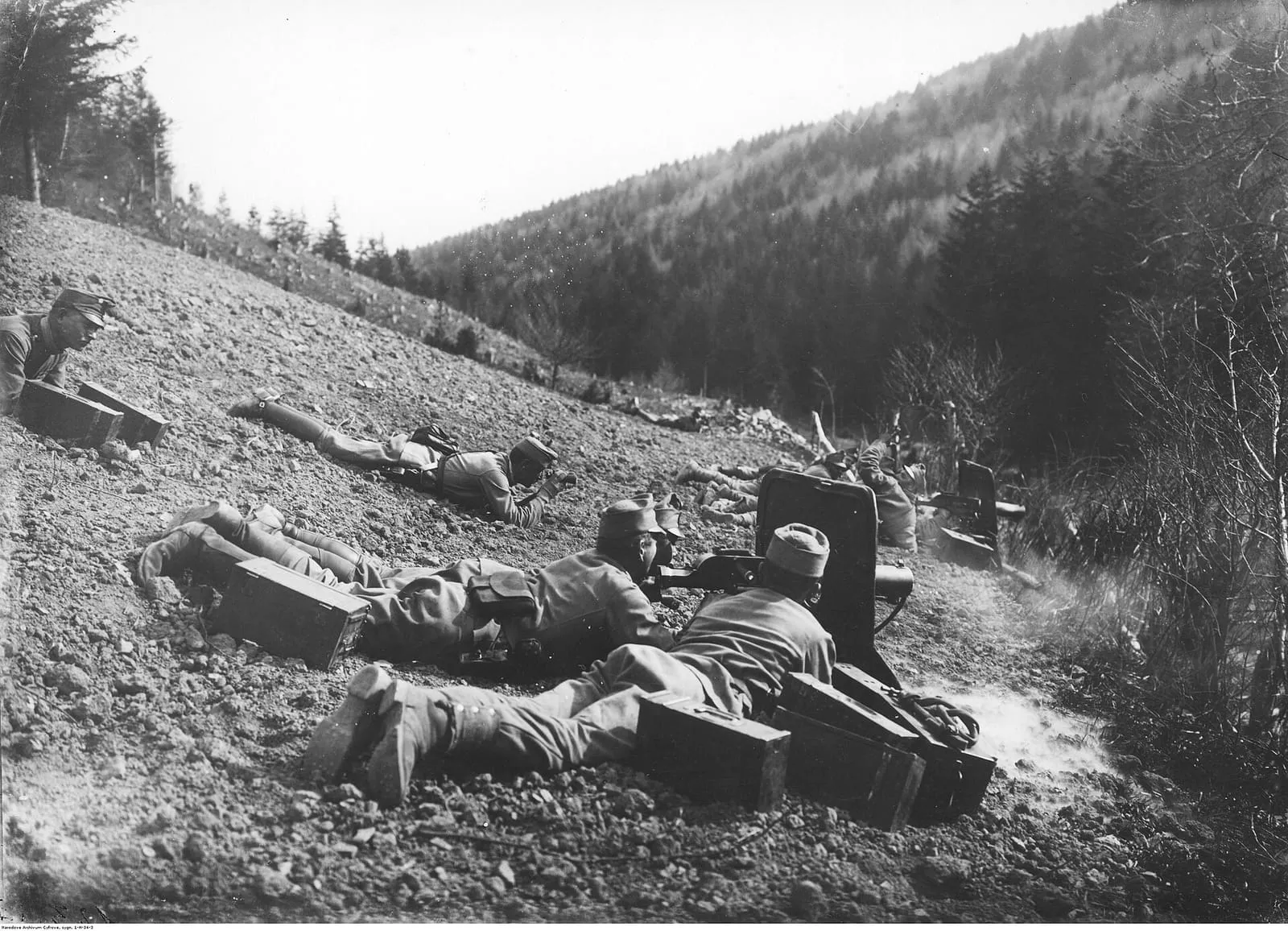
On 1 May 1915 hundreds of German and Austro-Hungarian guns opened up in the foothills between Tarnów and Gorlice. Batteries that had secretly taken up their positions over the preceding days began ranging on the Russian trenches and firing harassing fire. The British chronology of the war counts the Battle of Gorlice and Tarnów from this day. The main blow, however, came only the next morning: on 2 May, after a four-hour hurricane bombardment, the infantry of General August von Mackensen’s new German Eleventh Army went into the attack and broke through the first line of the Russian defences that same day.
A blow at a weak spot
Since December 1914 the front in Western Galicia had stood motionless on the line of the Dunajec, the Biała and the hills near Gorlice, established after the Battle of Limanowa. In the winter the heaviest fighting took place elsewhere, in the Carpathians, which swallowed hundreds of thousands of soldiers on both sides. The Russians had moved their best forces there, and the sector at Gorlice was held by the weakened Third Army of General Radko Dimitriev, stretched from the Vistula to the Carpathians and short of artillery shells.
In April the chief of the German General Staff, Erich von Falkenhayn, agreed to a plan long urged on him by the Austro-Hungarian chief of staff, Franz Conrad von Hötzendorf: to break the Russian front precisely here, in the rear of their armies fighting in the mountains. Eight picked divisions, including the Prussian Guard, were brought from the Western Front and, together with the Austro-Hungarian VI Corps, formed into the Eleventh Army. Mackensen, whose chief of staff was Colonel Hans von Seeckt, was also given command of the Austro-Hungarian Fourth Army of Archduke Joseph Ferdinand, stationed near Tarnów. The troop trains arrived from the second half of April, and the local population was evacuated from the concentration area. The Russians learned of the preparations from prisoners and began to bring up reserves, but underestimated the scale of the threat.
Bombardment and assault
The artillery Mackensen had assembled had no equal on the Eastern Front until then. According to the most frequently cited figures, his two armies had more than a thousand guns and mortars, including heavy howitzers and siege mortars. The fire was directed by observers connected to the batteries by telephone and by airmen. On 1 May and during the night the guns ranged on their targets while the infantry moved up to their jumping-off positions. Russian accounts describe this as an artillery preparation lasting more than ten hours that began on the evening of 1 May.
At 6 a.m. on 2 May the whole artillery opened fire, and at about 9 a.m. the heaviest mortars joined in. The shallow Russian trenches, more like ditches, were turned into craters. At 10 a.m. the artillery lifted its fire deeper and the infantry went in to the assault. The Prussian Guard on the hills near Ciężkowice passed through the shattered positions almost without resistance. The Austro-Hungarian 12th Infantry Division from Kraków, made up mostly of Poles, took the forest trenches on Pustki (PL) hill with the bayonet, losing there, according to Polish accounts, nearly 900 men. At Gorlice itself the Germans became bogged down in street fighting in the ruined town and broke the resistance only after a renewed bombardment. On the right wing a Bavarian division long failed to take the hills above the Sękówka valley. Near Tarnów the Fourth Army’s attack made slow progress.
The first day
By the evening of 2 May the first Russian line had been broken along the whole front of the attack, to a depth of several kilometres. According to various sources, from more than ten thousand to about 20,000 Russians were taken prisoner. The attackers also suffered heavy losses: some German regiments lost hundreds of men in a single day. The commander of the Russian X Corps, which was defending the Gorlice sector, allowed his divisions to fall back to a rear position in the late afternoon. Dimitriev, however, refused to permit a retreat and ordered the positions to be held and a counter-attack prepared as soon as III Caucasian Corps arrived from the reserve. For the next few days the Russian command believed that the attack could be stopped on successive lines of defence.
Remember the articles you have read? Only in this browser; nothing is sent anywhere.How it works
Read ·
A voice from the front
“The whole line of the R's was being pounded with crash after crash, sometimes four black columns rising almost simultaneously at intervals along it; under each would break out little angry teeth of sparkling flame; the only thing that seemed not to be hit was the church tower, which, as each cloud died down, came out simple again in the bright sunshine.”
Spotted a mistake?Report an error
Meanwhile
(04)Elsewhere in the same days.
- 1 May 1915 · War at seaTorpedoing of the tanker GulflightOn 1 May 1915 U-30 torpedoed the American tanker Gulflight off the Scilly Isles. She did not sink, but two seamen drowned and the master died of heart failure.
- 3 May 1915 · Western FrontJohn McCrae writes "In Flanders Fields"On 3 May 1915 near Ypres the Canadian doctor John McCrae, a day after a friend's burial, wrote "In Flanders Fields", the poem behind the remembrance poppy.
- 28 April 1915 · Middle EastBritish treaty with al-IdrisiIn late April 1915 Britain concluded a treaty with Muhammad al-Idrisi, ruler of Asir. Idrisi undertook to fight the Turks in return for arms and protection.
- 28 April 1915 · Middle EastFirst attack on KrithiaOn 28 April 1915 the British and French attacked from Helles towards Krithia village and the hill of Achi Baba. Turkish resistance halted the weary troops.
Related events
(04)The same battle, people or subject.
- 5 May 1915 · Eastern FrontEnd of the battle of GorliceOn 5 May 1915 the Russian Third Army, shattered at Gorlice and Biecz, was ordered back behind the Wisłoka. Counter-attacks failed and the front broke.
- 16 May 1915 · Eastern FrontBattle of the San beginsOn 16 May 1915 the Germans entered Jarosław and began crossing the San. On the river line the Russians were to halt the Central Powers' offensive in Galicia.
- 3 June 1915 · Eastern FrontThe Central Powers retake PrzemyślEarly on 3 June 1915 German and Austro-Hungarian troops entered Przemyśl, abandoned by the Russians. Russian rule in the town had lasted 73 days.
- 11 June 1915 · Eastern FrontEnd of the Battle of PrzemyślA British chronology ends the Battle of Przemyśl on 11 June 1915. After the fortress fell, the front halted at Mościska and Mackensen prepared to hit Lviv.