1914: The Battles of Łódź and Kraków
Battle of Limanowa
- Dates:
- 1–12 December 1914
- Front:
- Eastern Front
- Location:
- Western Galicia between the Vistula and the Beskids, from Wieliczka, Łapanów and Bochnia to Limanowa and Nowy SączOn the battle map →
- Sides:
- Austria-HungaryFranz Conrad von Hötzendorf, Archduke Joseph Ferdinand, Josef Roth, Svetozar BoroevićGerman EmpireAlfred von BesserRussian EmpireNikolai Ivanov, Radko Dimitriev, Aleksei Brusilov
- Result:
- Austro-Hungarian victory. The Russian Third Army fell back behind the Dunajec, and the threat of the Kraków fortress being outflanked from the south passed.
- Author:
- Łukasz Skowroń
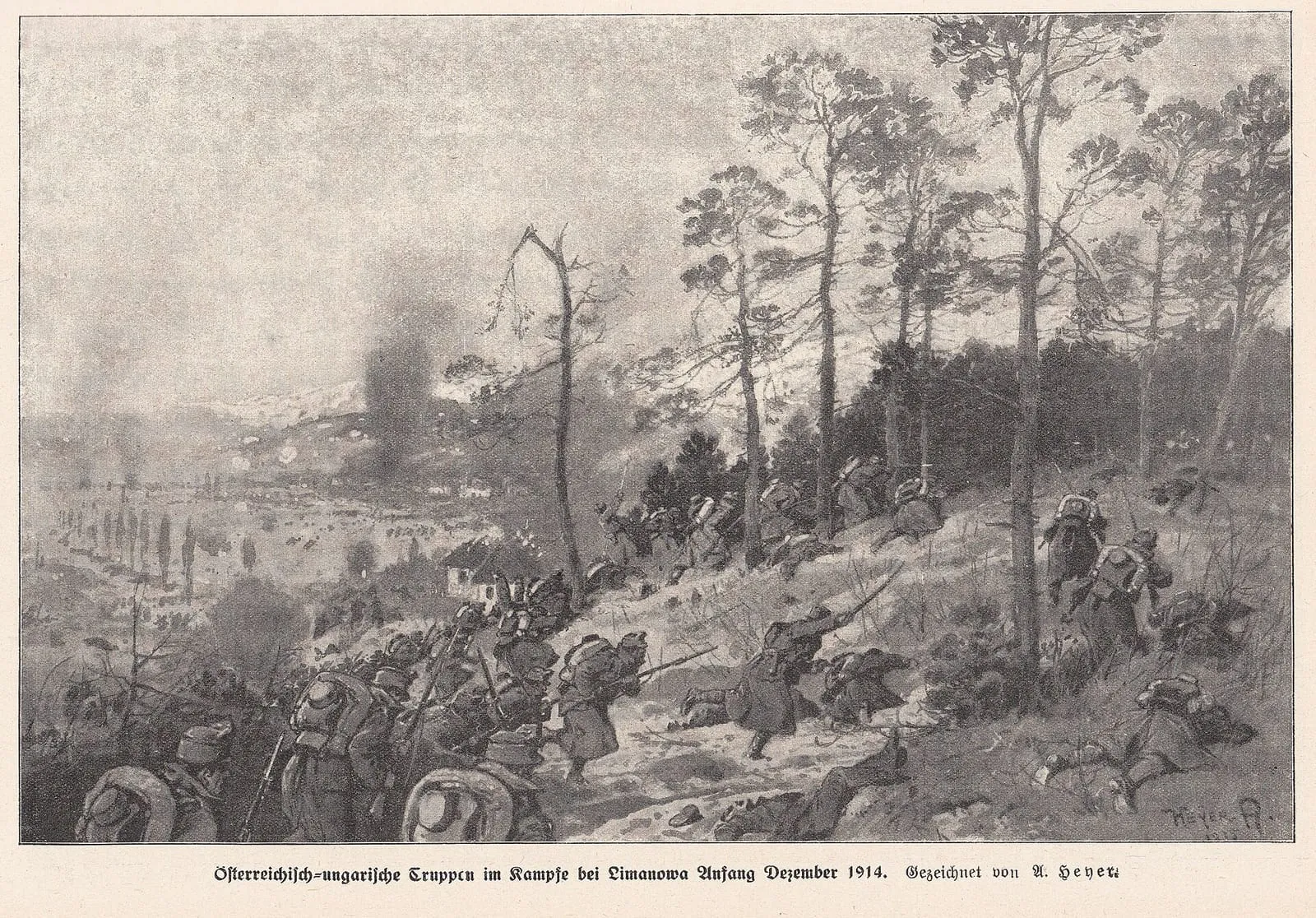
The Battle of Limanowa, also called the Battle of Limanowa–Łapanów or the Limanowa operation, was fought in the first half of December 1914 in the foothills and mountains south-east of Kraków. The Austro-Hungarian army, which since August had suffered defeat after defeat in the east, struck from the Raba valley into the flank and rear of the Russian Third Army advancing on Kraków. The fighting took place in snow and frost, on the steep slopes of the Island Beskids and the Wiśnicz Foothills (PL), around Łapanów, Limanowa and Nowy Sącz. After ten days, when a second Austro-Hungarian army arrived from the Carpathians, the Russians had to withdraw behind the Dunajec. It was one of the last major successes that the Austro-Hungarian army won almost without German help.
Name and dates
On this page we use the dates 1–12 December 1914. We take the start date from the British chronology of the war on which our timeline is based, which records the beginning of the battle of Limanowa and Łapanów under 1 December. According to some studies, on that day the first Austro-Hungarian units were already fighting their way out of the mountains around Kasina Wielka and Dobra. The Polish Wikipedia and most Polish authors, however, take 2 December as the start of the operation and set its end on 12 December, when the Russians left Nowy Sącz and troops of the Austro-Hungarian Third Army arrived there from the south.
Other sources give different dates. The English Wikipedia dates the battle to 1–13 December, the German to 1–14 December, and the Hungarian, which covers the whole of the operations in the Carpathians, even to 28 November – 18 December. The differences arise mainly from whether the earlier regrouping of troops and the later pursuit of the Russians are counted as part of the battle. In Austria and Hungary the engagement is known as the Battle of Limanowa and Łapanów, after the two places around which the heaviest fighting took place.
Background
At the end of November 1914 Austria-Hungary found itself in a dangerous position. The Battle of Kraków had ended with the Fourth Army back under the cover of the forts. Przemyśl had for several weeks been under siege again, and in the Carpathians Russian units had crossed the passes into Hungary for the second time. Between the Austro-Hungarian Fourth Army at Kraków and the Third Army of General Svetozar Boroević in the Carpathians a gap several dozen kilometres wide had opened.
Into this gap advanced the Russian Third Army of General Radko Dimitriev. Its corps were moving west from Tarnów, on both sides of the Raba and the Stradomka. Around 30 November the Russians took Wieliczka and Dobczyce, and their patrols reached the forts of Kraków. Further south, in the Sącz Basin, stood units of the Eighth Army of General Aleksei Brusilov, which had taken Nowy Sącz. The Russians could outflank the fortress from the south, cut it off and move on westwards, towards Silesia and Moravia.
The chief of the general staff, Franz Conrad von Hötzendorf, noticed that the Russian armies had stretched out in a great arc from the Vistula to the Carpathians and that their southern wing was poorly covered. Air reconnaissance confirmed that units of the Third Army were moving towards Wieliczka and Kraków. Conrad decided to strike their flank from the mountains. On 28–30 November units of the Fourth Army of Archduke Joseph Ferdinand, released from the Kraków front, were carried by rail through Kraków to Chabówka, Mszana Dolna and Jordanów. The core of the strike group was the Tyrolean XIV Corps of Feldmarschalleutnant Josef Roth, reinforced by the German 47th Reserve Infantry Division of General Alfred von Besser, several cavalry divisions and the Polish Legions. The Kraków fortress was meanwhile to be defended by its own garrison.
Forces
Estimates of the forces vary greatly, because authors draw the limits of the battle differently. The Polish Wikipedia, following Jan Dąbrowski, states that Roth’s group numbered about 90,000 soldiers and the Russian Third Army 110,000 to 120,000. Local studies give a similar ratio, about 90,000 against 120,000. The Russian historian Sergei Nelipovich, who also counts both armies fighting in the Carpathians, speaks of more than 270,000 soldiers on the side of the Central Powers and more than 280,000 on the Russian side.
On the Russian side the fighting was done above all by the corps of the Third Army: the IX of General Dmitry Shcherbachev, the XI and in time also the X and XXI, brought in from the Vistula. From Brusilov’s Eighth Army came the VIII Corps of General Vladimir Dragomirov, which struck at Limanowa from the direction of Nowy Sącz. On the Austro-Hungarian side, besides Roth’s group, the VI Corps of General Arthur Arz von Straussenburg, carried through Kraków during the battle, took part, as did units of Boroević’s Third Army, including the Hungarian group of General Sándor Szurmay.
Course
1–4 December. The first units of Roth’s group came out of the mountains from the direction of Kasina Wielka and Dobra, pushing back the Russian cavalry. On 2 and 3 December the attack moved north and north-east, along the valleys of the Raba, the Stradomka and the Łososina (PL). The Austrians took Tymbark and Skrzydlna. The Russians, however, quickly recovered. As early as 3–4 December the attack stalled in front of Łapanów and Rajbrot, where the Third Army built a front facing south. Dimitriev brought up reinforcements from the north and asked the neighbouring Eighth Army for help. In the same days there were clashes on the south-eastern approaches to Kraków, around Wieliczka. Some Polish publications call them the second battle for Kraków, but this was secondary fighting compared with what was happening at Łapanów and Limanowa. The Russian units were stopped before the forts, at advanced field positions, with the support of the fortress artillery.
5–9 December. The fighting turned into a bloody struggle for every hill. The Austrians, supported by the Germans, who often went in with the bayonet, advanced slowly towards Bochnia. The Russian defence at Łapanów broke only on 7 December, and even then the front moved only a few kilometres. Meanwhile from the east, from the Dunajec, came the Russian VIII Corps. It struck Roth’s exposed right wing at Limanowa, held by weak Landwehr and dismounted cavalry divisions, in particular the 10th Cavalry Division of Count Herberstein. Each side now tried to break the opponent’s wing: the Austrians towards Bochnia, the Russians towards Limanowa and Mszana Dolna. The Austrian command threw the fresh VI Corps with the 39th Honvéd Division in at Limanowa. On 9 December the Russians took the hill of Golców (PL), which dominates the town from the south.
10–12 December. 10 December was the most difficult day of the battle for the Austrians. Russian counter-attacks retook part of the ground won at Łapanów, and at Limanowa further Russian divisions appeared, including the 48th Division of General Lavr Kornilov. The decision, however, came from another direction. From 7–8 December the Austro-Hungarian Third Army had been attacking through the passes of the Low Beskids (PL). Its columns were heading for Nowy Żmigród, Dukla and Gorlice, and its left wing, Szurmay’s group with the 38th Honvéd Division, stood on 10 December at Nawojowa, a few kilometres from Nowy Sącz. The Russian armies began to be threatened with being cut off from their rear. On 11 December, while the fight for Jabłoniec hill was going on at Limanowa, the Russian command ordered the VIII Corps to retreat. On 12 December the Russians left Nowy Sącz, which Hungarian units and Polish legionaries entered. In the following days the whole of Dimitriev’s Third Army fell back behind the Dunajec.
The fight for Jabłoniec
The most famous episode of the battle was the fight for Jabłoniec (PL), a bare hill above the road from Limanowa to Nowy Sącz. It was held by dismounted regiments of Hungarian hussars. For 11 December the relief of the exhausted defenders by the 9th Nádasdy Hussar Regiment and the 13th Jászkun Hussar Regiment had been planned. The first of these had been commanded since 8 December by Colonel Othmar Muhr, a 54-year-old officer born in Kassa (Košice). Before dawn on 11 December Russian infantry of the VIII Corps broke into the trenches on the hill. Muhr, who was just leading his men to their positions, threw them into an immediate counter-attack. The hussars retook the trenches in hand-to-hand fighting, with rifle butts and spades. Muhr fell mortally wounded during the attack.
The Russians tried several more times to retake the hill, but without success. Some accounts move the assault to the night of 11–12 December, and the inscription on the monument to the Hungarian hussars in Limanowa speaks of those who fell on 11 and 12 December. The fight for Jabłoniec is sometimes presented as the turning point of the whole battle. In reality, as the Polish Wikipedia notes, while this fighting was going on, the retreat of the Russian armies behind the Dunajec, forced by the advance of the Third Army in the Carpathians, was already beginning. In Hungary the hussars’ fight became a legend. Emperor Franz Joseph posthumously ennobled Muhr with the predicate “limanowski”, and Limanowa is sometimes called the Hungarian Monte Cassino. A war cemetery no. 368 (PL) was later built on the hill, in which 409 soldiers were buried, including 161 Austro-Hungarian, one German and 247 Russian. Muhr lay in its chapel-mausoleum until his remains were moved to Hungary in the interwar period. A monument stands where he fell.
Poles in the battle
The battle was fought on land inhabited by Poles, among the villages of the Limanowa and Sącz regions. The inhabitants lived through the marches of both armies, requisitions, shelling and fires. After the fighting the head of the village of Stara Wieś, together with peasants from the surrounding villages, buried hundreds of the fallen on the slopes of Jabłoniec. Poles also fought on both sides of the front: many Galicians served in the Austro-Hungarian army, and conscripts from the Kingdom of Poland in the Russian army.
The 1st Regiment of the Polish Legions, about 2,000 soldiers under the personal command of Józef Piłsudski, also took part in the battle. At the end of November the legionaries reached the Jurków area, and on 5–8 December they passed through Limanowa, Wysokie and Trzetrzewina towards Marcinkowice. Piłsudski intended to strike at Nowy Sącz, held by the Russians, but ran into the VIII Corps, which was just then approaching. In the night Battle of Marcinkowice (PL) of 5–6 December the legionaries fought a heavy action and then withdrew. According to the historian Wacław Polakiewicz, the fight delayed the Russian attack on Limanowa by more than ten hours, which allowed the defenders to dig trenches and string out wire. Later the legionaries were sent to the Dunajec valley, and on 12 December they entered Nowy Sącz together with Hungarian units. Piłsudski entered the town at the head of the regiment a day later. There, on 19 December, his units were reorganised into the First Brigade of the Polish Legions.
Losses
Figures for losses differ even more than those for forces. According to the Polish Wikipedia, the Austrians lost about 12,000 killed and wounded, and the Russians about 30,000 killed, wounded and prisoners. Regional studies speak of about 11,000 killed on both sides. Russian historians, counting the losses of both armies in the whole of the December operations in western Galicia and the Carpathians, give figures of the order of 100,000–145,000 men on each side. The fallen were buried in dozens of war cemeteries built by the Austrian authorities in western Galicia in 1915–1918.
Significance
The Battle of Limanowa halted the Russian march westwards. The threat of the Kraków fortress being outflanked and cut off passed, and the Russians had to pull back their front north of the Vistula as well. The front moved several dozen kilometres east and came to rest on the line of the Dunajec and the Biała, where with minor changes it remained until May 1915 and the breakthrough at Gorlice. The Polish Wikipedia compares its significance for Austria-Hungary to that of the Battle of the Marne for France. The victory was won by armies worn out by months of defeats, in winter and in mountainous terrain, against a stronger opponent and with little help from the Germans.
The success, however, had its limits. Boroević’s Third Army failed to break through to besieged Przemyśl. At the end of December the Russians brought up reinforcements, went over to the counter-attack and pushed it back into the Carpathians. In this fighting, on 22–25 December, the First Brigade of the Legions fought the Battle of Łowczówek. The weight of the fighting in the east shifted to the mountains, where in the winter of 1915 Austria-Hungary suffered enormous losses trying to relieve Przemyśl. For Limanowa Josef Roth received the Knight’s Cross of the Military Order of Maria Theresa, and later the predicate “von Limanowa-Łapanów”.
Spotted a mistake?Report an error