Austria-Hungary · The Central Powers
Archduke Joseph Ferdinand of Austria
Commander of XIV Corps (1914), commander of the Fourth Army (1914–1916), inspector general of the air service (1917–1918)
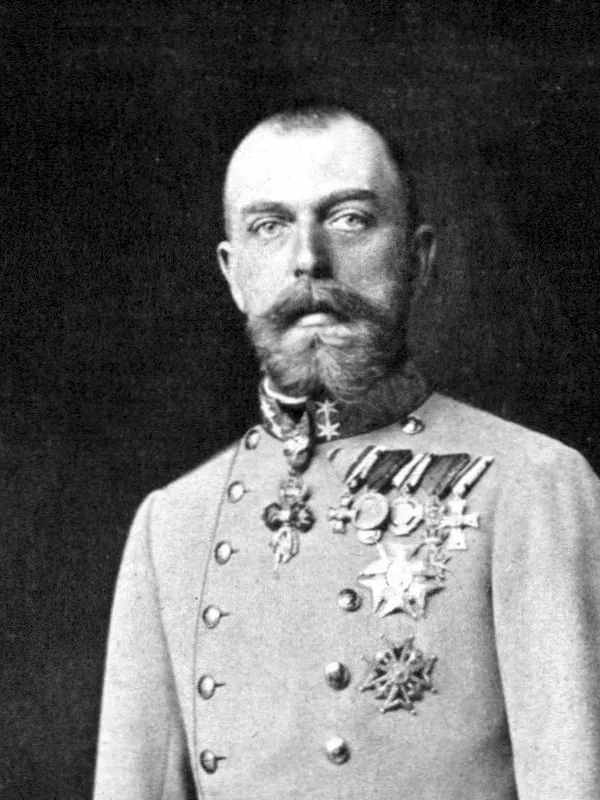
- Born:
- 24 May 1872, Salzburg (Austria-Hungary)
- Died:
- 28 August 1942, Vienna
- Author:
- Natalia
- Photo:
- Carl Pietzner, domena publiczna, Wikimedia Commons

For more than a year and a half Archduke Joseph Ferdinand commanded the Austro-Hungarian Fourth Army, which fought on Polish soil: at Cracow and Limanowa in 1914, and in 1915 at Gorlice, on the San, at Kraśnik and on the road to Lublin. The First Brigade of the Polish Legions also served under his orders in that time. His name, however, is linked above all with the disaster at Lutsk in June 1916, when the Russian Brusilov offensive shattered his army within a few days. At the Germans’ demand he was removed in the middle of the battle, something entirely new in the Habsburg army. Later he was inspector general of the air service, and after the war he lived in Vienna as a private citizen. In 1938 the Nazis held him in the Dachau camp.
Before the war
He was born on 24 May 1872 in Salzburg, the second son of Ferdinand IV (PL), the last ruler of the Grand Duchy of Tuscany (PL), which in 1860 was annexed to the Kingdom of Sardinia and soon afterwards became part of united Italy. His mother was Princess Alice of the Bourbon-Parma family. From then on the Tuscan line of the Habsburgs lived in Austria, Ferdinand IV settled in Salzburg, and his sons served in the army of Emperor Franz Joseph I. According to the British historian Michael Duffy, the emperor was the young archduke’s godfather.
Joseph Ferdinand graduated from the military secondary school at Hranice (PL) in Moravia and from the Theresian Military Academy in Wiener Neustadt. On 18 August 1892 he was commissioned as a lieutenant in the Tyrolean Imperial Rifles (Kaiserjäger). From 1895 to 1897 he attended the War School in Vienna, and then served in several infantry regiments. From 1905 he commanded the 93rd Infantry Regiment, from 1908 the 5th Infantry Brigade in Linz (PL), and in January 1911 he took over the 3rd Infantry Division stationed there. On 1 May 1911 he became a lieutenant field marshal.
From his youth he was passionate about ballooning, which the army then regarded as an eccentricity. In 1909 he flew a balloon himself from Linz to Dieppe in France. The flight took 16 hours.
1914: Galicia, Cracow and Limanowa
In August 1914 the archduke took over XIV Corps from Innsbruck, made up largely of Tyroleans. He succeeded Victor Dankl there, who had been given the First Army. The corps belonged to the Third Army, but at the end of August Franz Conrad von Hötzendorf assigned it to the Fourth Army of Moritz Auffenberg. In the Battle of Komarów XIV Corps advanced on the right wing of the army, which came close to encircling the Russian Fifth Army of Pavel Plehve. When Auffenberg then turned south to save Lemberg, the archduke’s group was left on its own on the Huczwa. In the Battle of Gródek and Rawa Ruska it fell back under the pressure of Russian corps coming from Tomaszów, and during the retreat one of the Tyrolean Imperial Rifles regiments was destroyed.
At the end of September, after the whole front had retreated behind the San, Auffenberg lost his command and Joseph Ferdinand took over the Fourth Army. Sources give 30 September or 1 October 1914. As early as the beginning of October his army set off in the counter-offensive in Galicia and fought at Jarosław and Przeworsk for the crossings of the San. In November, in the Battle of Cracow, the Fourth Army came out of the fortress and struck the left wing of the Russian Ninth Army, but after ten days it returned to the cover of the forts. Straight afterwards two of its corps were taken by rail into the mountains, to Mszana Dolna and Chabówka. From there they struck the Russian flank and decided the victory at Limanowa, after which the Russian Third Army fell back behind the Dunajec. The First Brigade of the Legions also fought in this army, and at Christmas 1914 it held the hills at Łowczówek. Fourth Army headquarters later awarded the legionaries more than 70 medals for that battle.
1915: from Gorlice to Lutsk
In the spring of 1915 the Fourth Army stood on the Dunajec and the Biała near Tarnów. When the Germans were preparing the breakthrough at Gorlice, it was placed under Field Marshal August von Mackensen, commander of the new German Eleventh Army. The archduke, though a member of the dynasty, now took his orders from a German general and his chief of staff, Hans von Seeckt. After the breakthrough the Fourth Army reached the lower San near Leżajsk and Nisko in May (Battle of the San), and in June took part in the Battle of Mościska and Lubaczów, which opened the road to Lemberg.
Mackensen then turned north, between the Vistula and the Bug. At the beginning of July the Fourth Army attacked the Russian positions on the hills at Kraśnik. On 3 and 4 July it broke through the front and, according to the Austrian official history, took about 8,000 prisoners, but its staff underestimated the Russian reserves. On 7 July fresh Russian corps counter-attacked at Urzędów and won back part of the lost ground. In the middle of the month Józef Piłsudski’s First Brigade of the Legions arrived at Urzędów. The Russians withdrew only on 19 July, after the Germans had broken through the front at Krasnystaw. On 30 July cavalry patrols of the Fourth Army rode into Lublin.
At the end of August Conrad wanted to win a victory in Volhynia without the Germans. In the so-called black-yellow offensive the archduke commanded an army group made up of the First and Fourth Armies, which was to outflank the Russian Eighth Army from the north. On 31 August his troops took Lutsk, and Brusilov fell back behind the Styr. In mid-September, however, the Russians counter-attacked near Dubno and struck hardest at the Fourth Army. The Austrian historian Manfried Rauchensteiner quotes notes from the high command of 15 September according to which this army was operating “outrageously poorly”, and Conrad himself is said to have remarked that no operation could be planned with such troops. On 23 September the Russians retook Lutsk, but soon gave it up to the advancing Germans (Battle of Tarnopol). From the autumn the Fourth Army belonged to the army group of the German general Alexander von Linsingen. On 26 February 1916 the archduke became a colonel general.
Lutsk 1916
Through the winter and spring of 1916 the Fourth Army held positions east of Lutsk that had been under construction since the autumn. According to Duffy, the archduke considered them impregnable, and among contemporaries he had a reputation as a lax commander who liked to spend his time hunting. Meanwhile the Russians were preparing the main blow of General Aleksei Brusilov’s South-Western Front on this very sector.
On 4 June the Russian artillery opened fire on the Fourth Army’s positions near Olyka. The next day the infantry of General Aleksei Kaledin’s Russian Eighth Army broke through the first and second lines of defence, and on 6 June the Fourth Army’s front fell apart. The Russians took tens of thousands of prisoners. Duffy estimates that within two days the archduke lost some 130,000 men killed, wounded and captured. Linsingen demanded his removal, and the Austro-Hungarian high command granted the request. On 7 June the archduke lost his command in the middle of the battle. Rauchensteiner notes that this was the first time it had happened in this war. That same evening the Russians entered Lutsk. The army was taken over by General of Cavalry Karl Tersztyánszky von Nádas.
The air service and the end of the war
The archduke’s career at the front was over, but the new emperor, Charles I, who came to the throne in November 1916, wanted to employ him again. Joseph Ferdinand became inspector general of the air service (PL). Sources give different dates: the German Wikipedia links the appointment with November 1916, while a British website on the Austro-Hungarian army gives 8 July 1917 and adds that the high command objected to it. He held the post until 3 September 1918. In practice, however, the air service was run by its chief, General Emil Uzelac. Not everyone valued the archduke’s enthusiasm. The Hungarian engineer Theodore von Kármán (PL), who was then serving in the Austro-Hungarian aircraft arsenal, called him in his memoirs an “ignorant and pompous fellow”.
After the war
After the collapse of the monarchy Joseph Ferdinand stayed in Austria and lived in Vienna as an ordinary citizen. In 1921 he married a commoner, Rosa Kaltenbrunner, whom he divorced in 1928, and in 1929 Gertrude Tomanek von Beyerfels-Mondsee. From the second marriage he had a daughter and a son. After the Anschluss in March 1938 the Gestapo (PL) arrested him along with many other opponents of Nazism and sent him to the Dachau (PL) camp. According to some sources he spent three months there, according to others a few weeks. He was released thanks to the intercession of Albert Göring (PL), Hermann’s brother, and his sister Olga. For the rest of his life he remained under Gestapo surveillance, and his time in the camp ruined his health. He died in Vienna at the end of August 1942. The Polish and English Wikipedias give 28 August, the German one 26 August, and the British website on the Austro-Hungarian army 25 August. He was buried in the Capuchin Crypt, the Habsburg burial vault.
Assessment
Historians judge the archduke harshly. Duffy calls him a “painfully unsuccessful” commander, and his name remained linked for ever with the “catastrophe at Lutsk”. Under his command the Fourth Army had its successes, at Limanowa in 1914 and in the advance from Gorlice to Lublin in 1915, but these followed the plans of Conrad and Mackensen and owed much to German troops. When he was to carry out an operation himself, in the black-yellow offensive, his army failed. Rauchensteiner nevertheless warns against laying all the blame for Lutsk on a single commander and his staff. He points out that large parts of one Moravian regiment went over to the Russians at the time. At Lutsk the Russians also had nearly a threefold superiority in battalions, and several divisions and much of the heavy artillery had earlier been taken from the eastern front for the offensive in the Tyrol. The archduke’s removal at the demand of a German general showed how dependent the Habsburg army had already become on its ally. A few months later Austria-Hungary had to accept a joint command of the Central Powers under German supremacy.
Sources
- Józef Ferdynand · Wikipedia (pl)
- austria-forum.org/web-books/en/firstworldwar01en2014isds/000529
- austria-forum.org/web-books/en/firstworldwar01en2014isds/000454
- austria-forum.org/web-books/en/firstworldwar01en2014isds/000457
- austro-hungarian-army.co.uk · JOSFERD
- bac-lac.wayback.archive-it.org · josef1942
- Archduke Joseph Ferdinand of Austria · Wikipedia (en)
- Joseph Ferdinand von Österreich-Toskana · Wikipedia (de)
Spotted a mistake?Report an error
Commanded in battles
(10)- 26 August – 2 September 1914Battle of KomarówEastern Front
- 8–11 September 1914Battle of Gródek and Rawa RuskaEastern Front
- 15–28 November 1914Battle of KrakówEastern Front
- 1–12 December 1914Battle of LimanowaEastern Front
- 22–25 December 1914Battle of ŁowczówekEastern Front
- 1–5 May 1915Battle of GorliceEastern Front
- 16–23 May 1915Battle of the SanEastern Front
- 12–15 June 1915Battle of Mościska and LubaczówEastern Front
- 1–19 July 1915Second Battle of KraśnikEastern Front
- 4 June – 20 September 1916Brusilov offensiveEastern Front
Mentioned in battles
(02)Often appears with
People who appear in the same events.