Russian Empire · The Entente
Pavel Plehve
Commander of the 5th Army (1914–1915) and the 12th Army (1915), acting commander of the Northern Front (1915–1916), general of cavalry
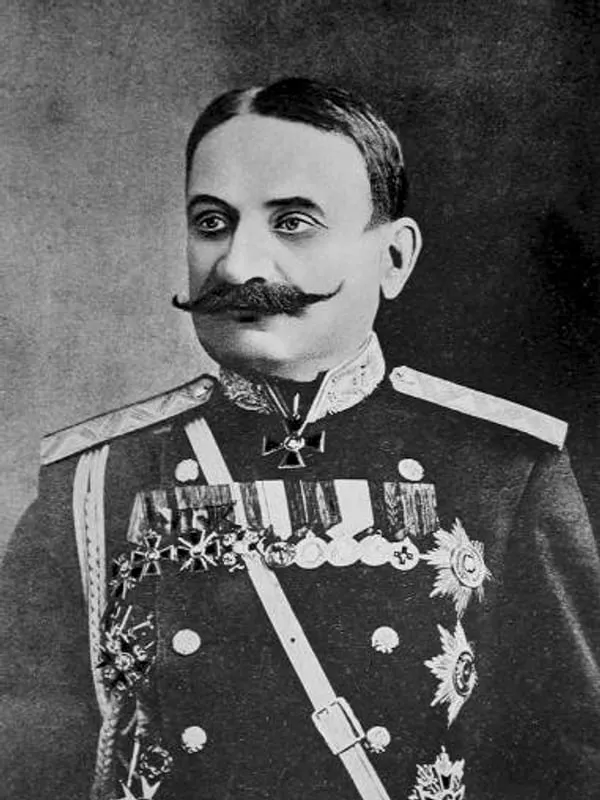
- Born:
- 1850, Pskov (Russian Empire)
- Died:
- 10 April 1916, Moscow
- Author:
- Łukasz Skowroń
- Photo:
- autor nieznany, domena publiczna, Wikimedia Commons

General of Cavalry Pavel Plehve commanded the Russian 5th Army in the first two years of the war, and for short spells also the 12th Army and the Northern Front. He was old, ailing and not much liked, but in a crisis he had few equals in the Russian army. In August 1914 he led his army out of the Austro-Hungarian pincers at Komarów, in November a forced march of his saved the 2nd Army from disaster at Łódź, and in the autumn of 1915 he held Dvinsk. The British military attaché Alfred Knox, who knew him well, believed that no Russian general achieved anything greater in this war. Plehve died in April 1916, before the revolution, and so, unlike many of his colleagues who later led the White armies, he was almost forgotten. He should not be confused with Vyacheslav von Plehve, the minister of the interior assassinated in 1904.
Before the war
Pavel Adamovich Plehve came from a family of Baltic German nobility, Lutheran by faith. He was born in June 1850 in Pskov. The day is given variously: some sources give 30 May in the Julian calendar (11 June in the Gregorian), others 11 or 30 June. He attended a gymnasium in Warsaw, and in 1870 graduated first in his class from the Nicholas Cavalry School and joined the Life Guard Uhlan Regiment, stationed in Warsaw, as a cornet. In 1877 he graduated from the Nicholas General Staff Academy and went straight to war. In the Russo-Turkish War he was a staff officer of the XIII Corps.
After the war he served for several years in Bulgaria, on the staffs of the newly forming Bulgarian army, and according to some sources in April 1880 he headed the Bulgarian war ministry for about two weeks. Back in Russia he held staff posts and taught. In 1889 he published “Essays on the History of Cavalry”. In 1890 he took command of a cavalry regiment, in 1893 became quartermaster-general of the Vilna Military District, from 1895 to 1899 was commandant of his old cavalry school, then commanded the 2nd Cavalry Division, and from 1901 was chief of staff of the Don Cossack Host. In the spring of 1905, when revolution broke out in the Kingdom of Poland, he was appointed commandant of the Warsaw fortress (PL). A few months later he took over the XIII Corps, and afterwards was deputy commander of the Vilna Military District. In 1907 he was promoted to general of cavalry, and in 1909 he became head of the Moscow Military District. From 1912 his chief of staff was General Yevgeny Miller, with whom he formed one of the best-matched partnerships in the Russian army.
In Moscow he had the reputation of a commander who meddled in every detail. He was exacting, dry in manner and made no effort to be popular. Knox described him as a small, bent old man in poor health, with a keen mind and “an iron will”.
1914: Komarów, Warsaw, Łódź
On mobilisation the troops of the Moscow Military District formed the 5th Army, and Plehve took command of it. Within General Nikolai Ivanov’s Southwestern Front it was to strike, together with the 4th Army, southwards from the Lublin region deep into Galicia. In the Battle of Galicia, however, both sides struck in opposite directions. On 26 August the 5th Army collided in the Zamość region with the Austro-Hungarian 4th Army of General Moritz von Auffenberg. After a week of fighting between Zamość, Komarów and Tomaszów Lubelski, the Austrians turned both Russian flanks and came close to repeating at Komarów the German success at Tannenberg. On the night of 1–2 September Plehve pulled his battered army back behind the Bug and escaped encirclement.
The defeat broke neither him nor his army. A few days later the rebuilt 5th Army marched south and entered the gap between the Austro-Hungarian armies, threatening Auffenberg’s rear. It was its pressure that decided the outcome of the Battle of Gródek and Rawa Ruska: on 11 September Franz Conrad von Hötzendorf ordered a retreat behind the San. The Russian general and historian Nikolai Golovin (PL) considered this march-manoeuvre after Tomaszów one of the most skilful of the whole war. Plehve received the Order of St George, 4th class, for the Galician campaign.
In the autumn the 5th Army was moved to the middle Vistula. In the Battle of Warsaw and Dęblin it crossed the river to strike the Germans’ flank and helped force their retreat from the capital. In November, when Paul von Hindenburg and August von Mackensen struck from Toruń at the flank of the Russian 2nd Army, Grand Duke Nicholas Nikolaevich called off the offensive into Silesia and sent Plehve’s army north. In a few days its soldiers covered more than a hundred kilometres by forced march and at Łódź closed the Germans’ way from the south. When an officer from General Scheidemann rushed up to Plehve crying that the 2nd Army was surrounded and would have to surrender, the general is said to have replied that if he had come with a report, he should make it to the chief of staff, but “no tragedy-playing”, or he would have him arrested. Knox wrote that it was Plehve who saved the 2nd Army from disaster, while Paul von Rennenkampf was blamed for letting Scheffer’s encircled group escape. According to Russian accounts, during the battle he was given command of all Russian forces in the Łódź area. In December, however, the Russians abandoned the city and fell back to the Bzura and the Rawka.
1915: Przasnysz, Šiauliai, Dvinsk
At the end of January 1915 Plehve handed over the 5th Army and took command of the 12th Army, forming on the Narew for an offensive into East Prussia. The Germans struck first. In February, when they surrounded the Russian garrison at Przasnysz, Plehve sent the II Siberian Corps from Ostrołęka against the flank of the attackers, and on 27 February the Russians retook the town. The First Battle of Przasnysz was one of the few Russian victories over the Germans that winter. A few days later Plehve, now with his headquarters at Łomża, threw the Guard Corps and the I Corps into an attack on the Biebrza near Wizna. The attacks, made one after another without enough artillery support, broke down with heavy losses, and the commander of the Guard, General Vladimir Bezobrazov, complained to the Grand Duke of Plehve’s “obstinate waste of life”.
In the spring the Germans advanced into Lithuania and Courland. At the beginning of June Plehve arrived in Riga to take over a new 5th Army, stretched from the Baltic to the Niemen. In July General Otto von Below’s Army of the Niemen struck it at Šiauliai and tried to encircle it. Plehve was long unwilling to believe in the danger and gave the order to retreat late, but he brought out most of his troops, and at the end of July his army counter-attacked at Kupiškis. Russian historians later held up his manoeuvring defence as a model.
From the autumn the 5th Army, part of General Nikolai Ruzsky’s new Northern Front, defended Dvinsk. The Battle of Dvinsk lasted from September to early November. In the critical days Plehve refused to retreat behind the Dvina and is said to have announced that as long as he was in the city, not a single step back was allowed. His methods were sometimes singular. According to one of the corps commanders he later removed, Plehve posted Cossack piquets on the bridges to watch that no staffs withdrew to the right bank. He also ordered “bomb-thrower” detachments to be formed in every company, armed with hand grenades, axes and wire-cutters, which are considered among the first assault units of the Russian army. The Germans did not take Dvinsk, and even the general’s enemies admitted that no one else could have held it.
The Northern Front and death
In December 1915 the ailing Ruzsky went away for a cure, and Plehve took over his duties at the Northern Front headquarters in Pskov. He was by then gravely ill himself. At the end of January 1916 he suffered a haemorrhage, and Nicholas II, who visited the front at the time, wrote to his wife that the general looked “like a green corpse” but thought clearly. On 20 February Knox lunched with him in Pskov and noted that the old man looked even more fragile than in the autumn, though his intellect was as keen as ever. Two days later Plehve was removed on account of ill health, and the front was taken over by General Aleksei Kuropatkin. The Tsar appointed him a member of the State Council. As Plehve left Pskov, one of the officers said “au revoir” to him. The general is said to have replied: “No, gentlemen, it is finally good-bye.”
He died in Moscow on 10 April 1916 (28 March in the Julian calendar). Shortly before his death he converted to Orthodoxy. He was buried in Moscow’s Brotherly Cemetery, set aside for those killed and died in this war. His son Nikolai was killed in 1918 serving in the White Volunteer Army.
Assessment
His contemporaries saw Plehve above all as a commander for crises. The Russian historian Aleksei Oleinikov called him a “master of crisis situations”, and Plehve was indeed sent wherever the front was giving way: to the Zamość region, to Łódź, to the Narew, to Courland and to the Dvina. Knox, who often criticised him, wrote that the rescue of the 2nd Army at Łódź in 1914 and the defence of Dvinsk in 1915 were two performances that no Russian general surpassed in the course of the war. He compared him with Rennenkampf: the latter might have been a Murat a hundred years earlier, whereas Plehve was more of the Moltke school. Golovin argued that had the enemy had a commander of his calibre in 1914, the Russians might have lost the first battles of the war.
He also had clear weaknesses. He waged war from his staff desk and, according to Knox, never visited the trenches, though probably because he could barely walk. To him, the attaché wrote, the men at the front were merely pawns. At Wizna in March 1915 he was accused of wasting men, and his harshness and prejudices made him many enemies among senior officers. Part of the credit went to his chief of staff Miller, but Knox, who had heard Plehve dictating orders himself, believed that the general, because of his unpopularity, got less credit than was his due. His German name also weighed on him. When Rennenkampf was removed at the end of 1914, the Grand Duke, faced with a wave of complaints about “Germans” in the army, chose a man with a Russian name as his successor instead of Plehve.
Sources
Spotted a mistake?Report an error
Commanded in battles
(07)- 23 August – 11 September 1914Battle of GaliciaEastern Front
- 26 August – 2 September 1914Battle of KomarówEastern Front
- 8–11 September 1914Battle of Gródek and Rawa RuskaEastern Front
- 11 November – 6 December 1914Battle of ŁódźEastern Front
- 22–27 February 1915First Battle of PrzasnyszEastern Front
- 14–25 July 1915Battle of ŠiauliaiEastern Front
- 9 September – 1 November 1915Battle of DvinskEastern Front
Mentioned in battles
(02)Often appears with
People who appear in the same events.
On the timeline
(12)1914
1915
February
July
September
- 09
- Start of the Battle of DvinskOn 9 September 1915 the right wing of the German Niemen Army set off for Dvinsk, to reach the Dvina and cover the attack on Vilna from the north.
- Start of the Battle of VilnaOn 9 September 1915 the German 10th Army struck north of Vilna, into the gap between two Russian armies. General Garnier's cavalry pushed into the breach.