1915: The Great Retreat of the Russian army
Battle of Šiauliai
- Dates:
- 14–25 July 1915
- Front:
- Eastern Front
- Location:
- Courland and northern Lithuania, between the Venta, the Dubysa and the Nevėžis, from Tukums and Mitau to Šiauliai, Šeduva and Panevėžys, Courland and Kovno governorates, Russian EmpireOn the battle map →
- Sides:
- German EmpireOtto von Below, Otto von Lauenstein, Curt von MorgenRussian EmpirePavel Plehve, Mikhail Alekseyev
- Result:
- German victory. The Army of the Niemen took western Courland, Šiauliai (21 July) and Panevėžys (25 July) and captured about 27,000–30,000 prisoners, but the Russian Fifth Army escaped encirclement and withdrew eastwards.
- Author:
- Łukasz Skowroń
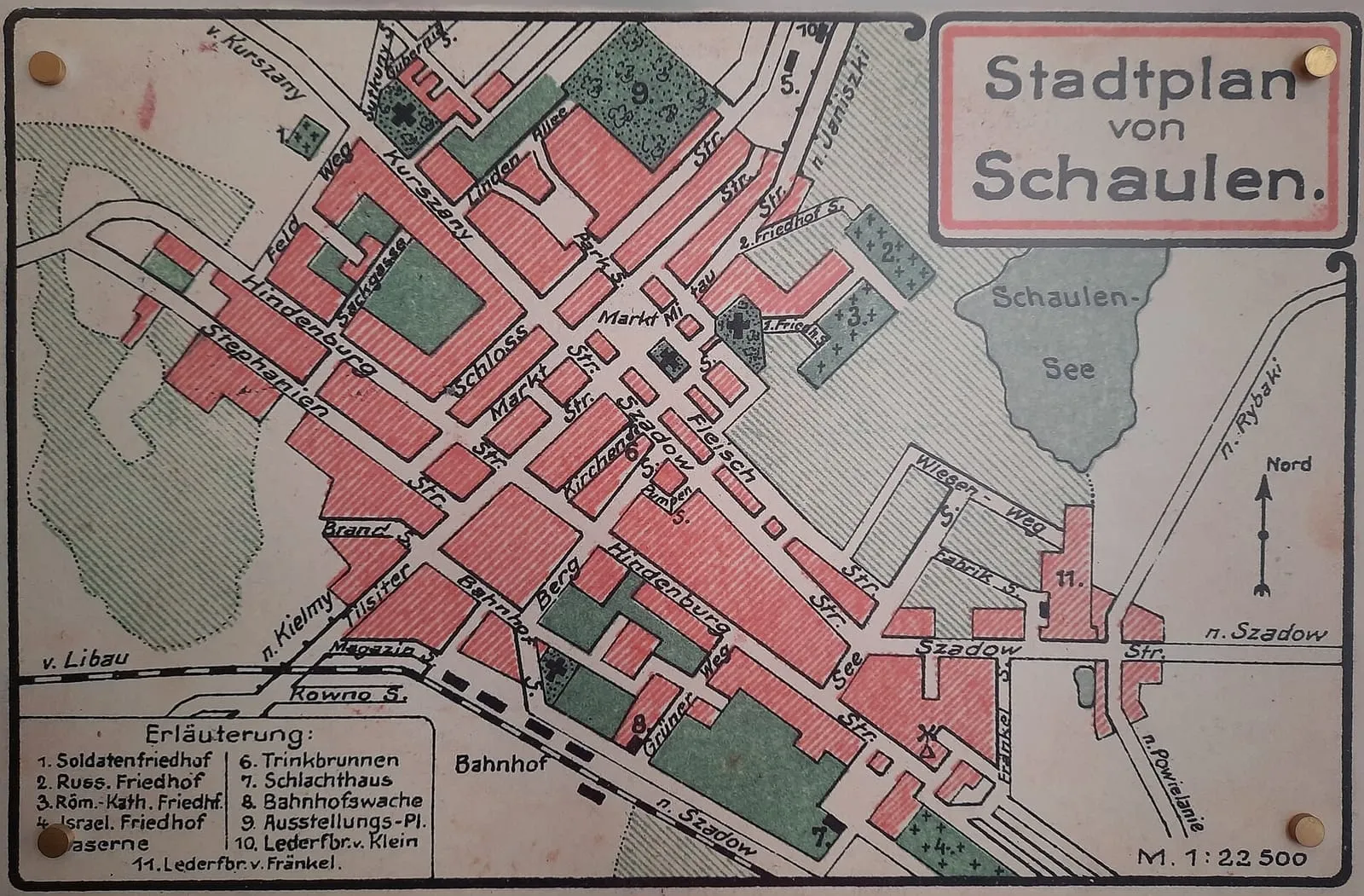
The Battle of Šiauliai was the largest operation on the northern wing of the Eastern Front in the summer of 1915. When the German offensive on the Narew got under way south of the East Prussian border, General Otto von Below’s Army of the Niemen struck in Courland and Lithuania at the Russian Fifth Army of General Pavel Plehve. The Germans forced the Venta, took western Courland within a few days, and then tried to encircle the Russian corps defending Šiauliai. The ring did not close. The Russians abandoned Šiauliai on the night of 20–21 July, and on 25 July they lost Panevėžys, but the main forces of the Fifth Army slipped away to the east.
Name and dates
On this page we use the dates 14–25 July 1915. Under 14 July the British chronology of the war records the start of the Battle of Šiauliai (Battle of Schaulen). The German official list of battles, used by the histories of German divisions, likewise dates the “battle of Šiauliai” to 14–25 July. The Germans named the further fighting east of Panevėžys, from 30 July to 7 August, separately as the Battle of Kupiškis. Russian historiography speaks of a twelve-day Battle of Šiauliai, ending with the capture of Panevėžys, and dates it by the Julian calendar to 1–12 July, that is 14–25 July New Style. More broadly, the whole German offensive in Courland and Lithuania, from the April raid on Šiauliai to the fighting on the Dvina at the end of August, is usually treated as the Riga–Šiauliai operation.
The German official history counts the battle from 14 to 23 July, when the encirclement turned into an ordinary pursuit, and this pursuit lasted until 25 July. The capture of Mitau, today Jelgava, on 1 August was a separate action of the northern wing of the Army of the Niemen.
Background
Šiauliai, an important railway junction in northern Lithuania, had already once been in German hands. During the raid by General Otto von Lauenstein’s army group, German cavalry took it on 30 April, and on 7 May the Germans captured Libau. In the face of approaching Russian reinforcements, however, they abandoned Šiauliai on 10 May, and the front settled for many weeks along the Venta and the Dubysa. At the end of May the German forces in this sector were combined into the Army of the Niemen under Otto von Below. The Russians placed their units between the Niemen and the Baltic under Plehve’s Fifth Army, part of General Mikhail Alekseyev’s North-Western Front.
At the beginning of July Field Marshal Paul von Hindenburg was concentrating all his forces on the offensive on the Narew. The Army of the Niemen was given a subsidiary task: it was to attack the Fifth Army, draw the Russians’ attention to itself and prepare the ground for a later thrust on Vilna. According to the German official history, Below had about seven infantry and five cavalry divisions on a front about 250 kilometres long, in reality somewhat more. Plehve had about seven and a half infantry divisions and seven cavalry divisions, but in June and July he had to give up several divisions to other sectors. His only reserve, the VII Siberian Corps near Mitau and Riga, was worn out by the fighting in Galicia.
Below decided to bypass the strong Russian positions at Šiauliai and strike the enemy’s northern wing, made up mainly of cavalry, and then to turn into the rear of Šiauliai. In the north, in Courland, Lauenstein’s Northern Corps (6th and 78th Reserve Divisions, 41st Infantry Division) advanced with General Egon von Schmettow’s cavalry corps and detachments from Libau. In front of Šiauliai stood General Curt von Morgen’s corps (I Reserve Corps), and in the south, from the Niemen to the area of Šiauliai, General Manfred von Richthofen’s group of cavalry and reserve divisions. The attack was to begin around 15 July, but at Hindenburg’s request it was brought forward by a day to coincide with the offensive on the Narew, which began on 13 July. In the Baltic the German fleet had been reinforced after the action off Gotland on 2 July.
Course of the battle
Across the Venta, 14–16 July. On the morning of 14 July the Northern Corps and three cavalry divisions forced the Venta on a front about 30 kilometres wide, north of Kuršėnai and in the area of Papilė. The Russian cavalry and militia fell back almost without a fight, and airmen reported fires and columns of refugees. On the first day the Germans advanced up to 15 kilometres in places. On 15 July they widened the breach, and on 16 July Schmettow’s cavalry corps routed the Russian horse and reached the area of Doblen, deep on the enemy’s flank.
Auce and Šiauliai, 17–18 July. Plehve threw against the Germans units of the VII Siberian Corps hastily brought from Mitau and Riga. On 17 July at Auce (Alt-Autz) they were routed and, according to German figures, lost about 4,000 prisoners. On the same day in the south Morgen’s corps failed in its attack at Šiauliai. A Russian counter-attack by the 1st Caucasian Rifle Brigade pushed the 6th Reserve Division back behind the Venta. The Russians reported 500 prisoners and seven machine guns. On 18–19 July in the north the Germans took Tukums and the port of Windau, blocked by the Russians with scuttled ships, and came within a dozen or so kilometres of Mitau. The whole of western Courland was in their hands.
Attempted encirclement, 19–23 July. Below left a weak screen in front of Mitau and turned the main forces of the Northern Corps south-east, into the rear of the Russian corps at Šiauliai. On 20 July the southern group on the Dubysa went into the attack, and in the evening the 78th Reserve Division, after a 30-kilometre march, stood near Meškuičiai, right behind the back of the Russian XIX Corps. Only at noon on 21 July, on the way to his new headquarters in Panevėžys, did Plehve issue the order for a general retreat. Russian units, however, had already begun to leave Šiauliai on the night of 20–21 July, and in the morning troops of Morgen’s corps entered the town. The Russian corps, turning east, struck the 78th Reserve Division and Schmettow’s cavalry and broke through the gaps in the German ring. On both sides of Šeduva there yawned a gap in it about 45 kilometres wide. On 21–22 July Schmettow’s cavalry corps had to fall back behind the Mūša river, and on 23 July the encirclement turned into a frontal pursuit.
Panevėžys, 24–25 July. On 23 July the headquarters of the Army of the Niemen concluded that the Russian Fifth Army was “completely beaten and for the most part scattered”, which proved an exaggeration. On Hindenburg’s orders Below’s main forces were now to turn south, against Kovno, part of them north, against Mitau, and the cavalry east, towards Vilna and Dvinsk. The pursuit therefore continued. On 25 July I Reserve Corps took Panevėžys, and the Russian XXXVII Corps, attacked west of the town, fell back in disorder by several dozen kilometres. The Germans reached the Nevėžis and the area of Pasvalys, the limit to which they could still bring up supplies.
Losses
According to the German official history, in the ten days of fighting up to 24 July the Army of the Niemen took 27,000 prisoners, 25 guns and 40 machine guns, while elsewhere the same work gives about 30,000 prisoners and 23 guns for nine days. The Germans put their own losses at about 5,000 men. The Russians estimated their losses since 14 July at no fewer than 35,000. More recent Russian tallies, covering the fighting up to the end of July, give about 50,000 killed, wounded and missing on the Russian side and about 10,500 on the German side.
Significance
The Army of the Niemen achieved a territorial success: it took western Courland with the coast from Libau to Windau, Šiauliai and Panevėžys, and reached the junction of the Russian Fifth and Tenth Armies. On 28 July Below moved his headquarters to Šiauliai. The main objective, the destruction of the Fifth Army, was not achieved. Plehve, although for a long time he did not believe in the encirclement that threatened him, led most of his troops out from Šiauliai, and Russian historians later held up his manoeuvring, active defence as a model.
For the Russians the battle was a warning. It opened the way for the Germans towards Riga, Dvinsk and Vilna at the moment when in the south the Russian armies were withdrawing from the Kingdom of Poland. Alekseyev began to move new divisions north, and in August the Twelfth Army was sent to defend Riga. On 1 August the Germans took Mitau, but when at the end of July the Russian Fifth Army, made up to strength with reinforcements, went over to a counter-offensive at Kupiškis, the Army of the Niemen had to postpone its march on Vilna and Dvinsk. Šiauliai remained in German hands until the end of the war.
Spotted a mistake?Report an error