1915: The war at sea
Battle of Gotland
- Dates:
- 2 July 1915
- Front:
- War at sea
- Location:
- The Baltic Sea off the eastern coast of Swedish Gotland, near the lighthouse and village of Östergarn; the torpedoing of the cruiser Prinz Adalbert off Rozewie (Rixhöft) at the entrance to the Gulf of DanzigOn the battle map →
- Sides:
- Russian Empire and United KingdomMikhail Bakhirev, Max HortonGerman EmpireJohannes von Karpf, Albert Hopman
- Result:
- Russian victory. The German minelayer Albatross, badly damaged, ran aground on the coast of Gotland and was interned by Sweden, and the British submarine E9 torpedoed the armoured cruiser Prinz Adalbert. The Russians, however, failed to exploit their advantage.
- Author:
- Łukasz Skowroń
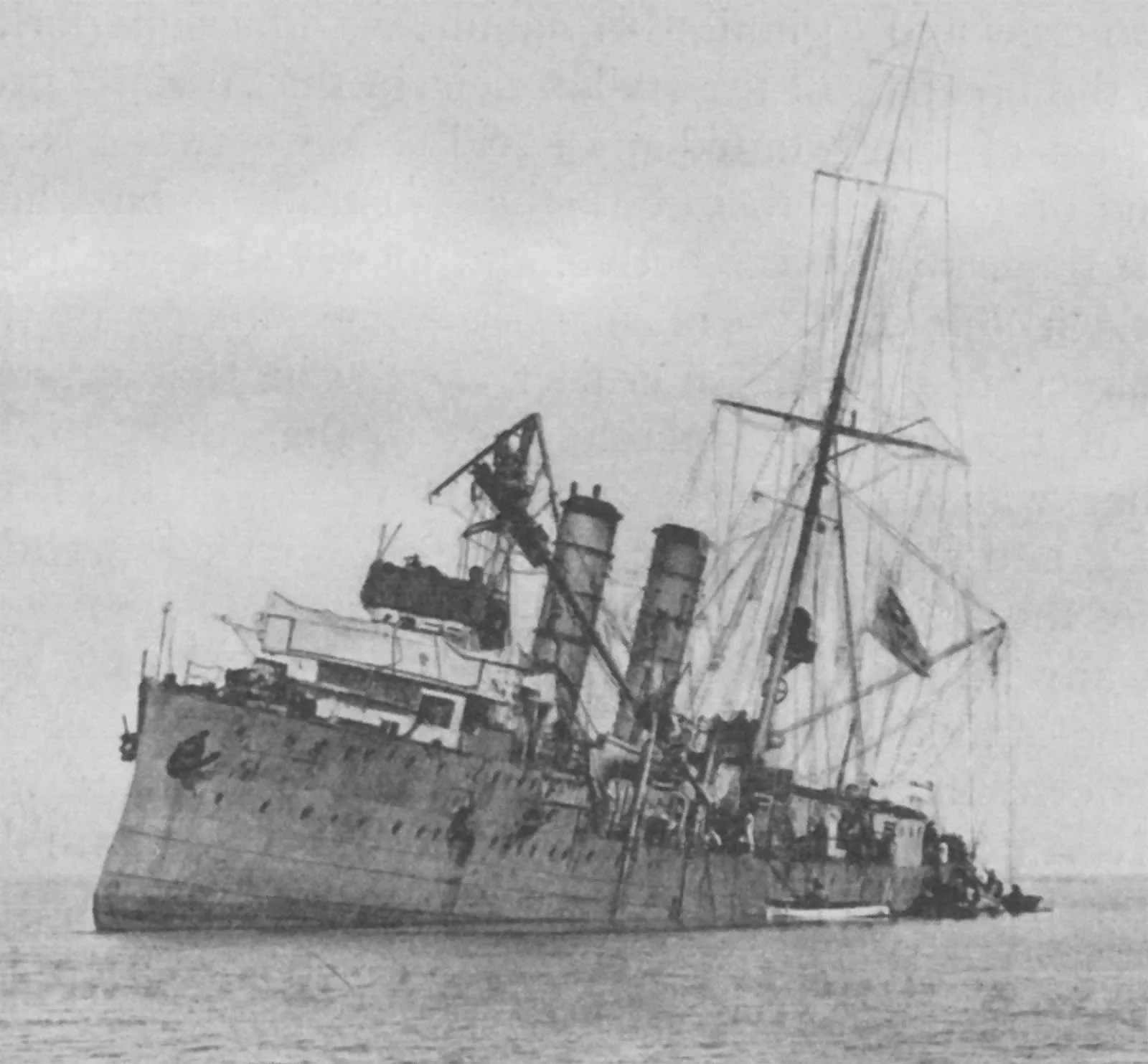
The Battle of Gotland was the largest surface engagement in the Baltic Sea in 1915. On the morning of 2 July 1915 the Russian cruisers of Rear-Admiral Mikhail Bakhirev intercepted in fog off the eastern coast of Gotland a German force returning from laying mines at the entrance to the Gulf of Finland. The Russians found the enemy thanks to decrypted German radio signals. They concentrated their fire on the slow minelayer Albatross, which, badly damaged, beached itself on the coast of neutral Sweden. A further clash with German cruisers proved indecisive, and in the afternoon the British submarine E9 torpedoed off the Pomeranian coast the German armoured cruiser Prinz Adalbert, which had been sent to help.
Name and dates
In Polish literature the battle is called the Battle of Gotland or of Östergarn; in Russian it is the “Gotland battle”, in German the “Gotland-Raid”, and in some English-language works, misleadingly, the “Battle of the Åland Islands”, after the place where the Germans laid their mines. The Russians called the whole operation the raid on Memel, that is Klaipėda. According to the Julian calendar, then in use in Russia, the battle was fought on 19 June 1915. Ships of both sides put to sea as early as 30 June and 1 July, but fighting took place only on 2 July, and we take that day as the date of the battle.
Background
In the summer of 1915 the Germans held the upper hand in the Baltic, although they kept only part of their fleet there: several older armoured and light cruisers, torpedo boats and minelayers. They supported the army advancing in Courland, and in May helped it take Libau, which became their forward base. The Russian Baltic Fleet, commanded since May by Vice-Admiral Vasily Kanin, successor to the late Admiral Nikolai von Essen, generally avoided battle and defended the Gulf of Finland with minefields. It was supported by British submarines, which had broken through into the Baltic in the autumn of 1914.
Officers of the fleet staff proposed a bold raid: a bombardment from the sea of one of the German ports, which was to give the lie to German claims of command of the Baltic and raise morale. The original target was to be Kolberg, but Kanin chose the nearer Memel. The raid was timed for when Kaiser Wilhelm II was visiting the fleet at Kiel, and the Russians expected some German ships to leave the Baltic for the occasion. Command was entrusted to Rear-Admiral Mikhail Bakhirev, commander of the 1st Cruiser Brigade. Under his orders were the armoured cruisers Admiral Makarov, on which he hoisted his flag, and Bayan, the protected cruisers Bogatyr and Oleg, the powerful armoured cruiser Rurik and the modern large destroyer Novik. Distant cover was provided by two old battleships, and submarines took up positions on the approaches to the German bases, among them the British E9 of Lieutenant-Commander Max Horton, which was stationed off Rozewie.
The Russians did not know that at the same time the Germans were preparing an operation of their own. The minelayer Albatross was to lay a barrage of 160 mines near the Bogskär rocks, on the approaches to the Gulf of Finland, close to the Åland Islands. It was covered by the armoured cruiser Roon, the light cruisers Augsburg and Lübeck and seven torpedo boats. The whole force was commanded by Commodore Johannes von Karpf in Augsburg. Karpf’s superior was Rear-Admiral Albert Hopman (PL), commander of the German reconnaissance forces in the Baltic, who had remained with two armoured cruisers at Danzig.
Course of the battle
Karpf’s signal
On 1 July both squadrons sailed through thick fog and passed each other, unaware of one another. Rurik and Novik lost the rest of the Russian force in it and operated separately until morning. In the evening Albatross laid her mines, and Karpf sent a radio report that the task had been completed, giving his position, course, speed and the place of rendezvous with Roon. Russian radio intelligence intercepted the signal and quickly decrypted it. The Russians had had German codebooks since August 1914, when the cruiser Magdeburg ran aground on the rocks off Odensholm. The fleet staff called off the bombardment of Memel and ordered Bakhirev to intercept the Germans. The order reached him at about 4 a.m. on 2 July. Over the following hours the staff kept passing him the enemy’s changes of course, read from successive German signals. Russian and Western historians regard this action as one of the first cases in which ships were directed onto the enemy thanks to signals intelligence.
The chase of Albatross
At about 6 a.m. Karpf, convinced that he was in no danger, divided his force. Roon and Lübeck with four torpedo boats headed for Libau, while Augsburg, Albatross and three torpedo boats sailed along Gotland towards Rozewie and Danzig. A quarter of an hour or so later, four Russian cruisers were sighted from Albatross emerging from the fog. At about 6.30 a.m. the Russians opened fire at a range of about 8 kilometres. The fast Augsburg could easily escape, but the minelayer was slower than the Russians. Karpf called Roon and Lübeck to his aid and ordered Albatross to seek shelter in Swedish territorial waters. He himself, covered by a smokescreen laid by the torpedo boats, made off to the south.
Bakhirev did not assign separate targets to his ships, and all four cruisers fired at Albatross. Shells fell simultaneously around a single ship, so the gunners could not tell which salvo was whose and found it hard to correct their fire. Even so, at about 7.20 a.m. Albatross took her first hit, and then more. The shells shattered the bow and the conning position, brought down the foremast and started fires. One hit the sickbay, killing the wounded lying there. The ship, commanded by Commander Fritz West, replied with her 88 mm guns whenever the range closed, and lightly damaged Admiral Makarov. At about 7.45 a.m. Albatross entered Swedish waters, but the Russians kept firing for another quarter of an hour or so. According to German figures the minelayer received more than twenty hits, including several 203 mm shells. Listing and taking on water, shortly after 8 a.m. she grounded in the shallows near the village of Herrvik, in the parish of Östergarn on the east coast of Gotland.
The clash with Roon and Rurik
The Russian cruisers turned north, towards the Gulf of Finland. Between 9 and 10 a.m. they ran into the approaching Roon, Lübeck and four torpedo boats. A brief exchange of fire followed, in which Bayan bore the brunt of the fight with Roon. The Russian ships, however, had already used up a large part of their ammunition, and Bakhirev, unwilling to take risks, began to withdraw. The Germans took this manoeuvre for an attempt to lure them into a trap and also drew off. Bayan was struck by a single heavy shell, which did no serious damage.
Soon afterwards Rurik, the most powerful ship in the area, came upon the Germans with Novik. Rurik fired on Lübeck and Roon, but after a false submarine alarm turned away and lost the enemy in the fog. According to Russian figures she herself received up to ten hits from light shells, without serious damage, and her fire carried away Roon‘s wireless aerial. German sources claim that their cruisers suffered only minor splinter damage. The two sides’ accounts of hits in this encounter differ widely.
E9’s attack off Rozewie
On news of the fighting Rear-Admiral Hopman sailed from Danzig with the armoured cruisers Prinz Adalbert and Prinz Heinrich to support Karpf and try to pull Albatross off the shoal. In the early afternoon, off the lighthouse at Rozewie, north-west of the Hel Peninsula, E9 lay in their path. Horton closed to a few hundred metres and fired two torpedoes at the leading ship. He barely managed to dive deeper before a ramming torpedo boat, which then hunted him for an hour. Horton believed he had hit a battleship. In fact one torpedo struck Prinz Adalbert below the conning position and killed ten men. The cruiser took on about 2,000 tons of water and drew so much that she could not enter Danzig. She had to sail all the way to Kiel, which she reached on 4 July. Hopman broke off the operation, and the German ships returned to base.
Losses
On Albatross 27 men were killed and about 50 wounded. Two of the wounded died later. 26 of the dead were buried that same evening in a common grave by the church at Östergarn, and one sailor who had fallen overboard was never found. On Prinz Adalbert ten sailors were killed. Russian losses were slight: according to Russian figures a dozen or so wounded, most of them on Rurik, of whom one died.
Significance
The Russians had overwhelming superiority and precise information about the enemy, yet they eliminated only one auxiliary ship. In Russian literature Bakhirev’s command was sharply criticised for dispersing fire, wasting ammunition and breaking off the fight with Roon. Even so, the battle was regarded in Russia as a victory and a good omen for a fleet that had so far mainly been on the defensive. The most important lesson, however, concerned intelligence. The engagement showed how much could be gained from reading the enemy’s signals, although the Germans still did not realise that their codes had been broken.
The Russian ships had fired on Albatross while she was already in Swedish territorial waters. Sweden protested against the violation of its neutrality, and the Russian government expressed its regret and gave assurances that it would not happen again. The Swedes interned the ship and more than two hundred sailors of her crew. The wounded were taken to a makeshift hospital at Roma, and the rest of the crew to an internment camp. On 23 July a Swedish salvage company pulled Albatross off the shoal and towed her via Fårösund to Oskarshamn, where she remained until the end of the war. Sweden returned the ship and crew to Germany only in January 1919.
The Germans responded to the defeat by transferring a squadron of older battleships from the North Sea to the Baltic, and from then on covered their operations with heavier ships. On the naval flank of the Eastern Front the Gulf of Riga was to gain growing importance, as the German army advancing in Courland drew near its entrance. Prinz Adalbert returned to service after repairs, but on 23 October 1915 she was torpedoed by another British submarine, E8. The cruiser blew up, and almost her entire crew was killed.
Spotted a mistake?Report an error