German Empire · The Central Powers
Otto von Below
Commander of the 8th Army, the Army of the Niemen, an army group in Macedonia, and the 6th, 14th and 17th Armies (1914–1918), general of infantry
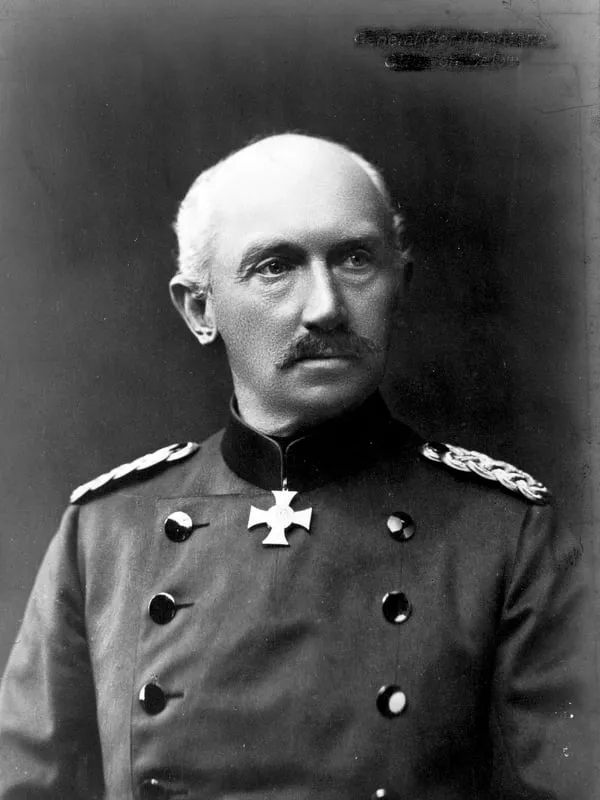
- Born:
- 18 January 1857, Danzig (Prussia)
- Died:
- 9 March 1944, Besenhausen near Göttingen
- Author:
- Łukasz Skowroń
- Photo:
- Paul Tellgmann, domena publiczna, Wikimedia Commons

Otto von Below commanded on more fronts in the First World War than almost any other German general. He fought in East Prussia in 1914, led the advance into Lithuania and Courland in 1915, defended the Macedonian front in 1916 and Arras in 1917, and in March 1918 his army struck in the great Spring Offensive. His name, however, is associated above all with one battle: in October 1917 the German and Austro-Hungarian 14th Army under his command broke through the Italian front at Caporetto and threw the Italians back as far as the Piave. He is sometimes confused with his cousin, General Fritz von Below, who in 1916 commanded the German defence on the Somme.
Before the war
He was born on 18 January 1857 in Danzig, into an old Pomeranian noble family. He was the eldest son of an officer who rose to the rank of lieutenant-general; two of his younger brothers also served in the army. After the cadet corps he became a second lieutenant of infantry in 1875. In 1884–1887 he completed the War Academy, and in 1889 he joined the Great General Staff. He then rose through successive levels of command: a battalion, a regiment at Görlitz, a brigade at Kassel, and from 1912 the 2nd Division in East Prussia. He therefore knew well the ground on which he was to fight in 1914.
1914–1915: East Prussia, Masuria, Courland
On mobilisation he took over the I Reserve Corps in the 8th Army, which was defending East Prussia. On 20 August his corps fought at Gumbinnen on the southern wing, but was unable to tip the balance of the battle. A few days later, now under the command of Paul von Hindenburg and Erich Ludendorff, Below’s corps, together with the corps of August von Mackensen, defeated the Russian forces on the eastern wing of Alexander Samsonov’s army and helped close the ring in the Battle of Tannenberg. Below was promoted to general of infantry, and in September he fought at the Masurian Lakes.
In November 1914 he took over the 8th Army. In February 1915 his army, together with the new 10th Army, opened the Winter Battle of Masuria, in which the Germans drove the Russians out of East Prussia and encircled the Russian XX Corps in the Augustów Forest. Below received the Pour le Mérite for it.
At the end of May 1915 the Germans combined the forces operating in Lithuania and Courland into the new Army of the Niemen, and Below became its commander. In July, when the great offensive of the Central Powers got under way along the whole Eastern Front, his army struck at Shavli against the Russian 5th Army, took Shavli and, on 1 August, Mitau, today’s Jelgava. In September, during the advance on Vilna, the Army of the Niemen was to cover it from the north and take Dvinsk. It did not take the fortress on the Dvina. In the autumn the front came to a halt on a line running from Riga along the Dvina. At the end of 1915 the Army of the Niemen was renamed the 8th Army again, and Below commanded it on this quiet sector until the autumn of 1916.
1916–1917: Macedonia and Arras
In October 1916 Below took over the German army group on the Macedonian front, made up of the German 11th Army and Bulgarian armies. He arrived just as the French, Serbs and Russians were attacking towards Bitola in the battle on the Crna. He held out in the bend of the Crna for several weeks, often visiting the front line in person. When, however, the Allies, above all the Serbs, broke into the hills in the bend of the river, he decided to give up Bitola, despite the opposition of the Bulgarian commander-in-chief, General Nikola Zhekov. He withdrew his troops to a new line north of the city, which the Allies were unable to break. In April 1917 he handed over command to General Friedrich von Scholtz.
He was summoned to France, where after the defeat at Vimy and Arras the commander of the German 6th Army, General Ludwig von Falkenhausen, had been dismissed. Below took over the 6th Army at the end of April 1917 (sources give 23 or 28 April), and his chief of staff, Colonel Fritz von Loßberg, built a defence in depth based on counter-attacks by reserve divisions. Further British attacks at Arras achieved little. In August, however, his army lost Hill 70 near Lens to the Canadians.
1917: Caporetto
In the summer of 1917 Austria-Hungary, exhausted by the Eleventh Battle of the Isonzo, asked the Germans for help. The German Supreme Army Command agreed to a joint offensive after a reconnaissance of the ground by the Bavarian mountain warfare specialist General Konrad Krafft von Dellmensingen. The 14th Army was formed from picked German divisions brought from other fronts and eight Austro-Hungarian divisions. Below received the command, and Krafft became his chief of staff. Below ordered the army to break through the front at Bovec (Flitsch) and Tolmin and, in an uninterrupted advance by day and night, to seize the mountain ridges.
On 24 October 1917, after a short bombardment including gas, in rain and fog, his infantry attacked on the upper Isonzo. German assault detachments advanced along the valleys, bypassing the Italian positions on the summits, and within a few days shattered the Italian 2nd Army. Among them was a young lieutenant, Erwin Rommel, who with a few companies took the summit of Matajur. The Italians lost several hundred thousand men, most of whom were taken prisoner, and half their artillery. The commander-in-chief, Luigi Cadorna, had to withdraw the army behind the Tagliamento and then to the Piave, where the front was halted with the help of French and British troops. The advance slowed because the troops had moved far from the railways, and the heavy artillery and supplies could not keep up. Below received the Order of the Black Eagle.
1918: Arras and retreat
At the beginning of 1918 the headquarters of the 14th Army was moved to France as the headquarters of the new 17th Army. In the plan of the great Spring Offensive, Below was to strike on the northern wing towards Bapaume and encircle the British forces in the Cambrai salient. On 21 March three German armies set off in Operation Michael. In the south Oskar von Hutier’s 18th Army routed the British Fifth Army, but Below’s 17th Army ran into the stronger, better prepared British Third Army and advanced slowly. On 28 March his attack at Arras, Operation “Mars”, which was meant to repeat the success of Caporetto in the west, collapsed within a single day with heavy losses.
In the summer and autumn the 17th Army fell back under the pressure of the British and Canadians, through the Drocourt–Quéant line and the Canal du Nord. In October Below took over the 1st Army, and a few days before the armistice he was given the task of preparing the defence of the Reich’s western frontiers.
After the war
After the revolution, in December 1918, he took over the XVII Corps in Danzig and commanded the troops covering the border with Poland in West Prussia. When Germany accepted the Treaty of Versailles, he left the army in June 1919. The Allies put him on the list of persons they wished to try for war crimes, but no trial took place. Below belonged to the Pan-German League and to the German National People’s Party, led nationalist veterans’ associations in northern Germany and, according to German biographers, was involved until 1923 in plans for a putsch against the republic. He lived in Kassel. He died on 9 March 1944 at Besenhausen near Göttingen.
Assessment
Below was above all a capable, experienced army commander, who was entrusted with one difficult task after another, sometimes in attack, sometimes in defence. Historians stress that his greatest successes were linked to his cooperation with outstanding chiefs of staff: Loßberg at Arras and Krafft at Caporetto, who planned the mountain offensive. The victory at Caporetto was one of the most spectacular breakthroughs of the war and a model for later operations by German assault troops. The Italians also owed their defeat to the mistakes of their own command, and Below himself was unable to turn the Piave line or force Italy out of the war.
In the west, in March 1918, Below did not repeat this success. His 17th Army faced one of the best prepared British armies, and the attack at Arras showed that methods which had worked against a shattered Italian defence failed against defence in depth and strong artillery. His post-war activity on the nationalist right and his part in conspiracies against the republic are today recalled alongside his military achievements.
Sources
Spotted a mistake?Report an error
Commanded in battles
(29)- 7–22 February 1915Winter Battle in MasuriaEastern Front
- 23 June 1915 – 9 November 1917Battles of the IsonzoItalian Front
- 14–25 July 1915Battle of ŠiauliaiEastern Front
- 9 September – 1 November 1915Battle of DvinskEastern Front
- 5 October 1915 – 30 September 1918The Salonika FrontBalkan Front
- 5 October – 11 December 1916Battle of the Crna and BitolaBalkan Front
- 11–23 March 1917March offensive in MacedoniaBalkan Front
- 9 April – 16 May 1917Battle of Arras (1917)Western Front
- 23–24 April 1917Second Battle of the Scarpe (1917)Western Front
- 28–29 April 1917Battle of ArleuxWestern Front
- 3–17 May 1917Battle of BullecourtWestern Front
- 3–4 May 1917Third Battle of the Scarpe (1917)Western Front
- 15–25 August 1917Battle of Hill 70Western Front
- 24 October – 9 November 1917Twelfth Battle of the IsonzoItalian Front
- 10 November – 26 December 1917First Battle of the PiaveItalian Front
- 21–23 March 1918Battle of St QuentinWestern Front
- 21 March – 5 April 1918Operation MichaelWestern Front
- 24–25 March 1918First Battle of BapaumeWestern Front
- 28 March 1918First Battle of Arras (1918)Western Front
- 5 April 1918Battle of the Ancre, 1918Western Front
- 21–23 August 1918Battle of Albert (1918)Western Front
- 21 August – 3 September 1918Second Battle of the SommeWestern Front
- 26–30 August 1918Battle of the Scarpe (1918)Western Front
- 31 August – 3 September 1918Second Battle of BapaumeWestern Front
- 2–3 September 1918Battle of the Drocourt–Quéant LineWestern Front
- 12 September 1918Battle of HavrincourtWestern Front
- 12 September – 12 October 1918Battles of the Hindenburg LineWestern Front
- 27 September – 1 October 1918Battle of the Canal du NordWestern Front
- 8–9 October 1918Battle of CambraiWestern Front
Mentioned in battles
(03)Often appears with
People who appear in the same events.