1916: The Salonika front
Battle of the Crna and Bitola
- Dates:
- 5 October – 11 December 1916
- Front:
- Balkan Front
- Location:
- The bend of the Crna River (Crna Reka) between Brod, Skočivir and Polog, and the plain south of Bitola (Monastir), from Lake Prespa to the Nidže range, Bulgarian-occupied Macedonia (part of the Kingdom of Serbia)On the battle map →
- Sides:
- Serbia, France, Russia and ItalyMaurice Sarrail, Živojin Mišić, Miloš Vasić, Victor Cordonnier, Paul LebloisBulgaria and GermanyOtto von Below, Arnold von Winckler, Dimitar Geshov, Nikola Zhekov
- Result:
- Entente victory. The Serbs took most of the Crna bend, and on 19 November the Allies took Bitola. The front was not broken and came to a halt a few kilometres north of the town.
- Author:
- Łukasz Skowroń
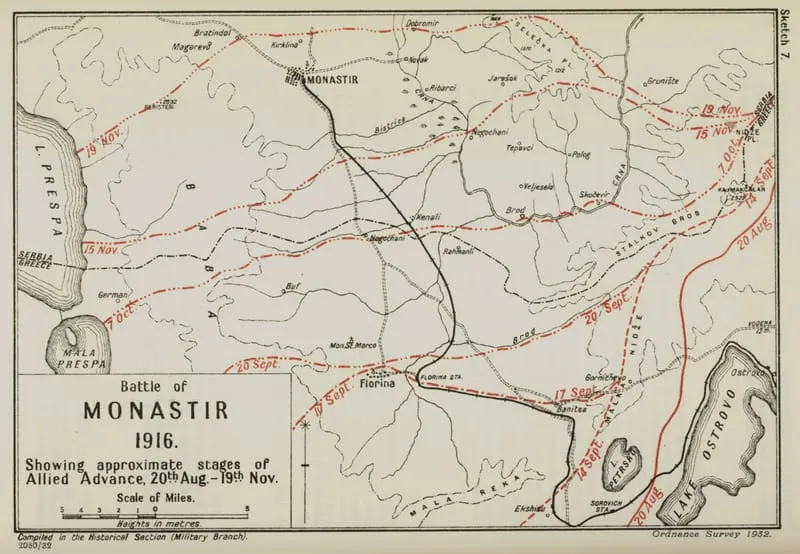
The Battle of the Crna and Bitola was the second, decisive part of the Allied autumn offensive in Macedonia. In September 1916 the army of General Maurice Sarrail drove the Bulgarians back from Lake Ostrovo, recovered Florina and took the peak of Kaymakchalan. At the beginning of October the Bulgarians took up a new, fortified line covering Bitola, known in Europe at the time as Monastir. For more than two months the Serbs fought their way through the mountainous bend of the Crna River, while the French and Russians stormed the Bulgarian trenches on the plain without success. In mid-November the defence on the eastern wing cracked, and on 19 November the Allies entered the abandoned town of Bitola, the first sizeable town of Serbia recovered since the autumn of 1915. On the hills just beyond the town, however, the Bulgarians and the Germans sent to help them halted the advance, and on 11 December the offensive was called off.
Name and dates
The British chronology of the war calls this engagement the Battle of the Cerna and Monastir and dates it from 5 October to 11 December 1916. We adopt the same limits on this page. The British official history of the operations in Macedonia describes the whole of Sarrail’s autumn offensive as the “Battle of Monastir”, lasting from 20 August to 19 November, and its last fighting, up to mid-December, as its continuation. The Bulgarians speak of the battle in the Crna bend, and in some of their studies it lasts from mid-October to 19 November. The Serbs call it the Battle of the Crna.
Sources put the very start of the battle somewhat differently. According to Bulgarian studies, on 5 October the Serbs tried to cross the river for the first time and were thrown back. The British official history writes that the commander of the French troops, General Victor Cordonnier, surveyed the Bulgarian positions on the plain from an aeroplane that day, and that the first Franco-Russian attack, which was repulsed, took place on 6 October. The British journalist Gordon Gordon-Smith, who accompanied the Serbian army, states that the Serbian Third Army reached the river as early as 4 October and forced it on 9 October at Skočivir. The end of the battle, 11 December, is the day on which the French commander-in-chief, General Joseph Joffre, halted the offensive. This date is given both by the Austrian official history and by Russian studies.
Background
The offensive in Macedonia was meant to pin down the Bulgarians when Romania entered the war. The Bulgarians, however, forestalled it in August with a strike at Florina (Battle of Florina), and when Sarrail finally moved on 12 September, Romania was already losing in Dobruja, where Tutrakan had fallen. The September fighting brought the Allies a considerable success. On 14 September the Serbs took Gornichevo and 32 guns, on 17 September the French and Russians entered Florina, and on 30 September, after eighteen days of fighting, the Serbian Drina Division finally took Kaymakchalan, more than two and a half thousand metres above sea level. During the night of 2/3 October the Bulgarians fell back to a line they had fortified earlier. It ran from Lake Prespa through the villages of German, Negočani and Kenali on the plain, about 15 kilometres south of Bitola, and then along the bend of the Crna.
The British official history describes this terrain in detail. The Crna flows from north to south past Bitola as a sluggish, winding and muddy lowland river, then turns sharply back to the north and enters a narrow, gloomy gorge through a mountain massif. This bend, filled with rocky hills, was called the Crna bend. Whoever held it covered Bitola from the east and the road from Bitola to Prilep. Sarrail wanted the French and Russians to break the Bulgarian line on the plain and the Serbs to outflank it through the mountains.
On the Allied side fought two Serbian armies, the First Army of Vojvoda Živojin Mišić and the Third Army of General Miloš Vasić, together with the French 156th, 57th and 17th Colonial Divisions and the Russian brigade of General Mikhail Diterikhs, under Cordonnier’s command. According to some studies, at the beginning of October the Allies had 103 battalions and 80 batteries on this sector against 65 battalions and 57 batteries of the enemy. The Bulgarian units, however, were exhausted after the September defeat. The heaviest fighting fell to the 8th Tundzha Infantry Division and several independent brigades. The Germans judged the situation dangerous. On 26 September the headquarters of the German 11th Army of General Arnold von Winckler exchanged sectors with the Bulgarian First Army and took over the front at Bitola. The commander of the First Army, General Kliment Boyadzhiev, was recalled, and his successor was General Dimitar Geshov. In October both armies were placed under the army group of the German General Otto von Below.
Course of the battle
First attacks (5–17 October)
At the beginning of October Joffre pressed Sarrail to strike again at once, because Romania needed help. According to Bulgarian studies, on 5 October the Serbs tried to cross the Crna for the first time. A few detachments reached the far bank, but a Bulgarian counter-attack threw them back. On 6 October the Serbs attacked again near the villages of Dobroveni and Skočivir and were again driven back, while the village of Brod remained in Bulgarian hands. On the plain Cordonnier believed that without cover and with little artillery he could not take the Bulgarian trenches by frontal assault, and proposed outflanking them through the mountains to the west. Sarrail, however, ordered him to attack at once in order to help the Serbs. The Franco-Russian attack of 6 October collapsed, and the Russians suffered heavy losses.
During the night of 7/8 October, as the British official history writes, the Serbs forced their way across the river between Brod and Skočivir, though they held on to the far bank only with difficulty. The Bulgarians defended themselves fiercely. According to their studies, during the night of 14/15 October the Serbs made eight successive attacks and all were repulsed. On 14 October the French and Russians struck again at Kenali, against Cordonnier’s advice, and ran into uncut wire. The French lost 1,490 men and the Russians 600. On 16 October Sarrail, dissatisfied with the conduct of operations on the plain, demanded Cordonnier’s recall. His place was taken temporarily by General Paul Leblois.
German reinforcements and fighting in the bend (18 October – 9 November)
On 18 October the Serbian First and Third Armies renewed the attack in the bend, threw the Bulgarians back in its western part and took the village of Veljeselo, a little over two kilometres north of Brod. The next day the Bulgarians, driven out of their trenches by heavy fire, also fell back in the eastern part of the bend, to the hills south of the village of Polog. Gordon-Smith wrote that in these days the Serbs took about a thousand prisoners, among them the first Germans from the reinforcements that had arrived from East Prussia a few days earlier. The Germans were bringing in individual battalions and batteries to rescue their ally from wherever they could: first machine-gun companies and the 146th Infantry Regiment from the Vardar valley, then rifle (Jäger) battalions from the Vosges and Champagne, and the 42nd Infantry Regiment from Volhynia. German counter-attacks on 20 and 22 October were repulsed, and a single battalion, the 12th Saxon Jäger Battalion, lost 350 men. At the same time the Ottoman 50th Division began to appear on the Struma, relieving some of the Bulgarians, who set off for Bitola.
Meanwhile the weather was deteriorating. Torrential rain hampered the Serbs’ march just when every hour counted, and the enemy gained time to dig in. On 23 October Sarrail finally adopted the plan Cordonnier had proposed earlier: he decided to drive the enemy off the plain by outflanking him through the mountains. He placed the French 17th Colonial Division, the 2nd Zouave Regiment and a large part of the artillery at the disposal of the Serbian command, for the fighting in the bend and on the hills between the river and Kenali. The Italians sent the “Cagliari” Brigade to the left wing, but because of the congested railway it went into action only three weeks later. For the following weeks heavy fighting went on that changed little. The Germans already had eight battalions in the western part of the bend and repulsed all attacks there.
The breakthrough and the capture of Bitola (10–19 November)
From 10 November the Serbs attacked anew. The Danube and Morava Divisions, together with French Zouaves, took the positions between Polog and the northern arm of the river, capturing 10 guns and a thousand prisoners. According to the Austrian official history, the battle was decided on 11 November: the Bulgarian eastern sector was broken through, and the brigade that was to counter-attack was swept away by the fugitives. On 13 November the Serbs broke into the German positions north of Veljeselo, taking 660 prisoners, and during the night of 14/15 November the enemy pulled back his whole line in the bend to a position cutting across it about 13 kilometres from its southern end. That same day the French again attacked the fortifications at Kenali. They were repulsed in fierce hand-to-hand fighting, but during the night the Bulgarians themselves abandoned the line they had held for six weeks and fell back to positions a few kilometres south of Bitola. West of the town the “Cagliari” Brigade was advancing in snowstorms along the ridges of the Baba range.
The battle was now being fought in winter conditions. The wind drove the snow horizontally, snowed-up paths led night columns astray, and on the plain the soldiers stood knee-deep in mud and water. Battle casualties were compounded by enormous losses to sickness. On 17 November the Zouaves took Hill 1212, which they lost during the night, and on 18 November the Serbian Danube Division took Hill 1378, the highest point of the whole area. The German command concluded that the town could not be held. Despite the objections of the Bulgarian commander-in-chief, General Nikola Zhekov, during the night of 18/19 November the Bulgarians and Germans abandoned Bitola. On the morning of 19 November French and Serbian cavalry entered it, followed by French and Russian infantry. It was the fourth anniversary of the town’s capture by the Serbs from the Turks in 1912. Bitola, which before the war had about 60,000 inhabitants, was the most important town in Macedonia after Salonika.
The last attacks (20 November – 11 December)
The enemy fell back only a few kilometres, to the hills north of the town, from where his artillery dominated Bitola. The British official history considered that a swift blow by fresh troops might then have taken even Prilep, but there were no fresh troops. The roads were wrecked, the railway from Salonika had been repaired only as far as Ekshisu station, and men and horses were exhausted. At the end of November the Serbs and the French 17th Colonial Division gained a little more ground in the bend, but a counter-attack threw them off Hill 1050, the most important point left in enemy hands. According to the Austrian official history, on 27 November Sarrail tried for the last time to break the front with his entire forces, without success. On 3 December the Serbian Drina Division took the village of Gruniste east of the river, and on 10 and 11 December the Serbs, with a second Russian brigade that had only just arrived at the front, attacked Hill 1050 without success. On 11 December Joffre halted the offensive. Romania was already defeated, Bucharest had fallen on 6 December, and tension was mounting in Greece behind Sarrail’s back.
Casualties
Losses on both sides were very heavy, but the available figures usually cover the whole offensive from August to December, not just the battle on the Crna. According to the British official history, the Serbs lost about 27,000 men in this period and the French 13,786. Russian and Italian losses were not known. Together with the 5,048 men the British lost in the subsidiary fighting on the Vardar and the Struma, this came to about 50,000. Russian studies estimate that in addition about 80,000 Allied soldiers died or were evacuated because of sickness.
The British official history estimated the enemy’s losses at at least 60,000 men from August to December, including more than 45,000 Bulgarians on the Bitola front and at least 8,000 Germans. The Allies took more than 8,000 prisoners there. The German battalions, brought into action from the second half of October, paid a high price: the 42nd Infantry Regiment lost 50 officers and 2,615 men in four weeks, up to 21 November.
Significance
The battle brought the Allies an undeniable, if limited, success. The Bulgarians lost not only the gains of their August strike at Florina, but also about a thousand square kilometres of Serbian territory. For the Serbs, the recovery of Bitola, after a year of wandering through Albania and Corfu, was of enormous moral importance. The British official history stressed that only the dispatch of 18 German battalions, including some of the best, and many batteries had saved the Bulgarians from defeat, and that the greatest credit for the victory was due to the Serbs.
The offensive did not, however, achieve its strategic aims. The front moved forward by an average of a few dozen kilometres, Bulgaria was not knocked out of the war, and the help for Romania proved, as the Russian historian Nikolai Korsun wrote, small and belated. The Austrian official history noted that the German command regarded the loss of Bitola as a moral rather than a military defeat and could not be diverted from its plans in Romania. The new line on the hills north of the town, with the Baba range and Hill 1248 in the west and Hill 1050 in the bend, lasted almost two years. Bitola, lying just behind the front, was shelled almost daily by Bulgarian artillery until 1918. The Bulgarians and Germans left it only in September 1918, after the front was broken at Dobro Pole.
Spotted a mistake?Report an error