Bulgaria · The Central Powers
Nikola Zhekov
Minister of War (1915), commander-in-chief of the Bulgarian field army (1915–1918)
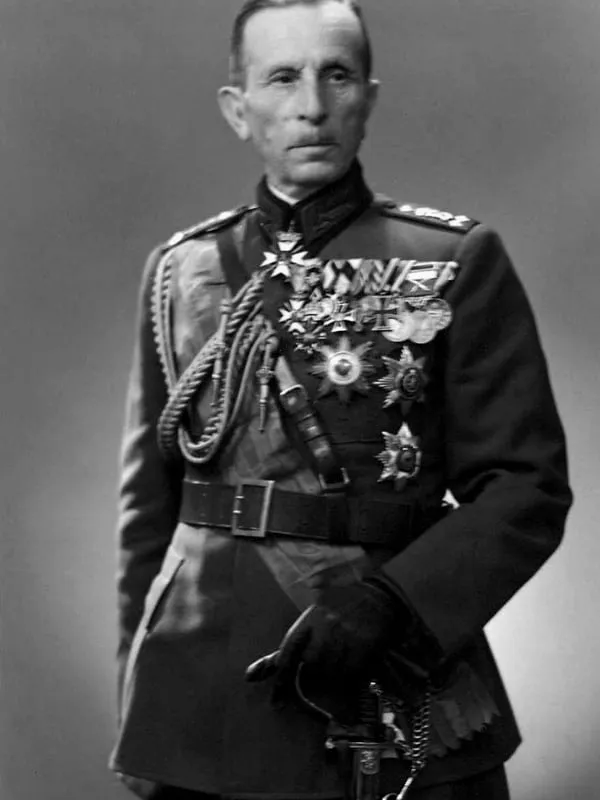
- Born:
- 6 January 1865, Sliven (Ottoman Empire, now Bulgaria)
- Died:
- 1 November 1949, Füssen (Germany)
- Author:
- Łukasz Skowroń
- Photo:
- autor nieznany, domena publiczna, Wikimedia Commons

Throughout the war that Bulgaria waged on the side of the Central Powers, Nikola Zhekov stood at the head of its army. Formally the commander-in-chief was Tsar Ferdinand, but it was Zhekov, as commander of the field army, who directed the troops in the Serbian campaign of 1915, in the war with Romania and through three years of fighting on the Macedonian front. He was among the most resolute supporters of the alliance with Germany, with which he cooperated, though not without disputes. His command ended in disaster: when the Allies broke through the front at Dobro Pole in September 1918, he was undergoing medical treatment in Vienna. After the war a court convicted him as one of those responsible for the “second national catastrophe”, and in the 1930s he became one of the leaders of the Bulgarian far right.
Before the war
He was born on 6 January 1865 (25 December 1864 according to the Julian calendar) in Sliven. During the Serbo-Bulgarian War of 1885 he was still a cadet at the military school in Sofia. A board refused to accept him as a volunteer because of poor health, so together with other cadets he enlisted in a reserve regiment, which, however, did not get into action in time. A year later he took part in the coup that overthrew Prince Alexander of Battenberg. For this he was reduced to the ranks, but he was covered by an amnesty and in 1887 became an artillery officer.
In 1894–1898 he studied at the war school in Turin, and on his return he served on the army staff. For many years he was an educator of officers: he lectured in military pedagogy at the military school in Sofia, headed the school for reserve second lieutenants and in 1912, after commanding the 1st Sofia Infantry Regiment, became commandant of the military school. In the First Balkan War he was chief of staff of the Second Army, which besieged and in March 1913 captured Adrianople. A serious illness prevented him from taking part in the Second Balkan War. In 1913–1914 he took part in talks in Constantinople on a military convention with Turkey, then served as deputy chief of the army staff, and in May 1915 he took over the 8th Tundzha Infantry Division.
1915: minister and commander-in-chief
In the summer of 1915 Bulgaria was wavering between the two coalitions. In August the Minister of War, General Ivan Fichev, regarded as cautious, resigned, and his place was taken by Zhekov, an advocate of entering the war on Germany’s side. In the same month he was promoted to major-general. At the beginning of September Bulgaria signed a treaty of alliance with Germany and a military convention with Germany and Austria-Hungary. When general mobilisation was announced, the Tsar, who according to Bulgarian historians had himself insisted on the appointment, entrusted Zhekov with command of the field army. General Konstantin Zhostov became his chief of staff, and General Kalin Naydenov took over the ministry of war.
Zhekov had three armies. In accordance with the convention, he placed the First Army under the orders of Field Marshal August von Mackensen, who commanded the whole expedition against Serbia. The Second Army of General Georgi Todorov remained under direct Bulgarian command and was to enter Serbian Macedonia, while the Third Army of General Stefan Toshev guarded the border with Romania. After the declaration of war on Serbia on 14 October the Second Army cut the railway to Salonika within a week, and at the beginning of November the First Army took Niš. Zhekov then informed the Prime Minister, Vasil Radoslavov, that the Bulgarian flag was flying over the fortress “for ever”. On 6 November at Paraćin he met Erich von Falkenhayn and Mackensen to agree on further operations.
At the end of the year, after the conquest of Serbia and the expulsion of the French and British from Macedonia, the Bulgarian troops stood on the Greek border. There they halted at the demand of the Germans, who did not want to push neutral Greece into the Entente camp. For Zhekov and the Bulgarian staff this was a decision hard to accept, as it allowed the Allies to entrench themselves at Salonika. In January 1916 Emperor Wilhelm II awarded him the Pour le Mérite.
1916: Greece, Romania and Bitola
Through the first half of 1916 the Bulgarians pressed the Germans for permission to strike into Greece, which would give them a better line of defence and the port of Kavala. They obtained consent only in the summer. In May Bulgarian and German units occupied Fort Rupel, and in August the First Army attacked at Florina, forestalling General Sarrail’s offensive. It took the town but did not break through the Serbian defences by Lake Ostrovo. On the eastern wing the Second Army entered Eastern Macedonia and in September, after the capitulation of the Greek IV Corps, Kavala.
At the same time Zhekov was preparing for war with Romania. On 28 July at Pless he agreed with the German and Austro-Hungarian high commands on a joint plan in the event of Romania’s entry into the war. Together with Falkenhayn he argued that the Bulgarians should first advance deep into the Dobruja rather than immediately force the Danube towards Bucharest, as Conrad von Hötzendorf wanted. This suited the Bulgarians, who wanted to fight above all for lands they regarded as their own. When Romania entered the war, the Third Army, under Mackensen’s overall command, took Tutrakan and within a few weeks recovered the southern Dobruja. On 6 October 1916 Zhekov was promoted to lieutenant-general.
In the autumn the situation in Macedonia was reversed. The Serbs took Kajmakčalan, and in the battle on the Crna the Allies began to push the Bulgarians and Germans off the mountains east of Bitola. The Macedonian front then passed under the command of the German army group of General Otto von Below. In mid-November Below decided to give up the town, despite the objections of Zhekov, for whom Bitola was a symbol of Bulgarian claims to Macedonia. On 19 November the Allies entered it. The new line north of the town, however, withstood all subsequent attacks.
1917–1918: from stalemate to defeat
In 1917 the Macedonian front barely moved. Sarrail’s spring offensive collapsed both on the Vardar and at Doiran, where the Bulgarians repulsed the British. Ever more serious troubles, however, had their source in the rear. Bulgarian soldiers lacked food and uniforms, their families at home were starving, and the German allies, who commanded a large part of the front in Macedonia, were carrying off grain and taking further batteries and battalions away to other fronts. The peace concluded with Romania in May 1918, which did not give Bulgaria the whole of the Dobruja, was a great disappointment. In June Radoslavov’s government fell, and the new Prime Minister, Aleksandar Malinov, sought a way out of the war.
Erich Ludendorff wrote in his memoirs that the German command had long tried to persuade the Bulgarians to keep whole formations in reserve instead of placing almost all their forces in the front line, and that Zhekov only gradually began to follow this advice. In the summer of 1918 the general fell seriously ill and on 8 September left for treatment in Vienna. The duties of commander-in-chief were taken over by his deputy, General Todorov. A week later the Serbs and French broke through the front at Dobro Pole, and in the following days the Vardar offensive split the Bulgarian army in two. On 29 September Bulgaria signed the Armistice of Salonika, and on 3 October the Tsar abdicated. Zhekov, still in Vienna, was dismissed and transferred to the reserve, according to Bulgarian sources on 4 October, according to others in November.
After the war
After the war he lived in Germany and Austria. The peasant government of Aleksandar Stamboliyski put on trial the politicians and generals it held responsible for the defeat. Zhekov returned to the country in October 1921 to defend his name and was sentenced to ten years’ imprisonment. He was released under an amnesty in 1924, when, after the overthrow of Stamboliyski, his opponents were in power. He wrote military works and memoirs, lectured at the military academy and in 1936 was promoted to general of infantry. In the 1930s he was honorary chairman of the Union of Bulgarian National Legions, a nationalist organisation modelled on the fascist movements, and published articles of an antisemitic and anti-communist tenor. He maintained contacts with Hitler, who in 1940 invited him to visit conquered France.
In September 1944, as the Red Army approached Bulgaria, he left for Germany. The People’s Court set up by the new communist authorities sentenced him to death in absentia on 1 February 1945, but the sentence was not carried out, as his whereabouts were unknown. He died on 1 November 1949 in Füssen in Bavaria. In 1992 his remains were brought to Sofia and laid in the Military Mausoleum.
Assessment
Bulgarian historians credit Zhekov with a share in the greatest successes of the Bulgarian army, the occupation of Macedonia in 1915 and the Dobruja campaign of 1916, and also with the fact that the Macedonian front withstood Allied attacks for almost three years. He enjoyed authority in the army and was regarded as a good speaker. They point out, however, that his independence was limited: the Tsar kept the last word, and on the Macedonian front the German commands in practice decided matters. Zhekov lost many disputes with the Germans, from the halt on the Greek border in 1915 to the abandonment of Bitola in 1916.
For the defeat of 1918 he is blamed above all for failing to prepare the army for defence in depth, keeping too few reserves and failing to prevent the disintegration of the army, which lacked food and faith in the purpose of the war. Ludendorff went so far as to accuse him of passivity and remarked sardonically that a few days before the expected battle he had left for a Viennese clinic because of an ear complaint. Some historians, however, believe that no commander could have saved the Bulgarian army in September 1918, exhausted as it was by three wars and deprived of German support. Assessment of Zhekov in Bulgaria was long complicated by his later political activity as well. For the communist authorities he was a war criminal and a fascist, and after 1989 he was restored to a place among the national commanders, although his links with Nazism and his antisemitism have continued to arouse opposition.
Sources
Spotted a mistake?Report an error
Commanded in battles
(02)Mentioned in battles
(02)Often appears with
People who appear in the same events.