Bulgaria · The Central Powers
Ferdinand I of Bulgaria
Prince (1887–1908) and Tsar of Bulgaria (1908–1918)
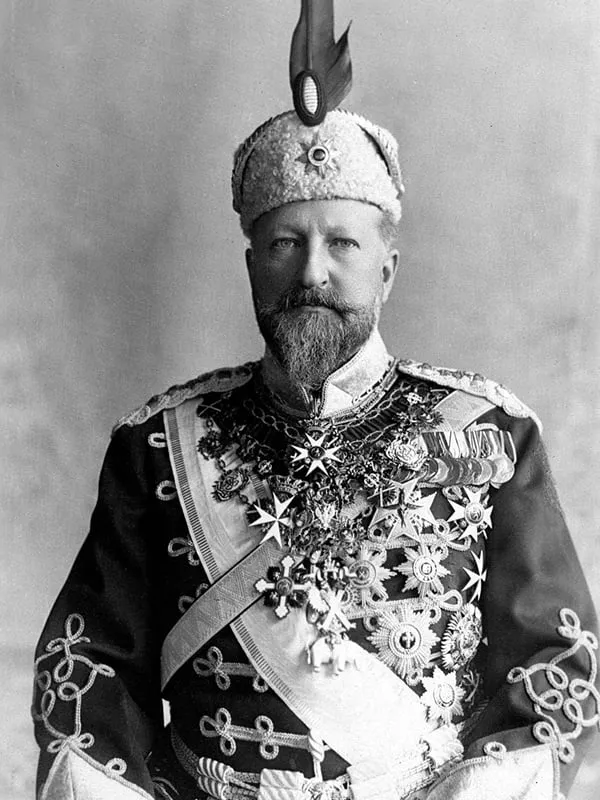
- Born:
- 26 February 1861, Vienna (Austria)
- Died:
- 10 September 1948, Coburg (Germany)
- Author:
- Łukasz Skowroń
- Photo:
- autor nieznany, domena publiczna, Wikimedia Commons

Ferdinand of the house of Saxe-Coburg and Gotha ruled Bulgaria for 31 years, longer than any other monarch of the modern Bulgarian state. He was first prince and, from 1908, tsar. A German aristocrat brought up in Vienna, a Catholic on the throne of an Orthodox country, he was regarded as the most skilful and most cunning politician in the Balkans. Abroad he was called “the fox”. He proclaimed Bulgaria’s independence and built up its army, but twice led the country into wars that ended in national catastrophe: in 1913 and in 1915–1918. In the autumn of 1915 it was above all he who decided that Bulgaria would side with the Central Powers. He was also the first of the monarchs of that camp to lose his throne.
Before the war
He was born on 26 February 1861 in Vienna, the youngest son of Prince August of the Hungarian branch of the Coburgs, a general in the Austrian army, and of Clémentine of Orléans, daughter of King Louis Philippe I of France. The family was very rich and related to half the courts of Europe. Ferdinand served in the Austro-Hungarian cavalry, but botany and ornithology interested him more than soldiering. At eighteen he made a natural history expedition to Brazil, and he remained faithful to his passion as a naturalist to the end of his life.
In 1886 pro-Russian officers forced the first prince of Bulgaria, Alexander of Battenberg, to abdicate. The throne was offered to many candidates, and on 7 July 1887 the Grand National Assembly elected the 26-year-old Ferdinand. Russia regarded the election as illegal, and Queen Victoria wrote that the candidate was totally unfit. For the first years the country was in fact governed by the prime minister Stefan Stambolov, an implacable opponent of Russia. In 1894 Ferdinand got rid of him, and in 1896 he was reconciled with St Petersburg: he had the heir to the throne, Boris, baptised in the Orthodox rite, bringing down on himself the anger of Pope Leo XIII and of his Catholic family. The reward was recognition by the powers.
He ruled in an increasingly personal way, playing the parties off against each other and filling the government with men who depended on his favour. On 5 October 1908, taking advantage of the Bosnian crisis, he proclaimed Bulgaria’s full independence at Veliko Tarnovo and assumed the title of tsar. He dreamed of a Greater Bulgaria and even, as his critics wrote, of a crown in Constantinople. In 1912 he helped create the Balkan League, and in the First Balkan War the Bulgarian army reached the approaches to Constantinople. The dispute over the division of Macedonia, however, broke up the alliance. During the night of 29–30 June 1913 the Bulgarians attacked their recent allies, the Serbs and the Greeks. According to many historians the attack was planned by the tsar and the army command without the government’s knowledge. In the Second Balkan War Romania and Turkey also turned against Bulgaria. The Treaty of Bucharest of August 1913 left almost all of Macedonia to Serbia and Greece, and gave Southern Dobruja to Romania. Adrianople, retaken by the Turks, was left to them by a separate Bulgarian treaty in September. In July 1913 the tsar entrusted the government to Vasil Radoslavov, a liberal hostile to Russia and close to Vienna and Berlin.
Neutrality and bidding
When the Great War broke out in 1914, Bulgaria was exhausted and declared neutrality. Ferdinand and Radoslavov leaned towards the Central Powers from the start. As early as July the country took out a large loan from German banks, and the tsar, although in private conversation he did not hide his contempt for Wilhelm II and Franz Joseph, believed that only Germany could give him what he wanted most: Macedonia. The Entente promised eastern Thrace and “just” acquisitions in Macedonia, but could not force Serbia and Greece to give up their gains of 1913. Ferdinand waited. He let both sides bid against each other and watched the fronts.
In the summer of 1915 the Russians were retreating from Galicia and Poland, and the Allies were stuck at Gallipoli. The tsar concluded that Germany would win. On 6 September Radoslavov signed in Sofia a secret alliance with Germany, which promised Bulgaria the whole of Serbian Macedonia. Few people knew of the negotiations, and even the general staff learned their purpose only at the last moment. On 17 September Ferdinand received the opposition leaders, among them the peasant tribune Aleksandar Stamboliyski, who according to accounts by those present warned him that he might pay for the war with his throne and his head. The tsar did not change his mind. On 22 September he signed the mobilisation decree, and when Russia demanded a break with Germany, Sofia rejected the ultimatum. On 14 October the tsar’s manifesto declared war on Serbia, presented as defence against an attack by a “perfidious neighbour”.
War at Germany’s side
The first years brought what he had counted on. Together with the armies of Field Marshal August von Mackensen, the Bulgarians conquered Serbia in a few weeks. The Second Army of General Georgi Todorov occupied Serbian Macedonia and cut the Serbs off from the Entente forces at Salonika. In January 1916 Ferdinand received Kaiser Wilhelm II in captured Niš, and the overland route from Berlin to Constantinople was open. When Romania entered the war in August 1916, the tsar summoned Radoslavov to his residence in the Rila mountains, cut him off from the world, and on 1 September Bulgaria declared war on Romania. The Bulgarians and Germans took Tutrakan, and by January 1917 the whole of Dobruja.
The tsar guarded his influence over policy and the army but appeared in public less and less often. He treated the Germans with distrust. The alliance brought Bulgaria gains while at the same time making it dependent on Berlin, which requisitioned food and was unwilling to give the Bulgarians everything it had promised. This was felt most painfully in the spring of 1918. The Peace of Bucharest granted Bulgaria only Southern Dobruja with a narrow strip to the north, and placed the rest of the region under the joint administration of the Central Powers, because the Turks too were bargaining over this land. Public opinion regarded it as a defeat. There was hunger in the country, and the soldiers on the Macedonian front were weary of war. In June Ferdinand dismissed Radoslavov and appointed a government under Aleksandar Malinov, a politician who in 1915 had favoured the Entente. According to some historians, the tsar wanted to have at hand a man who would, if need be, open talks with the other side.
Defeat and abdication
On 15 September 1918 the Allies broke through the front at Dobro Pole, and the Vardar offensive shattered the Bulgarian army in a few days. According to German accounts the tsar still firmly rejected General Ivan Lukov’s request to open talks, but when regiments began to mutiny and the allies sent no help, he agreed to ask for an armistice. On 29 September government delegates signed the Armistice of Salonica. At the same time mutinous soldiers proclaimed a republic at Radomir and marched on Sofia. The revolt was crushed, but the tsar’s authority was destroyed, and according to Bulgarian historians the Allies made it clear that they expected him to go.
On 3 October 1918 Ferdinand signed the act of abdication in favour of his son, who became tsar as Boris III. He wrote in it that he wished to set an example of the sacrifice that circumstances demanded of every citizen. He left the country by train without delay. Emperor Karl I would not allow him to live on his estates in Hungary, so the former tsar went to the family seat of Coburg. His sacrifice saved the dynasty: of all the defeated states, only Bulgaria kept its dynasty for long.
After the war
The peace signed in 1919 at Neuilly-sur-Seine also took away Bulgaria’s access to the Aegean Sea. Ferdinand outlived the defeat by 30 years. In Coburg he devoted himself to his collections of plants, insects and birds, was a member of many learned societies and made natural history expeditions to Africa and South America. He was never allowed to return to Bulgaria. He outlived both his sons: Boris died in 1943, and the younger, Kiril, a member of the regency council, was shot by the communists in 1945. His grandson Simeon II lost the throne in 1946. Ferdinand died in Coburg on 10 September 1948. He was buried in the crypt of the Church of St Augustine, and in May 2024 his remains were brought back to Bulgaria and laid to rest at the Vrana Palace near Sofia.
Assessment
Contemporaries in the Entente camp wrote of him with contempt, as a traitor to the Slav cause and a cynical intriguer who sold his country to the highest bidder. Historians are more cautious. They acknowledge that Ferdinand did not drag Bulgaria into the war against its will: the desire to recover Macedonia after the defeat of 1913 was shared by most of society, and the Entente could not satisfy it without breaking with Serbia. The choice of 1915 seemed rational, because the Central Powers were then winning on every front.
Critics stress, however, that the tsar conducted foreign policy almost personally, within a narrow circle and behind parliament’s back, and that in 1913 and 1915 he twice staked everything on a single card. Bulgarian historians see him as a contradictory figure: a monarch who gave the country independence, modern institutions and a strong army, and who at the same time bears a responsibility, hard to dispute, for two national catastrophes paid for with hundreds of thousands of victims and the loss of territory.
Sources
Spotted a mistake?Report an error
Mentioned in battles
(03)Often appears with
People who appear in the same events.