Key event
Armistice of Salonica
- Category:
- Diplomacy
- Front:
- Balkan Front
- Date:
- 30 September 1918
- Author:
- Łukasz Skowroń
- Tags:
- Bulgaria, France, Louis Franchet d'Espérey, Germany
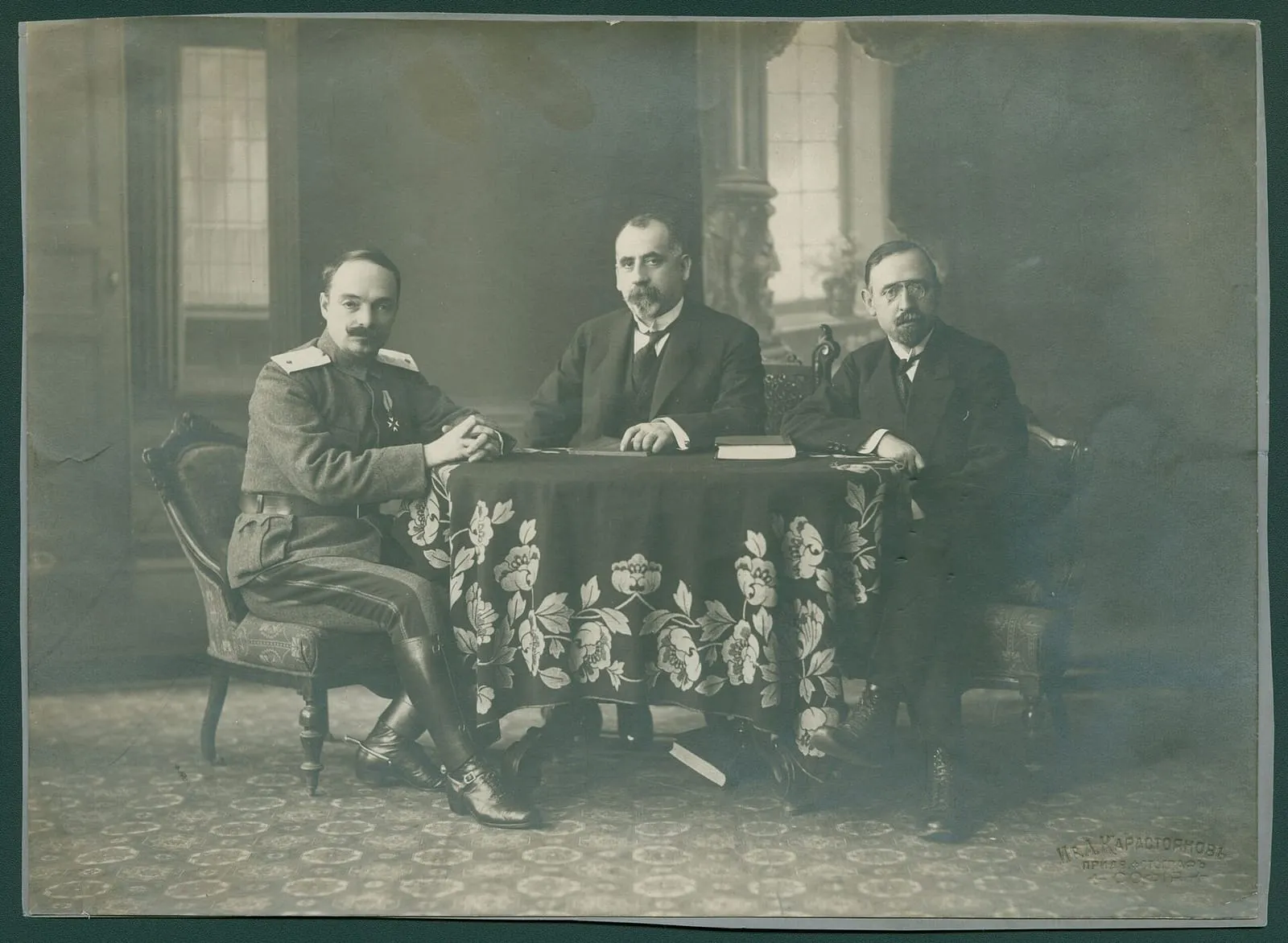
At noon on 30 September 1918 the guns fell silent on the Macedonian front. Late in the evening of the previous day, at the headquarters of the Allied armies in Salonica, General Louis Franchet d’Espèrey and delegates of the Bulgarian government had signed a military convention for the suspension of hostilities. The Tsardom of Bulgaria, which less than three years earlier had entered the war on the side of Germany, Austria-Hungary and Turkey, was the first of the Central Powers to lay down its arms. It was forced into the decision by defeat: in two weeks the Vardar offensive had shattered the Bulgarian front in Macedonia, and the retreating regiments had begun to mutiny.
The request for an armistice
The government of Aleksandar Malinov, appointed in June in place of Radoslavov’s cabinet, had been regarded in Berlin as unreliable from the start. When disaster began at the front, Sofia first turned to its allies for urgent help but received evasive answers. After a conference attended by Tsar Ferdinand, the government decided to ask for an armistice. The Bulgarian communiqué was dated 24 September, while according to a note later published by the leaders of the government bloc the official offer was made on 25 September at 5 p.m. The sources thus differ by a day, but all agree that the Tsar consented. According to German accounts cited by the British official history, only a few days earlier Ferdinand had firmly rejected a similar suggestion from the commander of the Second Army, General Ivan Lukov.
Early in the morning of 26 September a Bulgarian officer with a white flag crossed the British lines. He carried a letter dated 25 September and signed by the acting commander-in-chief, General Georgi Todorov, who, through the commander of the British army in Macedonia, General George Milne, asked for a 48-hour suspension of operations so that plenipotentiaries with armistice proposals could come to Salonica. Milne knew that halting the offensive at such a moment was out of the question, and sent the envoy on to Salonica without comment. On 27 September Franchet d’Espèrey replied: “I cannot grant either an armistice or a suspension of hostilities that would interrupt the operations in progress. I will, however, receive with due courtesy duly accredited delegates of the Royal Bulgarian Government.” The chronology of the war ties Bulgaria’s request to 27 September, but that was the day of this reply. The letter itself had reached the Allies a day earlier.
Malinov also tried a second route. The United States was not at war with Bulgaria, and the American chargé d’affaires Dominic Murphy had remained in Sofia. The Prime Minister asked him to forward an appeal to President Woodrow Wilson, but according to the British official history the Austrian wireless station refused to transmit the telegram. The French Prime Minister Georges Clemenceau instructed Franchet d’Espèrey not to enter into any talks with the American, and Washington made it clear that it did not wish to take part in these negotiations.
The delegates in Salonica
On 28 September a delegation set out from the headquarters of the Bulgarian Second Army at Sveti Vrach (today Sandanski): the Finance Minister Andrey Lyapchev, General Lukov and the diplomat Simeon Radev, the former envoy in Bucharest. At 1 p.m. it reached the British advanced headquarters, where Lyapchev had a brief talk with Milne. He explained that Malinov had inherited from his predecessors obligations towards Germany which he could not break, but that defeat had restored his freedom of action. He asked for an immediate armistice and for territorial questions to be deferred to the peace conference. In return the government would force its former allies to leave the country, rebuild the army and might follow Britain’s advice. The Bulgarians hoped to be treated as a neutral state, and perhaps soon as an ally. That same day they reached Salonica.
Franchet d’Espèrey would not hear of it. His terms, agreed according to French historians with Clemenceau, were not harsh, but they were meant to leave Bulgaria defenceless. The question of penalties was left to the peace conference. The Bulgarian delegates had no room to bargain, all the more so since instructions came from Sofia to reach an agreement on whatever terms they could get. On 29 September, before the document was signed, news arrived from the front that French cavalry had burst into Skopje that morning and cut the line of retreat of the troops standing further west. Franchet d’Espèrey then added the harshest clause of the convention. The document was signed late in the evening of 29 September. Some accounts give the time as 10.50 p.m., while some French works speak of the signing just before midnight. The text published in the British official history bears the signatures of Franchet d’Espèrey, Lyapchev and Lukov. According to the press of the time, all three delegates signed the document.
The terms
The convention had seven public clauses. Bulgaria had to evacuate the occupied Greek and Serbian territories immediately, without removing cattle, grain or food from them and without destroying anything. The army was to be demobilised at once, with the exception of three divisions and four cavalry regiments: two divisions were to guard the eastern frontier and the Dobruja, and one the railways. The weapons, ammunition and vehicles of the demobilised units were to be deposited at places designated by the Allies, and the horses handed over to the Allies. Greece was to recover the equipment of the IV Corps, which the Bulgarians had seized in 1916 in eastern Macedonia. Bulgarian soldiers standing west of the meridian of Skopje, that is, serving in the German Eleventh Army, were to lay down their arms and remain prisoners until further notice. The Allies could employ Bulgarian prisoners until peace was concluded, while their own prisoners were to be returned at once. Germany and Austria-Hungary were given four weeks to withdraw their troops from Bulgaria. Within the same period the diplomats and citizens of the Central Powers were to leave the country.
Secret articles gave the Allies the right of passage through Bulgaria and the use of its railways, roads, rivers and ports, as well as control of the telegraph and wireless stations. The Powers could temporarily occupy several strategic points in the interior. Franchet d’Espèrey gave assurances that, barring exceptional circumstances, he would not occupy Sofia. Bulgarian ports were opened to Allied and neutral ships. The convention was purely military. It did not settle frontiers or the terms of peace and was to remain in force until peace was concluded.
The Radomir rebellion
The negotiations took place in the shadow of a rebellion. Shattered regiments were making their way home on their own. On 24 September a crowd of soldiers seized Kyustendil, the seat of army headquarters. The government released from prison the leaders of the Bulgarian Agrarian National Union, Aleksandar Stamboliyski and Rayko Daskalov, in the hope that they would calm the soldiers. Things turned out otherwise. On 27 September at Radomir Daskalov announced the deposition of the Tsar and proclaimed a republic with a provisional government, to be headed by Stamboliyski. Several thousand rebel soldiers marched on the capital. On 29 September they attacked from the direction of the village of Vladaya and occupied the villages of Knyazhevo, Boyana and Gorna Banya on the outskirts of Sofia. The next morning the defenders of Sofia, including cadets of the military academy, supported by the first units of the German 217th Division, brought in hastily from the Crimea, counter-attacked and routed the rebels. News of the armistice did the rest. On 2 October government troops retook Radomir.
Noon on 30 September
At the front the ceasefire order arrived with delays. Many Allied divisions learned of the armistice only on the morning of 30 September. The situation was most uncertain at Skopje, where the French cavalrymen of General François Jouinot-Gambetta had since dawn been beating off Bulgarians from General Fleck’s cut-off German corps, who were trying to retake the town. At 11.30 a.m. an aircraft brought them news that the armistice had been signed the previous night and would come into force at noon. At about the same time a staff officer flew back to Fleck with a message from the commander of the Eleventh Army, General Kuno von Steuben: the armistice had indeed been signed, but the German troops did not recognise it. The Bulgarian soldiers attacking Skopje long refused to believe in the armistice, and the cavalry spent an anxious afternoon and night. Infantry reinforcements arrived only on 1 October.
By the time of the armistice the Allies had taken, according to the British official history, about 15,000 prisoners. When in the following days the units cut off west of Skopje capitulated, this figure rose to about 77,000, including three generals and 1,500 officers. Bulgarian studies put the number of troops who went into captivity because of this clause of the convention as high as about 100,000 men.
Significance
Bulgaria’s exit from the war tore apart the front of the Central Powers. An army of about half a million soldiers dropped out of the war, the Ottoman Empire was cut off from Germany by land, and Austria-Hungary was exposed from the south. The Allies gained a road to the Danube and towards Constantinople. News of the Bulgarian request reached German headquarters just as the great Allied offensive was starting on the Western Front, and contributed to Ludendorff’s demand for an armistice for Germany as well. Germany and Austria-Hungary did not recognise the convention, but the Germans had to pull their units out of the disintegrating front in haste.
Tsar Ferdinand did not survive the defeat. On 3 October he abdicated in favour of his son Boris III and left for Germany. As a result Bulgaria avoided revolution and, alone among the defeated states, kept its monarchy for good. The armistice remained in force until the Treaty of Neuilly of November 1919. Over the next six weeks the Ottoman Empire, Austria-Hungary and Germany signed armistices in turn.
Remember the articles you have read? Only in this browser; nothing is sent anywhere.How it works
Read ·
Spotted a mistake?Report an error
Meanwhile
(04)Elsewhere in the same days.
- 29 September 1918 · Western FrontBattle of the St Quentin Canal beginsOn 29 September 1918 the British 46th Division crossed the St Quentin Canal in fog, while Americans and Australians stormed the Hindenburg Line at Bellicourt.
- 29 September 1918 · Asia and the PacificHara cabinetOn 29 September 1918 Seiyūkai leader Takashi Hara became prime minister of Japan, the first premier from outside the aristocracy, heading a party cabinet.
- 29 September 1918 · AfricaLettow-Vorbeck returns across the RovumaAt the end of September 1918 Lettow-Vorbeck's force crossed the Rovuma and, after ten months in Mozambique, returned to German East Africa.
- 29 September 1918 · Middle EastThe Ma'an garrison surrendersOn 29 September 1918 at Ziza, south of Amman, the Turkish garrison of Ma'an, surrounded by Bedouin, surrendered to Australian light horsemen.
Related events
(04)The same battle, people or subject.
- 3 October 1918 · Balkan FrontAbdication of FerdinandOn 3 October 1918 Tsar Ferdinand I of Bulgaria renounced the throne in favour of his son Boris III and left the country. The dynasty survived the defeat.
- 23 September 1918 · Balkan FrontFrench take PrilepOn 23 September 1918 French cavalry rode into Prilep, abandoned by the Bulgarians and Germans. The Eleventh Army's right wing fell back towards Skopje.
- 1 November 1918 · Balkan FrontFalse report of Boris's abdicationIn early November 1918 news agencies reported that Tsar Boris III had abdicated and Bulgaria was a peasant republic. It was false; Boris reigned until 1943.
- 21 June 1918 · Balkan FrontRadoslavov resignsOn 21 June 1918 Tsar Ferdinand appointed Malinov's government. Radoslavov's cabinet, which took Bulgaria into the war and failed over Dobruja, stood down.