1918: The Salonika front
Vardar offensive
- Dates:
- 15–29 September 1918
- Front:
- Balkan Front
- Location:
- The Salonika front from Lake Ohrid to the Struma valley, with the main blow on the Dobro Pole–Sokol–Vetrenik ridge above the Moglena basin and a subsidiary attack at Doiran, then the valleys of the Vardar, the Crna Reka and the Bregalnica as far as Skopje (Bulgarian-occupied Macedonia, part of the Kingdom of Serbia)On the battle map →
- Sides:
- France, Serbia, United Kingdom, Greece and ItalyLouis Franchet d'Espèrey, Živojin Mišić, Stepa Stepanović, Petar Bojović, George Milne, Paul HenrysBulgaria and the German EmpireGeorgi Todorov, Friedrich von Scholtz, Kuno von Steuben, Stefan Nerezov
- Result:
- Allied victory. The Bulgarian front collapsed, the Bulgarian army began to mutiny, and on 29 September Bulgaria signed an armistice and became the first of the Central Powers to leave the war.
- Author:
- Łukasz Skowroń
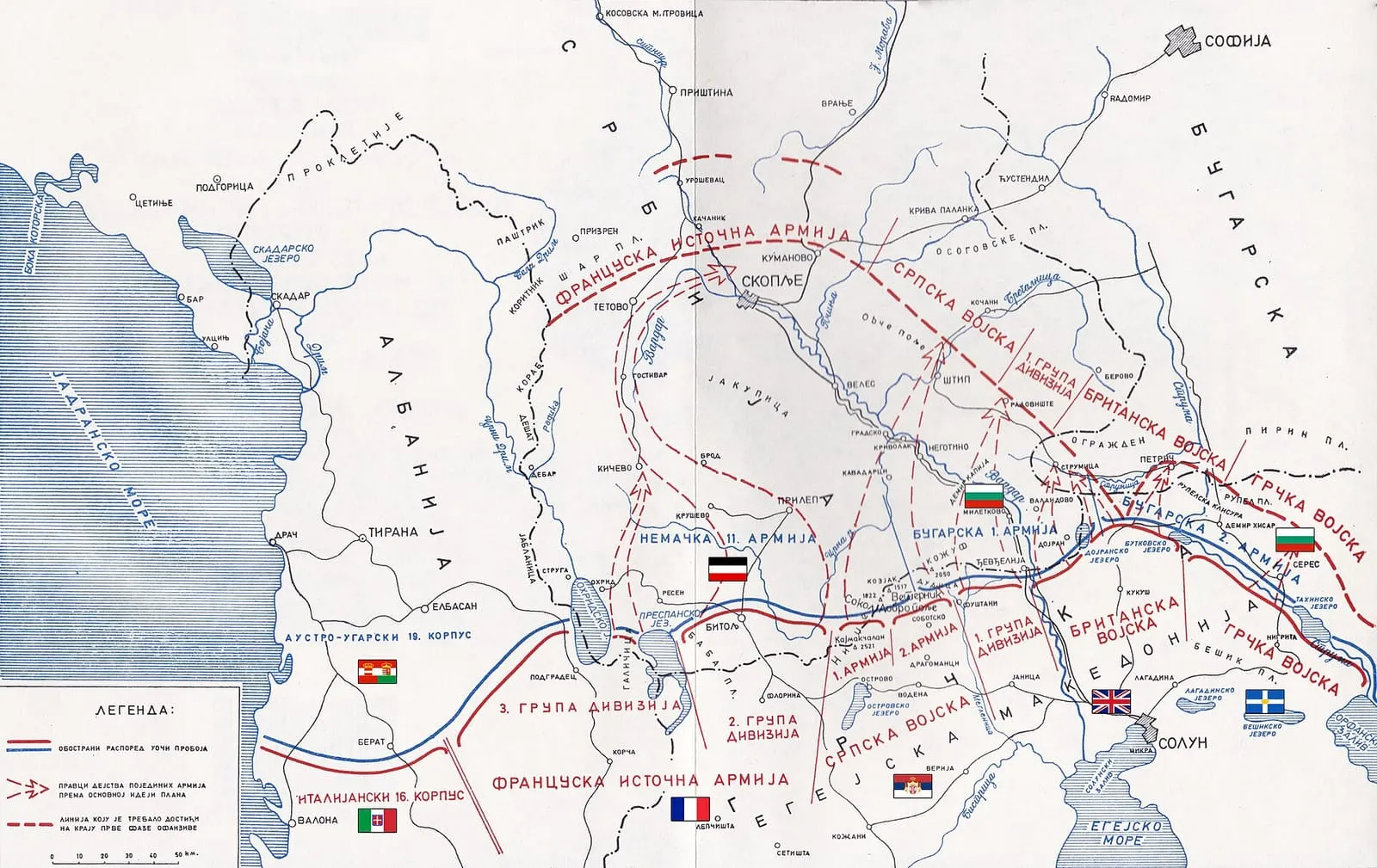
The Vardar offensive was the last, and the only decisive, Allied operation on the Salonika front. For almost three years the Entente troops in Macedonia had barely moved, and in Paris and London many regarded Salonika as an expensive internment camp. In September 1918 General Louis Franchet d’Espèrey struck where nobody expected it: at the highest mountains on the whole front. On 15 September the Serbs and French broke through the Bulgarian positions at Dobro Pole, and the Serbian armies, the French cavalry, the British, the Greeks and the Italians set off in a pursuit which within two weeks cut the Bulgarian front in two. On 29 September French cavalrymen rode into Skopje, and that evening in Salonika Bulgaria signed an armistice. It was the first breach in the bloc of the Central Powers.
Name and dates
The name “Vardar offensive” is the one used in English. The French speak of the offensive or breakthrough in Macedonia, the Serbs of the breakthrough of the Salonika front, and the Bulgarians of the breakthrough at Dobro Pole. Cyril Falls’s British official history calls the whole “the final offensive” and divides it into the battle of the breakthrough at Dobro Pole, the Battle of Doiran, the exploitation and the pursuit. The Vardar offensive should be distinguished from Sarrail’s unsuccessful offensive of May 1917.
This page adopts the dates 15–29 September 1918: from the infantry assault at Dobro Pole to the signing of the armistice late in the evening of 29 September. The artillery preparation began a day earlier, on 14 September, and the armistice came into force at noon on 30 September. Until then some Allied units were still fighting, because many divisions learned of the armistice only on the morning of 30 September. All dates are given in the Gregorian calendar, which Bulgaria had used since 1916. Serbia and Greece still reckoned dates in the Julian calendar at the time.
Background
Bulgaria entered the war in the autumn of 1915 to regain Macedonia, and in the campaign against Serbia it obtained almost all of it. From then on its army held a front about 450 kilometres long, from Albania to the mouth of the Struma. By the summer of 1918 the country was exhausted. Food was short, partly because of bad administration and partly because of German demands. The Bulgarians were embittered that the Germans had not given them the whole of the Dobruja; in June Radoslavov’s government fell, and the new prime minister, the moderate Aleksandar Malinov, was expected to take the country out of the war. The soldiers resented the rule of German commanders and staff officers. The Germans had taken almost all their units from Macedonia to the Western Front, leaving only headquarters, staffs and a few battalions.
On the Allied side General Adolphe Guillaumat had put the command in order, and the Greek victory at Skra di Legen in May 1918 convinced him that an offensive was possible. In June he left for Paris, and his successor, Franchet d’Espèrey, at once adopted the Serbian plan of attacking in the mountains. Meanwhile Guillaumat, as Military Governor of Paris, won over the Allies. The British held out longest, agreeing to the offensive only on 4 September.
Plan and forces
Franchet d’Espèrey based his plan on the enemy’s lines of communication. The most sensitive point of the Bulgarian front was two villages on the Vardar, Gradsko and Krivolak, about 55 kilometres behind the front line. There the railway from Salonika northwards, the narrow-gauge line from the front at Bitola and the roads linking the two wings of the Bulgarian forces all met. Whoever took them would split the enemy in two. The direct route to the Vardar, over the heavily fortified hills at Doiran or across the plain at Bitola, was closed, because there the Bulgarians were strongest and there they expected an attack. That left the mountain ridge above the Moglena (PL) basin, between the peaks of Vetrenik and Sokol, where the Bulgarian fortifications had little depth and the valleys behind them led straight towards the Vardar.
The main blow was entrusted to the Serbian armies, which, under the nominal command of the Regent Alexander, were directed by the chief of staff, Vojvoda Živojin Mišić. The Serbian Second Army, with two French divisions, was to break the front, and the First Army was to widen the breach. Then subsidiary attacks were to start one after another on other sectors: General George Milne’s British with two Greek divisions at Doiran, west of the Vardar General d’Anselme’s Franco-Greek 1st Group of Divisions, and on the left wing General Paul Henrys’s French Army of the Orient towards Prilep.
At the beginning of September the Allies had 28 divisions in Macedonia: eight French, six Serbian, four British, one Italian and nine Greek. According to Falls they numbered about 290 battalions and more than 1,500 guns, while the enemy had about 300 battalions and a similar number of guns. The Bulgarian divisions were much larger than the Allied ones, so in manpower the two sides were roughly equal. The Allies, however, had a clear superiority in aircraft, about 200 against 80, and their soldiers were better fed and clothed. The front was held, from west to east, by the German 11th Army of General Kuno von Steuben, in which, besides staffs and a few German battalions, Bulgarians served; the Bulgarian 1st Army of General Stefan Nerezov on the Vardar and at Doiran; and the 2nd and 4th Armies on the Struma and by the sea. The first two formed the army group of the German General Friedrich von Scholtz. The Bulgarian commander-in-chief, General Nikola Zhekov, who was receiving medical treatment in Vienna, was replaced by General Georgi Todorov.
Course of the offensive
The breakthrough (14–17 September). On 14 September at eight o’clock the artillery opened fire along the whole front from the Vardar to Bitola. It was heaviest on the ridge above the Moglena basin, where heavy guns had been hauled even onto the summit of Floka. On 15 September at 5.30 a.m. the French 17th Colonial Division and 122nd Division and the Serbian Šumadija Division went into the assault. By evening they had taken the peaks of Vetrenik, Dobro Pole and Sokol, capturing almost 3,000 prisoners and 33 guns, and during the night the Serbian Yugoslav and Timok Divisions passed through the breach. On 16 September the Serbs took the second position on the Kozjak massif, and on 17 September, when the commander of the Bulgarian 2nd Division withdrew without orders behind the Crna Reka, the third fell as well. Bulgarian units began to mutiny.
Doiran and the conference at Prilep (18–20 September). On 18 September the British and Greeks, in accordance with the plan, attacked the Bulgarian 1st Army on the hills west of Lake Doiran. The Bulgarians defended themselves superbly there, and the attacks of 18 and 19 September broke down, with Allied losses of more than 7,000 men. They did, however, tie down the enemy’s reserves. That same day, at a conference at the 11th Army’s headquarters in Prilep, Todorov, on Nerezov’s advice, proposed a great counter-offensive towards Salonika. The Germans rejected this plan as too risky, but they did not want a major retreat either, not least because it would mean the loss of Ohrid, a town especially dear to the Bulgarians. It was decided to hold on and patch up the breach. Meanwhile the Serbian First Army was fighting for the crossings of the Crna Reka, Colonel Rondet’s Franco-Greek group had taken the Dzena massif in the Kožuf range by 20 September, and the Yugoslav Division entered Kavadarci on the evening of 20 September. That afternoon Scholtz ordered a general retreat.
On the Vardar (21–24 September). On 21 September the Serbs came down into the Vardar valley, and on the night of 21–22 September the Bulgarian 1st Army abandoned its positions at Doiran, undefeated in the field. The British and Greeks set off in pursuit towards Strumica. In the west the Italians took Hill 1050 in the loop of the Crna Reka, which had been fought over since 1916. Franchet d’Espèrey refused to be drawn into a “sack”: he ordered the breach to be widened to the sides rather than pushing deeper. On 23 September the Serbs crossed the Vardar, and the French cavalry rode into Prilep, abandoned by the enemy. On 24 September, according to Falls, the French and Serbs occupied Gradsko, where they took 19 guns and about 40 locomotives. The aim of the first phase of the offensive had been achieved: the Bulgarian front had been cut in two.
The pursuit (25–29 September). On the night of 24–25 September the Bulgarians abandoned Štip, which the Serbian Cavalry Division entered, and on 26 September the Serbian First Army occupied Veles. Crowds of mutinous soldiers flooded Kyustendil, where the Bulgarian headquarters was, and forced the command to give them trains home. On 26 September the British entered Strumica, on pre-war Bulgarian territory. Meanwhile a race for Skopje was under way. The German LXII Corps of General Fleck, the right wing of the 11th Army, was withdrawing from Bitola and Ohrid through Kičevo and Tetovo, and its only escape route led through Skopje. General François Jouinot-Gambetta’s French brigade of African cavalry, made up of the 1st and 4th Chasseurs d’Afrique and a regiment of Moroccan spahis, instead of waiting for the Serbs to open the road through Veles, crossed the trackless Golešnica range, leading its horses by the bridle. At dawn on 29 September, in fog, it attacked Skopje, routed the larger but weak garrison and took the city. Fleck’s corps was cut off.
The armistice. According to German sources, immediately after the offensive began, the commander of the Bulgarian 2nd Army, General Lukov, asked Tsar Ferdinand to open talks. The Tsar hesitated at first, but in the end agreed to send a delegation. Early on the morning of 26 September Bulgarian envoys carrying a letter from Todorov crossed the British lines, asking for a 48-hour suspension of hostilities. Franchet d’Espèrey replied that he would not halt operations but would receive plenipotentiaries. On 28 September the finance minister Andrey Lyapchev, General Lukov and the diplomat Simeon Radev left for Salonika. At the same time mutinous soldiers proclaimed a republic at Radomir and marched on Sofia; one of their leaders was Rayko Daskalov. Late in the evening of 29 September, already knowing of the fall of Skopje, Franchet d’Espèrey signed with the Bulgarians a convention on the suspension of hostilities, which came into force at noon on 30 September.
Casualties and outcome
There are no complete figures for the losses of both sides in the whole offensive. The bloodiest actions for the Allies were the assault at Dobro Pole and the attack at Doiran. By the time of the armistice the Allies had, according to Falls, taken about 15,000 prisoners. Under the terms of the armistice the soldiers of the 11th Army standing west of the meridian of Skopje were to lay down their arms and go into captivity. When the units of Fleck’s corps capitulated over the following days, the number of prisoners rose to about 77,000, including three generals and 1,500 officers. According to Falls the Allies captured about 400 guns, and according to other tallies up to 500.
Significance
The Vardar offensive knocked out of the war an army of about half a million men and opened the way for the Allies to the Danube and to Constantinople. Bulgaria undertook to demobilise its army, evacuate the occupied Greek and Serbian territories, remove German and Austro-Hungarian troops from its territory and place its railways, roads and ports at the Allies’ disposal. The Ottoman Empire was cut off from Germany, and Austria-Hungary was exposed from the south. In Germany the news of Bulgaria’s request for an armistice arrived just as the great Allied offensive on the Western Front was starting, and it contributed to the Supreme Army Command’s decision that Germany too should seek a suspension of hostilities. On 3 October Tsar Ferdinand abdicated in favour of his son Boris, who during the retreat had gone from regiment to regiment to keep up the army’s spirits.
For the Serbs the offensive was a homecoming after the defeat of 1915. The Serbian army, which three years earlier had fled across the mountains of Albania, reached Belgrade within a few weeks. Franchet d’Espèrey, who had come to Salonika in June almost as if into exile, became one of the architects of the victory, and in 1921 he received the baton of a Marshal of France.
Spotted a mistake?Report an error
Battles and phases
(02)- 15–17 September 1918Battle of Dobro PoleOn 15–17 September 1918 the Serbs and French stormed the Dobro Pole–Sokol–Vetrenik mountain ridge and broke the Bulgarian front in Macedonia.
- 18–19 September 1918Battle of Doiran (1918)On 18–19 September 1918 the British and Greeks stormed Bulgarian defences by Lake Doiran. They lost over 7,000 men but pinned down the Bulgarian forces.