France · The Entente
Adolphe Guillaumat
Commander of the Second Army (1916–1917), Commander-in-Chief of the Allied Armies in Macedonia (1917–1918), Military Governor of Paris (1918)
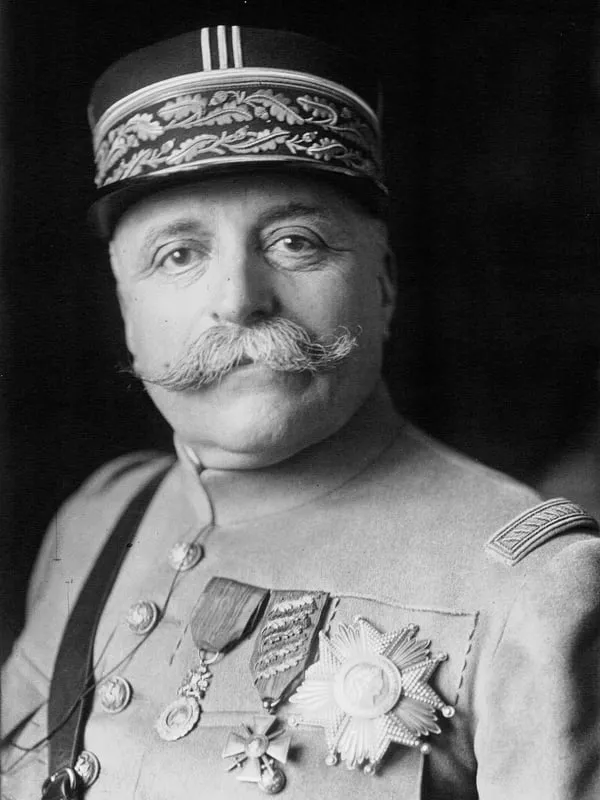
- Born:
- 4 January 1863, Bourgneuf (France)
- Died:
- 18 May 1940, Nantes
- Author:
- Natalia
- Photo:
- Agence de presse Meurisse, domena publiczna, Wikimedia Commons

General Marie Louis Adolphe Guillaumat was one of those French commanders who are seldom remembered, although at key moments of the war they were entrusted with the hardest tasks. In the space of three years he rose from divisional commander to army commander. In August 1917 his Second Army carried out at Verdun one of the first successful offensives after the mutinies in the French army. He then spent half a year commanding the Allied armies in Macedonia, where he put a quarrelsome command in order and began to prepare the offensive that in the autumn of 1918 knocked Bulgaria out of the war. The fruits of this work, however, were reaped by his successor, because in June 1918, when the Germans stood on the Marne, Clemenceau summoned him to defend Paris.
Before the war
He was born on 4 January 1863 at Bourgneuf in the department of Charente-Maritime, the son of an infantry captain. He went to the lycée in Nantes, a year below Aristide Briand, with whom he would sit in the same government years later. In 1884 he graduated from the military academy at Saint-Cyr top of his year. Like many officers of his generation, he spent part of his career in the colonies: he did topographical surveys in Algeria and Tunisia, served in the Foreign Legion and headed intelligence in Tonkin. During the Boxer Rebellion in 1900 he commanded the defence of the French concession in Tientsin and was wounded in the elbow by a shell fragment.
After returning to France he taught military history at Saint-Cyr, and in 1907 he took over the chair of infantry tactics at the École Supérieure de Guerre from Lieutenant-Colonel Philippe Pétain. When Pétain returned to the post a year later, Guillaumat had to give it up and took over the cadet school at La Flèche. From 1910 he commanded the 5th Infantry Regiment in Paris, and in 1913 he became director of infantry at the War Ministry and a brigadier-general. In July 1914 he had for a few weeks been head of the military cabinet of the War Minister, Adolphe Messimy.
1914–1916: from division to corps
When Messimy lost his portfolio at the end of August 1914, Guillaumat asked for a posting to the army and on 30 August took over the 33rd Infantry Division. He led it in the Battle of the Marne in the Vitry-le-François area, and then in the trenches of Champagne. In December he was given the 4th Division, and on 25 February 1915 I Corps, with which he fought in the final phase of the First Battle of Champagne and in April in the unsuccessful attack on the Woëvre plain. The corps, several times enlarged into a group bearing his name, then held the front on the Aisne.
When in February 1916 the Germans struck at Verdun, I Corps was moved to the Meuse. From 27 February to 8 April it defended itself in heavy fighting between the river and Douaumont. In the summer it was transferred to the Somme, where it fought in the Sixth Army north of the river, right next to the British. It took Maurepas, and on 26 September Combles, which the French and British captured together. On 7 October his corps advanced about 1,200 metres west of Sailly-Saillisel, which was the best advance of the day in the Battle of the Transloy Ridges, although Rocquigny remained far away.
1917: Verdun
In December 1916 General Robert Nivelle became Commander-in-Chief, and Guillaumat succeeded him at the head of the Second Army at Verdun. Through the first half of 1917 he held a front on which the Germans kept renewing local attacks, especially on the left bank of the Meuse.
When Pétain became Commander-in-Chief, he wanted to restore the soldiers’ faith in themselves with limited attacks, prepared so as to gain ground at small cost. One of two such blows was the Second Offensive Battle of Verdun. At dawn on 20 August 1917, after more than a week’s bombardment from nearly three thousand guns, eight divisions of the Second Army attacked on both banks of the Meuse. The attack was supervised by the army group commander, General Émile Fayolle. Within a few days the French took back from the Germans the Mort-Homme, Hill 304 and the Côte de Talou, into which thousands of soldiers had been swallowed throughout 1916. Guillaumat and the commander of XXXII Corps, General Passaga, wanted to go further and take from the Germans the last places from which they could see Verdun, but Pétain and Fayolle judged that another battle of attrition would not be worth it.
Salonika
In December 1917 the new Prime Minister, Georges Clemenceau, recalled General Maurice Sarrail from command of the Allied armies in Macedonia. Sarrail was at odds with the Allies, and his political ties with the left aroused the new Prime Minister’s distrust. In his place Clemenceau chose Guillaumat, a highly regarded 54-year-old general with no political backing. Guillaumat arrived in Salonika and took command on 22 December. He brought instructions signed by General Ferdinand Foch: the Allied armies were above all to keep the enemy out of Greece and hold the front from the Aegean Sea to the Albanian lakes.
At Salonika stood the troops of six nations: French, British, Serbs, Italians, Greeks and the remnants of the Russians, and their commanders had long distrusted one another. Guillaumat, calm and tactful, improved relations with the British and with the Greek government of Eleftherios Venizelos. Not everything went smoothly. According to Serbian biographers, the chief of staff of the Serbian army, Vojvoda Petar Bojović, quarrelled with him over whether the Serbs should take over a longer stretch of the front, and resigned. In the spring of 1918, in agreement with the Italians, the French carried out two successful operations in the mountains between Lake Ohrid and the Devoll river, which removed an Austrian salient and secured the supply route of the left wing of the front (see the offensive in Albania).
The turning point was the test Guillaumat set the Greeks. The British, and even the Greeks themselves, doubted the worth of the new Greek army, and the general believed it had to be tested in battle. For the attack on the strongly fortified Bulgarian salient of Skra di Legen he chose the divisions of the National Defence Corps, trained by French officers. On 30 May 1918 the Greeks stormed the position and beat off the counter-attacks. According to Guillaumat’s report 1,812 men were taken prisoner, and according to some French historians, counting the wounded, about 2,500. The British official historian Cyril Falls called the plan as bold as it was well thought out. The Battle of Skra di Legen convinced Guillaumat that the Bulgarians, weakened by the departure of the Germans and increasingly demoralised, would not withstand a great offensive, and he began to prepare one.
He ran out of time. On 27 May the Germans broke through the front on the Aisne and within a few days reached the Marne. Clemenceau wanted a general in the capital who would inspire confidence and, according to Falls, also one whose attachment to the Republic was beyond doubt. On 9 June Guillaumat left for France in haste and secrecy, and command at Salonika passed to General Louis Franchet d’Espérey, who by the end of June had already adopted the Serbian plan of striking in the highest mountains of the front.
1918: Paris and the Ardennes
On 17 June 1918 Guillaumat succeeded General Auguste Dubail as Military Governor of Paris. According to the memoirs of General Maxime Weygand’s son, Clemenceau even considered giving him command of the French army in place of Pétain, but Foch and the Allies talked him out of it. This version, however, is not confirmed by other sources.
Guillaumat also played an important role from a distance. In the summer Franchet d’Espérey needed the Allies’ consent to an offensive in Macedonia, and the British and Italians preferred not to take the risk. Their consent was won by Guillaumat, who knew the front and the men. The British official historian Cyril Falls went so far as to call him the chief hero of this story, although the general formally no longer had anything to do with Macedonia. On 4 September, at a meeting in Downing Street, questioned by the Prime Minister, David Lloyd George, he set out his case so clearly that the Prime Minister declared that he had convinced him, and the British, who had held out the longest, gave their consent. Guillaumat then went to Rome, where he won over the Italians. Interestingly, he himself expected rather a limited offensive, and foresaw a march on Sofia in five or six months. Less than two weeks later the Vardar offensive began, which within two weeks forced Bulgaria to sign an armistice.
After the victorious Second Battle of the Marne Guillaumat returned to the front. On 7 October he took over the Fifth Army, which in pursuit of the retreating Germans crossed the river Suippe, returned the ruins of Craonne to France, and in November entered Rethel and reached the Ardennes. For Macedonia he received the Médaille militaire in October, which was awarded to generals only for command-in-chief in the face of the enemy, with a citation saying that he had “conceived and prepared” the plan of the offensive that forced the Bulgarians to ask for an armistice.
After the war
After the war he was an inspector-general of the army and a member of the Supreme War Council, and from 1924 he commanded the French army of occupation in the Rhineland and all the Allied troops in the area. In June and July 1926 he was for four weeks War Minister in Briand’s short-lived government. He chaired the commissions that prepared the system of fortifications on the eastern frontier. According to French biographers, he was critical of the idea of a continuous line of forts and preferred a defence in depth that would not tie down the army. In 1927 he warned in a secret report that Germany was using the mild occupation to make military preparations. On 30 June 1930 in Mainz, with the French flag in his hand, he brought the occupation of the Rhineland to an end. He died in Nantes on 18 May 1940, in the days of the German offensive that shattered the French army. His ashes rest at Les Invalides in Paris.
Assessment
Historians agree in seeing Guillaumat as one of the ablest French generals of the second rank, a methodical commander who prepared his attacks carefully and spared his soldiers. The attack at Verdun in August 1917 is regarded as a model of the limited operation with artillery superiority that Pétain wanted to conduct after the mutinies. At Salonika he found an army divided and distrustful of the French command, and left an army that believed it could win.
The dispute concerns the division of credit for the victory in Macedonia. The French government, in its official citation, credited Guillaumat with conceiving the plan of the offensive. Many historians point out, however, that the plan of striking in the mountains was largely a Serbian work, that Guillaumat began the preparations but did not settle the direction, and that Franchet d’Espérey had the courage to adopt the plan and carry it through consistently. Franchet d’Espérey was made a Marshal of France for it, while Guillaumat, though no less deserving, did not receive the baton. His biographer Léon Noël explained this by the fact that President Raymond Poincaré was opposed to appointing marshals in peacetime.
Sources
Spotted a mistake?Report an error
Commanded in battles
(03)Mentioned in battles
(03)Often appears with
People who appear in the same events.