1918: The Allied counter-offensive
Second Battle of the Marne
- Dates:
- 15 July – 6 August 1918
- Front:
- Western Front
- Location:
- The German salient between the Aisne and the Marne, from Soissons and the forests of Villers-Cotterêts to Château-Thierry, Dormans and Reims, and Champagne east of Reims as far as Massiges (Aisne and Marne departments, France)On the battle map →
- Sides:
- France, United States, United Kingdom and ItalyFerdinand Foch, Philippe Pétain, Émile Fayolle, Paul Maistre, Henri Gouraud, Henri Berthelot, Charles Mangin, Jean Degoutte, Antoine de MitryGerman EmpireErich Ludendorff, Crown Prince Wilhelm, Max von Boehn, Bruno von Mudra, Karl von Einem, Johannes von Eben
- Result:
- Decisive Allied victory. The German attack on both sides of Reims collapsed within three days, and the counter-offensive launched on 18 July forced the Germans to abandon the whole Marne salient and retreat behind the Vesle. The Allies took nearly 30,000 prisoners and almost 800 guns. The initiative on the Western Front passed to them until the end of the war.
- Author:
- Natalia
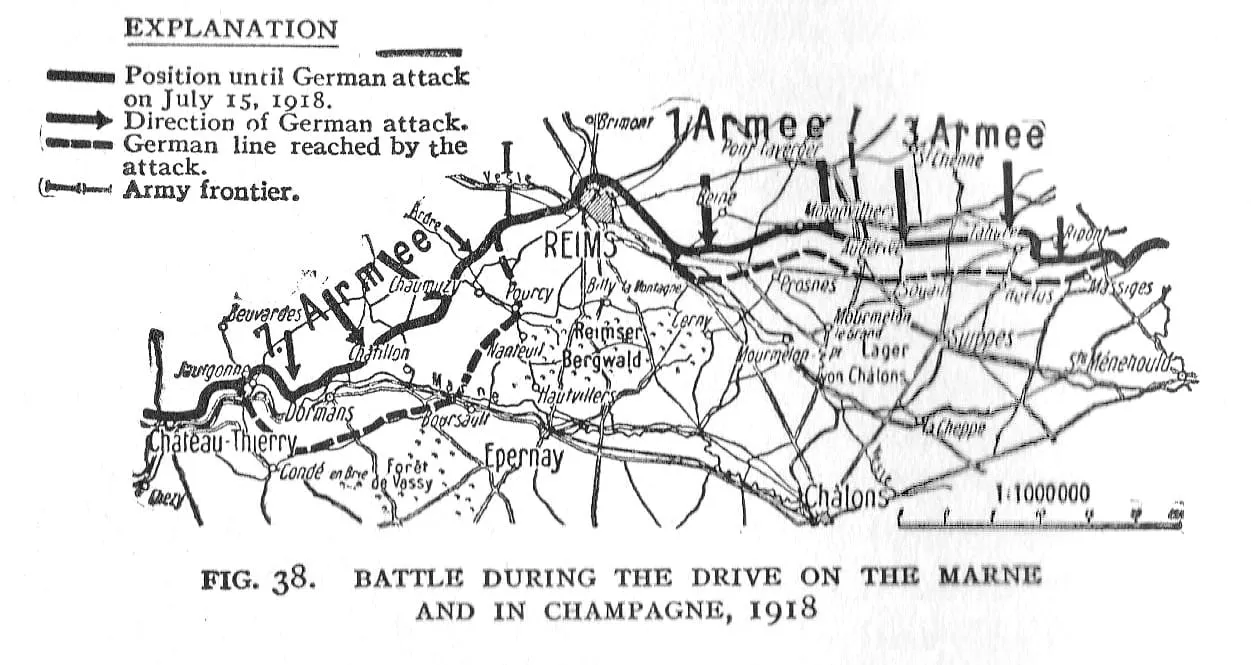
The Second Battle of the Marne began as the fifth and last great German offensive of 1918 and ended as the first great Allied victory, the one that began the turn of the war in the west. On 15 July 1918 three German armies attacked on both sides of Reims. East of the city, in Champagne, the attack broke against the elastic defence of General Henri Gouraud’s French 4th Army. West of Reims the German 7th Army crossed the Marne on both sides of Dormans, but stalled after a few kilometres. On 18 July General Ferdinand Foch launched a counter-offensive, prepared for weeks, against the western flank of the German salient, which stretched from Soissons to Château-Thierry and Reims. General Charles Mangin’s French 10th Army and General Jean Degoutte’s 6th Army, with American divisions and hundreds of tanks, took the Germans by surprise and threatened their only main supply line through Soissons. Over the next two weeks the Germans, defending themselves fiercely on the flanks, withdrew from the whole salient. On 2 August they gave up Soissons, and on 3 August they stood behind the river Vesle, from where they had begun their march to the Marne on 27 May.
Name and dates
The name refers to the First Battle of the Marne of September 1914, when the French and British stopped the Germans on their way to Paris. The dates 15 July – 6 August 1918 are used by most studies, although the detailed subdivisions vary. The Germans prepared the attack under the codenames “Marneschutz-Reims” (the 7th Army’s attack across the Marne and the attacks of the 1st and 3rd Armies east of Reims). It is also known as the “peace offensive” (Friedensturm): according to prisoners’ testimony, this was what the army called it, announcing that it would bring a victorious peace. The French call the fighting east of Reims on 15–18 July the Fourth Battle of Champagne, and the fighting west of the city the Battle of the Montagne de Reims. According to the British official history, the French divided the counter-offensive into the Battle of the Soissonnais and of the Ourcq (18–28 July) and the Battle of the Tardenois (29 July – 6 August). The British Battles Nomenclature Committee adopted these names but applied them to the fighting of four British divisions and gave them its own dates: 20–31 July for the Tardenois and 23 July – 2 August for the Soissonnais and Ourcq. The Americans count separately the Champagne-Marne operation (15–18 July) and the Aisne-Marne operation (18 July – 6 August). Facts, figures and times are given after the British official history (James Edmonds, Military Operations France and Belgium 1918, vol. III, 1939), which summarises at length the French official history and the German monograph on the battle, after the guide published in 1938 by the American Battle Monuments Commission (American Armies and Battlefields in Europe), and after the memoirs of Erich Ludendorff. Times are Allied time, one hour earlier than German time.
Background
After the Third Battle of the Aisne the Germans stood on the Marne in a deep, narrow salient, supplied by a single main railway line running through Soissons. In June the attack on the Matz failed to widen it to the west, and the Americans at Belleau Wood and at Vaux closed the road to Paris. General Erich Ludendorff still believed that the war would be decided by a blow against the British in Flanders, being prepared under the codename “Hagen”. First, however, he wanted to draw the French reserves south once more. The army group of Crown Prince Wilhelm was to attack on both sides of Reims, leaving the city itself aside. General Max von Boehn’s 7th Army was to cross the Marne east of Château-Thierry and advance along both banks of the river towards Épernay, while General Bruno von Mudra’s 1st Army and General Karl von Einem’s 3rd Army were to attack east of Reims, towards Châlons. If the two groups met at Épernay, Reims and the wooded Montagne de Reims would be cut off. The artillery was again prepared by Colonel Georg Bruchmüller. The attack was planned for 12 July but postponed to 15 July. In the west of the salient, where Ludendorff expected a counter-attack towards Soissons, a new 9th Army under General Johannes von Eben was formed on 5 July.
This time the French knew almost everything. From the end of June prisoners spoke of preparations for crossing the Marne and of an attack on both sides of Reims, airmen saw all the usual signs of an offensive, and the name “Friedensturm” circulated in Germany so freely that Ludendorff later complained of his countrymen’s talkativeness. From 4 July General Philippe Pétain moved reserves to Champagne, and behind the junction of the 5th and 6th Armies at Dormans he placed General Antoine de Mitry’s new 9th Army. On 10 or 11 July he convinced Foch, Allied commander-in-chief since April, that a blow of great strength was coming. Foch demanded reinforcements from the British, and despite the resistance of Field Marshal Douglas Haig, who feared an attack in Flanders, General Alexander Godley’s British XXII Corps with four divisions set off for the Marne. At the same time Pétain and Foch were preparing a counter-offensive on the western flank of the salient. On 12 July Pétain defined its aim: to cut off the salient with attacks from both sides towards Fère-en-Tardenois, or at least to deny the Germans free use of the junction at Soissons. The main role was to be played by Mangin’s 10th Army, hidden in the great forests around Villers-Cotterêts.
On paper the advantage lay with the Germans. According to the British official history, on the front of attack the Germans had 1,047 field batteries and 609 heavy batteries against 360 field and 381 heavy on the French side, and 22 divisions attacked east of Reims and 19 west of it. Most of them had been through the earlier offensives of that year, and the battalions were weakened by losses and influenza. On the Allied side fought French divisions, the American 42nd (Rainbow) Division in Gouraud’s army, the American 3rd Infantry Division on the Marne at Château-Thierry, and General Alberico Albricci’s Italian II Corps in General Henri Berthelot’s 5th Army, west of Reims.
Course of the battle
15 July. On 14 July Gouraud’s men captured 27 prisoners in a deep raid and learned from them that the German artillery preparation would begin ten minutes after midnight. The French artillery opened counter-preparation fire between 11 p.m. and midnight, about half an hour before the Germans, and hit the infantry massed for the attack. The German bombardment lasted 3 hours 40 minutes. East of Reims it fell mainly on an almost empty first position, because Gouraud had left only a handful of volunteers in it and based his main defence on the intermediate position, 2–3 kilometres further back. The German infantry that reached it was stopped by the fire of French artillery and machine guns, with the help of units of the American 42nd Division. West of Reims, where the defence was less well prepared and a large part of the troops stood in the front line, the Germans, after destroying the outposts, crossed the Marne under cover of smoke and within a few hours won a bridgehead on both sides of Dormans about 5 kilometres deep and 11–14 kilometres wide. Between the Marne and Reims they pushed the French and Italians back to the second position. The only sector where they gained nothing was held by the Americans of the 3rd Division at Mézy-Moulins, who counter-attacked and drove the Germans who had crossed back into the river. In the morning Pétain ordered the preparations for the counter-offensive to be halted, but Foch countermanded the order.
16–17 July. At noon on 16 July the German Supreme Army Command broke off the attack of the 1st and 3rd Armies. On the Marne the fighting went on: the Germans advanced a little further towards Épernay and took part of the French second position, but French counter-attacks with the American 28th Division retook the intermediate position on the western edge of the bridgehead, and the 3rd Division cleared its sector of the last Germans. French and British aircraft and artillery destroyed the bridges on the Marne, and the losses of the German engineers and of the troops crossing the river grew by the hour. On the evening of 17 July Boehn halted the 7th Army’s attack, and during the night the Supreme Army Command agreed to a gradual withdrawal of the troops from the bridgehead. Ludendorff still hoped to encircle Reims from the west, and went to Mons to settle the final details of the “Hagen” offensive.
18 July. At 4.35 a.m., without any preliminary bombardment, the French counter-offensive began. Mangin’s 10th Army had 16 divisions, including the American 1st Infantry Division and 2nd Infantry Division, which together with the French 1st Moroccan Division formed the spearhead of the attack, and Degoutte’s 6th Army had eight divisions, including the American 4th and 26th Divisions. The two armies together had almost 500 tanks, heavy Schneiders and Saint-Chamonds and light Renault FTs. The surprise was complete. By evening the Allies had advanced on average about 6–7 kilometres, and the road and railway from Soissons to Château-Thierry came under the fire of their guns. Before noon the Crown Prince ordered the bridgehead on the Marne to be abandoned.
19–21 July. On 19 July, now without surprise, the French and Americans advanced another 3–5 kilometres, fighting German machine-gun nests hidden in the tall corn. At Soissons the Germans threw fresh divisions into the fight and held the heights south of the city. During the night of 19–20 July they withdrew behind the Marne, and on 20 July the French 5th Army joined the attack on the eastern flank with the British 51st and 62nd Divisions, which began heavy fighting in the woods of the Ardre valley. By then Mangin had more than 15,000 prisoners and 400 guns. That same day Ludendorff concluded that the “Hagen” offensive would most likely never take place. During the night of 20–21 July the Germans pulled back their centre by a few kilometres, and on 21 July the French entered Château-Thierry, while the American 3rd Division crossed the Marne at Mont-Saint-Père. On the flanks of the salient, however, there was no progress: at Soissons the French tanks were shattered by German artillery brought up for the purpose, and near Reims the Germans held on to the heights above the Ardre.
22–31 July. The exhausted divisions of the first attack were replaced by fresh ones. From 23 July the British 15th (Scottish) and 34th Divisions fought in Mangin’s army. The Germans fell back in stages, from one prepared line to the next, saving as many supplies as they could, and defended each of these lines until Allied pressure forced them to retreat further. On 25 July they gave up Oulchy-le-Château, and the Americans of the 3rd Division took Le Charmel. On 27 July it turned out that the Germans had withdrawn along the whole front from Vrigny near Reims to the Chalmont hill above Oulchy. On 28 July the Allies took Fère-en-Tardenois, the American 42nd Division crossed the river Ourcq, the Scottish 15th Division stormed Buzancy, and the British in the Ardre valley took the hill above Bligny. The fighting north of the Ourcq, for Sergy and Seringes, was particularly fierce; some points changed hands several times.
1–6 August. On 1 August the French and British attacked on the western flank at Grand-Rozoy and Beugneux. During the night of 1–2 August the Germans began their retreat behind the Vesle and the Aisne, leaving only rearguards with machine guns. On the afternoon of 2 August they abandoned Soissons and blew up the bridges, and soon afterwards the French entered the city. On 3 August the Allies reached the Vesle and the Aisne along almost the whole front, and on 4 August the American 32nd Division took Fismes. Behind the rivers, however, the Germans dug in on a well-prepared position. On the evening of 6 August Pétain forbade any further attempts to take it, and the battle was over. That same day Foch was appointed Marshal of France (he was presented with his baton on 23 August).
Losses
According to the French official history, quoted by the British one, from 15 July to 5 August the French armies and the Allied divisions fighting with them took prisoner 659 officers and 28,708 other ranks and captured 793 guns and 3,723 machine guns. The French lost 2,539 officers and 92,626 other ranks, about 95,000 men in all. The Italian II Corps lost, up to its relief around 20 July, more than 9,300 of about 24,000 men, almost 4,000 of whom were taken prisoner. The four British divisions lost, according to frequently cited figures, about 16,000–17,000 men. The losses of the American divisions, which the American Battle Monuments Commission gives for each division separately, ran to several tens of thousands in July and early August; the 1st Division alone lost about 6,900 men, and the 3rd Division, including the defensive fighting on the Marne, almost 6,600. German losses are not known exactly. French intelligence estimated them on the Marne front in July at 168,000 men, and the British official history considers that they were probably even higher. For lack of replacements the Germans had to disband ten divisions.
Significance
The Second Battle of the Marne was Ludendorff’s last attempt to decide the war before the Americans arrived, and the attempt ended in defeat. The attack of 15 July showed that the German method of breaking through the front no longer came as a surprise: the French knew the day and hour of the attack, and Gouraud’s defence in depth brought the Germans nothing but losses. The counter-offensive of 18 July showed in turn how to fight from then on: surprise instead of a bombardment lasting several days, a creeping barrage, masses of tanks, air superiority, and fresh, numerous American divisions, whose soldiers won the respect of the French at Château-Thierry and Soissons. Ludendorff had to give up the offensive in Flanders and go over to the defensive. He himself admitted in his memoirs that the attempt to force the Entente to make peace through victories before the Americans arrived had failed, and that Germany’s situation had become very serious.
The battle wiped out all the gains of the May offensive on the Aisne, shortened the Allied front and freed Paris and the railway line from Paris to Châlons and Nancy from threat. As the British official history notes, prisoners taken after 15 July no longer believed in the promised victorious peace, and at the sight of the Americans some admitted that victory was no longer possible. Foch gave the Germans no rest. Two days after the end of the battle, on 8 August, the British and French attacked at Amiens, beginning the Hundred Days Offensive, which ended with the armistice.
Spotted a mistake?Report an error
Battles and phases
(02)- 20–31 July 1918Battle of the TardenoisFrom 20 to 31 July 1918 the British 51st and 62nd Divisions fought in the Ardre valley on the east flank of the Marne salient, taking Marfaux and Bligny hill.
- 23 July – 2 August 1918Battle of the Soissonnais and of the Ourcq23 July – 2 August 1918 the British 15th and 34th Divisions fought in Mangin's army south of Soissons until the Germans fell back behind the Vesle.