1918: The Allied counter-offensive
Battle of the Soissonnais and of the Ourcq
- Dates:
- 23 July – 2 August 1918
- Front:
- Western Front
- Location:
- The western flank of the German Marne salient, the plateaux south of Soissons between the Crise valley and the upper Ourcq, around Buzancy, Villemontoire, Tigny, Hartennes-et-Taux, Grand-Rozoy and Beugneux, Aisne department (France)On the battle map →
- Sides:
- France, United Kingdom and United StatesFerdinand Foch, Philippe Pétain, Émile Fayolle, Charles Mangin, Jean Degoutte, Hamilton Reed, Lothian NicholsonGerman EmpireErich Ludendorff, Crown Prince Wilhelm, Max von Boehn, Johannes von Eben
- Result:
- Allied victory, won slowly and at heavy cost. French attacks on the western flank of the salient long failed to break the German defence, but steady pressure forced the Germans to retreat. On the night of 1–2 August they fell back behind the Vesle and the Aisne, and on 2 August gave up Soissons. The two British divisions lost about 6,500 men between them.
- Author:
- Natalia
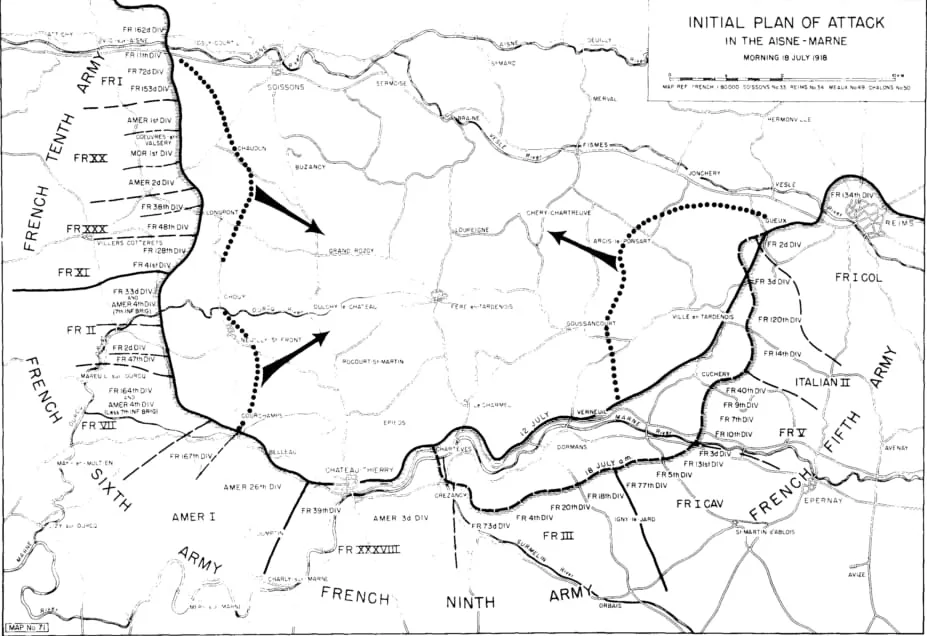
The Battle of the Soissonnais and of the Ourcq is the name under which British historiography knows the part played by two British divisions, the 15th (Scottish) and the 34th, in the second phase of the counter-offensive on the Marne in the summer of 1918. On 18 July General Charles Mangin struck from the Forest of Villers-Cotterêts at the western flank of the deep salient the Germans had driven in May between Soissons and Reims. The first impetus was soon spent, and the Germans reinforced the flanks of the salient with fresh divisions and artillery. Mangin therefore brought new forces into his Tenth Army, among them two British divisions, which on 23 July, straight off the march, relieved the exhausted American 1st Division and French 38th Division and went into the attack at once. For the next ten days they fought on the plateaux south of Soissons, in country cut by ravines, woods and fields of uncut corn, without trenches and with maps on a scale of 1:80,000. There were no great gains of ground. On 28 July the Scots briefly took the village of Buzancy, and on 1 August the 34th Division took the heights near Beugneux. Yet the steady pressure of the French, British and Americans all round the salient made the Germans begin a great retreat behind the Vesle and the Aisne on the night of 1–2 August, and on the afternoon of 2 August they left Soissons.
Name and dates
The name comes from the French official history, which divided the Second Battle of the Marne after 18 July into the Battle of the Soissonnais and of the Ourcq (bataille du Soissonnais et de l’Ourcq, 18–28 July according to the British official history) and the Battle of the Tardenois (29 July – 6 August). The Soissonnais is the region around Soissons, and the Ourcq is the river flowing through the middle of the German salient. The British Battles Nomenclature Committee adopted the French names but applied them to the sectors where British troops fought and gave them dates of its own. It called the fighting of the 15th and 34th Divisions in Mangin’s army from 23 July to 2 August 1918 the Battle of the Soissonnais and of the Ourcq, and the fighting of the 51st and 62nd Divisions on the eastern flank of the salient, near Reims, from 20 to 31 July the Battle of Tardenois. It counted both among the “Battles of the Marne 1918”, that is, the Second Battle of the Marne. The British chronology of the 1920s gives the same dates. English-language literature also uses the general name “Battle of Soissons”, and the Americans count the fighting of this period as part of the Aisne-Marne operation (18 July – 6 August). The course of events, times and figures are given after the British official history (James Edmonds, Military Operations France and Belgium 1918, volume III, 1939), which summarises the French official history and the German monograph on the battle at length, and after the history of the 15th Division (The Fifteenth (Scottish) Division 1914–1919, 1926).
Background
When Mangin’s counter-offensive began on 18 July, the British divisions were already on their way south. At the beginning of July General Ferdinand Foch, the Allied commander-in-chief, expecting a great German attack in Champagne, had asked Douglas Haig for four British divisions, the 15th, 34th, 51st and 62nd, under General Alexander Godley’s XXII Corps. On 13 July Haig agreed to place them entirely at Foch’s disposal. The 51st and 62nd Divisions went near Reims, to the French Fifth Army, and the 15th and 34th Divisions into reserve, from which after 18 July they were sent to Mangin’s Tenth Army. The 15th Division, made up of volunteers of Kitchener’s Army, had fought on the Western Front since the Battle of Loos in September 1915. The 34th Division was in effect new: in April, after heavy losses on the Lys, its infantry had been broken up, and in June it was re-formed from battalions brought from Palestine, Egypt and India that had not yet fought in France. One of them, the 2nd Battalion of the Loyal North Lancashire Regiment, was going in July into its first great battle since the fighting at Tanga in East Africa in November 1914.
After the success of 18 July the Tenth Army’s attack slowed with every day. The Germans, who had on this flank General Johannes von Eben’s Ninth Army and the right wing of General Max von Boehn’s Seventh Army, brought up fresh divisions and batteries that destroyed French tanks. On 21 July their 5th Division, rested after the battle on the Aisne, repulsed another French attack. At the same time the Germans’ position in the salient as a whole grew ever more difficult. The railway junction at Soissons was under heavy fire and had stopped working, and the Seventh Army was now supplied only by lorries that were short of petrol. On the night of 19–20 July the Germans withdrew behind the Marne, and on 22 July Erich Ludendorff, though reluctantly, ordered a retreat behind the upper Ourcq to be prepared. For the Germans it was vital that the flanks of the salient at Soissons and at Reims should hold until men, guns and stores had been evacuated from inside it.
Course of the battle
23 July. Mangin, without waiting for full preparation, threw both British divisions into the attack the day after they arrived. Major-General Hamilton Reed’s 15th Division received its orders at 9.20 p.m. on 22 July. During the night it relieved the American 1st Division in General Pierre Berdoulat’s XX Corps, opposite the village of Buzancy, and completed the relief at 3 a.m., two hours before the attack. Its artillery had not had time to get into position, so the attack was supported by the American guns, which stayed in place for another day. The line taken over from the French and Americans did not match the map, so the barrage fell several hundred metres behind the German machine-gun nests. The Scots advanced only about 150 metres, and the 6th Battalion of the Cameron Highlanders took a sugar factory in the Crise valley, which had to be abandoned in the evening. Major-General Lothian Nicholson’s 34th Division, which had relieved the French 38th Division opposite Hartennes, advanced after 7.40. Its 102nd Brigade went about a kilometre through the cornfields towards Reugny Wood, but the 101st Brigade, whose orders reached it late, lost the cover of the barrage and was driven back. According to the French official history, the Tenth Army’s attacks that day, despite the participation of about a hundred tanks, achieved little.
24–27 July. After the failed attack Mangin ordered his corps to consolidate the positions won, and only XX Corps to go on attacking. On 25 July the French took Villemontoire, and to the south, in General Jean Degoutte’s Sixth Army, they advanced slowly behind the withdrawing Germans. The Germans fell back in stages from the southern part of the salient, their retreats covered by machine-gun nests and night air raids on Allied bivouacs. On 23 July Foch handed Pétain a letter demanding that at least one flank of the salient be broken, and Philippe Pétain turned the main effort of the Tenth Army and the left wing of the Sixth Army south-east, towards Fère-en-Tardenois. On the night of 26–27 July the Germans, taking advantage of the rain, gave up unnoticed the whole belt between the Marne and the Ourcq, and the French realised it only the next day. At the end of the month the French and Americans of the Sixth Army occupied Fère-en-Tardenois and crossed the Ourcq.
28 July: Buzancy. On 28 July the French XI Corps took the Butte de Chalmont above Oulchy-le-Château, and Brigadier-General N. A. Thomson’s Scottish 44th Brigade attacked Buzancy, a village with a château and park on the slope of the plateau that dominated the Allied lines. The attack went in at 12.30 p.m., when the Germans would least expect it, after careful preparation, with a smoke screen and French flamethrowers. The 8th Seaforth Highlanders and the 1/5th Gordon Highlanders took the château at once and cleared the village house by house and cellar by cellar, capturing two officers and a hundred men in one of them. By 1.30 p.m. the objective had been reached. The companies of the French 91st Regiment attacking on the Scots’ right, however, could not get forward, and the Scots’ exposed right flank became the target of a counter-attack by reserves of the German 5th Division and 50th Reserve Division. After 4.30 p.m. the Scots were driven out of the village and the château, fought their way with grenades through German machine-gun nests in their rear and at about 6 p.m. returned to their start positions, bringing in more than 200 prisoners. The division regarded this day as the hardest of all its fighting since 1915.
29 July – 1 August: Grand-Rozoy and Beugneux. The 34th Division was moved to the right flank of XXX Corps, level with Grand-Rozoy. At 4.10 a.m. on 29 July, in fog, its 101st and 103rd Brigades advanced more than a kilometre and a half, but the French divisions on either side failed to keep up or were thrown back from Grand-Rozoy by a German counter-attack, and the British had to fall back to roughly the middle of the ground they had won. That day Pétain concluded that the German “pillars of resistance” on the plateaux near Soissons and on the Ardre could not be broken, and ordered only that the Germans be pushed back behind the Vesle by successive attacks, sparing the infantry. At 4.49 a.m. on 1 August the 34th Division renewed the attack. The 5th King’s Own Scottish Borderers and the 5th Argyll and Sutherland Highlanders surrounded the village of Beugneux and Hill 158 south of it, and the 101st Brigade advanced north-east of Grand-Rozoy. In the evening the division also took a hill commanding the German line of retreat. The same day the 15th Division, which had changed sectors with the French 87th Division, attacked in vain the hills known as the Three Mamelons on the edge of Hartennes Wood, between Tigny and Villemontoire.
2 August. At 11 p.m. on 1 August the German infantry began to withdraw behind the Vesle and the Aisne, leaving only weak rearguards. At 2 p.m. on 2 August the Germans left Soissons, and half an hour later they blew up the bridges over the Aisne. The French had been following them since the morning. The Scots of the 15th Division crossed the hills they had been fighting over for a week and in the evening entered the village of Villeblain on the Crise, and during the night they were relieved by the French 17th Division. The same day the French I Corps of Mangin’s army entered ruined Soissons, taken by the Germans on 29 May. On 3 August the Allies almost reached the Vesle and the Aisne between Fismes and Soissons.
Losses
According to the British official history, from 21 July to 3 August the 15th Division lost 165 officers and 3,856 other ranks, more than 4,000 men in all, and the 34th Division from 24 July 108 officers and 2,368 other ranks, almost 2,500 in all. The sources do not separate French and German losses in this phase of the battle alone; the total losses of both sides in the whole Second Battle of the Marne are estimated at more than a hundred thousand men on each side. The Germans did not publish their losses for the whole campaign, but admitted that for lack of replacements they had to break up ten divisions.
Significance
Against the background of the whole counter-offensive, the British contribution was modest: two divisions among the several dozen French and several American divisions that fought around the salient. General Émile Fayolle, commander of the French army group, nevertheless wrote to Haig that both divisions “by their ardour, courage and devotion aroused the admiration of the French troops among whom they fought”. The British official history notes bitterly that their share in the first victorious Allied offensive was appreciated in France and almost overlooked in Britain. Soldiers of the French 17th Division, which relieved the Scots, set up a memorial on the highest point of the plateau near Buzancy, where the body of the Scottish soldier who had got furthest was found, with the inscription: “Here the noble thistle of Scotland will flourish for ever among the roses of France”. The memorial of the Scottish division still stands near Buzancy today.
The battle completed the elimination of the German salient on the Marne. After this defeat Ludendorff, who had already postponed the planned attack in Flanders, lost the initiative on the Western Front and had to go over to the defensive. The fighting near Soissons also showed the limits of the French Army: on 31 July Pétain wrote to Foch that he no longer had a single fresh division in reserve and that “we are at the end of our effort”. Foch decided to strike his next blow elsewhere, and on 8 August the British and French attacked at Amiens.
Spotted a mistake?Report an error