1914: The war in Africa
Battle of Tanga
- Dates:
- 2–5 November 1914
- Front:
- Africa
- Location:
- Tanga, coast of German East Africa (now Tanzania)On the battle map →
- Sides:
- United Kingdom and British IndiaArthur Aitken, Michael Tighe, Richard WapshareGerman EmpirePaul von Lettow-Vorbeck, Tom von Prince
- Result:
- German victory. Indian Expeditionary Force "B" withdrew to its ships, leaving weapons, ammunition and equipment on the shore.
- Author:
- Natalia
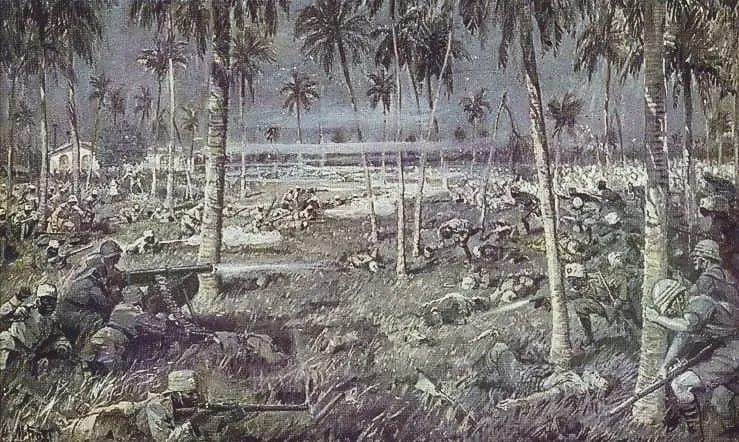
The Battle of Tanga was the first major battle in German East Africa and one of the most humiliating British defeats of the whole war. About 8,000 soldiers of Major-General Arthur Aitken’s Indian Expeditionary Force “B” tried to take the port of Tanga. They were beaten by roughly 1,000 soldiers of the German colonial forces, most of them African askaris, under Lieutenant-Colonel Paul von Lettow-Vorbeck. Because of a swarm of wild bees that scattered some of the attackers on the decisive day, the battle is sometimes called the “Battle of the Bees”.
We take 2 November 1914 as the start of the battle. On the morning of that day a British cruiser arrived off Tanga, and in the evening the landing began. The actual fighting took place from 3 to 5 November, which is why many accounts give 3–5 November as the dates of the battle.
Plan and preparations
Force “B” sailed from Bombay on 16 October with the task of bringing the whole German colony under British control. Tanga was the terminus of the railway running from the coast towards Kilimanjaro and was to be the starting point for a march inland. At the same time troops stationed in British East Africa were to attack the Germans at Longido, north of Kilimanjaro, and draw part of their forces there.
Aitken underestimated the enemy. He believed that Indian units would easily deal with African soldiers led by Germans. Yet his force was poorly prepared. Some of its battalions were among the worst trained in the Indian Army, some had received new rifles only before departure, and after two weeks on overcrowded ships many soldiers were sick and exhausted. Even so, at Mombasa Aitken did not let them go ashore and led the convoy straight on to Tanga. He also agreed that before the attack the Germans should be warned that the local truce of August was being ended, which robbed him of surprise.
Warning and landing
On the morning of 2 November the cruiser HMS Fox arrived off Tanga. Her captain, Francis Caulfeild, went ashore, informed the local official, Dr Auracher, that the truce no longer applied, and demanded the surrender of the town within an hour. Auracher gave an evasive answer and, on returning to the town, alerted the garrison. The news quickly reached Lettow-Vorbeck, who was then with his main forces in the area of Moshi, at the foot of Kilimanjaro. The German commander began moving his companies to the sea by rail.
The British, meanwhile, were losing time. They feared mines in the harbour and spent many hours sweeping its entrance. Instead of landing the troops in the port itself, Aitken chose a beach a few kilometres east of the town, near the headland of Ras Kasone. The landing began only late in the evening of 2 November and went on all night. The soldiers waded through shallows and dense scrub, knowing nothing of the ground ahead of them.
The first attack, 3 November
At dawn on 3 November the battalions already ashore, the 13th Rajputs and the 61st Pioneers, advanced on the town under General Michael Tighe. Tanga was then defended by only a few hundred askaris and policemen, but they held good positions on the edge of the town and along the railway line. Their fire stopped the attack, and a counter-attack forced the Indians into a disorderly retreat to the beach. On the first day of fighting the force lost several hundred men, and the morale of the Indian units suffered badly.
For the rest of the day and the following night the British landed further battalions and supplies. Aitken carried out no reconnaissance in that time. The Germans made use of the delay. More companies arrived in Tanga by rail, and in the night of 3–4 November Lettow-Vorbeck himself got there. He rode in person through the deserted town to inspect the positions and prepared the defence.
The main attack and the bees, 4 November
Around noon on 4 November the whole force advanced on the town on a broad front. On the right wing, nearer the sea, the British 2nd Battalion of the Loyal North Lancashire Regiment and the Kashmir Rifles broke into Tanga. They fought in the streets, took the customs house and a hotel in the centre of the town, on which they raised the British flag. On the left wing, where the weaker Indian battalions were attacking, the advance stalled in dense scrub under machine-gun fire.
Then the bees joined the fight. The firing angered swarms of wild bees whose hives hung in the trees in front of the town. The insects fell upon soldiers of both sides, but the attackers suffered most, especially the 98th Infantry, which scattered. Rumours later circulated in Britain that the Germans had deliberately placed the hives as traps, but nothing confirms this. The bees did not decide the outcome of the battle, but they added to the confusion.
In the afternoon Lettow-Vorbeck threw fresh companies of askaris into a counter-attack against the enemy’s exposed left wing. To the sound of bugles and war cries the askaris charged with the bayonet. The Indian units broke, and the retreat turned into a rout. The battalions that had already entered the town also had to withdraw. Captain Tom von Prince, one of the best-known German officers in the colony, was killed in the fighting. In the evening the remnants of the force gathered at the landing beaches.
Evacuation, 5 November
The night of 4–5 November produced a curious situation. Through a misunderstanding some German units withdrew from Tanga, and for several hours the town was left almost undefended. The British did not know this. Lettow-Vorbeck quickly restored order and reoccupied the positions.
Aitken decided that his troops were unfit for further fighting and ordered a withdrawal to the ships. The embarkation lasted until 5 November. In the haste, weapons, ammunition and equipment were left on the shore. The force’s intelligence officer, Captain Richard Meinertzhagen, went to the Germans under a white flag to arrange the handover of the wounded. The Germans released the wounded British officers on their word of honour that they would not fight again in this war.
Losses and booty
British losses are usually put at more than 800 killed and wounded: about 360 killed and nearly 500 wounded. To these were added about 150 missing. Some sources, especially German ones, give even higher figures. The Germans lost about 150 men, including a dozen or so Europeans and several dozen askaris killed.
Even more valuable to the Germans than the victory was the booty. According to Lettow-Vorbeck, from the abandoned equipment he armed three companies of askaris with modern rifles and captured some 600,000 rounds of ammunition, as well as a dozen or so machine guns, field telephones and large quantities of clothing. For a colony cut off from Europe this was priceless.
Consequences
The defeat at Tanga, together with the failure of the attack at Longido, ended British plans for a quick conquest of German East Africa. The British official history of the war called the battle one of the most notable failures in British military history. Control of operations in East Africa passed from the Government of India to the War Office in London. Aitken was recalled, and in 1915 he was reduced to the rank of colonel.
For Lettow-Vorbeck Tanga was a great triumph. Victory over a many times more numerous enemy strengthened his position with the governor of the colony, who would have preferred to avoid fighting, as well as the self-confidence of his askaris. A campaign began in which the German commander tied down far larger Allied forces in East Africa for four years and surrendered only after the war in Europe had ended.
Spotted a mistake?Report an error